engineermike
Well-Known Member
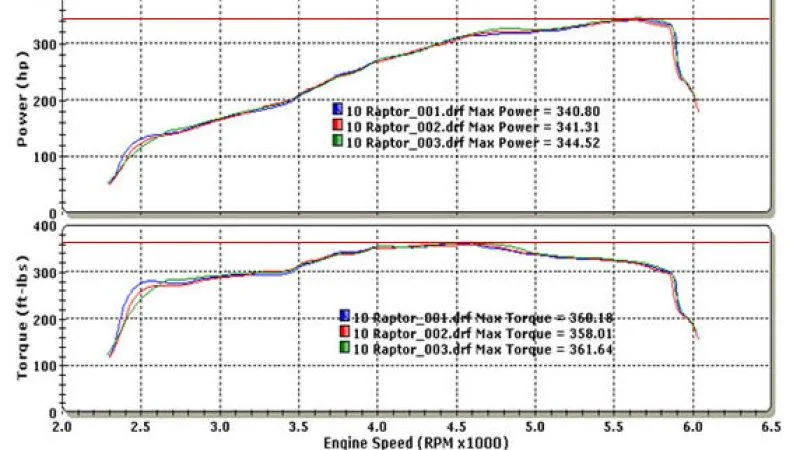
Here’s your 2-valve port injected 6.2 for reference. If your 7.3 makes 1 hp/cid you can expect a similar curve.
2018 5.0 for comparison:
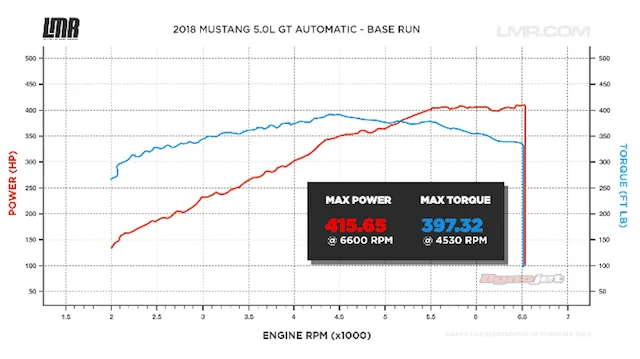
More everywhere even though it’s a “screamer” car motor.
Sponsored


See if you can follow the bouncing ball....the current 6.2 in the 3/4 ton makes 1 hp/cid. If we maintain that ratio (both are 2 valve, pfi truck motors), the 7.3 would have 450-455 hp. Could it be 482? Maybe. The problem with single cam 2-valve engines like the 6.2, 7.3, sbc, bbc, bbf, etc...is that they inherently have narrow rpm ranges. Dohc with tivct has a huge advantage when it comes to breadth of rpm range, but I digress. Anyway, you can’t add top end power without sacrificing bottom end. Now, take a look at the 6.2 truck motor power curves. They, due to the inherent narrow rpm range, are surprisingly weak below 3500 rpm. In fact, the 1.2 liter smaller “screaming” 5.0 makes more torque at 2000 rpm. So you’re saying the 7.3 will make even more power/cid than the current 6.2. Possibly, but that will give it an even more exaggerated lack of performance below 3500. Sadly, if your star engine makes the same or more power than the 5.0, it will be a terd until about 3500 rpm.
Dude, you seriously haven’t a clue what you are talking about. Gas direct injection has higher particulate emissions than port injection. The epa is currently moving to require particulate filters on gdi cars as we speak due to the high particulates. Port injection did not have this problem. Gdi was added to enable higher cylinder pressures, which allows engine downsizing and higher compression for better fuel efficiency, NOT to reduce particulates.

Ford designed the engine for TRUCKS. Light Duty trucks make very good advantage of cylinder deactivation, because the amount of time they need all 8 cylinders is minimal. Heavy Duty trucks (like the ones Ford designed the 7.3L for) spend more of their operating time at load, thus no cylinder deac. Should also note that Direct Injection DOES NOT reduce particulate emissions.........it CAUSES them. This is why the next emissions tech coming to DI gas engines will be GPFs....gas particulate filters.Nobody really wants cylinder deactivation in performance cars. Direct injection was added to reduce particate emissions. It’s an engine and one of the few V8s we have left.

DI increases particle emissions just as you said. Look at any DI-only tailpipe an see all the black soot if you don't believe us. Or, look here:This is just as false as, well, most everything else you’ve posted.
Yep, you missed the point. You keep spouting numbers like “482 hp”, which is >1 hp/cid. You aren’t going to get >1 hp/cid out of a 2-valve pushrod motor without killing the bottom end torque. If you want your massive low-end torque off-idle, then this thing is going to only make around 0.8 hp/cid (~360 hp).We only need the low end of the rpm range as far as I’m concerned and sacrifice the high end.
Yep, you missed the point. You keep spouting numbers like “482 hp”, which is >1 hp/cid. You aren’t going to get >1 hp/cid out of a 2-valve pushrod motor without killing the bottom end torque. If you want your massive low-end torque off-idle, then this thing is going to only make around 0.8 hp/cid (~360 hp).

The fox body 5.0 horsepower numbers were not lower than reality. 225 crank and about 190 rwhp. It adds up.The fox body motors were some of the fastest on the street and the horsepower number was lower than reality ....
Funny thing here....the LT1 ran circles around the TPI 350 it replaced. However, it actually had 20 ftlb of torque LESS.Same with my 1995 LT1 in that I was happy with the torque .
Just to be clear, you were spouting numbers like 482 hp. However, that kind of power would result in crappy low-end. To get low-end, the power would be limited to under 400, which you'd be "fine with". I don't think Ford is designing this engine based on your wants, though, so you'll probably be stuck with whatever they give you.Actually that is fine by me. ...
I sure as heck don't want to drive a performance vehicle daily on the road if that vehicle is set up so that I'm right in the power band all the time.The theory is as follows.
Most people spend the life of their driving at low rpms - let’s say between 1200 and 2000 rpm. That is the reality. Just check it out yourself on your daily commute.
Truck motors put out most of their power at low rpms so you would probably enjoy the power of a truck motor more in typical day/to-day driving. You’re paying for it so you may as well enjoy it.

If would be like driving the GT350 around at 6,000 rpm all the time. Can you imagine how touchy it would be? Just breathe on the throttle and you'll spin out, especially if the roads are a little cold and wet.
I'm not going to read all of this but you guys...you SERIOUSLY need to read up on why and how Ford got to the 7.3L displacement and what the math and data says about the application behind the fuel consumption and power strategy. This is NOT an engine that would be suitable for a 3800lb street car and it is not because the power isn't there. Why, you ask? Again, do some reading.
Since supercharging is on the table, you know what would be awesome? A supercharged 32-valve dohc engine with direct injection, and 12/1 compression. Great torque at any rpm!


