
Sponsored

Steeda CAI Review and Install Notes:

stoli

Fat Guy Racing
Joined
Sep 18, 2014
Threads
124
Messages
3,225
Reaction score
971
Location
Lakeland, FL
First Name
John
Vehicle(s)
'15 Black GT/PP
I tested it real world at the track. My stock intake temps averaged lower temps at idle/in the staging lanes than the Steeda. The aluminum housing during cooldown time in the pits retained heat longer than the stock intake did. I don't need an oven to see what my IAT readouts told me.

EDIT - Also... a sheet of aluminum is vastly different than a chunk of aluminum.
It's not the aluminum that is the root cause, it's the open element. The air isn't in contact with the velocity stack long enough for a thermal transfer (think if your kitchen oven is 200 degrees and you pop a glass of water in for under a second, it isn't changing temp).

When you aren't moving, it's drawing hot air from the engine bay since it is not 100% sealed like the oem box. Basically it's the path of least resistance; there is no cool external air being forced in, so it's drawing the hot air from the top of the hood area.
Sponsored

 
OP
OP
Evolvd

Evolvd

Instigator
Joined
Jan 19, 2015
Threads
186
Messages
6,865
Reaction score
5,868
Location
Northwest Florida
First Name
Brian
Vehicle(s)
2021 Shelby GT500
I tested it real world at the track. My stock intake temps averaged lower temps at idle/in the staging lanes than the Steeda. The aluminum housing during cooldown time in the pits retained heat longer than the stock intake did. I don't need an oven to see what my IAT readouts told me.

EDIT - Also... a sheet of aluminum is vastly different than a chunk of aluminum.
Aluminum does not retain heat, it conducts it (i.e. transfers the movement of electrons (heat) much easier than other metals and materials). The relevance of the thickness of material is that it will conduct (transfer) heat faster as it has more material to do so. This is thermodynamics, you're applying your observations based on a misconception. The aluminum will allow heat to transfer away faster during your cool down than plastic will. You can't defy physics and assumptions aren't causality. Your intake temps while at idle are irrelevant in the application of racing. When the car starts moving, the air is passing through the velocity stack too fast for it to pick up much heat from the engine bay, hence why intake temps at cruise are just above ambient and not the scorching 200+ degrees of your cylinder head.

Bottom line, the aluminum velocity stack and MAF housing may transfer heat during idle, however when cooling air is passing over it during acceleration it also transfers more heat away from it, and also while sitting off during your cool downs. And nobody races at idle in the staging lanes.
 
Last edited:

Stang Racer

Well-Known Member
Joined
Sep 17, 2015
Threads
8
Messages
172
Reaction score
97
Location
Ohio
First Name
Tom
Vehicle(s)
2019 Mustang GT A10 301A
Air Gap at top

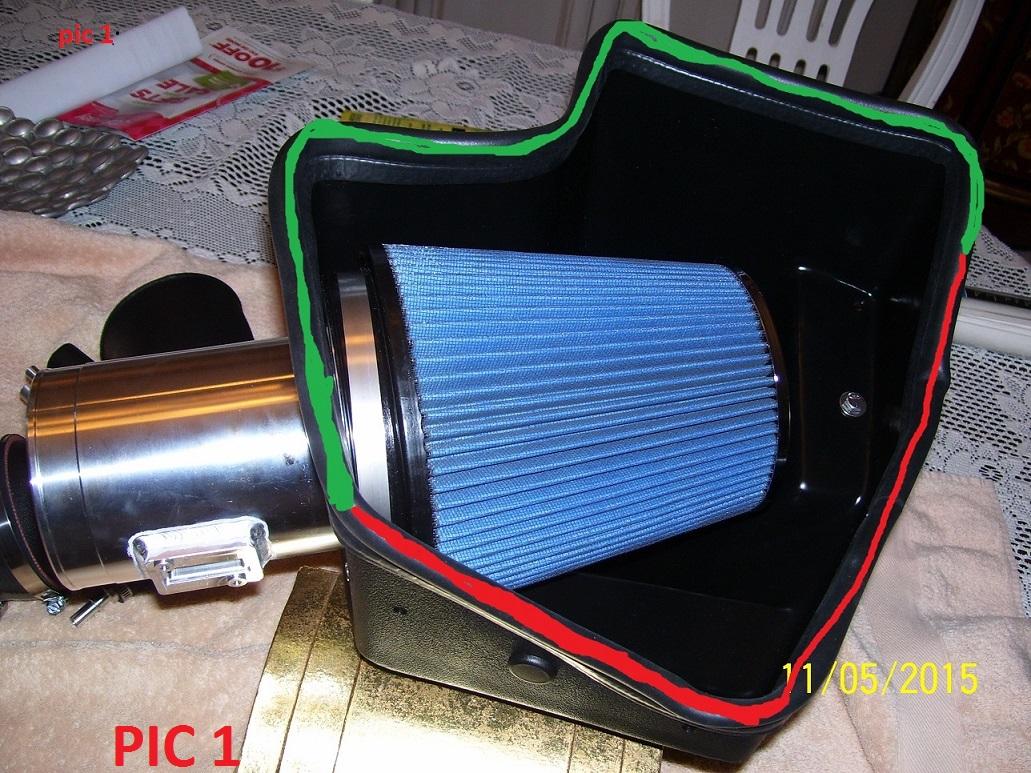
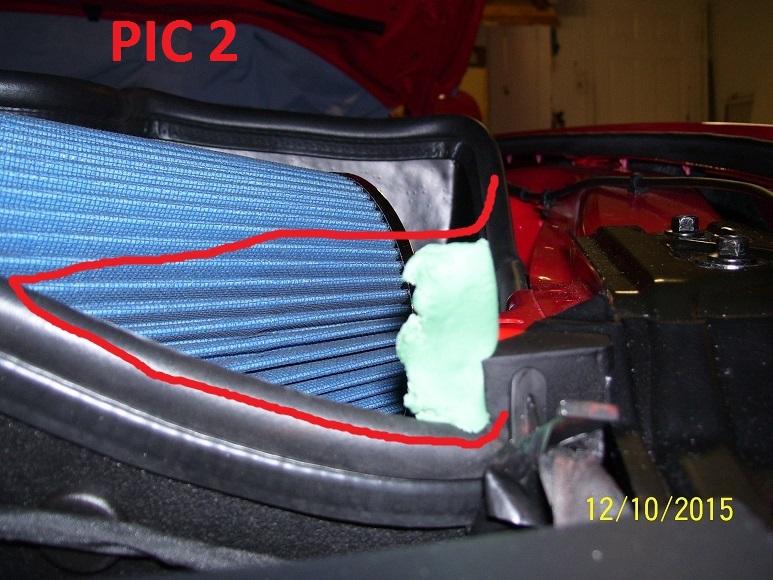
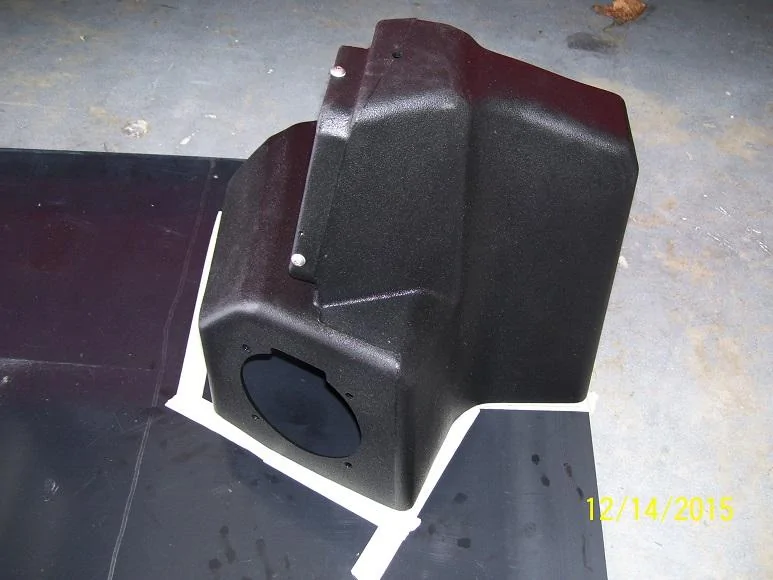
Just posting to help with people that race I am not trying to ruffle any feathers. I also purchased the Steeda CAI and a great piece, I have been using Steeda parts since the fox body day`s for decades:hail: and still have the fox body! If you only do Dyno this will not help because the hood will be open problem solved.I used a inspection camera to look at the seal with the hood close because of IAT . Pic 1 Green seals great but the Red has a very large gap in front and side.
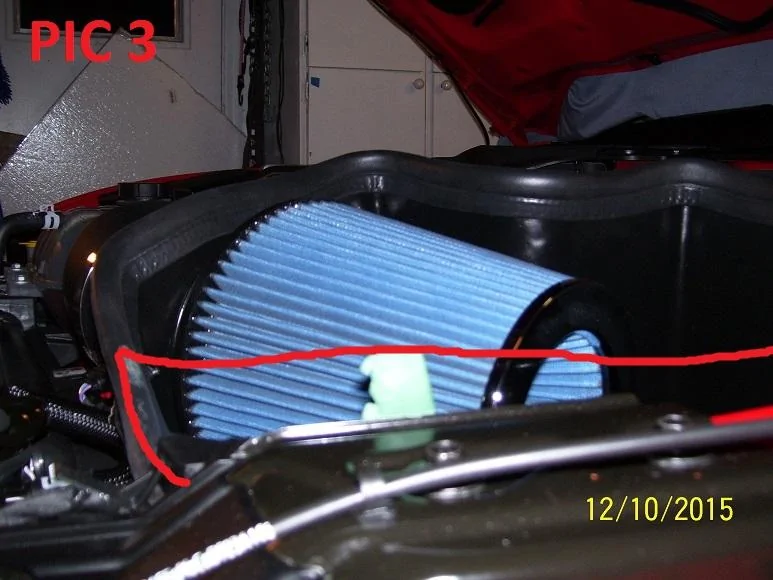
Pic 2 is molding clay at front and also in Pic 3 showing the gap.
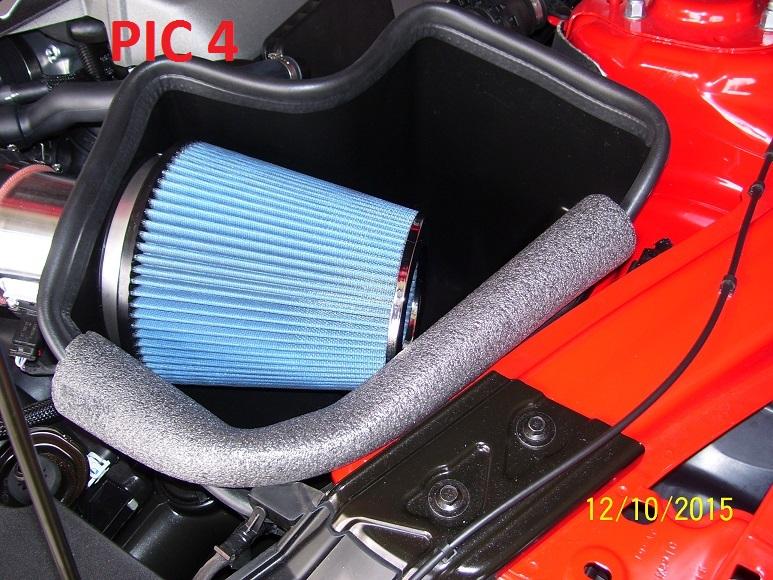
Pic 4 Tried to fill the gap as a quick fix but not eye appealing or tall enough but did help. Next move I will be doing a ABS molded top to seal off, will give update on top seal:thumbsup:
Just trying to help with the people that race..I am a long time (old) Steeda Fan!
Steeda 006.JPG
steeda cai 2 006.JPG
steeda cai 2 007.webp
steeda cai 2 001.JPG
 

Poppacapp

Well-Known Member
Joined
Apr 29, 2015
Threads
11
Messages
1,325
Reaction score
365
Location
NC
Vehicle(s)
2015 Mustang GT
Aluminum does not retain heat, it conducts it (i.e. transfers the movement of electrons (heat) much easier than other metals and materials). The relevance of the thickness of material is that it will conduct (transfer) heat faster as it has more material to do so. This is thermodynamics, you're applying your observations based on a misconception. The aluminum will allow heat to transfer away faster during your cool down than plastic will. You can't defy physics and assumptions aren't causality. Your intake temps while at idle are irrelevant in the application of racing. When the car starts moving, the air is passing through the velocity stack too fast for it to pick up much heat from the engine bay, hence why intake temps at cruise are just above ambient and not the scorching 200+ degrees of your cylinder head.

Bottom line, the aluminum velocity stack and MAF housing may transfer heat during idle, however when cooling air is passing over it during acceleration it also transfers more heat away from it, and also while sitting off during your cool downs. And nobody races at idle in the staging lanes.
My observations are different. I had higher average IATS at the track in the lanes with the Steeda vs. the stock airbox. While in the pits cooling down with the hood up, the one thing I noticed with the Steeda vs stock box was when I would do a key on check with the gauge to see where IAT was, the Steeda consistently was retaining more heat for a longer period of time than the stock airbox. This is my observation with my own eyes. I don't really care about the laws of thermodynamics... only my runs at the track and trying to run with as consistent IATs as possible. I am also constantly checking by feel the stock intake elbow, and also the Steeda tube. Bottom line is the Steeda HELD heat at stop longer... when moving, the Steeda cooled down quickly... but that does not help me at the starting line if the car is pulling timing.
 

stoli

Fat Guy Racing
Joined
Sep 18, 2014
Threads
124
Messages
3,225
Reaction score
971
Location
Lakeland, FL
First Name
John
Vehicle(s)
'15 Black GT/PP
My observations are different. I had higher average IATS at the track in the lanes with the Steeda vs. the stock airbox. While in the pits cooling down with the hood up, the one thing I noticed with the Steeda vs stock box was when I would do a key on check with the gauge to see where IAT was, the Steeda consistently was retaining more heat for a longer period of time than the stock airbox. This is my observation with my own eyes. I don't really care about the laws of thermodynamics... only my runs at the track and trying to run with as consistent IATs as possible. I am also constantly checking by feel the stock intake elbow, and also the Steeda tube. Bottom line is the Steeda HELD heat at stop longer... when moving, the Steeda cooled down quickly... but that does not help me at the starting line if the car is pulling timing.
Yes - the thick aluminum will hold, and radiate, the heat after turning the engine off. The temps in the area immediately around the MAF will probably even rise after parking it since there is no air movement. Upon starting it and drawing air through it though it becomes moot.

Edit: Monitoring intake air temps when the car is off isn't exactly a good test since the engine isn't actually taking in any air...
 

Sponsored

ridenfish39

Well-Known Member
Joined
Feb 25, 2015
Threads
12
Messages
405
Reaction score
138
Location
Philthydelphia
Vehicle(s)
2015 Guard GT PP
I've been considering asking Steeda if the air box can be bought separately. I'd love to buy one (if it was reasonable) and make a lid for it. I have access to all kinds of neat materials at work.
 
OP
OP
Evolvd

Evolvd

Instigator
Joined
Jan 19, 2015
Threads
186
Messages
6,865
Reaction score
5,868
Location
Northwest Florida
First Name
Brian
Vehicle(s)
2021 Shelby GT500
Yes - the thick aluminum will hold, and radiate, the heat after turning the engine off. The temps in the area immediately around the MAF will probably even rise after parking it since there is no air movement. Upon starting it and drawing air through it though it becomes moot.

Edit: Monitoring intake air temps when the car is off isn't exactly a good test since the engine isn't actually taking in any air...
Again this is wrong, aluminum conducts heat, it doesn't "hold" it. Conductivity is the transfer of something to something else. While at idle it may conduct (transfer) heat into the intake track as the air inside the tube is convective and will retain heat, but as stated before, no one races at idle. You can put aluminum under extreme heat and it will not retain it, it will transfer it...hence my analogy with the oven.

Something else to note, not allowing the ECU to relearn the way the MAF is sensing air is a disservice to the claim of better times with any intake testing.

Poppacap, you should care about thermodynamics as it is DIRECTLY related to your engine performance.
 

Poppacapp

Well-Known Member
Joined
Apr 29, 2015
Threads
11
Messages
1,325
Reaction score
365
Location
NC
Vehicle(s)
2015 Mustang GT
@Poppacapp Our filter is designed to work WITH the velocity stack, that’s why our filter has a racing spike in the center of it - this increases the air flow coming in to the velocity stack. A racing spike merges air flow thus creating more power, similar to exhaust headers which use a spike in the collector to improve exhaust flow - the same thing is happening with our Steeda air filter (when it’s actually installed).

One of the key advantages to a CAI is the high-flow air filter. When you remove that element of the equation, you will not see the full benefits of the CAI compared to the stock box.

We’ve done our testing with the full CAI kit installed, in real-world driving 99.9% of our customers will drive their cars with the filter installed. This is also how we’ve tested the stock air box, with the filter in place.

To get a better understanding of what’s going on, can you provide dates and time slips of all passes (including the one from weeks ago where it went 89)?

Also, how many passes did you make with each configuration? What was cylinder head temp at for each run? Where are your shift points at, what RPM?

Just trying to get a full understanding of the conditions so we can chime in as best as we can.

Ok, so gathering the slips up and scanning... To answer a couple of your other questions above. Cylinder head temps average from 190ish to 210ish range. It really depends on how long I have to sit in the lane after pulling up. I don't let the car idle in the lanes.. I leave car in neutral and roll downhill.

Shift points are wherever the ECU tells it to shift in D.. I don't drive in sport mode as the car tends to shift earlier than it should. This is stock tune, 3.15 car. It tends to be VERY consistent provided the 60fts are similar.

I will try to preface the slips I post with the info I have available:

First slips up are the ones from yesterday. I wrote pertinent info on the slips. First run was with Steeda intake, filter removed. Actual cooldown time was approx 50mins(I arrived at the track at 1:30pm). Also of note is the date on the slips.. track date is incorrect.. looks to be 2 days off.

Second run was 34mins later. I swapped the stock intake back in. This is without filter too. There was no need to tun multiple runs with each configuration. My car runs pretty much equally with the same 60ft times.
CHT was in the averages 190-210 on both runs. IAT was in the 90s.

I am car# 15


Now some slips from last week with just the Steeda intake. I made notes on the slips which runs had the filter, and which runs didn't. The car ran faster without the filter installed, which is what I have noticed with my stock intake without filter:


The following runs were made without the filter installed:
The 89.0 run is as fast as I have run with the Steeda Intake.


After these runs, I put the filter back in the intake and made a couple of passes. The car slowed back down:


Here are some other slips from a 1/4 mile track from 2 different dates. The first date, the DA was pretty good that day. low 100s. The second date the DA was 1392ft. This is with the stock airbox at a completely different track, no filter.. running better average MPH.


I am open to suggestions. I try to make my runs as consistent as possible. I am probably paying more attention to trying to run below 100F IAT than I should. But these are my observations. Consistent 60fts, with 20more rwhp would net an average 2 tenth drop in ET with a corresponding bump in mph.
 

Poppacapp

Well-Known Member
Joined
Apr 29, 2015
Threads
11
Messages
1,325
Reaction score
365
Location
NC
Vehicle(s)
2015 Mustang GT
Yes - the thick aluminum will hold, and radiate, the heat after turning the engine off. The temps in the area immediately around the MAF will probably even rise after parking it since there is no air movement. Upon starting it and drawing air through it though it becomes moot.

Edit: Monitoring intake air temps when the car is off isn't exactly a good test since the engine isn't actually taking in any air...
True, but it also gives you an indicator of how much it is cooling down. I DO start the car everynow and then for about 10secs to pull air in. Same results. The stock intake would be at a lower starting point. i agree that once moving the CAI will cool down quicker. But I stress again.. I don't care about the IAT cooling down after the 330ft mark... what matters to me is having zero timing pulled at the starting line.
 

Poppacapp

Well-Known Member
Joined
Apr 29, 2015
Threads
11
Messages
1,325
Reaction score
365
Location
NC
Vehicle(s)
2015 Mustang GT
Again this is wrong, aluminum conducts heat, it doesn't "hold" it. Conductivity is the transfer of something to something else. While at idle it may conduct (transfer) heat into the intake track as the air inside the tube is convective and will retain heat, but as stated before, no one races at idle. You can put aluminum under extreme heat and it will not retain it, it will transfer it...hence my analogy with the oven.

Something else to note, not allowing the ECU to relearn the way the MAF is sensing air is a disservice to the claim of better times with any intake testing.

Poppacap, you should care about thermodynamics as it is DIRECTLY related to your engine performance.
Ok, I will make this as simple as I can. Steeda had higher starting IAT temps than the stock airbox after similar cooldown times. This DOES make a difference when you pull up to the starting line with 110 IAT vs. 95.

The Steeda has been on my car a couple of weeks with a ECU reset. It should have been performing at its best "learning" point at the track. If I had reset the ECU at the track yesterday with the stock intake, the results would have been skewed because it takes an average of 50-100 miles for the ECU to relearn completely. NOT resetting the ECU most likely hurt the stock intake rather than helped it. i see no validity in your point on this.
 

Sponsored

Stang Racer

Well-Known Member
Joined
Sep 17, 2015
Threads
8
Messages
172
Reaction score
97
Location
Ohio
First Name
Tom
Vehicle(s)
2019 Mustang GT A10 301A
Poppacapp, The large gap with hood closed allows very hot under hood air to be sucked in instead of through the air duct in pics I posted. Sealing this area will be somewhat of a challenge but well worth it:thumbsup:
 

Poppacapp

Well-Known Member
Joined
Apr 29, 2015
Threads
11
Messages
1,325
Reaction score
365
Location
NC
Vehicle(s)
2015 Mustang GT
Poppacapp, The large gap with hood closed allows very hot under hood air to be sucked in instead of through the air duct in pics I posted. Sealing this area will be somewhat of a challenge but well worth it:thumbsup:
I agree.. I can see this helping. My main point is I did not see any power gains with the no-tune version. This intake would most likely perform very well with a tune, power wise.
 

Khyber

it's a hard parked life
Joined
Nov 28, 2014
Threads
141
Messages
7,615
Reaction score
3,581
Location
Lexington/Myrtle Beach, SC
First Name
Landon
Vehicle(s)
2015 GT PP CO
OP
OP
Evolvd

Evolvd

Instigator
Joined
Jan 19, 2015
Threads
186
Messages
6,865
Reaction score
5,868
Location
Northwest Florida
First Name
Brian
Vehicle(s)
2021 Shelby GT500
i see no validity in your point on this.
I made no claims to validity, I simply stated your data is skewed as you have one set of parameters for one intake but you didn't use the same parameters for the other. This leads your data to be unreliable as they were not tested under the same conditions. FYI, my current responsibilities are as a Test Director for Air Force Research and Development where my job is to design and implement test plans. You can't make an accurate assumption off of so little data without accounting for all the variables, noise, and control factors and achieve a statistical power that gives credit to your claims.

But feel free to keep believing your "observed data". Try reading on Design of Experiments and learn something...I'm going to stop with this back-n-forth.
Sponsored

 
Last edited:


Top