Sponsored

More boost with 20% overdrive?

illtal

Well-Known Member
Joined
Nov 16, 2018
Threads
17
Messages
2,125
Reaction score
1,042
Location
USA
Vehicle(s)
2018 Mustang GT
It’s not true. No matter what supercharger you have more blower rpm is more blower rpm. Yes a PD is linear but that just means that you get to your boost all at once. The rpm of the blower determines how much boost you make.
if you have a 4.00 upper and a 20% lower you will not have the same rpm as a 3.20 upper and a stock lower. It’s basic math. So if you have less rpm then you have less boost. I can’t believe I even have to point this out. Come on just admit when you’re wrong. You will get more respect
How do you explain the same amount of boost then?
I mean I would like to know then, @engineermike explaination is actually what one should go by. but if the Blower RPM is different then why is the boost the same or VERY close. Eaton does not specify internal gearing, all of that shit going on internally is a secret.

You must admit, if you get the same amount of boost or lets say within a 1/2 pound the rotors are spinning at a similar speed. also the two values you posted about the Centri's RPM is within 3.01 % of each other, is it EXACTLY the same? NO! is it close FUCK YEA!!!! I don't know if you would see the same boost maybe you can find out and let us know.

I don't give a shit about internet rep, that's crazy.
Sponsored

 

illtal

Well-Known Member
Joined
Nov 16, 2018
Threads
17
Messages
2,125
Reaction score
1,042
Location
USA
Vehicle(s)
2018 Mustang GT
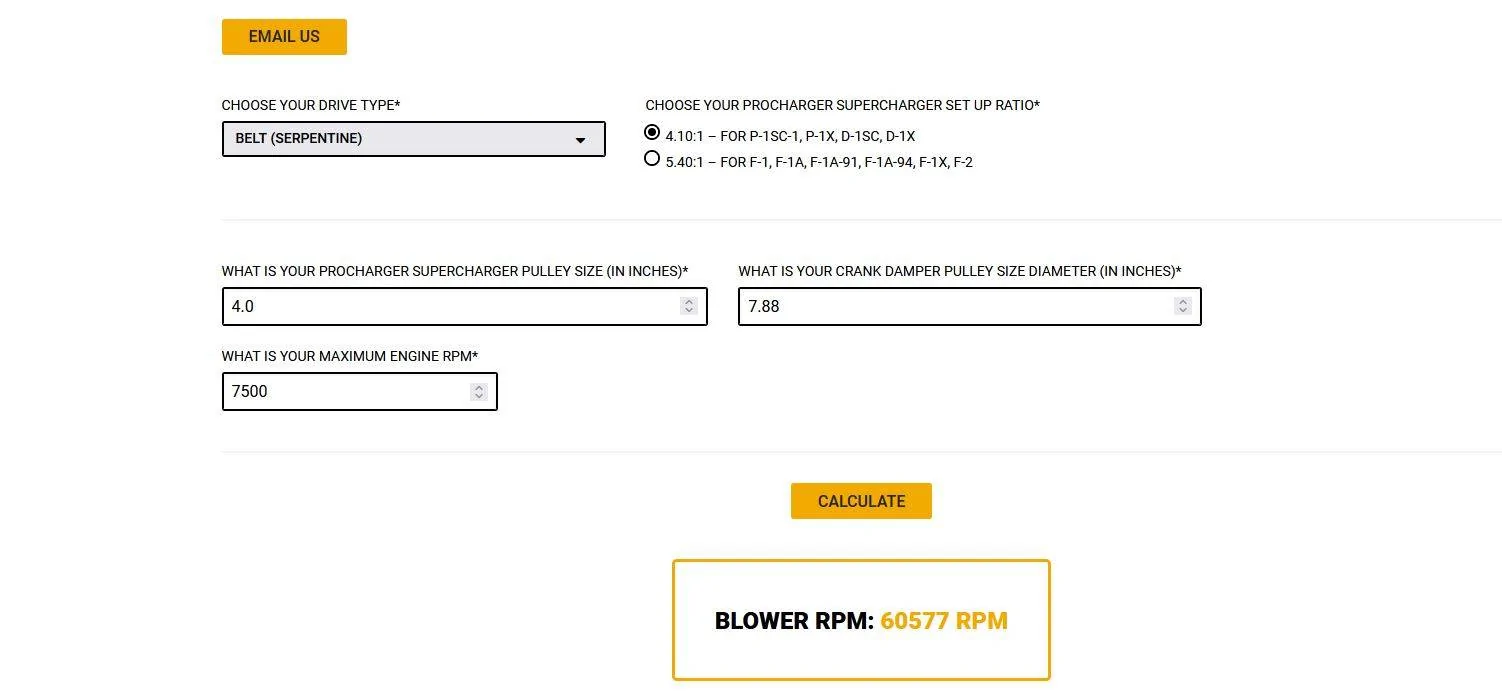
I actually did some simple math
6.5 + 20% = 1.7 which is 7.8 not 7.88 Significant digits mean something here
closest thing would be 6.566~/6.57~ " stock lower

More interestingly if we go BACKWARDS
7.88"-20%= 6.304"
then look at what happens....

Simple boost1.webp

simple boost 2.webp


numbers and ratios, same RPM with a 20% smaller crank balancer than the 7.88
it obviously doesn't work out the same the other way but it's within 3% of the blower rpm as I previously stated.

cool!
 
OP
OP
Jaywebs

Jaywebs

Well-Known Member
Joined
Apr 13, 2020
Threads
16
Messages
105
Reaction score
37
Location
11961
First Name
Jason
Vehicle(s)
2019 mustang gt. 2019 c7 z06. 2019 rs5
So the results are as follows. The car prior to the 20% overdrive was making 17lbs. at 8k rpm as per digital boost gauge. Finally was able to make a WOT pull after the 20% overdrive with a friend monitoring the boost gauge. He claims he saw a reading of 22lbs when i let off at 8k. So however you guys want to figure the math is up to you. Now the other question is efficiency at these levels. How much more power is it making at these higher inefficient boost levels are another question. Obviously overspinning around 7200 but only for a fraction of a second as the additional 800 rpm till rev limiter comes real quick.
 

illtal

Well-Known Member
Joined
Nov 16, 2018
Threads
17
Messages
2,125
Reaction score
1,042
Location
USA
Vehicle(s)
2018 Mustang GT
So the results are as follows. The car prior to the 20% overdrive was making 17lbs. at 8k rpm as per digital boost gauge. Finally was able to make a WOT pull after the 20% overdrive with a friend monitoring the boost gauge. He claims he saw a reading of 22lbs when i let off at 8k. So however you guys want to figure the math is up to you. Now the other question is efficiency at these levels. How much more power is it making at these higher inefficient boost levels are another question. Obviously overspinning around 7200 but only for a fraction of a second as the additional 800 rpm till rev limiter comes real quick.
looks like more than 2 PSI to me....
 

markmurfie

Well-Known Member
Joined
Jun 6, 2015
Threads
15
Messages
1,320
Reaction score
625
Location
Hawaii
First Name
Mark
Vehicle(s)
2015 Ford Mustang GT
Intercooler effeciency means nothing in all this math? It is possible to be increasing boost a few PSI, and not actually be flowing more air, you would just be increasing heat in the air.

Something that "fan laws" used for a residential or commercial HVAC systems don't need to consider as the pressure ratios they are dealing with are very close to 1. and 1^2 is 1.
Affinity laws as they are actually called, just say three things when comparing the same pump at different speed ratios. Flow ratio is proportional to speed ratio, pressure ratio is proportional to the square of speed ratio, and power ratio is proportional to the cube of speed ratio.
None of it is meant to allow you to calculate a pumps unknown characteristics. Just that flow pressure and power are all realated to speed in their own unique exponential way.

The superchager is not creating pressure all by its self, the engine restricting flow from the supercharger is what is creating this discharge pressure. You put a supercharger on a stand spinning with an electric motor, nothing but the atmosphere restricting intake and discharge, and then you could apply affinity laws. The engine is also an air pump, just not one you can apply affinity laws too. Don't use affinity laws to guess, as it won't even be an educated one. Just measure it with a MAP sensor, and watch your MAF and widebands, and go up slowly in increments with the RPMs if you are not sure of your fuel system keeping up.

Too calculate this... you don't, you need a compressor map.
Really it comes down to needing to know the amount of air the supercharger is going to flow because the engine, in series with it, it will flow that much air as well. Compressor maps usually have plotted speed lines, pressure ratio as one axis, and airflow as the other axis. They usually are not available publicly. Your engines size and volumetric effeciency over its RPM range will detemine its required and expected pressure ratio at different airflows. You could then use affinity laws to come up with where the compressor will fall on its compressor map.
That of course brings us back to what I started this with, can your intercooler shed the extra heat created in this ineffecient pressure increase or is that just going to add to the pressure ratio? Just stick to mass flow, because a gases pressure with out tempature and a reference volume doesn't mean much. PV=nRT, ideal yet too many variables for most to follow.
 
Last edited:

Sponsored

illtal

Well-Known Member
Joined
Nov 16, 2018
Threads
17
Messages
2,125
Reaction score
1,042
Location
USA
Vehicle(s)
2018 Mustang GT
Intercooler effeciency means nothing in all this math? It is possible to be increasing boost a few PSI, and not actually be flowing more air, you would just be increasing heat in the air.

Something that "fan laws" used for a residential or commercial HVAC systems don't need to consider as the pressure ratios they are dealing with are very close to 1. and 1^2 is 1.
Affinity laws as they are actually called, just say three things when comparing the same pump at different speed ratios. Flow ratio is proportional to speed ratio, pressure ratio is proportional to the square of speed ratio, and power ratio is proportional to the cube of speed ratio.
None of it is meant to allow you to calculate a pumps unknown characteristics. Just that flow pressure and power are all realated to speed in their own unique exponential way.

The superchager is not creating pressure all by its self, the engine restricting flow from the supercharger is what is creating this discharge pressure. You put a supercharger on a stand spinning with an electric motor, nothing but the atmosphere restricting intake and discharge, and then you could apply affinity laws. The engine is also an air pump, just not one you can apply affinity laws too. Don't use affinity laws to guess, as it won't even be an educated one. Just measure it with a MAP sensor, and watch your MAF and widebands, and go up slowly in increments with the RPMs if you are not sure of your fuel system keeping up.

Too calculate this... you don't, you need a compressor map.
Really it comes down to needing to know the amount of air the supercharger is going to flow because the engine, in series with it, it will flow that much air as well. Compressor maps usually have plotted speed lines, pressure ratio as one axis, and airflow as the other axis. They usually are not available publicly. Your engines size and volumetric effeciency over its RPM range will detemine its required and expected pressure ratio at different airflows. You could then use affinity laws to come up with where the compressor will fall on its compressor map.
That of course brings us back to what I started this with, can your intercooler shed the extra heat created in this ineffecient pressure increase or is that just going to add to the pressure ratio? Just stick to mass flow, because a gases pressure with out tempature and a reference volume doesn't mean much. PV=nRT, ideal yet too many variables for most to follow.
you can't apply the ideal gas law without the pressure ratio which is a moving target on a centri (i'm sure they have the map that they wouldn't share and it probably is plottable). lord forbid you ask a gear head what the number of mols he's working with.
Hell we didn't even notice that ATI's 20% lower isn't 20% by multiple ways of calculations.

the size difference between the two crank pulleys is the number you wanna use to determine the upper size.
 

markmurfie

Well-Known Member
Joined
Jun 6, 2015
Threads
15
Messages
1,320
Reaction score
625
Location
Hawaii
First Name
Mark
Vehicle(s)
2015 Ford Mustang GT
you can't apply the ideal gas law without the pressure ratio which is a moving target on a centri (i'm sure they have the map that they wouldn't share and it probably is plottable). lord forbid you ask a gear head what the number of mols he's working with.
Hell we didn't even notice that ATI's 20% lower isn't 20% by multiple ways of calculations.

the size difference between the two crank pulleys is the number you wanna use to determine the upper size.
Yeah, you would need a pressure and tempature of both compressor discharge, and in the manifold. Then to correalate the volumes of those measurements using engine RPM and size, and compensate a bit for dynamic airflows between intake port flow and flow at those measured points. You could even get into measuring at compressor discharge, post intercooler, and manifold for turbo/ centri setups. Look at what Mike is having to go through analyzing his exhaust... just in the intake side for sensors. Accurate airflow models are one of two things, not simple math or wrong.

None of it matters when changing a pulley to increasing boost, unless you are planning and quantifying improvments upon a design. Usually just what extra air is making it into the cylinder is all that matters to most people, and you can do that with a rationalaity checked mass air flow. Sort of like "Sorry, 7psi of boost isn't going to get you over 100lb/min on a stock coyote reving to 7500rpm." Theres always a grey zone to it, hopefully the injector data and fuel system you use is reliable, but thats why you should collect as much data, even things like corrected dyno numbers, track/ draggy numbers, and fuel mileage to compare before and after changes with. Its a lot easier than math, and I enjoy it more than seeing people do math and tring to infer things very badly, when they could have just measured. Then there are people with similar combos, and they made similar changes that have measured what they saw before and after.... You can't argue with that through bad math calculations and no data of your own. Some one could be a real dick and come in here and say a 20% lower doesn't add any boost... Of couse they would then say they have a turbo setup. Thats what its like seeing an arguement on how a 20% lower effects a PD compared to a centri compressor.
 

engineermike

Well-Known Member
Joined
Jul 15, 2018
Threads
31
Messages
6,188
Reaction score
6,449
Location
La
Vehicle(s)
2018 GTPP A10
@markmurfie the pump/fan/affinity laws are used in many industries, not just HVAC. In fact, I would wager they're used more for centrifugal pumps than anything else.

Anyway, doing anything more accurate than using fan laws or rules of thumb would require a bit of a science project, as you suggested. Do we even have access to a P1X compressor map? Without that, it's all just an educated guess.
 

HKusp

Well-Known Member
Joined
Jul 22, 2021
Threads
37
Messages
2,227
Reaction score
2,875
Location
Hampton, Md.
First Name
Jason
Vehicle(s)
2018 Mustang GT
Some of you may not know this, some of you clearly do, but boost is a measurement of restriction in your set-up. You can add boost just by restricting the flow, depending on where you are measuring. Does that elevation in boost mean you are going to make more power? Not always, and certainly not if all you did was add restriction to your flow.
 

markmurfie

Well-Known Member
Joined
Jun 6, 2015
Threads
15
Messages
1,320
Reaction score
625
Location
Hawaii
First Name
Mark
Vehicle(s)
2015 Ford Mustang GT
@markmurfie the pump/fan/affinity laws are used in many industries, not just HVAC. In fact, I would wager they're used more for centrifugal pumps than anything else.

Anyway, doing anything more accurate than using fan laws or rules of thumb would require a bit of a science project, as you suggested. Do we even have access to a P1X compressor map? Without that, it's all just an educated guess.
The ratio math gets rid of units, which makes it easy to standardize utilizing/reading different compressor maps.

I don't have any non public compressor maps.
 
Last edited:

Sponsored

Torinate

Well-Known Member
Joined
Feb 18, 2018
Threads
87
Messages
2,037
Reaction score
943
Location
Ontario
Vehicle(s)
2016 GT Convertible
Intercooler effeciency means nothing in all this math? It is possible to be increasing boost a few PSI, and not actually be flowing more air, you would just be increasing heat in the air.
Kind of like when I first started modding a fox body back in the day. This was pre-intercooler days when Vortech first came out. There was a sweet spot between boost and temps that were way too high. Spin it harder and it created too much heat and would slow down. Less was a lot of times "more".
 

Jackson1320

Banned
Banned
Banned
Joined
Sep 26, 2019
Threads
26
Messages
3,057
Reaction score
1,228
Location
California
First Name
Jaxson
Vehicle(s)
2015 mustang gt
How do you explain the same amount of boost then?
I mean I would like to know then, @engineermike explaination is actually what one should go by. but if the Blower RPM is different then why is the boost the same or VERY close. Eaton does not specify internal gearing, all of that shit going on internally is a secret.

You must admit, if you get the same amount of boost or lets say within a 1/2 pound the rotors are spinning at a similar speed. also the two values you posted about the Centri's RPM is within 3.01 % of each other, is it EXACTLY the same? NO! is it close FUCK YEA!!!! I don't know if you would see the same boost maybe you can find out and let us know.

I don't give a shit about internet rep, that's crazy.
I already let you know what kind of boost increase I got from a 20%od. The information you post is not everything the same and only a 20% balancer. You will get 2psi from the 10rib upgrade alone. You can’t compare apples to oranges and think you know something
 

Angrey

Well-Known Member
Joined
Jun 21, 2020
Threads
104
Messages
2,794
Reaction score
2,984
Location
Coral Gables
Vehicle(s)
2016 GT350
Some of you may not know this, some of you clearly do, but boost is a measurement of restriction in your set-up. You can add boost just by restricting the flow, depending on where you are measuring. Does that elevation in boost mean you are going to make more power? Not always, and certainly not if all you did was add restriction to your flow.
This is a common sticking point for guys in the boost/car community.

It's difficult for guys to understand that you can lower boost and increase power.

A very simplistic way to frame the problem is the base power of the motor.

If you have a blower and pulley that makes say 12 psi on the unmodified motor, by adding things like headers and improving exhaust flow and then adding things like larger throttle body, ported and polished heads, bigger valves, etc (essentially increasing the intake flow between the blower and the combustion) the result is the setup will actually make more power at lower pressure, because the flow has substantially increased.

Boost isn't a good or consistent measurement of power unless it's paired with the original N/A capabilities of the motor. (or another way, it's about flow, not necessarily just pressure).

A simpler way to think about it is, if you double the air flow on a motor, it's obviously going to make more power if the motor makes 600 hp before boosting vs 500 hp. Both at the same boost pressure, but one making significantly more power.

With PD blowers it's less complicated than with the pump/efficiency curve of centris.

Combined with the fact that measured boost values are notoriously error prone and lacking accuracy, boost is a poor metric for determining power without some accompanying information.
 

Jackson1320

Banned
Banned
Banned
Joined
Sep 26, 2019
Threads
26
Messages
3,057
Reaction score
1,228
Location
California
First Name
Jaxson
Vehicle(s)
2015 mustang gt
I actually did some simple math
6.5 + 20% = 1.7 which is 7.8 not 7.88 Significant digits mean something here
closest thing would be 6.566~/6.57~ " stock lower

More interestingly if we go BACKWARDS
7.88"-20%= 6.304"
then look at what happens....

Simple boost1.JPG

simple boost 2.JPG


numbers and ratios, same RPM with a 20% smaller crank balancer than the 7.88
it obviously doesn't work out the same the other way but it's within 3% of the blower rpm as I previously stated.

cool!
Coyote balancer is advised at 6.5
 

smokescreens

Well-Known Member
Joined
Jan 1, 2021
Threads
63
Messages
577
Reaction score
581
Location
michigan
First Name
jason
Vehicle(s)
2014 impala, 2017 HD. 2018 Royal C mustang gt pp1
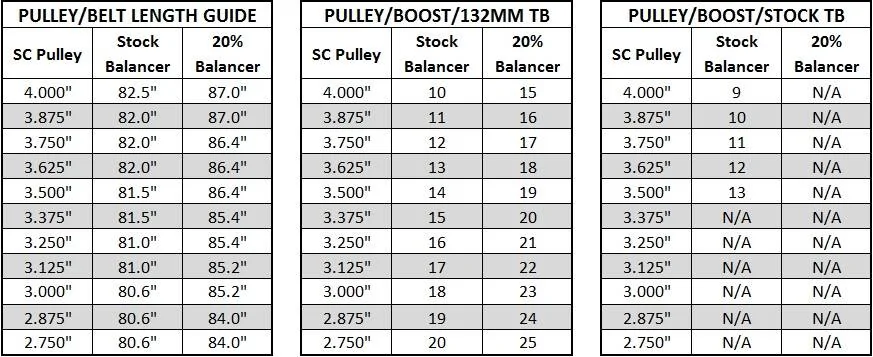
From whipples website. I know its centri but it makes a big difference on a whipple

Belt Info_R1.webp
Sponsored


Top