Sponsored

HP VS Torque

K4fxd

Well-Known Member
Joined
Apr 2, 2020
Threads
121
Messages
13,455
Reaction score
12,262
Location
NKY
First Name
Dan
Vehicle(s)
2017 gt, 2002 FXDWG, 2008 C6,
In all transparency, the car with 1000 hp and 100 ft-lbs of torque will be faster. Why? Because we can multiply the torque through gearing.
I'm 100% sure in WH's example the gearing was the same.

My example of 2 cars running 11.0 1/4 miles, one at 105 MPH and the other at 117, is a real world comparison of high torque vs high HP.
Sponsored

 

Angrey

Well-Known Member
Joined
Jun 21, 2020
Threads
104
Messages
2,794
Reaction score
2,984
Location
Coral Gables
Vehicle(s)
2016 GT350
I'm 100% sure in WH's example the gearing was the same.

My example of 2 cars running 11.0 1/4 miles, one at 105 MPH and the other at 117, is a real world comparison of high torque vs high HP.
It was, I'm only pointing out that practically speaking, we can overcome low torque with multiplication, which is why HP becomes the desired output to improve and focus upon.

If anyone doesn't believe that torque (net, multiplied torque) is what propels the vehicle, just try this.

Take your car, start it in the 1:1 drive and run a 1/4 mile, all in that gear. Then do the same run using multiplication in the lower gears. The motor output is the same for both (power) and the motor torque is as well, but what's different is the actual multiplied torque to the tires.
 

junits15

Well-Known Member
Joined
Jul 7, 2022
Threads
19
Messages
1,192
Reaction score
1,310
Location
MA
First Name
Justin
Vehicle(s)
2019 Mustang GT
The thing we miss is that what really matters is work. Integrating the power of the engine gives us the work that it did over the RPM range it was tested. With all variables controlled, more work means a faster car, always.

Torque is linearly related to horsepower, meaning that for a given horsepower at a given RPM there is only one torque value that is physically possible. The inverse is true as well, for a given torque at a given RPM there is only one horsepower value that is physically possible.

Horsepower is integrated over time to find work. So if work is what we care about, we need torque and RPM, or horsepower, not both.

A car with "high torque" will feel fast at low engine speed, because its making more power at low engine speeds. A car with "high horsepower" will feel faster at high engine speed, because its making more power at high engine speeds. A car with "high torque" and "high horsepower" will feel fast all the time because its making more power all the time.


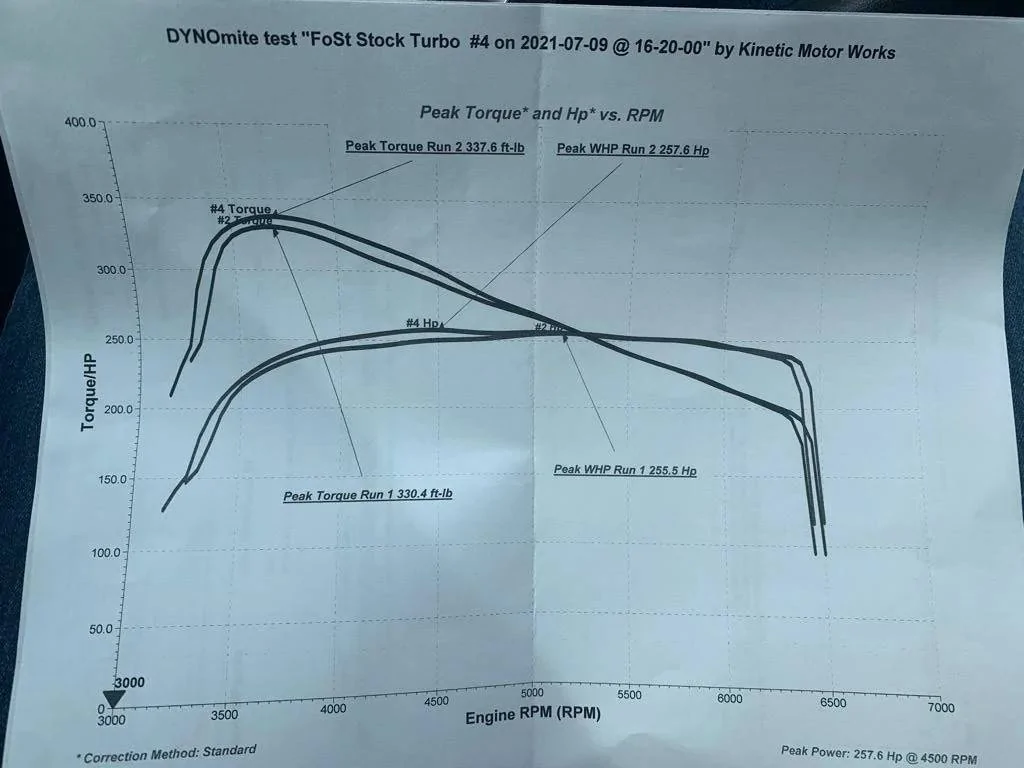
If you look at cars with small engines and small turbos, you see dyno graphs like this:
dyno graph.jpg


A giant torque bump. Note how flat that power curve is, its making basically the same power from 3500RPM to 6500RPM. This car feels fast at low engine speed and slow at high engine speed.

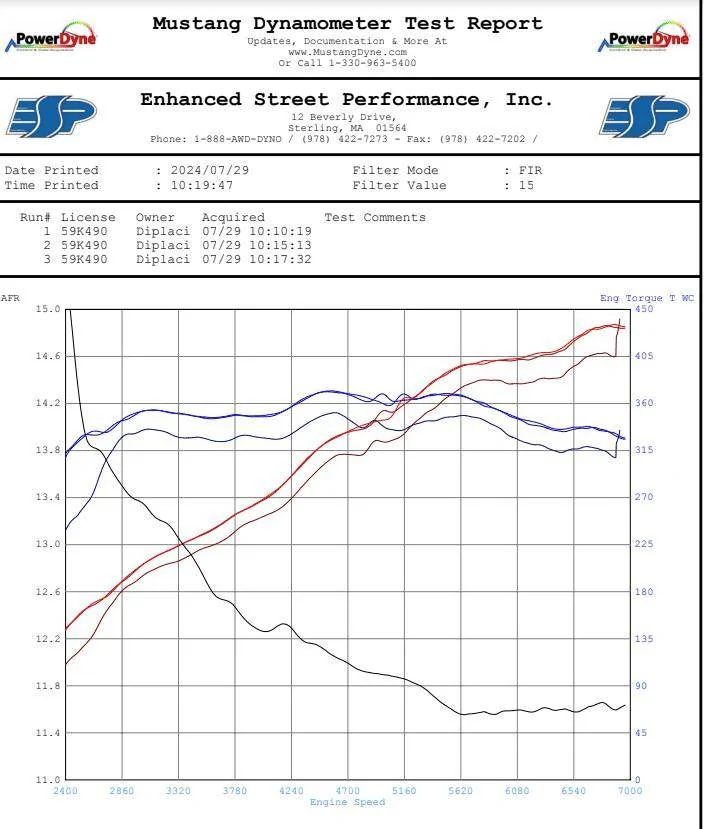
Compared to my mustang:
1722271131465-2o.jpg


The torque is flat here but the horsepower is not, if you look at these two graphs this 5.0L V8 is making basically the same hosrepower (and also the same torque) as a 2.0L turbo at 3500RPM. This car feels slow at slow engine speeds and fast at high engine speeds.

But look at the torque drop off, the 440hp mustang is making 315 ft-lbs. at redline, while the 250hp focus is making only 200ft-lbs. If the focus was modded to make 440hp it would make the same 315 foot-lbs. of torque.

The conclusion is that to really understand the power output of a motor you need to look at a torque graph over engine speed. Peak values are useless as they don't let you understand work, I think they just quote them to have big numbers to sell cars.
 
Last edited:

K4fxd

Well-Known Member
Joined
Apr 2, 2020
Threads
121
Messages
13,455
Reaction score
12,262
Location
NKY
First Name
Dan
Vehicle(s)
2017 gt, 2002 FXDWG, 2008 C6,
Most of the 60's muscle cars had a curve like that. Makes a fun street car.

It didn't copy the graph? Oh well I'm quoting the first graph with the TQ peak early in the RPM range.
 

junits15

Well-Known Member
Joined
Jul 7, 2022
Threads
19
Messages
1,192
Reaction score
1,310
Location
MA
First Name
Justin
Vehicle(s)
2019 Mustang GT
Most of the 60's muscle cars had a curve like that. Makes a fun street car.

It didn't copy the graph? Oh well I'm quoting the first graph with the TQ peak early in the RPM range.
Weird let me try again they're both up when i look at it but the second one was done differently
 

Sponsored

robvas

Well-Known Member
Joined
Nov 18, 2023
Threads
15
Messages
3,485
Reaction score
3,274
Location
MI
Vehicle(s)
2011 GT
If anyone doesn't believe that torque (net, multiplied torque) is what propels the vehicle, just try this.

Take your car, start it in the 1:1 drive and run a 1/4 mile, all in that gear. Then do the same run using multiplication in the lower gears. The motor output is the same for both (power) and the motor torque is as well, but what's different is the actual multiplied torque to the tires.
Except you're operating the engine at different RPM ranges in each of these tests....the motor output is not the same.
 

junits15

Well-Known Member
Joined
Jul 7, 2022
Threads
19
Messages
1,192
Reaction score
1,310
Location
MA
First Name
Justin
Vehicle(s)
2019 Mustang GT
Except you're operating the engine at different RPM ranges in each of these tests....the motor output is not the same.
The motor output is the same.

He's essentially saying "wind your car out from 3k to 6k in a 1:1 gear and then wind your car out from 3k to redline in a lower gear"

Your motor outputs a fixed power and torque for a given RPM with the throttle blade fully open
 

robvas

Well-Known Member
Joined
Nov 18, 2023
Threads
15
Messages
3,485
Reaction score
3,274
Location
MI
Vehicle(s)
2011 GT
The motor output is the same.

He's essentially saying "wind your car out from 3k to 6k in a 1:1 gear and then wind your car out from 3k to redline in a lower gear"

Your motor outputs a fixed power and torque for a given RPM with the throttle blade fully open
The average motor output isn't the same when you bring gearing into it.

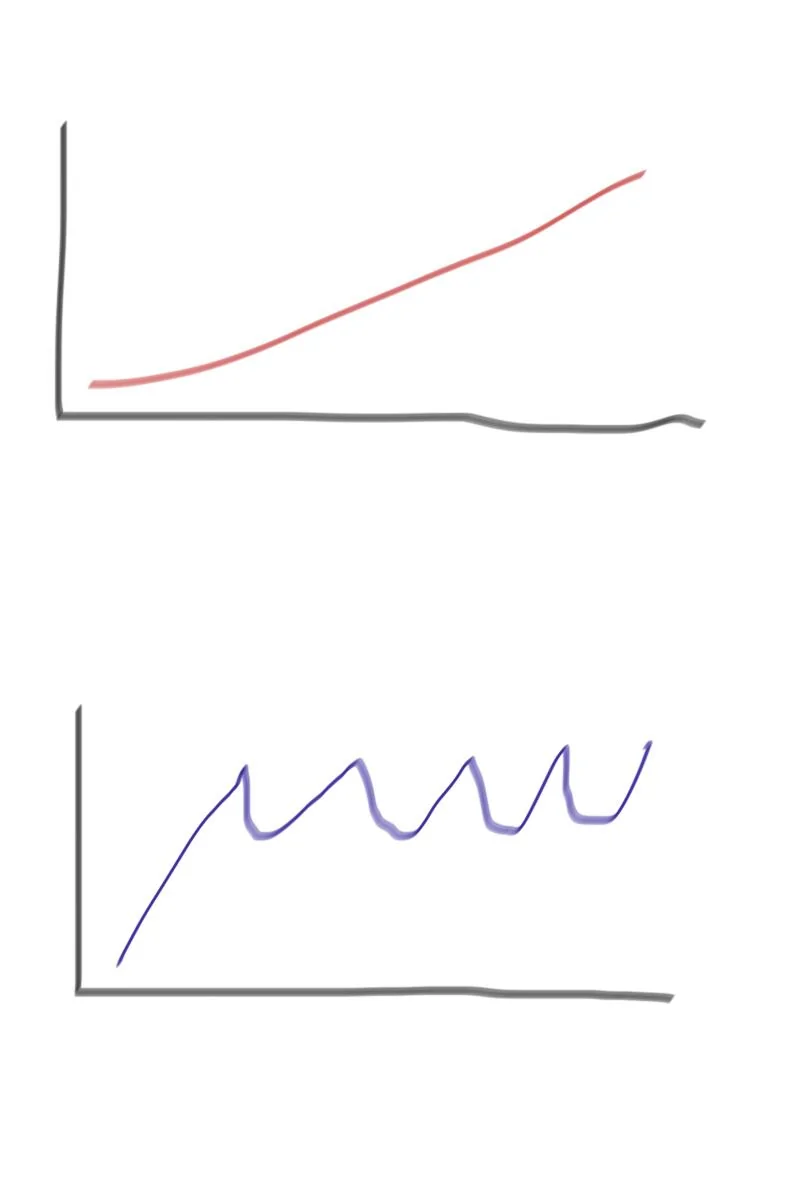
"Take your car, start it in the 1:1 drive and run a 1/4 mile, all in that gear."

You get out of the low RPM's quickly and never go back below say 5k-6k (depending on your transmission gearing)

accel.jpg
 

robvas

Well-Known Member
Joined
Nov 18, 2023
Threads
15
Messages
3,485
Reaction score
3,274
Location
MI
Vehicle(s)
2011 GT
The maximum a an automobile can accelerate forward is with the greatest torque applied to the driveline, then the wheels and tires, then the tires to the ground. You can not PHYSICALLY create forward acceleration (using a wheel) without torque, which is the force applied at a distance/radius.

To MAXIMIZE forward acceleration, you must maximize the overall torque received at the tires. To SUSTAIN that maximum acceleration is where power (the expenditure of work/energy over a length of time) comes into play.

We can overcome insufficient torque created by the motor with gear multiplication (hence the use of transmissions and differentials). But there are practical limits to this (more gears = more space and more weight).

The bottom line is if you want to maximize acceleration, assuming adequate traction, you maximize the area under the torque curve.

The two are also inexorably connected using a chassis dyno because in order to MAINTAIN a torque output, the motor HAS to expend more and more work (so when you see a table top flat torque curve, the reason you see an ever increasing power curve is because the motor HAS to put in increasing work in order to maintain that torque level.)

Where this confuses people is on the top end of the rpm range where power may indeed be high, but if the torque is dropping the available force to apply to moving the vehicle forward is dropping.

I can't be any clearer, to maximize acceleration over a set of different gears, the optimal approach is to maximize the area under the torque curve, NOT the power curve.
Remember last time you were wrong about this?

https://www.mustang6g.com/forums/th...-hellion-top-mount.153484/page-3#post-3904095
 

junits15

Well-Known Member
Joined
Jul 7, 2022
Threads
19
Messages
1,192
Reaction score
1,310
Location
MA
First Name
Justin
Vehicle(s)
2019 Mustang GT
The average motor output isn't the same when you bring gearing into it.

"Take your car, start it in the 1:1 drive and run a 1/4 mile, all in that gear."

You get out of the low RPM's quickly and never go back below say 5k-6k (depending on your transmission gearing)

accel.webp
No the motor output is always the same, you're confusing it with wheel torque and you're also not understanding the scenario, he's not comparing a single gear run to one where you shift, he's trying to make you visualize why torque is all that matters.

The high gear scenario is a low torque situation
the low gear scenario is a high torque situation

Which one is faster? High torque, why? The integral of that run will be larger.


An easier way is to visualize is to imagine two ideal motors with a perfectly flat torque curve and 1:1 gearing. One makes 200 ft-lbs. and the other makes 400 ft-lbs.. Which is faster?
 
Last edited:

Sponsored

K4fxd

Well-Known Member
Joined
Apr 2, 2020
Threads
121
Messages
13,455
Reaction score
12,262
Location
NKY
First Name
Dan
Vehicle(s)
2017 gt, 2002 FXDWG, 2008 C6,
Remember last time you were wrong about this?
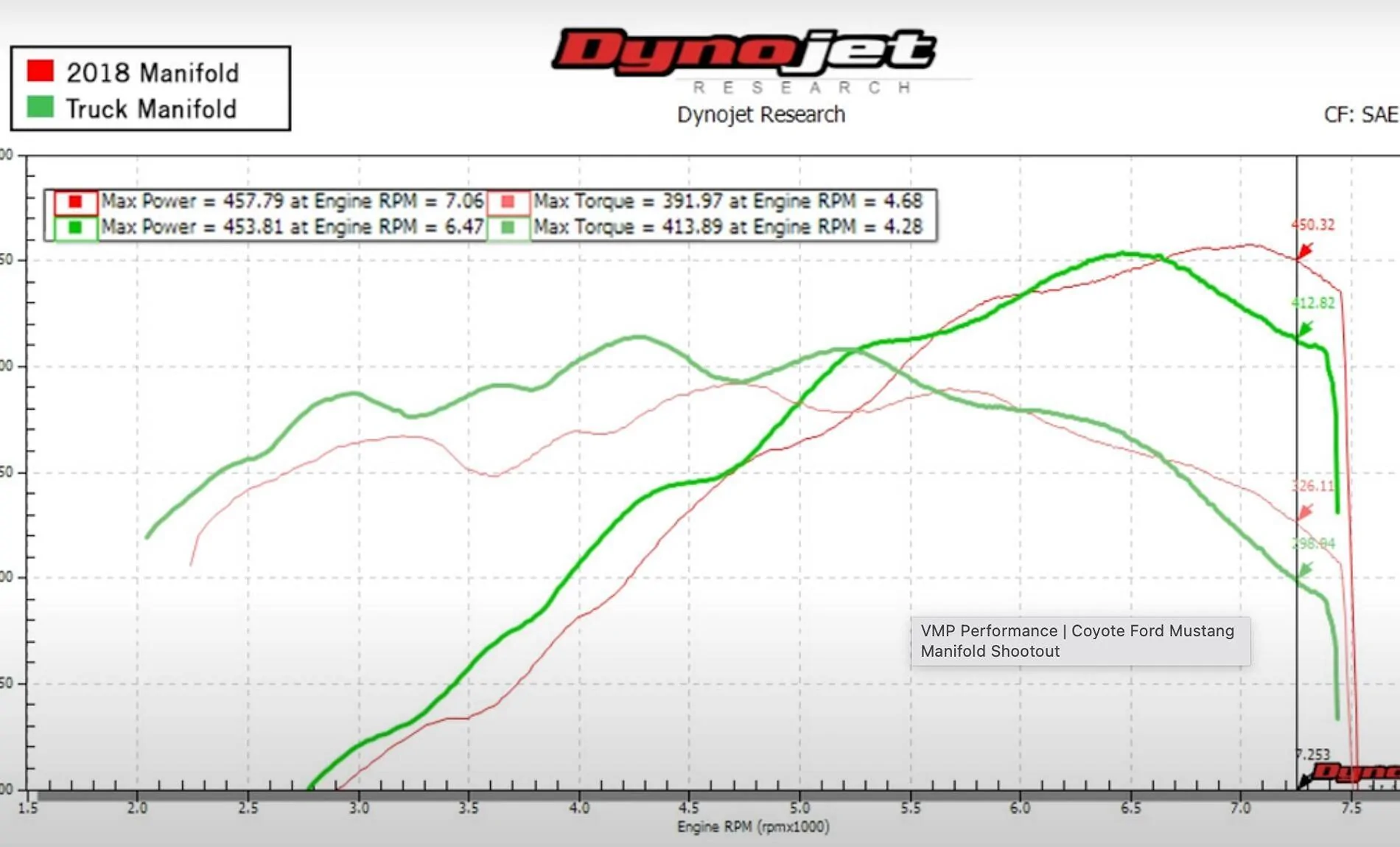
When I run the F150 manifold, (gen 3) it is quicker in the 1/4 mile shifting at 6800 than shifting at 7200

The GT350 manifold is quicker shifting at 7600.

Surprising the Truck mani is only a tenth slower on average ET. It is 3 MPH slower in the traps.
 

robvas

Well-Known Member
Joined
Nov 18, 2023
Threads
15
Messages
3,485
Reaction score
3,274
Location
MI
Vehicle(s)
2011 GT
When I run the F150 manifold, (gen 3) it is quicker in the 1/4 mile shifting at 6800 than shifting at 7200

The GT350 manifold is quicker shifting at 7600.

Surprising the Truck mani is only a tenth slower on average ET. It is 3 MPH slower in the traps.
Which makes perfect sense. 3mph difference from ~38hp deficiency compared to a non-truck manifold

A lot of people are confused by this but you want the car's operating RPM range to be in the highest average HP of your engine. Power at 7200 on the truck manifold. is getting back under where it would be had you already shifted.

Screenshot 2024-09-17 at 1.37.09 PM.jpg
 

robvas

Well-Known Member
Joined
Nov 18, 2023
Threads
15
Messages
3,485
Reaction score
3,274
Location
MI
Vehicle(s)
2011 GT
My example of 2 cars running 11.0 1/4 miles, one at 105 MPH and the other at 117, is a real world comparison of high torque vs high HP.
You would have to let off the gas really early in the run to run an 11.0 @ 105

11.0 is an amazing ET for only going 117mph

S550 with drag radials might go 12.0 @ 117

S550 all-out drag setup NA might go 10.9 @ 125
Sponsored


Top