Sponsored

Does The EcoBoost Need A Catch Can?

Status
Not open for further replies.
OP
OP
Mishimoto

Mishimoto

Well-Known Member
Joined
Sep 3, 2014
Threads
61
Messages
1,047
Reaction score
413
Location
Delaware
Vehicle(s)
2015 EcoBoost, 2016 GT
Time for an update on this project! Check it out below.

http://engineering.mishimoto.com/?cat=207

Mishimoto 2015+ Ford Mustang 2.3L EcoBoost Direct-Fit Baffled Oil Catch Can System, Part 2: Catch Can Selection and Bracket Fabrication

Now that we had a good idea of where to start with this project, our team began by selecting the appropriate catch can for the Mustang.

Catch Can Selection
We have two options in catch cans. Our standard baffled oil catch can is shown below.


Mishimoto Baffled Oil Catch Can

This innovative catch can features a slew of high-quality CNC-machined components. The unit utilizes thread-in fittings, an internal baffle, and a bronze 40-micron filter to separate the particles. We have had a ton of success offering this product as a universal catch can. One thing that may hold us back from using this component in the Mustang 2.3L is the general footprint. This is a large catch can and provides a massive volume for oil collection. Although the engine compartment of the 2.3L is rather spacious, we would need to fit two of these cans under the hood. This could affect the appearance of the kit and would also have an impact on fitment with other aftermarket components.

We addressed this issue a few months back and introduced an awesome new compact baffled oil catch can. This unit includes all the great features of our larger unit, all squeezed into a smaller package. Check it out!


Mishimoto Compact Baffled Oil Catch Can

We highlighted the entire build process of this particular catch can in the thread below.

http://engineering.mishimoto.com/?cat=124

This catch can is so awesome that several of our employees preordered them for their own vehicles. This can has found its way into our existing direct-fit kits and has worked out quite well. This will be the can our team uses for the Mustang. There … it has been decided!

We mentioned that we would need two catch cans for this particular kit. We also discussed this a bit on the forums already. Unfortunately, one catch can with three ports cannot be used to link a breather and PCV line. These lines will have differing pressures, which can cause some serious issues. Instead, we use one catch can for each line to ensure no ill effects. Since the Mustang has only one breather line, we will require only two 2-port cans for the mighty 2.3L.

Catch Can Bracket Fabrication
Time to grab some steel and get to work mocking up some brackets. Our goal here is a clean installation, without a mishmash of hoses splicing throughout the engine compartment. This kit needs to look like it was equipped on the vehicle from the factory.


Mustang bracket measurements

Here we have Dan taking a few measurements near the driver’s strut tower. We decided that this was a good location for mounting our catch cans. Not only would it provide ideal proximity for short line routes, but it would also stay out of the way of the turbocharger. We are well aware that turbo upgrades are certainly possible for those seeking big power, so we are looking ahead to pick a location with the smallest chance of fitment concerns.

After some initial measurements, one bracket was created and mounted into position.


Mustang bracket mounted


Mustang bracket mounted

Then we added a second bracket to the setup. These two brackets work together to create a rigid mounting point for the dual can setup. Check it out!


Mustang dual can brackets mounted


Mustang dual can brackets mounted

One important factor we wanted to consider during design was the ease of servicing the cans. Our goal is that the user can easily remove the can base to empty the contents without touching the hoses or bracket. Here is a shot of one of our team members checking clearance.


Checking serviceability of catch can location

Plenty of room!

Now that we had a solid location for the catch cans themselves, we would need to sort out the line routing. Check back with us next time for our hose mockup and final prototype.

Thanks!
Sponsored

 

neodark

Left 4cyl @home
Joined
Sep 3, 2014
Threads
44
Messages
1,505
Reaction score
237
Location
FL
First Name
Jorge
Vehicle(s)
2019 GT PP2
Looking good. One question, and sorry if I missed it... But, will you have to drill anything? I assume no, since you mentioned these are direct fit, and it looks like the pictures show the bracket attached to the strut tower
 

Dirtleg

BoostCreep
Joined
May 24, 2014
Threads
34
Messages
481
Reaction score
77
Location
Cloverdale Va
First Name
Greg
Vehicle(s)
15' EB Prem PP, 07' GT (track Car), 01' RC51, 16" S1000XR
I really like the way you have approached this solution. Nice work. Looking forward to the finished product.
 

ECOKN815

Well-Known Member
Joined
Oct 22, 2014
Threads
0
Messages
105
Reaction score
11
Location
New York
Vehicle(s)
1985 Mustang LX Hatch T-Tops
Excellent! Curious to find out why UPR using a single set up? Looking forward to this can.
 

Max57

Well-Known Member
Joined
Dec 21, 2014
Threads
7
Messages
197
Reaction score
52
Location
Palmyra, VA
Vehicle(s)
2015 Jeep Cherokee Limited, 1957 Chevy BelAir
I won't have the car until the late spring, but I'm definitely interested!
 

Sponsored

e30og

Well-Known Member
Joined
Aug 9, 2014
Threads
13
Messages
1,015
Reaction score
168
Location
MD
Vehicle(s)
'19 Genesis G70 3.3T Sport
Interested, dual setup sounds like a better idea but it would be beneficial to have more info backing it up. Nice seeing all the new catch can systems out now, but if the results are decent and the price is right I may order with these guys
 

UPRjoe

Well-Known Member
Diamond Sponsor
Joined
Dec 19, 2014
Threads
24
Messages
592
Reaction score
260
Location
750 S. Eastcoast St, Lake Worth Fl. 33460
Website
www.uprproducts.com
First Name
Joe
Vehicle(s)
UPR 2015 Ecoboost Mustang
Reason for Single Catch Can Vs. Twin Catch Can

Excellent! Curious to find out why UPR using a single set up? Looking forward to this can.
UPR has sold thousands of Twin Catch Can setups for the Ecoboost platform and results have always been repeatable. The larger 3.5L Ecoboost Twin Turbo has a much heavier demand on the PCV system venting from the crankcase than the 2.3L Ecoboost Single Turbo. The 3.5L engine has the old PCV design for the dirty and clean side oil lines and is a lot more susceptible to blowing oil out the clean side

Even the heavily modified 3.5L Twin Turbo setups never really see any real oil travel and are more for overall protection some customers want or they just like the way the system looks. On top of it this coming from a business owner who offers the very best catch cans in the industry and this statement will lose sales.

I would rather we promoted products based on actual need and real world results. We have become one of the most well known manufacturers in the Ecoboost world because of the results and support we give. Now combine that with hundreds of hours of testing and multiple customer tests that always return the same results.

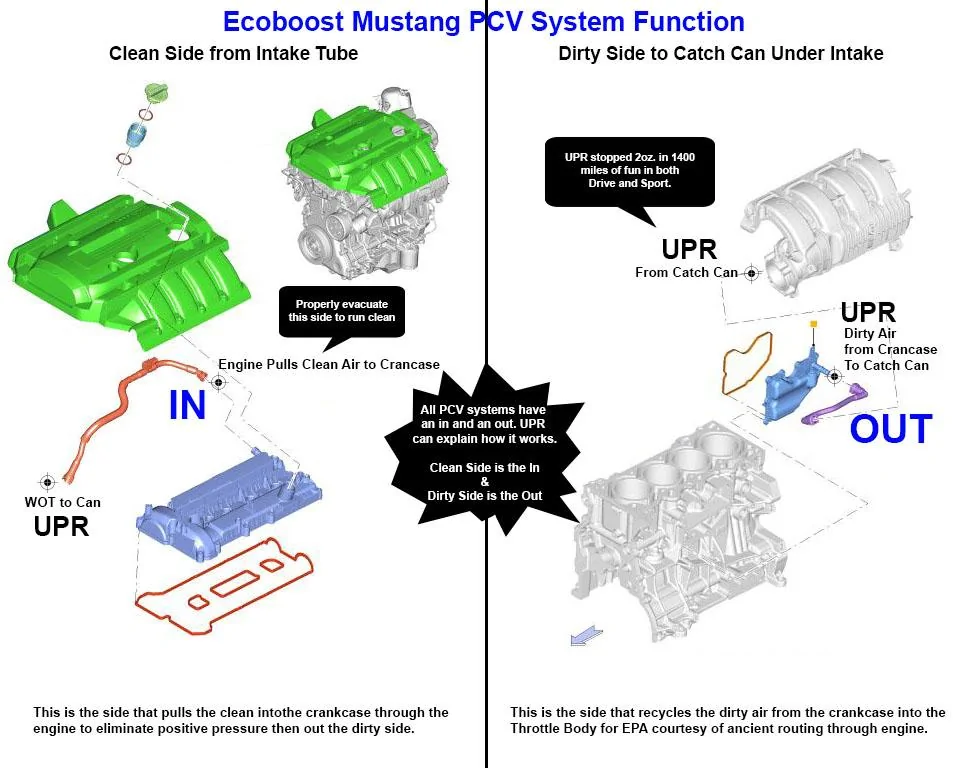
If you guys really want a Twin Catch Can system that is fine. But the importance of the Dual Valve Catch Can Setup is to help the system maintain the in on the clean side and the out to from the dirty side. The WOT line on the is what helps the engine keep a directional flow and under WOT without a Dual Valve you will push very small amounts of oil out the clean side.

WOT evacuation from the Dual Valve is Vital to Eliminate the need for Twin Catch Cans. When in boost the first valve closes and prevents the catch can from being pressurized. Then the second valve goes to work and the WOT line pulls a higher vacuum from the Turbo inlet so you're properly evacuating the crankcase and not pressurizing it like traditional catch cans.

Sorry this is so long, but it's very important to understand the PCV system is designed with an In / Clean Side and an Exit / Dirty Side. It's more important to improve the function and maintain the directional flow VS. just slapping two cans on it. Even more important is Twin Catch Cans do absolutely nothing for the engine performance while in boost or improve performance.

Twin Catch Cans allow the crankcase to build up excessive positive pressure and that is why oil comes out both sides.


Lord Helmet

New Member
Joined
Dec 28, 2013
Threads
0
Messages
3
Reaction score
0
Location
US
Vehicle(s)
Slow Stang
I'm interested

BTW Joe I like that Oil catch can.
 
Last edited:

Max57

Well-Known Member
Joined
Dec 21, 2014
Threads
7
Messages
197
Reaction score
52
Location
Palmyra, VA
Vehicle(s)
2015 Jeep Cherokee Limited, 1957 Chevy BelAir
When I get our Mustang in the spring, this will be one of the first additions! Put me on your list! :thumbsup:
 

e30og

Well-Known Member
Joined
Aug 9, 2014
Threads
13
Messages
1,015
Reaction score
168
Location
MD
Vehicle(s)
'19 Genesis G70 3.3T Sport
UPR has ...but it's very important to understand the PCV system is designed with an In / Clean Side and an Exit / Dirty Side. It's more important to improve the function and maintain the directional flow VS. just slapping two cans on it. Even more important is Twin Catch Cans do absolutely nothing for the engine performance while in boost or improve performance.

Twin Catch Cans allow the crankcase to build up excessive positive pressure and that is why oil comes out both sides.
Can anyone validate this?

Also can you guys demonstrate some catch from real world testing on the 2.3 EB?
 

Sponsored

doulos4jc

......looking^
Joined
May 8, 2014
Threads
101
Messages
2,006
Reaction score
318
Location
Maryland
Vehicle(s)
2015 Turbo Mustang
Even more important is Twin Catch Cans do absolutely nothing for the engine performance while in boost or improve performance.
It's my understanding catch cans(single, double)are for preventative maintenance. At best they maintain the performance you already have. Am I missing something?
 
OP
OP
Mishimoto

Mishimoto

Well-Known Member
Joined
Sep 3, 2014
Threads
61
Messages
1,047
Reaction score
413
Location
Delaware
Vehicle(s)
2015 EcoBoost, 2016 GT
Looking good. One question, and sorry if I missed it... But, will you have to drill anything? I assume no, since you mentioned these are direct fit, and it looks like the pictures show the bracket attached to the strut tower
Great question. Our kit will not require any cutting or drilling of vehicle components. The can bracket mounts to the engine bay utilizing existing mounting holes/points.

Thanks!

I really like the way you have approached this solution. Nice work. Looking forward to the finished product.
Thanks for checking it out!

I won't have the car until the late spring, but I'm definitely interested!
Thanks!

Interested, dual setup sounds like a better idea but it would be beneficial to have more info backing it up. Nice seeing all the new catch can systems out now, but if the results are decent and the price is right I may order with these guys
We will be thoroughly testing our kit to ensure that both cans are necessary! Stay tuned for the results.

Excellent! Curious to find out why UPR using a single set up? Looking forward to this can.
UPR has sold thousands of Twin Catch Can setups for the Ecoboost platform and results have always been repeatable. The larger 3.5L Ecoboost Twin Turbo has a much heavier demand on the PCV system venting from the crankcase than the 2.3L Ecoboost Single Turbo. The 3.5L engine has the old PCV design for the dirty and clean side oil lines and is a lot more susceptible to blowing oil out the clean side

Even the heavily modified 3.5L Twin Turbo setups never really see any real oil travel and are more for overall protection some customers want or they just like the way the system looks. On top of it this coming from a business owner who offers the very best catch cans in the industry and this statement will lose sales.

I would rather we promoted products based on actual need and real world results. We have become one of the most well known manufacturers in the Ecoboost world because of the results and support we give. Now combine that with hundreds of hours of testing and multiple customer tests that always return the same results.

If you guys really want a Twin Catch Can system that is fine. But the importance of the Dual Valve Catch Can Setup is to help the system maintain the in on the clean side and the out to from the dirty side. The WOT line on the is what helps the engine keep a directional flow and under WOT without a Dual Valve you will push very small amounts of oil out the clean side.

WOT evacuation from the Dual Valve is Vital to Eliminate the need for Twin Catch Cans. When in boost the first valve closes and prevents the catch can from being pressurized. Then the second valve goes to work and the WOT line pulls a higher vacuum from the Turbo inlet so you're properly evacuating the crankcase and not pressurizing it like traditional catch cans.

Sorry this is so long, but it's very important to understand the PCV system is designed with an In / Clean Side and an Exit / Dirty Side. It's more important to improve the function and maintain the directional flow VS. just slapping two cans on it. Even more important is Twin Catch Cans do absolutely nothing for the engine performance while in boost or improve performance.

Twin Catch Cans allow the crankcase to build up excessive positive pressure and that is why oil comes out both sides.
Thanks for chiming in Joe! Quite a unique setup you have there. Have you conducted any road testing to determine the fluid accumulation rate? Our current prototype separates the breather line from the PCV line, this way we do not experience any issues with the pressure differences between these ports. By doing so, we will be able to determine which particular line accumulates the most byproduct, and we can then address that line with an appropriate separator. From what I understand, you are using a series of check-valves to combine both lines into a single can.

The Mishimoto setup does not change the factory flow or routing, we are simply adding separators to collect any contaminants. By doing so our kit will be fully bolt-on, and will not require extensive modification to the EB (I notice you have customers drill into the turbo inlet tube). Additionally, we have tested our baffled oil catch can on a variety of vehicles, as well as bench tests, to ensure flow was not negatively impacted. Each test has shown that our can setup is extremely efficient at pulling fluid, thanks to the use of our 40-micron bronze filter.

Do you have any testing to show that oil will pass through the filtration system of a dual catch can system?

Thanks!

Can anyone validate this?

Also can you guys demonstrate some catch from real world testing on the 2.3 EB?
Keep an eye out for the results from our testing. We are conducting some road and dyno tests to see what fluid accumulation we have in each particular system.

It's my understanding catch cans(single, double)are for preventative maintenance. At best they maintain the performance you already have. Am I missing something?
Correct. A catch can will reduce the chance of oil reaching your combustion chamber. Oil will reduce fuel octane rating which can impact performance. I would not consider this upgrade a component that will "increase" power output. As you mentioned, it is more of a preventative component that will help sustain the power provided by the 2.3L when it rolled off the factory line!
 

ELPYBOOST

Well-Known Member
Joined
Nov 26, 2014
Threads
3
Messages
165
Reaction score
14
Location
Toronto, Canada
First Name
Eugene
Vehicle(s)
2015 Race Red Mustang EB Premium w/ PP and Navi
This is getting more and more interesting.
 

UPRjoe

Well-Known Member
Diamond Sponsor
Joined
Dec 19, 2014
Threads
24
Messages
592
Reaction score
260
Location
750 S. Eastcoast St, Lake Worth Fl. 33460
Website
www.uprproducts.com
First Name
Joe
Vehicle(s)
UPR 2015 Ecoboost Mustang
Mishimoto:
Thanks for chiming in Joe! Quite a unique setup you have there. Have you conducted any road testing to determine the fluid accumulation rate? Our current prototype separates the breather line from the PCV line, this way we do not experience any issues with the pressure differences between these ports. By doing so, we will be able to determine which particular line accumulates the most byproduct, and we can then address that line with an appropriate separator. From what I understand, you are using a series of check-valves to combine both lines into a single can.

UPRproducts
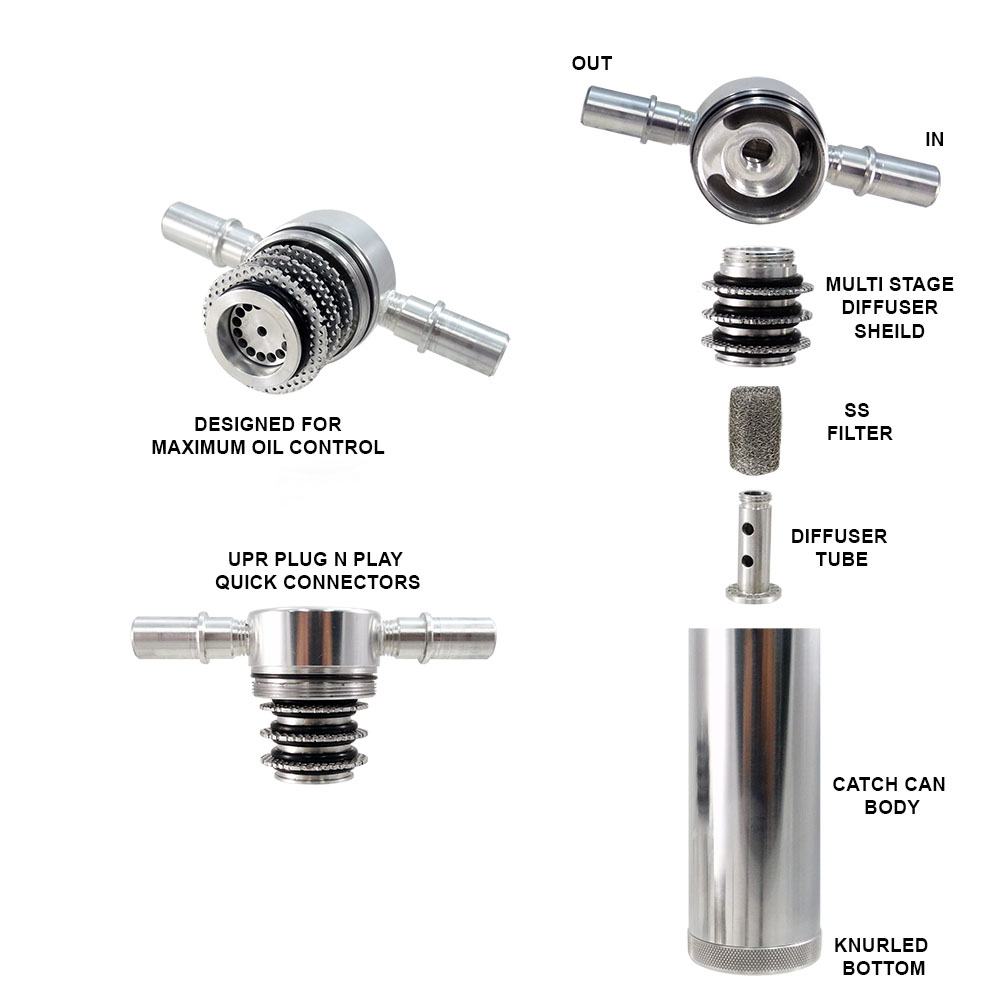
( You cannot combine the PCV line with the Breather line on the 2.3L ecoboost as this will throw the check engine light. Nor does our system do so through a series of check valves as you would lock the PCV system. We already know without question which lines collects the most oil and don't need to experiment on something that we have an extensive knowledge of. ) - ( We could offer a more basic design with hollow internals and a 40 micron filter but we steered into a more complex multi-stage system that is designed specifically to offer the best coalescing and condensing properties. )

Mishimoto:
The Mishimoto setup does not change the factory flow or routing, we are simply adding separators to collect any contaminants. By doing so our kit will be fully bolt-on, and will not require extensive modification to the EB (I notice you have customers drill into the turbo inlet tube). Additionally, we have tested our baffled oil catch can on a variety of vehicles, as well as bench tests, to ensure flow was not negatively impacted. Each test has shown that our can setup is extremely efficient at pulling fluid, thanks to the use of our 40-micron bronze filter.

Do you have any testing to show that oil will pass through the filtration system of a dual catch can system?

UPRproducts
(Our system was not designed to do more than just collect oil by preventing it from pulling through the exit/clean line. I have tested every single can out there and there is only one other unit that can control oil and it's a complex design just like the UPR Catch Can. The problem with a simple internal design and using a bronze filter no matter what the micron is that it will not slow the oil down long enough to collect and reduce the actual oil in vapor form.) - ( The need for the WOT line is obviously not understood well by many except the few thousand Ecoboost SUV and Truck owners that run them. We had some very trick cans with multi-stage filters that could fill a a 5oz. capacity every oil change on the 5.0L engine let alone the ecoboost. )

( We have tested and been involved in so many tests and the importance of the internal design is vital to the level of performance a catch can delivers. Any simple internal design are referred to as pull through catch cans. I'm not saying they don't catch oil, but I will tell you that if you check the exit line for oil on basic systems they always have a build up of oil in them showing how much still gets by the system. )

( The science and physics involved with a properly functioning catch can are something we spent years learning about proper systems and the need for them to be able to condense the fluid and coalesce the oil vapors to stop oil vapors from being able to escape. Catch Cans don't pull fluid as they are just filters and it's the level of complexity of that sets them apart and the performance. )

( How many oz of oil does your system catch per oil change or 3,000 miles and what brings you to the conclusion about it's efficiency ? )

( I'm glad you are asking me to explain and point things out. If you search the web you will find people that talk about many cans including your current design that pulls oil out the exit. We were in the same boat when we resold other manufacturers cans years ago. Now that we spent years developing some pretty high end systems and sell thousands of units a year with many different variations not just a one size fits all like 90% of the manufacturers out there. )
Sponsored

 
Status
Not open for further replies.


Top