Sponsored

AFD ProFlex E85 Commander Journey w/ GT350

OP
OP

mmakam2

Well-Known Member
Joined
Nov 30, 2015
Threads
16
Messages
309
Reaction score
56
Location
Houston, TX
Vehicle(s)
2019 GT350
Bank 2 always coming up lean, never bank 1. My current theory is the very slight amount of lithium grease i put on the fuel line o rings may have made their way into one of the injectors.

Is lithium grease going to dissolve away?

Either way, it would be good to know which side is bank 2, so i can swap injectors to see if the issue goes away.
 
OP
OP

mmakam2

Well-Known Member
Joined
Nov 30, 2015
Threads
16
Messages
309
Reaction score
56
Location
Houston, TX
Vehicle(s)
2019 GT350
On a side note, i have just confirmed the GT350 has the same injector as the 15-17 GT, they are rated at 34.6 lb/hr @ 43.5psi, so at 55psi (GT350 base pressure), they are 41.83 lb/hr injectors, or basically 42lb. The 2019 model year has the same one as well.
 

JAJ

Well-Known Member
Joined
Apr 9, 2016
Threads
4
Messages
2,232
Reaction score
1,987
Location
Vancouver BC
Vehicle(s)
2016 GT350 Track Pack
Bank 1 is 1 to 4, bank 2 is 5 to 8.

Lambse is "commanded lambda" based on engine operating conditions and is 1.0 for stoichiometric mixture where fuel is exactly matched for oxygen in the air. The ECU thinks of fueling in terms of lambda, not AFR. It also varies the commanded lambda: the ECU can choose a perfect 1.0 for cruising but it might drop down to a slightly rich 0.95 for hard acceleration or a very rich 0.8 for extended high power operation to protect the cats. Lambda of 1.0 is determined by fuel type - if it's E0 gasoline, lambda of 1.0 is around 14:1 AFR. If it's E85, lambda of 1.0 is around 9.8 AFR.

The thing is that the commanded torque part of the ECU doesn't think about AFR - it looks at the driver commanded torque, sets the throttle angle to get the right amount of air and picks a lambse to deliver the appropriate power. If it sets lambse at 0.95, it checks the O2 sensor to see if it's getting 0.95. If it's not, there's a fueling adjustment via short term and long term fuel trims. There's a separate set of tables that looks at injector timing to see if the AFR is in the "normal" range. If that's out of range, then there's a code. A flex fuel vehicle has a wider range of acceptable AFR's.

If you want to know what's going on with lean or rich, find the Long Term and Short Term Fuel Trim PID's. They will tell you where things are out of range - if you've got SCT Livelink, you can create a synthetic PID which is the sum of STFT and LTFT. That's the total error in mixture at any moment and when you map it vs Load (which is essentially power output) it'll tell you where the problem lies in the map. Once you've isolated it to one bank or the other, there are other PID's that can tell you which cylinder it is. The ECU is very smart - it monitors the crank for odd motions and can detect a single cylinder with a mixture problem. It's essentially a super-sensitive version of the misfire detection algorithm.

I doubt you have a gunked up injector. The problem goes away when you disconnect the ethanol control unit; an injector problem wouldn't go away.
 

Sponsored

Mjc1241

Well-Known Member
Joined
Jun 25, 2017
Threads
32
Messages
688
Reaction score
406
Location
Georgia
First Name
Reese
Vehicle(s)
2016 Shelby GT350
JAJ your technical knowledge and insight on this is great reading material!
 
OP
OP

mmakam2

Well-Known Member
Joined
Nov 30, 2015
Threads
16
Messages
309
Reaction score
56
Location
Houston, TX
Vehicle(s)
2019 GT350
Bank 1 is 1 to 4, bank 2 is 5 to 8.

Lambse is "commanded lambda" based on engine operating conditions and is 1.0 for stoichiometric mixture where fuel is exactly matched for oxygen in the air. The ECU thinks of fueling in terms of lambda, not AFR. It also varies the commanded lambda: the ECU can choose a perfect 1.0 for cruising but it might drop down to a slightly rich 0.95 for hard acceleration or a very rich 0.8 for extended high power operation to protect the cats. Lambda of 1.0 is determined by fuel type - if it's E0 gasoline, lambda of 1.0 is around 14:1 AFR. If it's E85, lambda of 1.0 is around 9.8 AFR.

The thing is that the commanded torque part of the ECU doesn't think about AFR - it looks at the driver commanded torque, sets the throttle angle to get the right amount of air and picks a lambse to deliver the appropriate power. If it sets lambse at 0.95, it checks the O2 sensor to see if it's getting 0.95. If it's not, there's a fueling adjustment via short term and long term fuel trims. There's a separate set of tables that looks at injector timing to see if the AFR is in the "normal" range. If that's out of range, then there's a code. A flex fuel vehicle has a wider range of acceptable AFR's.

If you want to know what's going on with lean or rich, find the Long Term and Short Term Fuel Trim PID's. They will tell you where things are out of range - if you've got SCT Livelink, you can create a synthetic PID which is the sum of STFT and LTFT. That's the total error in mixture at any moment and when you map it vs Load (which is essentially power output) it'll tell you where the problem lies in the map. Once you've isolated it to one bank or the other, there are other PID's that can tell you which cylinder it is. The ECU is very smart - it monitors the crank for odd motions and can detect a single cylinder with a mixture problem. It's essentially a super-sensitive version of the misfire detection algorithm.

I doubt you have a gunked up injector. The problem goes away when you disconnect the ethanol control unit; an injector problem wouldn't go away.
I have not tried disconnecting the unit yet because I still have ethanol in the tank. Let me try your suggestion for logging.
 
OP
OP

mmakam2

Well-Known Member
Joined
Nov 30, 2015
Threads
16
Messages
309
Reaction score
56
Location
Houston, TX
Vehicle(s)
2019 GT350
adding STFT and LTFT on both banks 1 and 2, they stay around 2.3 the whole time regardless of load/rpm.
 
OP
OP

mmakam2

Well-Known Member
Joined
Nov 30, 2015
Threads
16
Messages
309
Reaction score
56
Location
Houston, TX
Vehicle(s)
2019 GT350
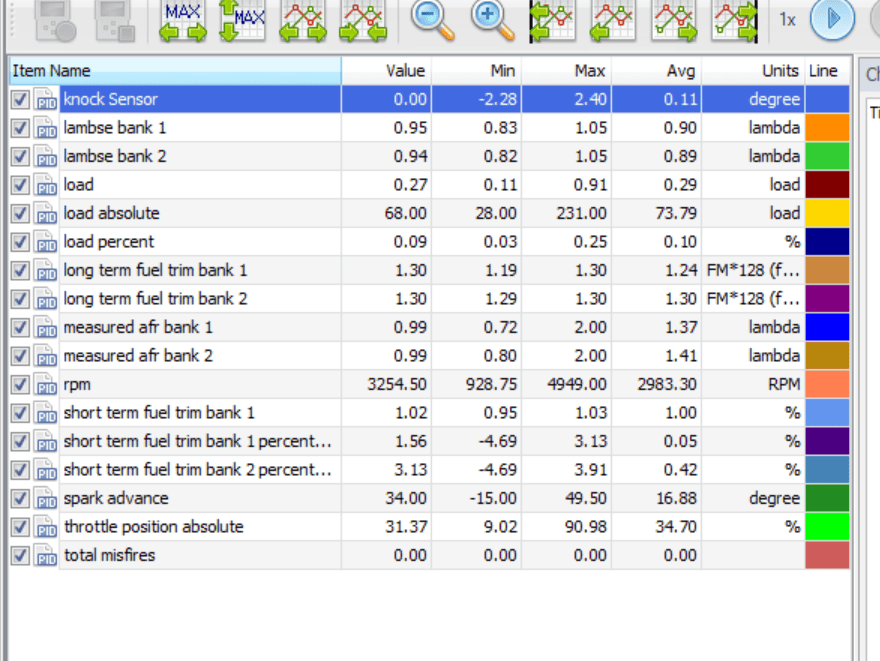
This log has a custom parameter as suggested with STFT and LTFT on bank 1 and 2 seperately, (bank 1 error test, bank2).

bank 1 error test = STFT Bank 1 + LTFT Bank 1

Bank2 = STFT Bank 2 + LTFT Bank 2
 

Attachments

Last edited:

Sponsored

JAJ

Well-Known Member
Joined
Apr 9, 2016
Threads
4
Messages
2,232
Reaction score
1,987
Location
Vancouver BC
Vehicle(s)
2016 GT350 Track Pack
Well, this is progress, kinda. It's been over five years since I was this deep into this stuff, but it's coming back. Fuel trims are a ratio - they're 1.0 when they're doing nothing and they range up and down depending on whether they are adding (above 1) or removing (below 1) fuel. When you add the two PID's you need to subtract 1 to get it to be in the right range. But that's not needed in this case - the goal here isn't to know exactly what the error is, it's to get the system so the average value of both is 1.0 and the sum of the two is 2.0. But I think you're done collecting data - the answer is in the data you already have.

Here's how it works: the average LTFT is 1.3 on bank 2 and 1.24 on bank 1. That's why only one bank is throwing a code - the threshold is 25% added LTFT (1.25) to throw a lean code. However, they're both a long way (adding 24% and 30%) from OK.

So, my take is that, first, you don't have an injector problem - both banks LTFT's are off by large amounts - the difference of 6% between bank 1 and 2 is a manufacturing variation and doesn't mean anything. Second, at E70, the ECU should be adding about 30% more fuel to get to lambda = 1.0. So, the ECU is adding the about right amount of extra fuel to make E70 work. Since the ECU is adding the extra fuel, I'd conclude that the ethanol controller isn't. The problem is simple: the gizmo isn't working.

So, check the wiring to the unit to make sure it's powered up, and if the wiring is right, then you're needing a replacement unit. As for the E70 in the tank, you're at the edge of what the ECU can correct for, but if you have room in the tank for 4 gallons of E10, that should bring the LTFT back to 1.25 or less and make the codes stop.
 

lightrules

Well-Known Member
Joined
Jul 25, 2018
Threads
62
Messages
2,446
Reaction score
2,288
Location
West Coast
Vehicle(s)
Yes
Vehicle Showcase
1
i wonder if this batch of proflex commanders is not optimal. i know they were rushing to get orders out and were programming them, testing them just prior to shipping. I've been wondering if my unit is off bc of the loud popping, backfiring I'm getting. still trying to tell if this is normal or not with the proflex.
 
OP
OP

mmakam2

Well-Known Member
Joined
Nov 30, 2015
Threads
16
Messages
309
Reaction score
56
Location
Houston, TX
Vehicle(s)
2019 GT350
that's a little scary, I hope I didn't do any permenant damage..

I did see some knock values in the log but not sure if it's good or bad because I don't know what a good reference is.
 
OP
OP

mmakam2

Well-Known Member
Joined
Nov 30, 2015
Threads
16
Messages
309
Reaction score
56
Location
Houston, TX
Vehicle(s)
2019 GT350
the unit is definitely powered up because the app is picking it up. Not sure what else I can do to troubleshoot it.
 

JAJ

Well-Known Member
Joined
Apr 9, 2016
Threads
4
Messages
2,232
Reaction score
1,987
Location
Vancouver BC
Vehicle(s)
2016 GT350 Track Pack
the unit is definitely powered up because the app is picking it up. Not sure what else I can do to troubleshoot it.
that's a little scary, I hope I didn't do any permenant damage..

I did see some knock values in the log but not sure if it's good or bad because I don't know what a good reference is.
The knock data is probably not relevant to this issue - the ECU actually pushes spark toward incipient knock to get the most power out of the least fuel. It's constantly cycling up to the knock sensor limit and backing off just a touch.

It's unlikely you've done any damage. The ECU has a bunch of guardrails to protect the engine and it'll put you in limp mode if you really color outside the lines. You're not there at this point.

If the unit's powered up then you'll have to contact the manufacturer and ask them about it. Tell them you're getting high LTFT numbers (30%) with E70 and see what they say. Good luck!
Sponsored


Top
