Sponsored

10R80 Adaptive Learning with different drive modes

Robottrainer

Well-Known Member
Joined
Apr 25, 2021
Threads
79
Messages
992
Reaction score
422
Location
Canada
First Name
John
Vehicle(s)
2018 Ford Escape. 2020 Jeep Cherokee. 2021 Ford Mustang GT Stage 2 Roush
The 10R80 code appears to have been generated by simulink/matlab style software, eg its computer generated code. As such deciphering how it works via reading code (especially assembly) was never the intent of Ford, this means something that would take a human a year to write (and not be completely obscene to comprehend) takes a few weeks but is perhaps a few orders of magnitude more complex in terms of number of tables, inputs outputs etc.

A lot of tables are chained together with indexes, eg shift character etc which tell the computer which row/column is being used. Those characters are then decided by other logic that is more human readable.

This is simply how it is, we expose everything as otherwise you only see a small part of the picture giving you the illusion of it being simple when it is not. It is also why there are not many people who tune 10R80s beyond mild tweaks.

The best method is to compare say ALT1 and ALT2 of several maps (eg drag and sport in a Mustang) and see what Ford has done, you then figure out some ideas of what you might want to change.

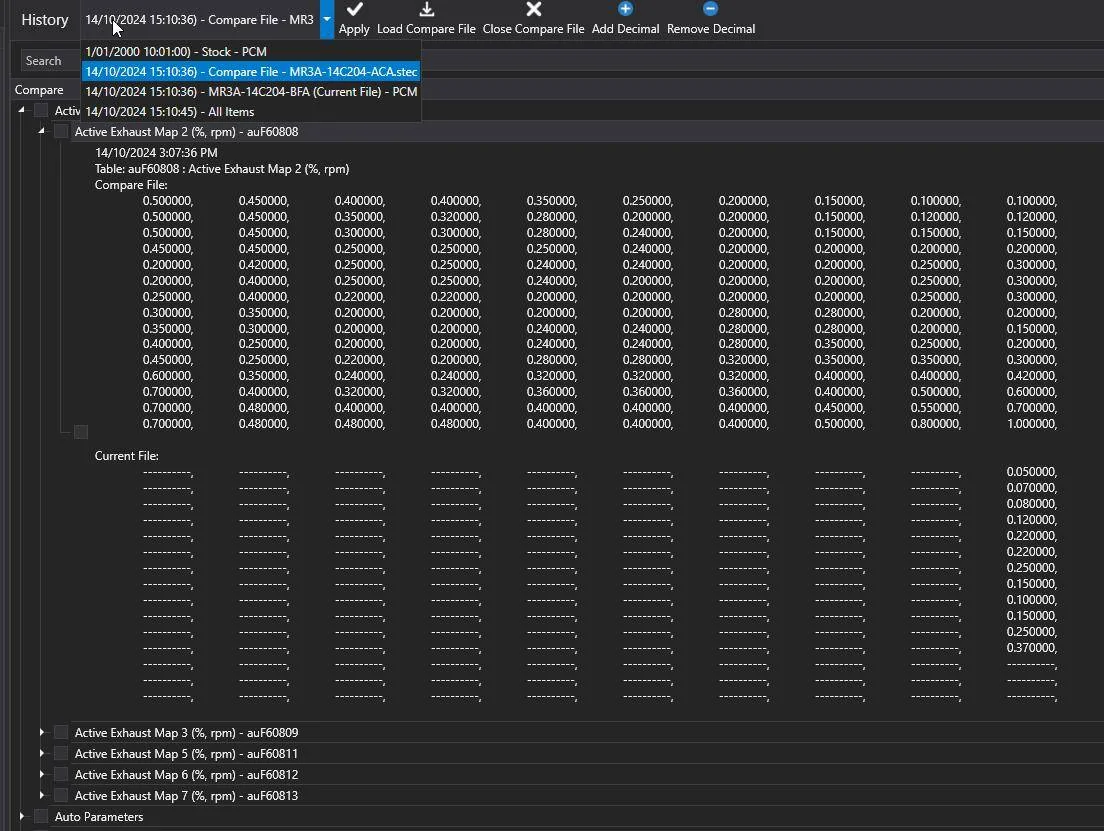
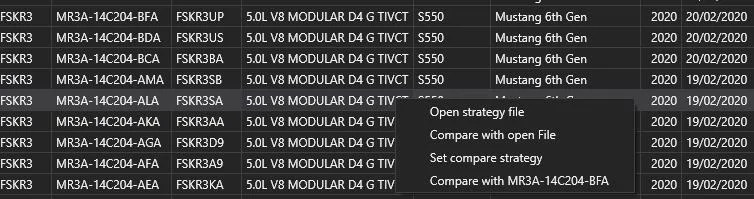
Our software allows you to pick two stock files and compare them to assist in this. Here is an example.

1728880710108-me.jpg


Then for example you can see they have changed the active exhaust (and many other things) between the two years/models.

1728880774927-gd.jpg
In trying to address an intermittent 3 to 4 and 4 to 5 flare that only presented itself in Sport, Sport Plus and Track mode, I played around with ALT 0 and Alt 2. Alt 0 gets rid of the flaring while still retaining a good shift feel in sport mode/sport plus.

Alt 2 showed very quick and harder shifts in Sport/sport plus and track, however, in sport, 2 to 3 and 4 to 5 felt like their was intermittent clutch bind at certain rpm/load conditions. In Track mode mode, ALT 2 works very well. Firm quick shifts and no bind feel.

I think there is some manufacturing differences between each trans build that causes one particular shift characteristic to work in some drive modes on some transmission and not work in other.

I tried to figure out why alt 2 works in some drive modes and not others but had no luck. I looked at the torque reduction tables and Normal mode vs Sport Mode werent all that different in the the two shift sequences mentioned. The oncoming and off going clutch ramp 1 and ramp 0 are characteristic specific and not mode specific. The only thing I can figure is the torque converter clutch lock up schedules are different in each mode and dont play well with certain drive mode/characteristic settings. But I havent been able to determine that either.

Sport Mode has some specific parameters the the other modes dont have.
Sponsored
 

Robottrainer

Well-Known Member
Joined
Apr 25, 2021
Threads
79
Messages
992
Reaction score
422
Location
Canada
First Name
John
Vehicle(s)
2018 Ford Escape. 2020 Jeep Cherokee. 2021 Ford Mustang GT Stage 2 Roush
In trying to address an intermittent 3 to 4 and 4 to 5 flare that only presented itself in Sport, Sport Plus and Track mode, I played around with ALT 0 and Alt 2. Alt 0 gets rid of the flaring while still retaining a good shift feel in sport mode/sport plus.

Alt 2 showed very quick and harder shifts in Sport/sport plus and track, however, in sport, 2 to 3 and 4 to 5 felt like their was intermittent clutch bind at certain rpm/load conditions. In Track mode mode, ALT 2 works very well. Firm quick shifts and no bind feel.

I think there is some manufacturing differences between each trans build that causes one particular shift characteristic to work in some drive modes on some transmission and not work in other.

I tried to figure out why alt 2 works in some drive modes and not others but had no luck. I looked at the torque reduction tables and Normal mode vs Sport Mode werent all that different in the the two shift sequences mentioned. The oncoming and off going clutch ramp 1 and ramp 0 are characteristic specific and not mode specific. The only thing I can figure is the torque converter clutch lock up schedules are different in each mode and dont play well with certain drive mode/characteristic settings. But I havent been able to determine that either.

Sport Mode has some specific parameters the the other modes dont have.
Speaking of torque reduction...so generally speaking, if one were to make the values higher in the normal mode tables, anything using shift characteristics Alt 0, the shifts would be firmer? Correct? And if you exceed the values on the Y axis, that would be the default torque level, correct?
 

engineermike

Well-Known Member
Joined
Jul 15, 2018
Threads
31
Messages
6,188
Reaction score
6,450
Location
La
Vehicle(s)
2018 GTPP A10
@Robottrainer thats a good question. At a glance you might assume that the torque y axis is the engine torque just before the shift, and if it’s higher than that it cuts to that, if lower it does nothing. But I’ve come to realize it may be more complicated.

For starters, the y axis torque I believe is the torque converter turbine output torque which equals the transmission input torque after the torque converter. This would be the engine torque plus or minus effects of slip and multiplication and possibly even dynamic effects like engine inertia. Not sure on the inertia part.

Secondly, I don’t really know if the input to all other shift tables is the modulated torque or the pre-modulated torque. If you modulate drag mode down to 250 ftlb, it still shifts hard, so I tend to believe it uses unmodulated torque for those table input values.

So what if the table value is higher than the y axis input torque? I believe the logic actually does attempt to increase engine torque if that’s the case. If you log torque source you occasionally see “torque+ from trans”, which is the same torque source you see when it blips the throttle to “rev match” on decelerating downshifts. Obviously it can only do this if the engine isn’t at max torque already, but at part throttle it has room to increase.

And the question about increasing torque making shifts firmer…it depends. The sensation of shift firmness comes during the inertia phase of the shift. Two things affect how this part feels: the speed or quickness of the shift and the engine torque during the shift. If you increase torque through torque modulation, the shift duration stays the same. To me this seems like it would make for a wonky feeling shift where it does feel firm due to the throttle blipping open but still takes the same amount of time. But I’ve also felt wonky shifts in the other direction where they are very quick time-wise but cut all all the torque, so there is a balance.

You can experiment with the torque modulation tables without much fear of messing things up, though.
 

Robottrainer

Well-Known Member
Joined
Apr 25, 2021
Threads
79
Messages
992
Reaction score
422
Location
Canada
First Name
John
Vehicle(s)
2018 Ford Escape. 2020 Jeep Cherokee. 2021 Ford Mustang GT Stage 2 Roush
@Robottrainer thats a good question. At a glance you might assume that the torque y axis is the engine torque just before the shift, and if it’s higher than that it cuts to that, if lower it does nothing. But I’ve come to realize it may be more complicated.

For starters, the y axis torque I believe is the torque converter turbine output torque which equals the transmission input torque after the torque converter. This would be the engine torque plus or minus effects of slip and multiplication and possibly even dynamic effects like engine inertia. Not sure on the inertia part.

Secondly, I don’t really know if the input to all other shift tables is the modulated torque or the pre-modulated torque. If you modulate drag mode down to 250 ftlb, it still shifts hard, so I tend to believe it uses unmodulated torque for those table input values.

So what if the table value is higher than the y axis input torque? I believe the logic actually does attempt to increase engine torque if that’s the case. If you log torque source you occasionally see “torque+ from trans”, which is the same torque source you see when it blips the throttle to “rev match” on decelerating downshifts. Obviously it can only do this if the engine isn’t at max torque already, but at part throttle it has room to increase.

And the question about increasing torque making shifts firmer…it depends. The sensation of shift firmness comes during the inertia phase of the shift. Two things affect how this part feels: the speed or quickness of the shift and the engine torque during the shift. If you increase torque through torque modulation, the shift duration stays the same. To me this seems like it would make for a wonky feeling shift where it does feel firm due to the throttle blipping open but still takes the same amount of time. But I’ve also felt wonky shifts in the other direction where they are very quick time-wise but cut all all the torque, so there is a balance.

You can experiment with the torque modulation tables without much fear of messing things up, though.
I wonder if the guys that came up with these tables truly understand what they are created. I've seen many an engineer outsmart themselves.
 

Sponsored

K4fxd

Well-Known Member
Joined
Apr 2, 2020
Threads
121
Messages
13,455
Reaction score
12,262
Location
NKY
First Name
Dan
Vehicle(s)
2017 gt, 2002 FXDWG, 2008 C6,
I wonder if the guys that came up with these tables truly understand what they are created. I've seen many an engineer outsmart themselves.
Rolls has said the trans software is mostly machine generated. Said that is why it is so complicated.

torque+ from trans
I've wondered what this is.
 

Robottrainer

Well-Known Member
Joined
Apr 25, 2021
Threads
79
Messages
992
Reaction score
422
Location
Canada
First Name
John
Vehicle(s)
2018 Ford Escape. 2020 Jeep Cherokee. 2021 Ford Mustang GT Stage 2 Roush
Rolls has said the trans software is mostly machine generated. Said that is why it is so complicated.


I've wondered what this is.
Sky Net. We'll be back!
 

engineermike

Well-Known Member
Joined
Jul 15, 2018
Threads
31
Messages
6,188
Reaction score
6,450
Location
La
Vehicle(s)
2018 GTPP A10
I've wondered what this is.
Log torque source during decelerating downshifts. It blips the throttle open and it shows “tq+” or “tq incr from trans”. It all made sense when I saw this. It’s one of the few times torque management will add torque.
 

Robottrainer

Well-Known Member
Joined
Apr 25, 2021
Threads
79
Messages
992
Reaction score
422
Location
Canada
First Name
John
Vehicle(s)
2018 Ford Escape. 2020 Jeep Cherokee. 2021 Ford Mustang GT Stage 2 Roush
@Robottrainer thats a good question. At a glance you might assume that the torque y axis is the engine torque just before the shift, and if it’s higher than that it cuts to that, if lower it does nothing. But I’ve come to realize it may be more complicated.

For starters, the y axis torque I believe is the torque converter turbine output torque which equals the transmission input torque after the torque converter. This would be the engine torque plus or minus effects of slip and multiplication and possibly even dynamic effects like engine inertia. Not sure on the inertia part.

Secondly, I don’t really know if the input to all other shift tables is the modulated torque or the pre-modulated torque. If you modulate drag mode down to 250 ftlb, it still shifts hard, so I tend to believe it uses unmodulated torque for those table input values.

So what if the table value is higher than the y axis input torque? I believe the logic actually does attempt to increase engine torque if that’s the case. If you log torque source you occasionally see “torque+ from trans”, which is the same torque source you see when it blips the throttle to “rev match” on decelerating downshifts. Obviously it can only do this if the engine isn’t at max torque already, but at part throttle it has room to increase.

And the question about increasing torque making shifts firmer…it depends. The sensation of shift firmness comes during the inertia phase of the shift. Two things affect how this part feels: the speed or quickness of the shift and the engine torque during the shift. If you increase torque through torque modulation, the shift duration stays the same. To me this seems like it would make for a wonky feeling shift where it does feel firm due to the throttle blipping open but still takes the same amount of time. But I’ve also felt wonky shifts in the other direction where they are very quick time-wise but cut all all the torque, so there is a balance.

You can experiment with the torque modulation tables without much fear of messing things up, though.
I played with it in the -50% range on the 2-3 shift with ALT2. didnt really notice anything different. With regards do the torque values on the Y axis, I believe the the go up to 900N.m which is roughly 664lb.ft. This is roughly what the engine puts our at 4000 rpm. If you consider the torque coverter multipying conservatively at 2.0 we would have almost 1300 lb.ft at the turbine or input shaft.
 
OP
OP
Joe Gonsalves

Joe Gonsalves

Well-Known Member
Joined
Aug 15, 2024
Threads
2
Messages
393
Reaction score
505
Location
East Coast, US
First Name
Joe
Vehicle(s)
2021 Mustang GT/CS, 2011 Mustang, 1983 Mustang 5.0, 1969 Mustang Mach 1 428 CJ
So the answer to all my 10R80 issues and quirks was the Ford Performance kit M-9603-M8B. I'm not here to review this kit. There are dedicated posts on it. But what I will say, is that the kit has made my car a pleasure to drive. All the crappy shifts are gone. Nice smooth operation and yes there is torque down low. No more lugging in low RPM with the higher gears. I ask myself how many trips to the stealership, the time out of work, and the arguments with service writers, did I just avoid. Money well spent if you ask me.
 

Sponsored

engineermike

Well-Known Member
Joined
Jul 15, 2018
Threads
31
Messages
6,188
Reaction score
6,450
Location
La
Vehicle(s)
2018 GTPP A10
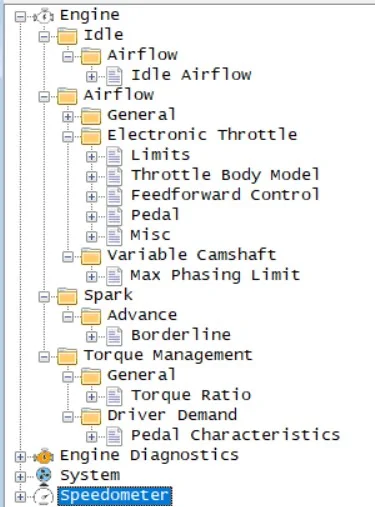
Oddly, at least the version of the Ford Performance Gen3 auto file I have does not make any changes at all to the transmission tuning. In a nutshell, the calibration accounts for the throttle body and MAF size changes, gives a little more torque response from 1/4 pedal and up, and adds some borderline spark timing. That's about it. I guess it's possible the increased engine torque works better with the stock shift schedule, or perhaps the KAM reset made it feel a little different. Attached is the comparison log of a 2020 GT auto FRP vs stock files.

frp mods.webp
 
OP
OP
Joe Gonsalves

Joe Gonsalves

Well-Known Member
Joined
Aug 15, 2024
Threads
2
Messages
393
Reaction score
505
Location
East Coast, US
First Name
Joe
Vehicle(s)
2021 Mustang GT/CS, 2011 Mustang, 1983 Mustang 5.0, 1969 Mustang Mach 1 428 CJ
Oddly, at least the version of the Ford Performance Gen3 auto file I have does not make any changes at all to the transmission tuning. In a nutshell, the calibration accounts for the throttle body and MAF size changes, gives a little more torque response from 1/4 pedal and up, and adds some borderline spark timing. That's about it. I guess it's possible the increased engine torque works better with the stock shift schedule, or perhaps the KAM reset made it feel a little different. Attached is the comparison log of a 2020 GT auto FRP vs stock files.

frp mods.webp
All who added this kit have commented on how well it fixes the 10R80 shifting. You may be right about torque management playing into it. All I can say, is that the tune, at least for me, cleared up all my issues. Yes, I did use FORscan previously to clear the learning tables. And that made a modest improvement but it still had wonky shifts. But this tune adds torque down low where it needs it most. Especially with the 3.15 rear gear that I have. Also I see your ECU readout but not the TCU. Anyway I don't doubt what you say and you may be 100% correct, but Ford put some magic sauce in there somewhere because my car has never been this smooth with shifts, up and down. Is your car a stick or auto? Maybe the Pro-Cal tuner detects the 10R80 and then downloads the appropriate tune. Just spit balling.
 

engineermike

Well-Known Member
Joined
Jul 15, 2018
Threads
31
Messages
6,188
Reaction score
6,450
Location
La
Vehicle(s)
2018 GTPP A10
But this tune adds torque down low where it needs it most.
Just for fun I went through the math. At 39% pedal at 2000 rpm in normal mode, the stock tune commands 370 ftlb. Borderline timing is about 9.5 deg.

With the FP package, the same 39% pedal requests 405 ftlb and borderline timing is 11. It would be higher but the increased torque demand requests higher cylinder air load, which pushes borderline back down some. The 1.5 deg is worth another 1-2% torque in this load and timing range, so add on another 5 ftlb and you're getting 410, an increase of 40 ftlb.

Now that I look at the advertising I see they are claiming 42 ftlb at 2000 rpm....now I'm wondering if they meant at part pedal because that lines up very close.

Anyway, so how that affects the transmission:
- Shift points are not modified at all. However, when you're driving the "human PID loop", as Greg Banish calls it, comes into play. If you're getting the acceleration you want with less pedal input, then it uses a different row in the shift schedule and actually shift at a lower rpm.
- The shift pressures are affected by transmission torque input, so while the torque-to-shift firmness rates did not change, you do wind up on a different row on the table. Same goes for torque management.

Also I see your ECU readout but not the TCU.
In modern Fords, they are one in the same.

... Is your car a stick or auto? Maybe the Pro-Cal tuner detects the 10R80 and then downloads the appropriate tune.
This file isn't for my car. It's a file I acquired and confirmed correct. It's for a 2020, and I compared it to a 2020 Mustang GT stock read, both autos obviously. I even converted it to .tec format so I could compare to all 2020 Mustang GT auto stock files and found the same basic differences to all of them.
 
OP
OP
Joe Gonsalves

Joe Gonsalves

Well-Known Member
Joined
Aug 15, 2024
Threads
2
Messages
393
Reaction score
505
Location
East Coast, US
First Name
Joe
Vehicle(s)
2021 Mustang GT/CS, 2011 Mustang, 1983 Mustang 5.0, 1969 Mustang Mach 1 428 CJ
Just for fun I went through the math. At 39% pedal at 2000 rpm in normal mode, the stock tune commands 370 ftlb. Borderline timing is about 9.5 deg.

With the FP package, the same 39% pedal requests 405 ftlb and borderline timing is 11. It would be higher but the increased torque demand requests higher cylinder air load, which pushes borderline back down some. The 1.5 deg is worth another 1-2% torque in this load and timing range, so add on another 5 ftlb and you're getting 410, an increase of 40 ftlb.

Now that I look at the advertising I see they are claiming 42 ftlb at 2000 rpm....now I'm wondering if they meant at part pedal because that lines up very close.

Anyway, so how that affects the transmission:
- Shift points are not modified at all. However, when you're driving the "human PID loop", as Greg Banish calls it, comes into play. If you're getting the acceleration you want with less pedal input, then it uses a different row in the shift schedule and actually shift at a lower rpm.
- The shift pressures are affected by transmission torque input, so while the torque-to-shift firmness rates did not change, you do wind up on a different row on the table. Same goes for torque management.


In modern Fords, they are one in the same.


This file isn't for my car. It's a file I acquired and confirmed correct. It's for a 2020, and I compared it to a 2020 Mustang GT stock read, both autos obviously. I even converted it to .tec format so I could compare to all 2020 Mustang GT auto stock files and found the same basic differences to all of them.
Thank you, great explanation.
 

ZXMustang

Well-Known Member
Joined
Oct 24, 2020
Threads
9
Messages
774
Reaction score
947
Location
US
Vehicle(s)
2025 Mustang GT
So the answer to all my 10R80 issues and quirks was the Ford Performance kit M-9603-M8B. I'm not here to review this kit. There are dedicated posts on it. But what I will say, is that the kit has made my car a pleasure to drive. All the crappy shifts are gone. Nice smooth operation and yes there is torque down low. No more lugging in low RPM with the higher gears. I ask myself how many trips to the stealership, the time out of work, and the arguments with service writers, did I just avoid. Money well spent if you ask me.
Any tuner can make the 10R80 10x better. 90% of the issues people see are just the shit ford shift schedules and tq modulation.
Sponsored


Top