engineermike
Well-Known Member
- Thread starter
- #31
At least so far, it sounds to me like no one who has responded has seen a Gen3 piston fail in this manner. So maybe it was a fluke, manufacturing defect, or perhaps just on the edge of the statistical manufacturing distribution of overall strength.
As far as root cause goes, there is some very interesting data in the log. The following log is only a 2 second window containing the failure, and the channel list was limited so polling rate was very fast.

The following was the sequence of events:
46.296 (relative): Traction control intervened (this was triggered by stability control) at 7200 rpm, cut throttle to 55 deg and spark to 9 deg by 7300.
46.611: Peak rpm of 7345 reached as driver was releasing throttle and throttle was closing.
46.770: Engine speed 7226 rpm and decreasing, first indication of failure becomes evident. Driver indicated no signs of distress until after he let off throttle and log agrees. Next is debatable, but I believe the piston failed between 46.745 and 46.770 because that is when the WBO2 signals diverged. By 46.869 the STFT was reacting to attempt to correct just before going into DFCO. WBO2 response rate is only 20 ms with less than 5 ms of transport delay at that load and speed. When the piston failed it turned into a large air leak, causing the air/fuel ratio to become very imbalanced between banks. This becomes more evident after DFCO. The initial indication of this divergence is at 46.770 and subtracting the 25 ms of response time gets you to 46.745 as the actual failure time.
This seems to indicate that the failure actually occurred after throttle and timing dropped and even just after the rpm started falling.
As far as root cause goes, there is some very interesting data in the log. The following log is only a 2 second window containing the failure, and the channel list was limited so polling rate was very fast.
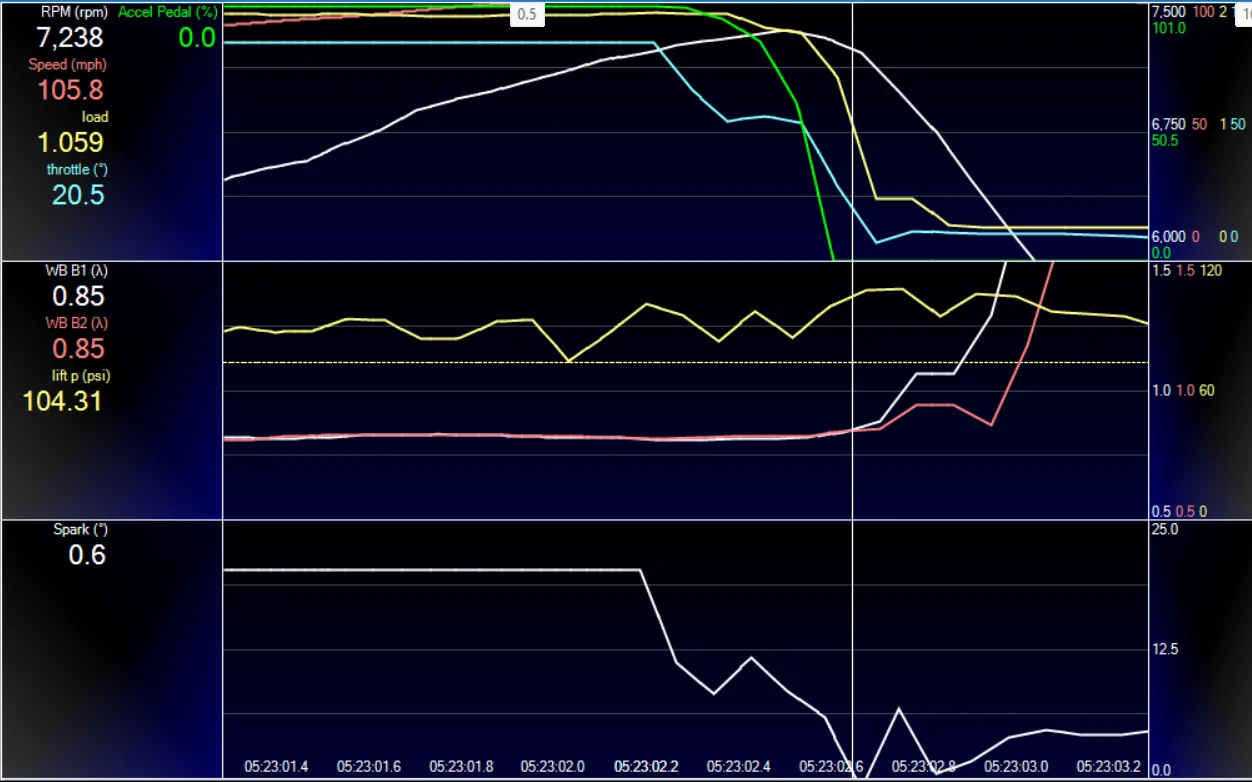
The following was the sequence of events:
46.296 (relative): Traction control intervened (this was triggered by stability control) at 7200 rpm, cut throttle to 55 deg and spark to 9 deg by 7300.
46.611: Peak rpm of 7345 reached as driver was releasing throttle and throttle was closing.
46.770: Engine speed 7226 rpm and decreasing, first indication of failure becomes evident. Driver indicated no signs of distress until after he let off throttle and log agrees. Next is debatable, but I believe the piston failed between 46.745 and 46.770 because that is when the WBO2 signals diverged. By 46.869 the STFT was reacting to attempt to correct just before going into DFCO. WBO2 response rate is only 20 ms with less than 5 ms of transport delay at that load and speed. When the piston failed it turned into a large air leak, causing the air/fuel ratio to become very imbalanced between banks. This becomes more evident after DFCO. The initial indication of this divergence is at 46.770 and subtracting the 25 ms of response time gets you to 46.745 as the actual failure time.
This seems to indicate that the failure actually occurred after throttle and timing dropped and even just after the rpm started falling.
Sponsored