Sponsored

BBQ Tick After Oil Change...

TheLion

Well-Known Member
Joined
Jul 1, 2016
Threads
68
Messages
1,621
Reaction score
601
Location
US
Vehicle(s)
Ruby Red 2016 Mustang GT PP 6-MT
BTW Driven does make a "street performance" multi-viscosity oil. This could be another possible solution. I do believe one BBQ Tick sufferer was going to try their oil to see if it eliminated their tick, but I don't recall if they ever had a chance to try it or not. You'd have to go back and look at my list.

http://www.drivenracingoil.com/dro/fr20-synthetic-5w-312html/
Sponsored
 

TheLion

Well-Known Member
Joined
Jul 1, 2016
Threads
68
Messages
1,621
Reaction score
601
Location
US
Vehicle(s)
Ruby Red 2016 Mustang GT PP 6-MT
http://admin.compperformance.com/news/dro/training-center/guides/5-things-know-motor-oil/

Obviously I disagree with their statements on "additive's" and to always avoid them. However that is generally true. I think Cera Tec is a small anomaly given the primary additive isn't ZDDP, which can have a dramatic and negative affect on your oil's performance. nBN isn't used in most automotive oils yet as far as I know (but is in air craft grade lubricants) and in the testing I've seen adding more than necessary had no negative side effects on viscosity, wear or friction. It just posed no additional benefit unlike ZDDP which can have some significantly negative effects if too much is present (same as if too little).

At the end of the above article is just one more reason that hBN can be beneficial. By providing a better seal, your allowing the oil control rings and piston rings to do two things more effectively: 1. reduce blow / fuel wall seepage past the rings even if there's no significant added compression which reduces varnish deposits and dilution from your fuel 2. reduce oil entering the combustion chamber = knock and carbon buildup that must be burned off.

And their article on ZDP (ZDDP or Zinc) illustrates the benefits of nBN as well. It's a sacraficial "dry lubricant" that prevents metal on metal contact in boundary layer lubrication applications like Cam's, valve guides, piston rings, timing chains etc. and the requirements of lubricating those components is very different from your rod bearings which are hydrodynamic and ride on hydraulic pressure generated from the motion of two opposing films at high speeds in close proximity.

Oil performs the following three functions:

1. Hydraulic Fluid - for the rod / main bearings, cam phasors and lash adjusters and timing chain guide adjustment
2. Coolant - pistons and rod / main bearings
3. Boundary Layer Lubricant - for cam lobes, timing chains, valve guides, roller finger followers

I don't know if the cam's themselves operate on hydrodynamic lubrication or if they rely on boundary layer lubrication as they do have bearing surfaces as well (not talking about the cam lobes, but the whole cams shaft also rides on bearings), but given their small size I"m guessing they are boundary layer lubricated. Hydrodynamic bearings MUST have a constant oil supply to 1. prevent oil from "squishing out" of the bearing surfaces 2. prevent over heating.

Anyway, reducing friction and heat = more power. There's plenty of heat from the combustion process alone to keep the oil temperature optimal, but reducing it in the MANY moving parts of the 5.0L could reduces it's operating temperature during hard use and allow that 5.0 to really run free. I have a theory that the 5.0 will see more significant gains to high quality lubrication and thermal transfer than it's cam in block rivals because it has more than double the valve train friction.

I'll bet that a Power Pack 2 5.0 on 93 octane with optimized lubrication and a catch can would make higher average power than the hottest 93 tuned 5.0 out there with the typical lubricants used, especially when you push it and with greater long term reliability. The 5.0 is all about efficiency and lubrication is even more critical in engines with a valvetrain.
 

ponyv6

Well-Known Member
Joined
May 25, 2016
Threads
18
Messages
188
Reaction score
25
Location
Texas
First Name
ozzy
Vehicle(s)
2019 301A PP1 Velocity Blue
Update for my case: it has been 6weeks the car has been in the dealer. They haven't found it normal at all. They have tried many things nothing worked so far. Last week on Friday, they said they changed vct solenoids and it was fixed. When I checked it I realized nothing was fixed. The noise was still there. service advisor called the shop foreman. He heard it and said "car stays".

At this point I just wanna lemon it but dont know how to do it. Ford already refused my buyback. I am exploring my legal options but I dont wanna do anything wrong.
 

GT Pony

Well-Known Member
Joined
Mar 13, 2015
Threads
77
Messages
9,402
Reaction score
4,839
Location
Pacific NW
Vehicle(s)
2015 GT Premium, Black w/Saddle, 19s, NAV
I don't know if the cam's themselves operate on hydrodynamic lubrication or if they rely on boundary layer lubrication as they do have bearing surfaces as well (not talking about the cam lobes, but the whole cams shaft also rides on bearings), but given their small size I"m guessing they are boundary layer lubricated. Hydrodynamic bearings MUST have a constant oil supply to 1. prevent oil from "squishing out" of the bearing surfaces 2. prevent over heating.
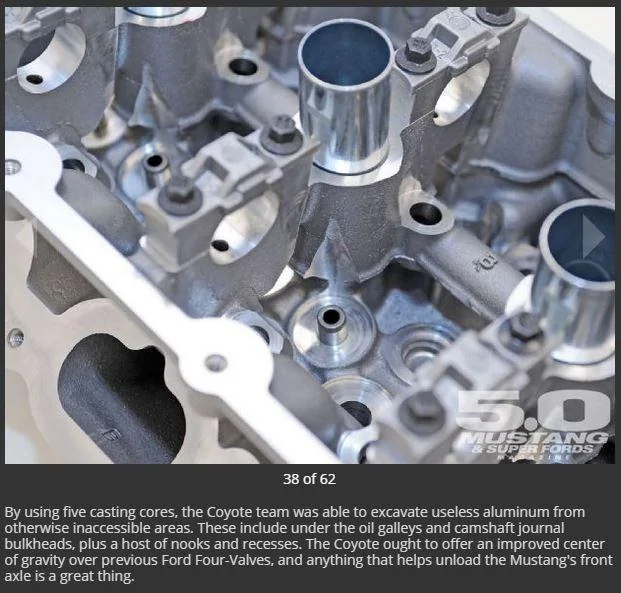
Cam bearings are also journal bearings - but they don't have bearing inserts like rod or crank bearings, but instead are "line bored" and the bearing surface is the aluminum head and bearing cap. So they too will operate on a hydrodynamic film just like the journal bearing on rod or crankshaft. Cam bearings are also feed with pressurized oil (you can see the oil feed holes in the photo below) to ensure a good constant supply of oil as the journal bearings flow oil from rotation and naturally have side leakage - same as with rod and crank journal bearings.

Coyote 5.0L Photo 31.webp
 

Sponsored

TheLion

Well-Known Member
Joined
Jul 1, 2016
Threads
68
Messages
1,621
Reaction score
601
Location
US
Vehicle(s)
Ruby Red 2016 Mustang GT PP 6-MT
Ok then Ceratek will have little benefit there as there is no metal to metal contact. But timing chains, cam lobes, piston rings and oil control rings will all benefit.
 

GT Pony

Well-Known Member
Joined
Mar 13, 2015
Threads
77
Messages
9,402
Reaction score
4,839
Location
Pacific NW
Vehicle(s)
2015 GT Premium, Black w/Saddle, 19s, NAV
Ok then Ceratek will have little benefit there as there is no metal to metal contact. But timing chains, cam lobes, piston rings and oil control rings will all benefit.
If Cera Tec helps reduce friction and wear, then is could possibly help with journal bearings on cold starts where the bearings do have metal-to-metal contact for a second before full hydrodynamic lubrication is established.
 

Kong76

Well-Known Member
Joined
Apr 23, 2016
Threads
47
Messages
1,925
Reaction score
440
Location
Turlock, Ca
Vehicle(s)
2016 Ingot Silver GT
Dropped the car off this a.m. Gave me a Ford Edge to drive which was really nice of them. They are starting with the intake manifold and going from there. Should get some news tomorrow. Told them to look at the AC while it's there as it takes 15 min for it to get cool and noticing white film on windshield that I have to clean weekly.

Man it never ends. Tob,pilot bearing, new clutch, new tranny and now the engine. I've never abused the car. Never used line lock, launch control, never tracked. Only time I actually get on it is merging on the freeway. For those that question, been driving manual for 16 years. Everything from a Tacoma, civic, Wrangler to an STI.
 

GT Pony

Well-Known Member
Joined
Mar 13, 2015
Threads
77
Messages
9,402
Reaction score
4,839
Location
Pacific NW
Vehicle(s)
2015 GT Premium, Black w/Saddle, 19s, NAV
Man it never ends. Tob,pilot bearing, new clutch, new tranny and now the engine. I've never abused the car. Never used line lock, launch control, never tracked. Only time I actually get on it is merging on the freeway. For those that question, been driving manual for 16 years. Everything from a Tacoma, civic, Wrangler to an STI.
@Kong76 - that really sucks ... how many miles are on your 2016?
 

TheLion

Well-Known Member
Joined
Jul 1, 2016
Threads
68
Messages
1,621
Reaction score
601
Location
US
Vehicle(s)
Ruby Red 2016 Mustang GT PP 6-MT
@Kong76 - that really sucks ... how many miles are on your 2016?
Agreed. It really sucks when you get a car that's got a bunch of problems with it, especially when it's a car you've wanted for a long time and work hard for. I beat the living crap out of my GT and so far it's held up just fine. Did the same with my 07 Focus ST which was my just post college car.

Hopefully you can get these issues sorted out and finally enjoy the car without having stupid crap go wrong. If it continues maybe consider a 2019 GT for trade in? You could go over to the dark side of the Camaro or Charger / Challenger, but I've illustrated many times they have just as many issues and it's luck of the draw there as well.

Some people end up with zero problems despite beating the crap of their cars daily while others are falling apart despite being babied. That's the downside of any mass production car, some are just lemons.
 
Last edited:

Sponsored

TheLion

Well-Known Member
Joined
Jul 1, 2016
Threads
68
Messages
1,621
Reaction score
601
Location
US
Vehicle(s)
Ruby Red 2016 Mustang GT PP 6-MT
Getting back to the issue at hand, if I'm right about the base oil in Cera Tec or VRX 500 being the primary reason for the reduced mechanical noise, then the noise will return after an oil change even though the internal bearing surfaces of the engine are still coated in a layer of Hexagonal Boron Nitride. So if anyone running Cera Tec currently needs to change their oil, let us know if the ticking comes back after changing the oil.

According to Cera Tec to get the full effect of hBN, you need you use 300mL per every 5 Liters of engine oil. That translates to about 500mL for 8 quarts or nearly two full bottles. Now at least one person who tested it only used 150mL (1/2 a bottle). If you do 1/2 a bottle every oil change you'll build up the hBN coating over the span of 4 oil changes at 5,000 mile intervals AND maintain the noise dampening benefits of Cera Tec's base oil if that's the primary noise dampening mechanism.

According to Liqui Moly's marketing literature, Cera Tec provides both chemical and physical friction / wear reducers. It more or less has similar effect to running both their Motor Protect and their Oil Additive: https://www.liqui-moly.com/en/press/press-releases/detail/news/fight-engine-wear-2946.html

So you would not want to run their MoS2 (Motor Protect) if your running Cera Tec as it's a 2 in 1 additive and Cera Tec also contains a chemical friction reducer, not sure if it has MoS2 in it or it's something else, but it's all intended to work together. And I did receive a reply from Cera Tec, their base oil is a Group III which is what most off the shelf synthetics are:

thank you for the inquiry and your interest for our Liqui Moly products.
Our LIQUI MOLY Cera Tec has got a carrier fluid based on group III.

Freundliche GrĂĽĂźe / Best regards

i. A. Martin Tepper
Anwendungstechniker

F & E / Anwendungstechnik

Phone: +49 731 1420-281
Fax: +49 731 1420-461
[email protected]

LIQUI MOLY GmbH
Jerg-Wieland-StraĂźe 4 | 89081 Ulm | GERMANY

www.liqui-moly.de
Xenum's VRX 500 hBN additive uses a Group V Ester base oil. Not sure what else is in the VRX, weather it would be more or less effective than the Group III and what ever other additives are in Cera Tec. Higher base group oils do not necessarily mean better lubrication, it's the combination of the base oil and the additive package that make the oil ideal or not.
 

HermanGerman

Well-Known Member
Joined
May 17, 2018
Threads
0
Messages
57
Reaction score
52
Location
Berlin / Germany
First Name
Olaf
Vehicle(s)
Mustang GT 2018 AT
Vehicle Showcase
1
Getting back to the issue at hand, if I'm right about the base oil in Cera Tec or VRX 500 being the primary reason for the reduced mechanical noise, then the noise will return after an oil change even though the internal bearing surfaces of the engine are still coated in a layer of Hexagonal Boron Nitride. So if anyone running Cera Tec currently needs to change their oil, let us know if the ticking comes back after changing the oil.

According to Cera Tec to get the full effect of hBN, you need you use 300mL per every 5 Liters of engine oil. That translates to about 500mL for 8 quarts or nearly two full bottles. Now at least one person who tested it only used 150mL (1/2 a bottle). If you do 1/2 a bottle every oil change you'll build up the hBN coating over the span of 4 oil changes at 5,000 mile intervals AND maintain the noise dampening benefits of Cera Tec's base oil if that's the primary noise dampening mechanism.

According to Liqui Moly's marketing literature, Cera Tec provides both chemical and physical friction / wear reducers. It more or less has similar effect to running both their Motor Protect and their Oil Additive: https://www.liqui-moly.com/en/press/press-releases/detail/news/fight-engine-wear-2946.html

So you would not want to run their MoS2 (Motor Protect) if your running Cera Tec as it's a 2 in 1 additive and Cera Tec also contains a chemical friction reducer, not sure if it has MoS2 in it or it's something else, but it's all intended to work together. And I did receive a reply from Cera Tec, their base oil is a Group III which is what most off the shelf synthetics are:


Xenum's VRX 500 hBN additive uses a Group V Ester base oil. Not sure what else is in the VRX, weather it would be more or less effective than the Group III and what ever other additives are in Cera Tec. Higher base group oils do not necessarily mean better lubrication, it's the combination of the base oil and the additive package that make the oil ideal or not.
Again a great Work by the Lion. your work is the reason why i tried liqui moly ceratec for my 2018 GT and why i enjoy it again. ( I am the half bottle user , because i would not overfill the Motor. so i used 150ml ceratec and the tick was gone. ) As a German i have to say, that ironically i never used Motoroil from the german brand liqui moly. mostly i used american brands. but liqui moly has a good Name here. you can get it everywhere and many , many Dealers ans Shops use it to maintain cars of all brands. before i used it i was reading in different german Forums and most of the users where very satisfied with the product. thanks again to the Lion that he wrote to the technician from Liquid Moly. I have driven now some hundred Kilometers with the ceratec and the tick is gone and the car runs like it should. cheers to you all from Germany Olaf
 

Kong76

Well-Known Member
Joined
Apr 23, 2016
Threads
47
Messages
1,925
Reaction score
440
Location
Turlock, Ca
Vehicle(s)
2016 Ingot Silver GT
Just got a call from dealership. Intake manifold was not the problem, now they are digging deeper taking a look at the valves,bearing caps etc.
 

GT Pony

Well-Known Member
Joined
Mar 13, 2015
Threads
77
Messages
9,402
Reaction score
4,839
Location
Pacific NW
Vehicle(s)
2015 GT Premium, Black w/Saddle, 19s, NAV
Just got a call from dealership. Intake manifold was not the problem, now they are digging deeper taking a look at the valves,bearing caps etc.
@Kong76 - If they get into the bottom end, ask them to check the rod side clearance of all rods, and the crankshaft end play clearance, and compare to service manual specs. Excessive clearance of those parts are suspect of causing the BBQ Tick.
Sponsored


Top