Sponsored

Question about inlet air temps and performance

Dragster

Well-Known Member
Joined
Nov 11, 2014
Threads
132
Messages
868
Reaction score
287
Location
USA
Vehicle(s)
2015 GT PP
There's countless threads on here about cold air kits and covered versus open filters, etc., but I don't recall seeing anyone explain when the temps become an issue or a hinderance to performance. Is there a certain temperature where performance will start to fall off, or is it just a gradual thing that is constantly adjusting? I'm just curious, so if anyone can help educate me, I would appreciate it. Thanks in advance!
Sponsored

 

Rhinogt

Well-Known Member
Joined
Aug 29, 2015
Threads
1
Messages
140
Reaction score
37
Location
Arkansas
Vehicle(s)
2018 gt
There are two things to consider:
First, the ECM's IAT timing tables. Unless they are modified by your tuner, the car won't actually start to pull timing until it sees over 100 degree IAT's. Anything below 100, and the car will actually be adding more timing gradually the cooler the IAT's get.

Second, the actual air temp. Obviously, the cooler the air is, the denser it is and therefore the more power you will make. However, just because you IAT sensor says a certain temperature, that doesn't mean that is the actual temperature of the air entering the engine.
A good example would be: you are sitting in traffic on a 85 degree day. Your IAT's get up to 95 degrees. Now your car won't be adding any timing because of the air temp it thinks it is ingesting. However the 95 degree IAT is not the true air temp going to the motor. It is really closer to 85. Reason being is your IAT sensor is being heated by the engine bay. However the air going into the intake doesn't have time to heat up to that temperature. So while you aren't making as much power as you would if your IAT sensor read 85 degrees, you are making more power than if the ambient temp was really 95 degrees.
Bottom line: There is more to it than just reading what the dash is telling you.

BTW, you have to have about 114 degree IAT's before the ECM will pull 1 full degree of timing.
 

RBS550

Well-Known Member
Joined
May 10, 2015
Threads
72
Messages
645
Reaction score
439
Location
Port St Lucie Fl
Website
www.youtube.com
First Name
RB
Vehicle(s)
2015 Mustang GT
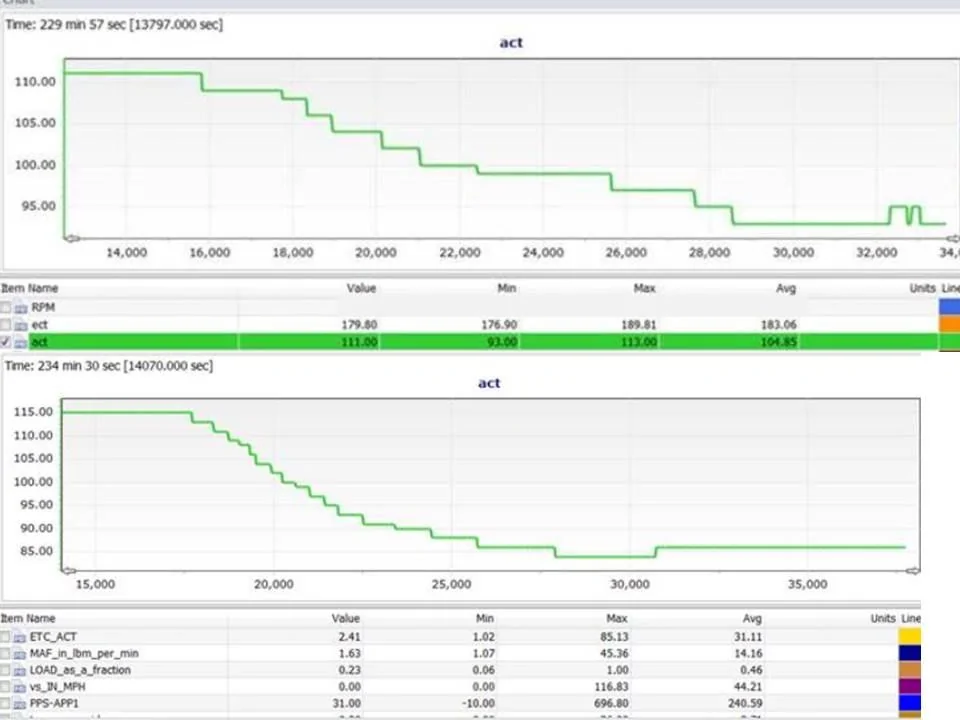
I definitely do not have the technical knowledge that Rhinogt has, but you can see my temps were better once I sealed up against my hood in the graphs below. And this has to help the knock & timing issues, which equal more power :)
Air temps.webp
 

Rhinogt

Well-Known Member
Joined
Aug 29, 2015
Threads
1
Messages
140
Reaction score
37
Location
Arkansas
Vehicle(s)
2018 gt
RBS550, are correct. That is the downside of a open filter. At slow speed the open element does pull engine bay air in, which it hotter, but it eventually cools back down once the engine starts sucking more air in. The stock air box does stay warmer longer as many have mentioned before, but as RB just showed, a sealed aftermarket CAI cools off quicker. When solely looking at IATs, if the stock box gets heatsoaked, it won't be cooled back down quickly.
I was running the MMR CAI for a while, and while it would heat up to 110-115, it cooled back down much quicker than stock. It would usually be cooled back down by the time I hit 40 or so. Conversely, I've never seen my IATs get above 110 with the stock box, even down here in the Mississippi delta. However, when the stock box gets that hot, it takes quite a while to cool it back down. Luckily though, even at that temp, my car isn't taking away anything. So the power loss is minimal IMO.
BUT if you can get your temps down closer to 70 or below, the car WILL be adding more timing, which equals more power.

Disclaimer:
I am no 1/4 mile trailblazer like RBS550, I just have a lot of time data logging and tuning MY car. RB having a CJ manifold kinda takes the argument out of play since you can't use the stock airbox with it anyway. And even if you could it would be a restriction. However for the stock manifold, I think the stock airbox is plenty and not worth replacing.
 

california special gt

Active Member
Joined
Feb 2, 2016
Threads
0
Messages
28
Reaction score
3
Location
SW Missouri
Vehicle(s)
GT California Special
It is a compromise that you have decide on. The stock boxes on these cars are really good. I noticed an easy 2 tenths and 1 mph plus slower once my IAT's climbed up into the 115 range waiting in line at busy track. So it does kill power. But, my car is not daily and I live in smaller city close to a lot of rural open roads. Once above 30 mph my car almost immediately drops to at or 2 below ambient. Stock box (as stated) would take a lot longer to cool down once heated. I do not really have a closed box option with my setup anyway. FYI.
 

Sponsored

MyFirst5.0

Well-Known Member
Joined
Oct 15, 2015
Threads
16
Messages
1,208
Reaction score
337
Location
west coast, Fl
Vehicle(s)
2016 deep impact blue premium gt
good info here, did not know that once the stock box is heatsoaked takes longer to cool down. way to many cold air out there to decide which one..
 

Gibbo205

Well-Known Member
Joined
Jan 23, 2015
Threads
156
Messages
6,673
Reaction score
2,217
Location
UK
Vehicle(s)
UK 2015 Mustang & BMW E46 M3
My intake temps stay within 5c of ambient and my car makes fantastic power and great throttle response. :)
 

GTBOB

Well-Known Member
Joined
May 27, 2015
Threads
37
Messages
1,304
Reaction score
623
Location
Fairfield Township, OHIO
First Name
Bob
Vehicle(s)
'18 GT, Royal Crimson, 10 speed, Active Exhaust
Vehicle Showcase
1
I datalogged a quarter mile run a couple weeks ago. Ambient temps were 55. IAT was showing 115 in staging lanes. After my burnout, 95. After my quarter mile pass, 58. This was with my Roush CAI. Just goes to show how fast an open CAI can heat up, but cool right back down.
 

NightmareMoon

Well-Known Member
Joined
Nov 22, 2015
Threads
62
Messages
7,076
Reaction score
6,337
Location
Austin
Vehicle(s)
2016 Mustang GT PP w/ Voodoo
Vehicle Showcase
1
There are two things to consider:
First, the ECM's IAT timing tables. Unless they are modified by your tuner, the car won't actually start to pull timing until it sees over 100 degree IAT's. Anything below 100, and the car will actually be adding more timing gradually the cooler the IAT's get.
If you're not getting added timing from cold air below 100 degrees, you're still down on power. From this description it doesn't sound like 100 degrees is some magic number.

1) Cold air is denser, so more O2 available to burn more fuel.

2) Lower intake temperature means more timing is possible before knock occurs.

Temps are always a problem for power due to #1. Even with the same timing, the engine will be more efficient in colder air. Something like 1% horsepower change per 10 degrees temp as a rule of thumb.

Once underway, and given time to cool from heat soak, the stock box keeps temps within 6 or 10 degrees of ambient. CAI boxes aren't significantly better. As mentioned in this thread, heat soak idling while stopped could be another matter. A higher-flow air intake might also make a difference, IF the engine is also tuned to take advantage of it.
 

Higgs Boson

Detonation Denotation
Joined
Oct 11, 2015
Threads
9
Messages
1,053
Reaction score
408
Location
Texas Hill Country
Vehicle(s)
19 GT350R
If you're not getting added timing from cold air below 100 degrees, you're still down on power. From this description it doesn't sound like 100 degrees is some magic number.

1) Cold air is denser, so more O2 available to burn more fuel.

2) Lower intake temperature means more timing is possible before knock occurs.

Temps are always a problem for power due to #1. Even with the same timing, the engine will be more efficient in colder air. Something like 1% horsepower change per 10 degrees temp as a rule of thumb.

Once underway, and given time to cool from heat soak, the stock box keeps temps within 6 or 10 degrees of ambient. CAI boxes aren't significantly better. As mentioned in this thread, heat soak idling while stopped could be another matter. A higher-flow air intake might also make a difference, IF the engine is also tuned to take advantage of it.
1% per 10 degrees is the rule

100 degrees is just the stock tune transition number from adding to subtracting, of which it is not doing a lot of on either side (90 or 110)
 

Sponsored

D.Brown

Save the Manuels
Joined
Jul 19, 2015
Threads
64
Messages
707
Reaction score
166
Location
Rhode Island
First Name
David
Vehicle(s)
15' GT
I datalogged a quarter mile run a couple weeks ago. Ambient temps were 55. IAT was showing 115 in staging lanes. After my burnout, 95. After my quarter mile pass, 58. This was with my Roush CAI. Just goes to show how fast an open CAI can heat up, but cool right back down.
I would have to imagine the air you're pulling in from a launch is awfully warm though.
 
OP
OP

Dragster

Well-Known Member
Joined
Nov 11, 2014
Threads
132
Messages
868
Reaction score
287
Location
USA
Vehicle(s)
2015 GT PP
Thanks for the replies everyone, I really appreciate the info! For cars that have an intake with a larger MAF housing, how much impact does the extra airflow make (let's assume a tune and catted headers)? Is the trade off of more air volume versus higher air temps worth it?
 

Higgs Boson

Detonation Denotation
Joined
Oct 11, 2015
Threads
9
Messages
1,053
Reaction score
408
Location
Texas Hill Country
Vehicle(s)
19 GT350R
Thanks for the replies everyone, I really appreciate the info! For cars that have an intake with a larger MAF housing, how much impact does the extra airflow make (let's assume a tune and catted headers)? Is the trade off of more air volume versus higher air temps worth it?
depends if you need more volume.

at 4000 RPMs you don't.

at 7500 RPMs, you do.
 

2015 Silver GT

Well-Known Member
Joined
Jul 5, 2015
Threads
5
Messages
1,387
Reaction score
598
Location
East Haven Connecticut
Vehicle(s)
2022 Oxford White GT Premium
Intakes with a larger MAF doesn't mean it's going to make more power. That's a common misconception.
 

Higgs Boson

Detonation Denotation
Joined
Oct 11, 2015
Threads
9
Messages
1,053
Reaction score
408
Location
Texas Hill Country
Vehicle(s)
19 GT350R
Intakes with a larger MAF doesn't mean it's going to make more power. That's a common misconception.
further, there is technically no such thing as a bigger maf anymore anyways....

used to be a bigger maf housing, when they were separate from the intake tube. now you just remove and replace the maf into whichever tube you use.
Sponsored


Top