
Sponsored

Question: Pump e85 + Boost

Rolls

Well-Known Member
Gold Sponsor
Joined
Jan 29, 2020
Threads
2
Messages
355
Reaction score
457
Location
Australia
Website
www.pcmtec.com
Vehicle(s)
Mustang 18 GT

Rolls

Well-Known Member
Gold Sponsor
Joined
Jan 29, 2020
Threads
2
Messages
355
Reaction score
457
Location
Australia
Website
www.pcmtec.com
Vehicle(s)
Mustang 18 GT
Not sure I was clear. Flex Fuel and Boost will NOT work! I create different tunes based on the intended application. If you're going to run 93, E60 or E80, that's three different tunes.
Not with PCMTEC!

You have proper interpolation and Lund have done probably 100+ tunes like this now. Once you set the ethanol % its locked, it doesn't change and the timing is fixed. It is as safe as it gets.
 

Angrey

Well-Known Member
Joined
Jun 21, 2020
Threads
104
Messages
2,794
Reaction score
2,984
Location
Coral Gables
Vehicle(s)
2016 GT350
Not with PCMTEC!

You have proper interpolation and Lund have done probably 100+ tunes like this now. Once you set the ethanol % its locked, it doesn't change and the timing is fixed. It is as safe as it gets.
I was trying to understand from your example in the video:

In your example, you referenced the parameters for an existing 10% ethanol (0) tune and an 85% ethanol tune (1).

I didn't quite capture or understand the "blending" and whether that's ramped in at different interpolations (rather than a crude straight line). If we were to plot the optimal borderline for tune/content along the way from 10% to 85%, as others have pointed out, most of the timing benefits can be enjoyed once you get above say E55-E60. So the "ramp" into the more advanced spark timing would be greater on the bottom end than the top end.

Obviously the math can arrive at the proper output if you use a curve function (or just incorporate more tunes/data points).

Was just curious as to that as that was one of my earlier posts, I hope they're using more than just 2 tables and crudely blending them because it's not a straight line interpolation. But it seems like with the factor you adjusted, is that some sorta linear ramp factor?
 

Angrey

Well-Known Member
Joined
Jun 21, 2020
Threads
104
Messages
2,794
Reaction score
2,984
Location
Coral Gables
Vehicle(s)
2016 GT350
I was trying to understand from your example in the video:

In your example, you referenced the parameters for an existing 10% ethanol (0) tune and an 85% ethanol tune (1).

I didn't quite capture or understand the "blending" and whether that's ramped in at different interpolations (rather than a crude straight line). If we were to plot the optimal borderline for tune/content along the way from 10% to 85%, as others have pointed out, most of the timing benefits can be enjoyed once you get above say E55-E60. So the "ramp" into the more advanced spark timing would be greater on the bottom end than the top end.

Obviously the math can arrive at the proper output if you use a curve function (or just incorporate more tunes/data points).

Was just curious as to that as that was one of my earlier posts, I hope they're using more than just 2 tables and crudely blending them because it's not a straight line interpolation. But it seems like with the factor you adjusted, is that some sorta linear ramp factor?
In fairness, if it is just a crude straight line interpolation, it's probably safe(r) you're just leaving money on the table for optimizing the flex tune for various mid-ethanol contents. (i.e. you can run 90% of the timing you achieve with 85% by E50, but if you're straight lining it, you're only rolling about half in).
 

mejohn50

Intergalactic Snail
Joined
Jun 12, 2016
Threads
24
Messages
876
Reaction score
1,060
Location
United States
First Name
Mitch
Vehicle(s)
slow junk
I was trying to understand from your example in the video:

In your example, you referenced the parameters for an existing 10% ethanol (0) tune and an 85% ethanol tune (1).

I didn't quite capture or understand the "blending" and whether that's ramped in at different interpolations (rather than a crude straight line). If we were to plot the optimal borderline for tune/content along the way from 10% to 85%, as others have pointed out, most of the timing benefits can be enjoyed once you get above say E55-E60. So the "ramp" into the more advanced spark timing would be greater on the bottom end than the top end.

Obviously the math can arrive at the proper output if you use a curve function (or just incorporate more tunes/data points).

Was just curious as to that as that was one of my earlier posts, I hope they're using more than just 2 tables and crudely blending them because it's not a straight line interpolation. But it seems like with the factor you adjusted, is that some sorta linear ramp factor?
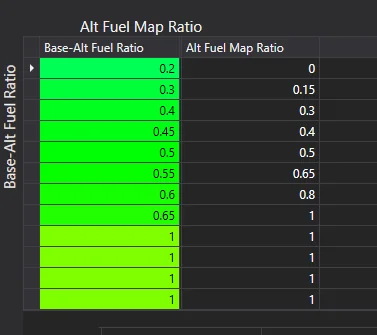
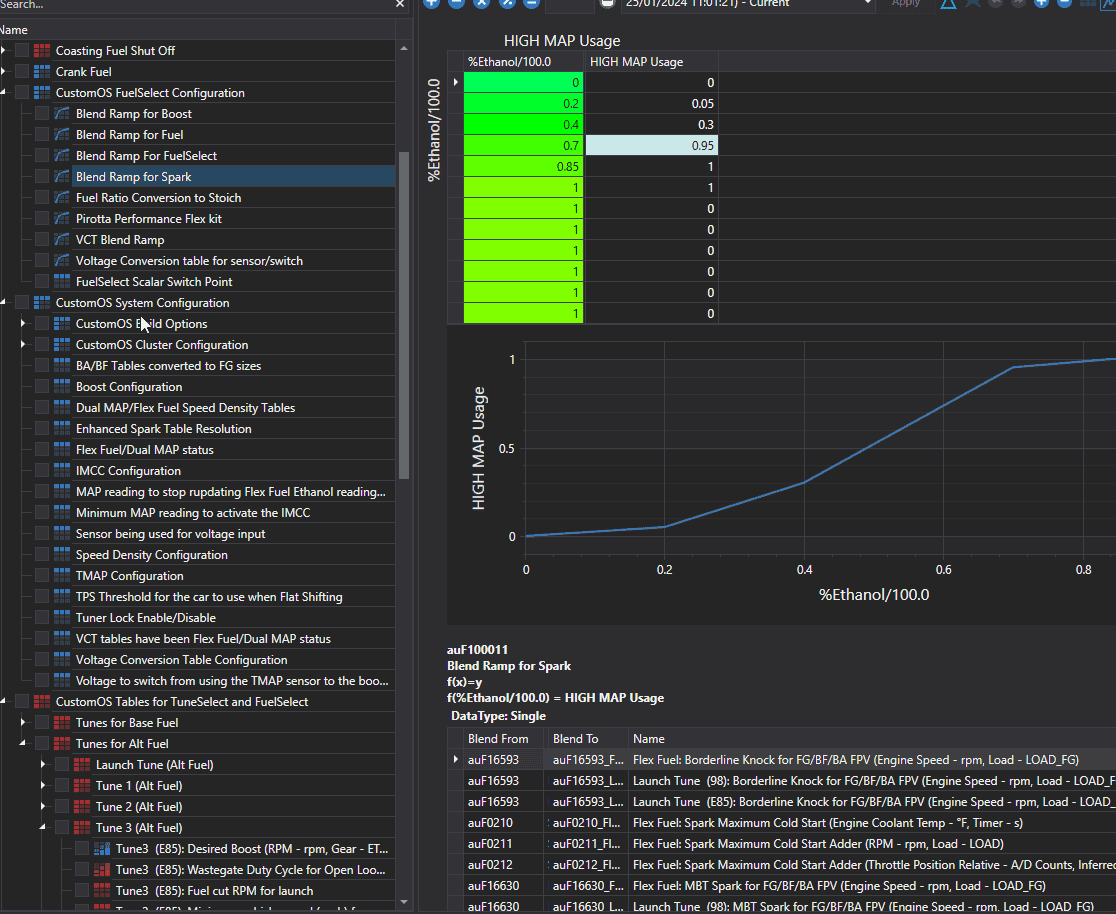
There’s a tuner-defined blend curve. Here’s an example of one I’m going to try out this spring. In this use-case, the left column is E%/100 and right column is the map use ratio.

You can see I have it set to do no table blending at 20% and below. Then it’s 100% on E85 tables at 65% ethanol and up. There’s a separate stoich table that is unaffected by this blend so it’s not like AFR/lambda will be wrong because of this blend curve.

IMG_0241.png
 

Sponsored

Angrey

Well-Known Member
Joined
Jun 21, 2020
Threads
104
Messages
2,794
Reaction score
2,984
Location
Coral Gables
Vehicle(s)
2016 GT350
There’s a tuner-defined blend curve. Here’s an example of one I’m going to try out this spring. In this use-case, the left column is E%/100 and right column is the map use ratio.

You can see I have it set to do no table blending at 20% and below. Then it’s 100% on E85 tables at 65% ethanol and up. There’s a separate stoich table that is unaffected by this blend so it’s not like AFR/lambda will be wrong because of this blend curve.

IMG_0241.png
So we've blended spark and fuel, does this bleed into the blending of the load and what boost you're allowing it to make.

That's really where the crucial piece is, to NOT let the motor make it's typical max boost at lower ethanol content.
 

mejohn50

Intergalactic Snail
Joined
Jun 12, 2016
Threads
24
Messages
876
Reaction score
1,060
Location
United States
First Name
Mitch
Vehicle(s)
slow junk
So we've blended spark and fuel, does this bleed into the blending of the load and what boost you're allowing it to make.

That's really where the crucial piece is, to NOT let the motor make it's typical max boost at lower ethanol content.
This blend table defines the curve that both sets of tables are interpolated by.

So, if a tuner decided to do a load limit based on ethanol content, the interpolation between those two tables would follow this curve.

Hypothetically: I could set a load limit of 1.6 on my pump gas table and a limit of 2.2 or whatever on the E85 table while running a pulley that makes 2.0 load. Ideally, the upper and lower load limits would be calculated by the tuner to not allow max load until there’s enough ethanol, but that would be simple to figure out.
 

junits15

Well-Known Member
Joined
Jul 7, 2022
Threads
19
Messages
1,192
Reaction score
1,310
Location
MA
First Name
Justin
Vehicle(s)
2019 Mustang GT
So we've blended spark and fuel, does this bleed into the blending of the load and what boost you're allowing it to make.

That's really where the crucial piece is, to NOT let the motor make it's typical max boost at lower ethanol content.
You can blend nearly any table, you could make a tune that changes your exhaust flaps based on ethanol content if you so desired.

There is very little limit to it.
 

Rolls

Well-Known Member
Gold Sponsor
Joined
Jan 29, 2020
Threads
2
Messages
355
Reaction score
457
Location
Australia
Website
www.pcmtec.com
Vehicle(s)
Mustang 18 GT
We actually have 4 blend curves under the hood, we can expose them to allow different blend curves for different parameters if people ask for it.

As said above you can blend almost anything. You could make your alternator output a different voltage based on ethanol if you wanted. Change shift maps etc.

You can also turn scalars on and off, eg you could change firing order based on ethanol, not that it makes any sense but the system is that flexible. You pick what you need and it builds the firmware for you, there is about 30,000 parameters you can pick from. Most keep it simple and only add a few but you can go as crazy as you like.

There is almost 2mb of spare ROM in a 18+ so the limit is literally thousands before you run out of memory.
 

mejohn50

Intergalactic Snail
Joined
Jun 12, 2016
Threads
24
Messages
876
Reaction score
1,060
Location
United States
First Name
Mitch
Vehicle(s)
slow junk
We actually have 4 blend curves under the hood, we can expose them to allow different blend curves for different parameters if people ask for it.
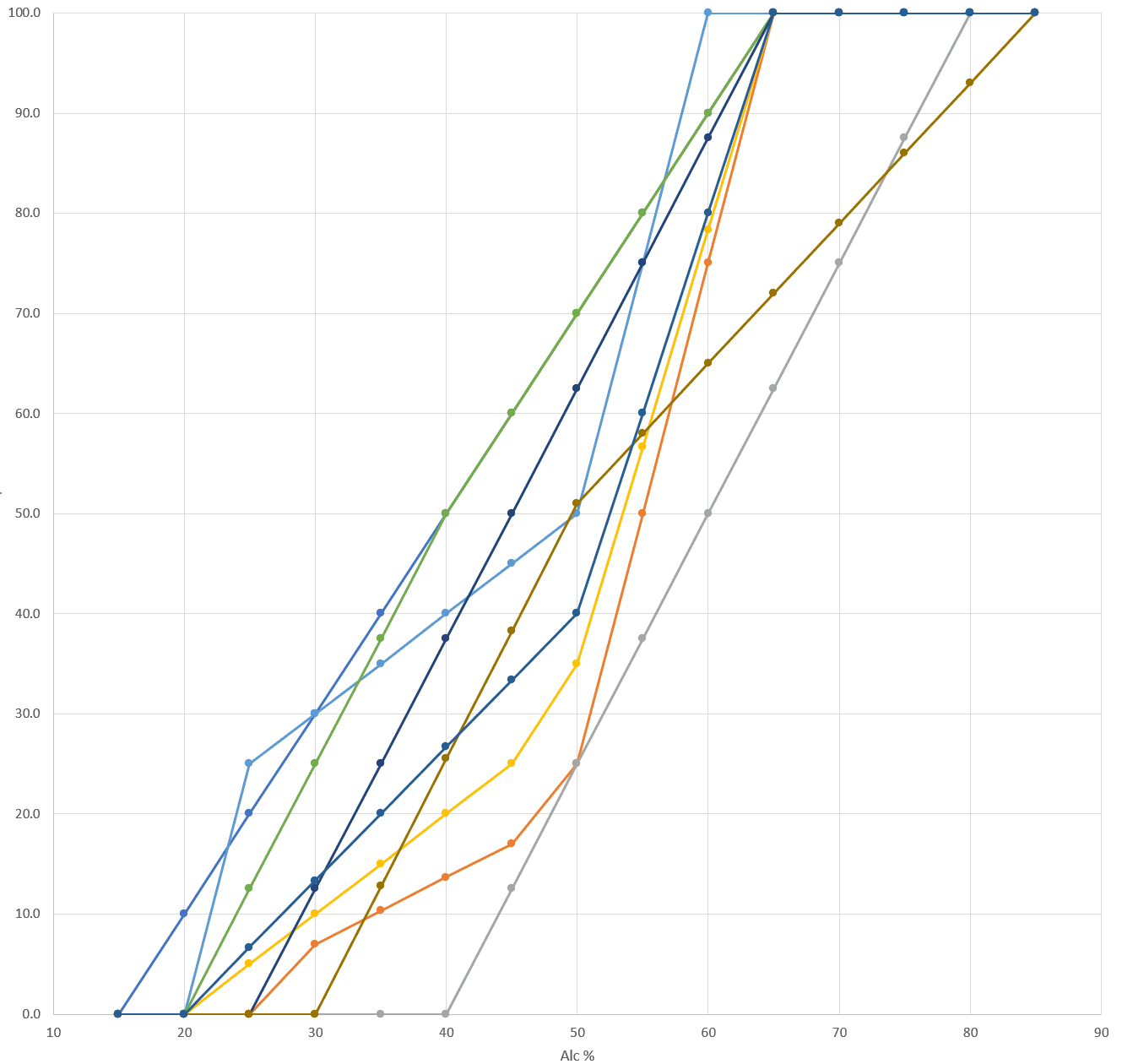
You wouldn't hurt my feelings if you gave us one more blend curve to work with. Do we need it? Probably not, but having the option would be nice. Looking at the OEM F150 logic as a guide, the curves are all over the place. Having a bit more granularity in our control over table blending might not hurt.

Screenshot 2024-01-24 171339.png
 

Sponsored

Rolls

Well-Known Member
Gold Sponsor
Joined
Jan 29, 2020
Threads
2
Messages
355
Reaction score
457
Location
Australia
Website
www.pcmtec.com
Vehicle(s)
Mustang 18 GT
You wouldn't hurt my feelings if you gave us one more blend curve to work with. Do we need it? Probably not, but having the option would be nice. Looking at the OEM F150 logic as a guide, the curves are all over the place. Having a bit more granularity in our control over table blending might not hurt.

Screenshot 2024-01-24 171339.png
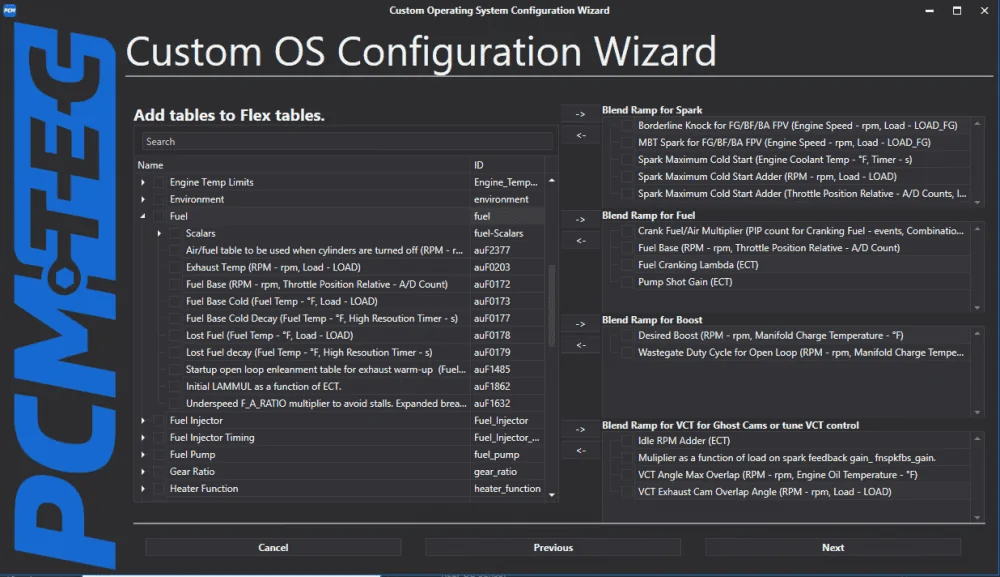
We could have 100s of curves technically, there is no real limitation, the hurdle is making the UI not bloated. Eg you'd need a way to assign which parameter goes to which curve. We did this in the Falcon with a multi screen wizard here:

1706144178052.png


However this wizard had 6 pages and was quite cumbersome/slow to navigate for tuner pumping out tunes in short time frames.

If you did a wire frame mockup for how we could add which blend curve a parameter is added to, then we could make it happen quite easily. There are already 4 blend curves in the background (3 are just invisible and not used) that we can assign parameters to. If you do this post a thread on our forums and link it here/send it to support, we have a backlog of features however this was always something we planned to add eventually.

The extra curves are great for turbo cars, as often you don't want your spark curve to track your boost curve etc. Same with load limiting, there are many uses as you have alluded to. We named the blend curves in the Falcon, however for the Tricore they would simply be named "Interpolation Curve 1,2,3,4" and everything would go to curve 1 by default.

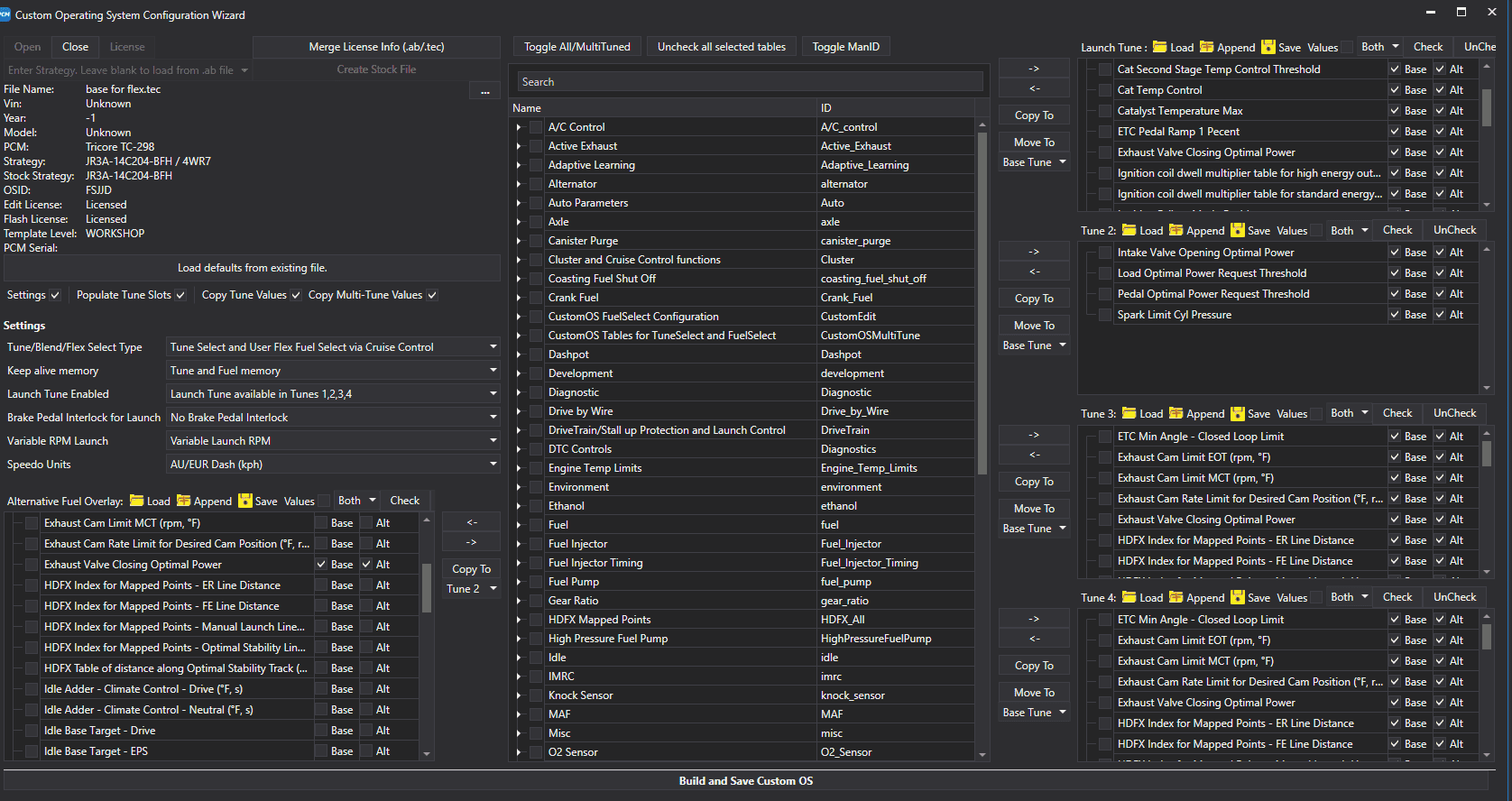
The backend of the tricore Custom OS is set up so we can do exactly the same thing if there is demand and we can make the UI usable. It is already complex for most users, so if we added this it would need to be something that is hidden by default and you enable via a checkbox etc

1706144886565.png


Here is how the Falcon CustomOS looks.

You can see which parameters are assigned to which curve via the editor (hidden in the tricore currently via this view) in the Falcon

1706144571979.png
 

ZXMustang

Well-Known Member
Joined
Oct 24, 2020
Threads
9
Messages
774
Reaction score
947
Location
US
Vehicle(s)
2025 Mustang GT
Yeah no its too easy just to have an E70 tune and an E30 tune and an E10/93 tune. Get consistent predictable performance and no worries about prematuring of the stoich before all the E gets picked up by the 02 sensors. Its more of a pain than worth.
 

Rolls

Well-Known Member
Gold Sponsor
Joined
Jan 29, 2020
Threads
2
Messages
355
Reaction score
457
Location
Australia
Website
www.pcmtec.com
Vehicle(s)
Mustang 18 GT
Yeah no its too easy just to have an E70 tune and an E30 tune and an E10/93 tune. Get consistent predictable performance and no worries about prematuring of the stoich before all the E gets picked up by the 02 sensors. Its more of a pain than worth.
That is what user flex is for. You simply select exactly what you have in the tank via the cruise control buttons. Measure what is in your tank. You have E57 or something weird? Easy, dial up 57mph on the dash and job done, timing is locked in at exactly what it should be for E57.

Not possible with individual tunes and risky with the OEM flex logic and trimming. If you want full automation simply install the CANBus flex fuel sensor and you don't even have to measure your content. Curious what is in your tank? Simply do a key cycle and the ethanol content will flash up on your dash for 2 seconds before you start the car. Just saved yourself buying an extra gauge you have to look at, or even better having to use one of those dirty water tester kits that I bet all of you have spilt on yourself at least once.
 

Angrey

Well-Known Member
Joined
Jun 21, 2020
Threads
104
Messages
2,794
Reaction score
2,984
Location
Coral Gables
Vehicle(s)
2016 GT350
Yeah no its too easy just to have an E70 tune and an E30 tune and an E10/93 tune. Get consistent predictable performance and no worries about prematuring of the stoich before all the E gets picked up by the 02 sensors. Its more of a pain than worth.
Then you'd have to reflash each time the content changes. That's the big leap, not having to reflash. And this isn't an inferred 02 feedback tune, it's directing the tune to use appropriate values and tables with either a user selected input or a fed signal from the ethanol sensor.

Again, my biggest concern isn't fuel or spark, that's the easy part, it's getting the "map" correct for air loading. It's the ability to run a small pulley on a PD or Centri and choke the tune so that it doesn't make full sauce when on lower content fuel. That's the big risk. I think a flex fuel for anything less than typical 93 limits (say 12 psi) is probably pretty easy. You just adjust fuel and spark and away you go. But for anything that runs higher than sensible boost limits for 93, the risk is making 19 lbs of boost on low E content.
 

mejohn50

Intergalactic Snail
Joined
Jun 12, 2016
Threads
24
Messages
876
Reaction score
1,060
Location
United States
First Name
Mitch
Vehicle(s)
slow junk
Again, my biggest concern isn't fuel or spark, that's the easy part, it's getting the "map" correct for air loading. It's the ability to run a small pulley on a PD or Centri and choke the tune so that it doesn't make full sauce when on lower content fuel. That's the big risk. I think a flex fuel for anything less than typical 93 limits (say 12 psi) is probably pretty easy. You just adjust fuel and spark and away you go. But for anything that runs higher than sensible boost limits for 93, the risk is making 19 lbs of boost on low E content.
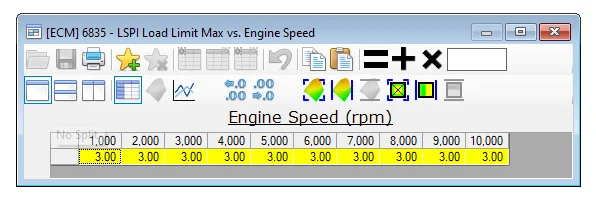
The gen 3 PCM has OEM air load limiters. They aren’t set to do anything from Ford, but they are there. This is one of many.

Screenshot 2024-01-25 072550.webp


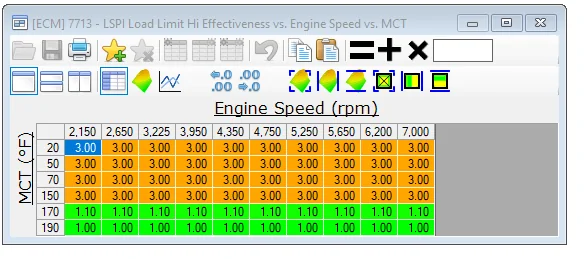
Whipple uses them to limit boost as MCT temps rise or as ambient temps get too cold. Again, one of many.

Screenshot 2024-01-25 072700.webp


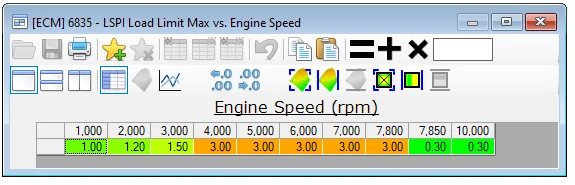
I use this one to limit boost at low RPM to keep torque in check and also a soft "rev limiter" that will close the throttle before it hits my programmed rev limiters.

Screenshot 2024-01-25 072741.webp


All very easy to set up, and they all work reliably. It would be easy to blend two load limit tables as a function of ethanol with the PCMTEC solution, which is exactly what I plan to do.
Sponsored


Top