Sponsored

Ford Racing ProCal Tune

metalhead79

That thang got a Hemi?
Joined
Sep 17, 2016
Threads
14
Messages
525
Reaction score
151
Location
Colorado Springs, Co
Vehicle(s)
2022 Mustang GT
On a manual, at least, the driver can take steps to avoid LSPI by driving in the right gear, downshifting to a lower gear for heavy acceleration, not flooring the gas pedal in 6th (and maybe 5th?) gear, and avoiding full throttle under 3k RPM.
If one is not doing this, and has a tuned engine, well.... we know how that story ends.

I'm curious if a lot people coming to the EB don't have a turbo/manual background and are simply driving it like they would a NA/manual combo. The turbo cars I've been driving since 2009 have all been auto's. Had it not been for this forum, I'd be driving my EB like my old 5spd non-turbo Geo Storm.

When accelerating, I normally shift at ~3500rpm for each gear. I keep my cruising RPM around 2500rpm. When cruising, if my acceleration needs are anything above a light push on the pedal, I downshift and accelerate. The idea is to keep the RPM high enough at all times that getting into boost won't cause LSPI. Am I doing it right? I don't know. I just went with Unleashed for my tune, so time will tell.
Sponsored

 
Last edited:
Plain17

Member
Joined
Aug 15, 2017
Threads
1
Messages
14
Reaction score
0
Location
MD
First Name
Ven
Vehicle(s)
17 EB Magnetic
You don't need to have the tune and CAI installed at a Ford dealer to get the warranty. Any local shop that has ASE certified techs can do it.

I did mine at my son's shop, he printed me a work or for an hours labor. I sent that along with the receipt for the kit to the email address in the Ford Performance warranty document. Within two hours I had to notification back that my warranty was registered.

BTW, one hour of labor at my son's shop is $105. You should only be paying in that range to have the kit installed. It actually took me less than an hour.
Yeah, i knew about the ASE option, but I don't have the "connection" you do, wish i did!
 

Vulch

Member
Joined
Oct 20, 2014
Threads
0
Messages
17
Reaction score
1
Location
Nor Cal
First Name
Brent
Vehicle(s)
2015 Guard Ecoboost
I'm going to pass 36k before I get around to buying the tune, is there any benefit to having it installed by a dealer/ASE tech?
 

Berstuck

Well-Known Member
Joined
Jan 12, 2017
Threads
6
Messages
212
Reaction score
62
Location
Northern California
First Name
Brien
Vehicle(s)
2015 Ecoboost Premium PP M/T Competition Orange
Maybe potentially not voiding the remaining 24k of your powertrain warranty. Otherwise no.
 

dgc333

Well-Known Member
Joined
Dec 6, 2014
Threads
13
Messages
1,637
Reaction score
461
Location
MA
First Name
Dave
Vehicle(s)
15 Mustang Ecoboost Premium
Yeah, i knew about the ASE option, but I don't have the "connection" you do, wish i did!
My connection saved me an hours labor. I can't believe there isn't an independent shop in your are that won't do it for an hour's labor. $500 at a Ford dealer is hiway robbery.
 

Sponsored

jtmat

Well-Known Member
Joined
Mar 8, 2015
Threads
9
Messages
1,995
Reaction score
881
Location
DC/MD/VA metro
Vehicle(s)
Vert turbo!!!!
My connection saved me an hours labor. I can't believe there isn't an independent shop in your are that won't do it for an hour's labor. $500 at a Ford dealer is hiway robbery.
Waldorf Ford will do it for $200 in our area. They have done a lot of them at this point, so I'd go to them for that reason alone and to save time.

Not that it would matter, except for maybe the CAI, which I heard is a pain to put on (but probably not THAT difficult).

Over the years I've tried saving money by not going to the rip off dealer.... sometimes it cost me more money and time. :(
 

Plain17

Member
Joined
Aug 15, 2017
Threads
1
Messages
14
Reaction score
0
Location
MD
First Name
Ven
Vehicle(s)
17 EB Magnetic
Waldorf Ford will do it for $200 in our area. They have done a lot of them at this point, so I'd go to them for that reason alone and to save time.

Not that it would matter, except for maybe the CAI, which I heard is a pain to put on (but probably not THAT difficult).

Over the years I've tried saving money by not going to the rip off dealer.... sometimes it cost me more money and time. :(
I ordered the kit today from Levittown and will call Waldorf Ford when it gets here. I think the experience they have is a big plus. I've already made plans to go to the tail of the dragon next month though, so debating when to get it done, before or after, incase there are any unforeseen problems.
 

dgc333

Well-Known Member
Joined
Dec 6, 2014
Threads
13
Messages
1,637
Reaction score
461
Location
MA
First Name
Dave
Vehicle(s)
15 Mustang Ecoboost Premium
Not that it would matter, except for maybe the CAI, which I heard is a pain to put on (but probably not THAT difficult).
Since CAI in the kit utilizes the stock intake, it is literally a 10 minute job.
 
OP
OP
TheLion

TheLion

Well-Known Member
Joined
Jul 1, 2016
Threads
68
Messages
1,621
Reaction score
601
Location
US
Vehicle(s)
Ruby Red 2016 Mustang GT PP 6-MT
On a manual, at least, the driver can take steps to avoid LSPI by driving in the right gear, downshifting to a lower gear for heavy acceleration, not flooring the gas pedal in 6th (and maybe 5th?) gear, and avoiding full throttle under 3k RPM.
If one is not doing this, and has a tuned engine, well.... we know how that story ends.

I'm curious if a lot people coming to the EB don't have a turbo/manual background and are simply driving it like they would a NA/manual combo. The turbo cars I've been driving since 2009 have all been auto's. Had it not been for this forum, I'd be driving my EB like my old 5spd non-turbo Geo Storm.

When accelerating, I normally shift at ~3500rpm for each gear. I keep my cruising RPM around 2500rpm. When cruising, if my acceleration needs are anything above a light push on the pedal, I downshift and accelerate. The idea is to keep the RPM high enough at all times that getting into boost won't cause LSPI. Am I doing it right? I don't know. I just went with Unleashed for my tune, so time will tell.
LSPI typically occurs at around 1500 to 2500 RPM. Higher revolutions are usually fast enough that there's not enough time for auto ignition which is why it only occurs are lower RPMs.

Shorter gearing in manuals helps, cruising at 78 mph I'm just a touch over 2500 RPM. However LSPI occurs because of the deposits left from current oil droplet formulations and to some degree fuels. That also explains why people see much higher knock on Shell gas, it's heavily laden with additives....bad idea for TDI engines even if it might help keep clean NA engines, unless of course the additives don't result in heavy deposits or increased heat.

Catch cans DO NOT eliminate the risk of LSPI. The primary source of deposits IS NOT from vaporization of oil, that only affects the intake valves and can be solved by a low boil off oil and an oil cooler combination. Most of the vapor is in small enough particulates and it's mixed with water that there are not large enough patches of deposits left to cause LSPI.

It typically occurs due to the oil squirters and oil sneaking past the rings from over spray. Fuel can be a contributor as well, but does not seem to be the biggest culprit. When not under pressure the rings aren't going to be forcing themselves against the cylinder walls and some oil will inevitably get into the groves and work their way up to the lands.

Eventually this oil gets launched out of the lands and grooves at top dead center because of the massive force applied due to the sudden change in direction downward. During that power stroke the oil burns away and leaves the deposits, so LSPI doesn't occur on the stroke in which the oil enters the chamber, it occurs on the compression stroke of the next cycle.

That would be why there are two knock sensors, one is specifically for irregular ignition detection. That's also why the stock tunes run so rich. While fuel deposits can accumulate and exacerbate the issue (which running leaner helps prevent the fuel deposit issue), the primary mechanism is believed to be due to oil additives after oil contamination which normally happens in every engine. Because of that running rich helps cool the chamber down and prevent the deposits from getting hot enough to cause an auto ignition in the first place.

That's why I made such a big deal about AMSOIL releasing an LSPI resistant oil formulation in September. It's the first on the market and it's a big deal for those who are tuned, especially once your warranty is up. I'm at 27500 right now and planning on switching to my Livernois 91 calibration once I hit 36k. Auto ignition was my biggest reason or going with the Ford Performance calibration because they run it pig rich like stock for the very reason of LSPI due to oil contamination from the lands and grooves. Your removing entirely one of the primary contributing factors to auto ignition. You can solve the fuel issue much more easily by running leaner to get as close to stoich as it is safe to do (need some small margin to protect against regular knock). That give you better power AND better fuel economy and explains why the Ford Performance Calibration drops fuel economy while Livernois and other tuners are seeing fuel economy gains. They are NOT accounting for oil contamination LSPI and that's why we see tuned car throw rods when pulling out of a parking lot (50%~75% throttle, 1500~2000 RPM, high low, low RPM condition).

There's no way to account for LSPI through tuning other than running pig rich like they do from the factory, but that limits fuel economy AND power output. According to AMSOIL's media (if they are right), OE's will be re-tuning their cars from the factory to run leaner once the new GF6 standard comes out in 2019 to keep up with the next iteration of requirements for improved fuel economy set to take effect in 2020. In order to do that they need to solve the oil related LSPI issue and that means new oil formulations that eliminate the offending additives (or counteracting them some how). Right now they are relying solely on tuning, which is a band aid fix that limits the power and efficiency potential gains.

Also there is another cool technology being developed. Solenoid operated valves. Instead of fixed valve trains, each valve can be opened and closed independently. That means the duty cycle can be linear across the RPM range and achieve maximum power and efficiency. VVT is only a two stage system, if at one angle or another (typically about a 50~60 degree phase change). But a linear phase change would be even more beneficial (assuming it can be done reliably).

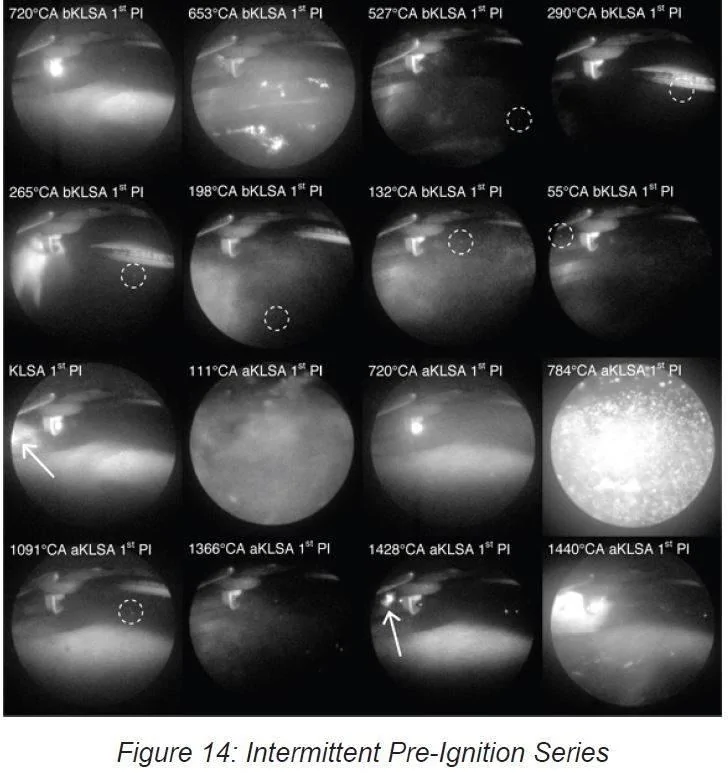
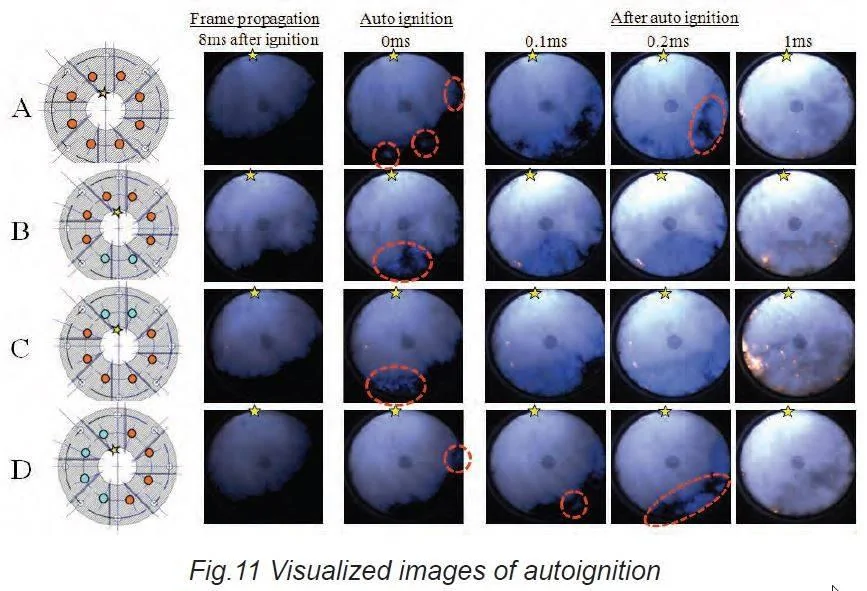
There are varying levels of auto ignition. A single occurrence late in the compression stroke will not destroy an engine by itself, but it could lead to a cascade of ensuing auto ignitions that eventually result in super knock due to increasing heat.

You want to see what LSPI actually looks like? Here you go (not all the glowing deposits, not all deposits have sufficient thermal energy to auto ignite, they must be large enough to cause auto ignition):

Intermittent%20Pre-Ignition_zpsorkj7t84.webp
Sequence%20of%20Auto%20Ignition_zpsyuta6rgm.webp
 
Last edited:
OP
OP
TheLion

TheLion

Well-Known Member
Joined
Jul 1, 2016
Threads
68
Messages
1,621
Reaction score
601
Location
US
Vehicle(s)
Ruby Red 2016 Mustang GT PP 6-MT
By the way, running rich also explains why Ford Performance artificially drops the torque off really fast after 5800 RPM where other tuners can maintain torque rather linearly all the way out and hold almost 50HP more to the wheels than the Ford Performance Calibration.

When running rich you increase catalyst temps at higher RPM's because you excess fuel is burning in the heated catalyst after if vaporizes (gas state). But they HAVE to run rich to protect against oil contamination related LSPI because there currently no anti-LPSI oil formulations on the market.

Most tuners, including Livernois, are not account for the possibility of oil contamination induced LPSI and that's why they are able to push power at the top end so much better than Ford Performance even though otherwise their tuning strategies and peak power output is so similar. I see no reason not to run their tuning as an upgraded alternative once the appropriate oil formulations are available.

FP knows something and they are currently the safest bet for a tune, bar none. At least until anti-LPSI formulations of oil are available, then you can run leaner like Livernois and eliminate the LSPI issue and reduce the risk of fuel deposit related LSPI (which running leaner helps with).
 

Sponsored

Regs

Well-Known Member
Joined
Jun 4, 2016
Threads
5
Messages
546
Reaction score
79
Location
NJ
Vehicle(s)
Mustang 2016 Echoboost
To not account for fatigue would be a mistake for engine failure as well. I don't know of many sub 30k cars with 4 cylinders that pushes 400 ft-lbs of torque. Blaming oil formulations for ecobooms is a little far-fetched.
 
OP
OP
TheLion

TheLion

Well-Known Member
Joined
Jul 1, 2016
Threads
68
Messages
1,621
Reaction score
601
Location
US
Vehicle(s)
Ruby Red 2016 Mustang GT PP 6-MT
To not account for fatigue would be a mistake for engine failure as well. I don't know of many sub 30k cars with 4 cylinders that pushes 400 ft-lbs of torque. Blaming oil formulations for ecobooms is a little far-fetched.
Not really. Certainly running enough power will cause a failure, I'm not suggesting pushing 400 whp and 450 wtq isnt' going to result in a failure. However a bunch of testing on this was done by Livernois during their development. They found the stock bottom end gives out typically when you exceed around 350 whp and 425 wtq on average. Some engines a little more, some a little less due to metallurgical and manufacturing variations.

I do not blame all ecobooms on oil. However ones that fail a lower RPMs at partial throttle are likely LSPI related as that's prime LSPI territory. Especially since all of these calibrations are pushing even more low end torque than the factory calibration while also running them leaner = LSPI open season. They are pushing the engines partial throttle low RPM operation right into the conditions most ripe for LPSI.

Ford Performance also did a 60k mile test for durability with their calibration and found no wear differences between a stock engine and one tuned with their calibration. At these power levels we are not adding a significant amount of increased stress, peak power levels are not dramatically higher, gains are mostly achieved through broadening the power band, which also has risks.

The untapped power in the factory engine calibration is largely due to the fact that it has to run on 87 and LSPI can only be mitigated by engine tuning at the present time, both of which significantly hurt performance and efficiency potential. That and they want to sell GT's.

By far the largest forces of strain are TDC and BTC, the compression and tension stresses on the rods / wrist pins and pistons, which is largely affected by weight and velocity (which is dependent on stroke and RPM). The forces are related to the square of the velocity, even a small RPM increase has a significant affect on tension and compression stresses.

I suggest reading Corky Bell's maximum boost for a better understanding of where the real peak stresses actually come from even on highly boosted engines.

As long as the piston can move, the forces acting on the piston and rods are actually quite small compared to forces acting on it when changing direction at high RPM. That would be why we can push so much more power through these engines mechanically without causing failures. Some times what is is not what you perceive it to be....

I have no doubt however that some of these stock blocks running big turbos or even super juiced up stock turbos on E30 tunes pushing 375 whp are exceeding the functional mechanical limits. Fatigued components however fail when you re-stress them. Low RPM partial throttle without LSPI occurring isn't as mechanically stressful as WOT at high RPM. So guys blowing engines at the drag strip, or when pushing the power limits on a dyno sure, but I have a hard time buying that for those pulling out of a paring lot.

If the fatigue was so bad the rod sheared, the whole thing would have come apart during the last high RPM pull. It's not going to remain together at peak stress then suddenly let go under low RPM where tension and compression stresses are low.
 

TorqueMan

Well-Known Member
Joined
Aug 24, 2017
Threads
7
Messages
692
Reaction score
218
Location
St. Jacob, IL
Vehicle(s)
2017 EcoBoost Premium
LSPI is not a new phenomenon. Manufacturers of GDI turbocharged engines--including Ford and GM--have been studying LSPI for a few years now. I have not been able to find any authoritative studies claiming precisely what the primary cause is, although there is much evidence to suggest oil composition is a factor. Enough evidence, in fact, that GM developed a specification--dexos1 Gen 2--as a result of the studies.

That said, I don't think there is anything special about Amsoil's products as regards LSPI. It doesn't say it's oils formulated to combat LSPI do anything beyond meeting the GM dexos1 Gen2 specification. Walmart's Super Tech full-synthetic oil also meets the GM dexos1 Gen 2 spec.
 

tw557

Well-Known Member
Joined
May 9, 2016
Threads
40
Messages
573
Reaction score
105
Location
PA
Vehicle(s)
16 GT automatic
It is an interesting theory as I have read up on this lately. They do seem to have some test results that seem to be able to turn LSPI on and off with different oils addatives. I have to admit though, its just really hard to imagine the incredibly small amount of oil that could be in a cylinder to cause this. Many new motors use much less then a quart of oil in 5000 miles. Mine uses less then a half a quart. On top of that oil is not the easiest fluid to ignite even ones with low flash points. I did some quick calculating and if it takes a droplet of oil the size of one cubic millimeter and this droplet is produced every stroke, that motor would use a quart of oil every 5 hours at 3000rpm. But I will certainly admit I'm sure its much more complex then the simplistic thoughts I have here. Its just hard to imagine. It sure would be great if they really can reduce LSPI with something as simple as running a certain oil formulation. It would help push me over the edge to finally get a good tune.
 

sharp21

Well-Known Member
Joined
Aug 8, 2015
Threads
29
Messages
245
Reaction score
44
Location
Houston
Vehicle(s)
Mustang
I figured a stock gearing auto would be the most likely to blow. Had a rental and it wants to maintain 1750rpm all day. Mine rarely goes below 2k and only when im grandma rodding
Sponsored


Top