Sponsored

Exhaust Pressure Testing

andrewtac

Well-Known Member
Joined
Feb 24, 2021
Threads
62
Messages
1,194
Reaction score
625
Location
TX
First Name
mark
Vehicle(s)
F250. 2020 GT 400A
Wanted to add, I am seeing about 2 psi less than before at peak (I did go down in pulley size as well 3.1 now instead of 3.25). It is probably a little less than this as I haven't put the bell mouth back on yet.
Sponsored


 
OP
OP

engineermike

Well-Known Member
Joined
Jul 15, 2018
Threads
31
Messages
6,188
Reaction score
6,447
Location
La
Vehicle(s)
2018 GTPP A10
Another update on this science project...I didn't like that my data was using an A/D converter and standalone software, so was not correlatable directly to other engine parameters. So, I purchased the HPTuners Pro Feature set that allows logging of external analog parameters in conjunction with other OBD data. With my current exhaust setup using stock cats but dual *true* 3" all the way, the exhaust pressure data log is shown below with the taps just before (p2) and just after (p1) the cat:

1649705262256.png


I'm very happy with this, as I never really thought near 5 psi with cats was possible at such a high airflow. FWIW I'm flowing on the order of 89 lb/min (max MAF PID data shown). The stock cats are adding less than 4 psi exhaust pressure here.

Just out of interest, I pulled the data showing what backpressure this exhaust imposes at a stock flow rate:

1649705501795.png


As you can see, the cats are only imposing about 1/2 a psi at a stock-ish flow rate of 48 lb/min.
 

Torinate

Well-Known Member
Joined
Feb 18, 2018
Threads
87
Messages
2,037
Reaction score
943
Location
Ontario
Vehicle(s)
2016 GT Convertible
Very impressive! Your knowledge marvels me...

So if I am to understand this correctly, you have stock headers and cats but the remainder of your exhaust system is modified with any 3 inch tubing and any of the narrow spots have been opened up to the 3 inches as well. What do you think the gains are with your set up versus a completely stock system?

If you were to recommend one area that made the biggest difference, what do you think it would be?

How do you think these flow numbers would compare to a set of long tube headers with out cats? How do you think it compares to cat deletes?

When I see these numbers, I can't help but think that there's not a lot of improvement left on the table... But I could be wrong...
 

markmurfie

Well-Known Member
Joined
Jun 6, 2015
Threads
15
Messages
1,320
Reaction score
625
Location
Hawaii
First Name
Mark
Vehicle(s)
2015 Ford Mustang GT
70*f CO2 @15.7 PSI is 2 Kg/m^3
225*f CO2 @15.7PSI is 1.5 Kg/m^3
1500*f CO2 @ 15.7PSI is 0.5 Kg/m^3

This is just 1 PSI above standard sea level pressure.

70*f CO2 @19.7PSI is 2.5 Kg/m^3
225*f [email protected] is 1.9 Kg/m^3
1500*F [email protected] is 0.66 Kg/m^3

This is 5 PSI above standard sea level pressure.

At normal air temperatures, you have a drastic change in density from pressure changes. When you get to normal exhaust temperatures, no so much.
So Im assuming 0 PSI in yout PID math is something like 14.7 absolute, but is it 14.7 at 70*f or 1500*f?
Its hard to understand flow or restriction with out knowing density. Then you also have to factor in engine RPM, to truly see the speed density of the exhaust manifold, just like you would the intake manifold. Just looking at flow out of the engine not into it.

Keep at it.
 
OP
OP

engineermike

Well-Known Member
Joined
Jul 15, 2018
Threads
31
Messages
6,188
Reaction score
6,447
Location
La
Vehicle(s)
2018 GTPP A10
...you have stock headers and cats but the remainder of your exhaust system is modified with any 3 inch tubing and any of the narrow spots have been opened up to the 3 inches as well. What do you think the gains are with your set up versus a completely stock system?
That is correct, stock manifolds and cats but 3" dual all the way with a StainlessBros resonator and Magnaflow mufflers. I also fabbed an H pipe and a pair of Helmholtz resonators. I don't know exactly what the power gains were because this has been a long process and I made other changes along the way. I can say, though, that I'm certain I gained due to reduction in pumping losses and also added spark timing since lower exhaust pressure helps with knock margin. On my last log I was running 17 deg timing at 15 psi (3.375 pulley whipple) and stock 12/1 compression with zero knock detected. The added timing is probably worth more than the reduced pumping losses.

If you were to recommend one area that made the biggest difference, what do you think it would be?
Unfortunately, it didn't turn out that way. Every 2.5" component was adding significant restriction. When supercharged, the entire 2.25/2.5" system needs to be upgraded. The sticking point that most miss is that most "3 inch" resonators are actually only 2.5" internally, so don't overlook this part.

How do you think these flow numbers would compare to a set of long tube headers with out cats? How do you think it compares to cat deletes?
LTH and deleting cats would leave you with the backpressure imposed by my cat back only, or about 2 psi. This would be under 1/2 psi if NA.

When I see these numbers, I can't help but think that there's not a lot of improvement left on the table... But I could be wrong...
I agree. Lingenfelter (IIRC) published many years ago that under 5 psi should be the goal. Once you get there the returns dwindle down to nothing. I even checked this on a dyno some years ago and found it to be true.

So Im assuming 0 PSI in yout PID math is something like 14.7 absolute, but is it 14.7 at 70*f or 1500*f?
Its hard to understand flow or restriction with out knowing density. Then you also have to factor in engine RPM, to truly see the speed density of the exhaust manifold, just like you would the intake manifold. Just looking at flow out of the engine not into it.

Keep at it.
The original goal here was to determine how bad the exhaust pressure was and determine the most effective ways to improve it. By measuring the pressure directly, I don't need density to determine velocity to determine pressure. Since I determined pressure at numerous points in the system, I was able to spend my time and money most effectively in addressing them. Since I'm now barely over 5 psi backpressure at 90 lb/min airflow, I am basically done. The only work left to do is to remove some baffle plates I installed earlier to see how much it changes noise and pressure. After that, I'll move my analog inputs on to a MAP sensor in the manifold so I can sharpen up the SD model or perhaps thermocouples in the cat converter to check the cat temp model and COT effectiveness.

On this subject, one interesting bit that came to light for me was that, as you reduce restriction at the rear of the system, it reduces pressure at the front (the goal). But the result of lower pressure, as you know, is lower density. At the same mass flow rate, the lower density causes a higher velocity. So, IF the cats only added 2 psi with a stock cat-back, they might add 4 psi when you upgrade the mufflers or resonator because the velocity through the cat is nearly double. It's not like incompressible fluids where reducing dP by 2 psi in one place will translate to the same 2 psi elsewhere in the system.
 

Sponsored

markmurfie

Well-Known Member
Joined
Jun 6, 2015
Threads
15
Messages
1,320
Reaction score
625
Location
Hawaii
First Name
Mark
Vehicle(s)
2015 Ford Mustang GT
Part of the Ford SD model, is the SD of the exhaust. A small part, but it's there. Two pressures of a gas doesn't say much, other than maybe direction it's going to flow. In certain plenum like conditions, not even that.
 
OP
OP

engineermike

Well-Known Member
Joined
Jul 15, 2018
Threads
31
Messages
6,188
Reaction score
6,447
Location
La
Vehicle(s)
2018 GTPP A10
@markmurfie I'd like to use my data to correct the Ford exhaust pressure model, but HPT doesn't give us access to those parameters. With the collector pressure a solid 10 psi below boost, I believe the blowthrough calculation could become relevant in my case. The GT500 has more strategy definition in the exhaust pressure area, but even it doesn't seem to give enough access to really tweak it. At any rate, I do think dropping exhaust pressure from 15+ psi to below 6 using the data collected was worth-while for me and a very interesting project.
 

dead_inside

Well-Known Member
Joined
Nov 22, 2019
Threads
14
Messages
474
Reaction score
1,285
Location
PNW
Vehicle(s)
16 GT Prem PP
That is correct, stock manifolds and cats but 3" dual all the way with a StainlessBros resonator and Magnaflow mufflers. I also fabbed an H pipe and a pair of Helmholtz resonators. I don't know exactly what the power gains were because this has been a long process and I made other changes along the way. I can say, though, that I'm certain I gained due to reduction in pumping losses and also added spark timing since lower exhaust pressure helps with knock margin. On my last log I was running 17 deg timing at 15 psi (3.375 pulley whipple) and stock 12/1 compression with zero knock detected. The added timing is probably worth more than the reduced pumping losses.
Is there an "off the shelf" cat back system that you think would get close to your results with the custom system you've created?
 
OP
OP

engineermike

Well-Known Member
Joined
Jul 15, 2018
Threads
31
Messages
6,188
Reaction score
6,447
Location
La
Vehicle(s)
2018 GTPP A10
Is there an "off the shelf" cat back system that you think would get close to your results with the custom system you've created?
Any cat-back that uses the “factory connect” isn’t going to cut it, since it’s only 2.25”. Also, every resonator I’ve seen doesn’t maintain 3” internally, so it would have to be one with just an H-pipe. Short answer is: no.
 

markmurfie

Well-Known Member
Joined
Jun 6, 2015
Threads
15
Messages
1,320
Reaction score
625
Location
Hawaii
First Name
Mark
Vehicle(s)
2015 Ford Mustang GT
"Volumetric regression curve in which both X and y axes have been scaled by ExhMAP/ExhMAP nom. Where ExhMAP is exhaust manifold absolute pressure and where ExhMAP nom is a nominal exhaust manifold absolute pressure (e.g. at sea level)."

Barometric pressure changes with elevation changes.
VCT angles change with Barometric pressure changes.
SD data collection needs to be done at different elevations for all mapped VCT points. You need a max calculated MAP scalar. The exhaust pressure is it, or more accurately the exhaust pressure ratio is it according to Ford.

A small part, but it's there. I don't know how much of a benefit it is to account for it the way Fords patent does it. There isn't an exhaust pressure model for HPT to define. This is just part of scaling for elevation while regressing the coeffecients. HPT has exhaust pressure in their calculator... but I doubt many know why or how to use it properly.

I take issue with Fords patented way of scaling MAP with elevation, as it assumes no exhaust temperature differences, therefore density changes to the exhaust flow are solely because of pressure changes. Their SD for MAF only cars is a different approach, cylinder air mass to MAP instead of MAP to cylinder airmass (backwards), they account for ACT, but still falls short for elevation changes IMO. Other Manufactures(and 18+ mustangs) just add a Barometric or MAP sensor to verify the MAF with. Hence why I felt like pointing out your PIDs not being in an absolute pressure scale, and that exhaust temperature fluctuations really matter for exhaust gas densities and exhaust volumetric effeciency. You should understand the importance of using gas density not just for the SD regression application, but figuring out how much exhaust changes, improve or not improve, exhaust flow restrictions. It would be like using just the MAP sensor and VE% with out charge temperature correction for fueling, no bueno. I've seen people put resistors in place of IAT sensors before tho.
 

Sponsored
OP
OP

engineermike

Well-Known Member
Joined
Jul 15, 2018
Threads
31
Messages
6,188
Reaction score
6,447
Location
La
Vehicle(s)
2018 GTPP A10
"Volumetric regression curve in which both X and y axes have been scaled by ExhMAP/ExhMAP nom. Where ExhMAP is exhaust manifold absolute pressure and where ExhMAP nom is a nominal exhaust manifold absolute pressure (e.g. at sea level)."

...There isn't an exhaust pressure model for HPT to define. This is just part of scaling for elevation while regressing the coeffecients.
Lacking a direct measurement, in order to accurately calculate an ExhMAP, the PCM would need exhaust mass flow, exhaust temp, exhaust composition, barometric pressure, and some representation of the losses the exhaust system imposes. It is known that the PCM has access all of that data except the numerical representation of the system losses. This is really just a single constant, like an orifice coefficient or equivalent area like the TB model. However, I don't see that coefficient or area defined anywhere in my file. I do see where the Ecoboost strategies have the information needed to model the turbine and determine drive pressure, though, and where the GT500 has exhaust pressure limits set up.

You should understand the importance of using gas density not just for the SD regression application, but figuring out how much exhaust changes, improve or not improve, exhaust flow restrictions.
Figuring out how much exhaust changes change the restriction was precisely the goal of this science project. Correcting the ExhMAP model would just be icing on the cake if possible.

It would be like using just the MAP sensor and VE% with out charge temperature correction for fueling, no bueno.
If calculating exhaust pressure from known parameters, you would certainly need the temperature. But as you know, the calibration has all it needs to determine the exhaust temp already. However, I started out by directly measuring "the answer" that would result from this calculation, so there was really no need to take temperature into account. The whole point was to see how much physical changes to the exhaust system lowered or raised the collector pressure, not to determine mass flow rate or velocity.
 

markmurfie

Well-Known Member
Joined
Jun 6, 2015
Threads
15
Messages
1,320
Reaction score
625
Location
Hawaii
First Name
Mark
Vehicle(s)
2015 Ford Mustang GT
On a final note, with a knock-limited supercharged Coyote, spark timing is the key to making power. The reduction in exhaust pressure of 4 psi should allow about 1 deg of additional spark timing according to the link below and professional contacts, which in turn would make about 20 more hp due to timing alone.

https://etd.ohiolink.edu/apexprod/r...ssion=dayton1375262182&disposition=attachment
I wasn't satisfied with the reference you provided for this correlation between exhaust pressure and timing advance. The paper cited said "Compared to other factors that influence knock, exhaust back pressure does not have as dramatic of an effect, but it is still worthwhile to consider"

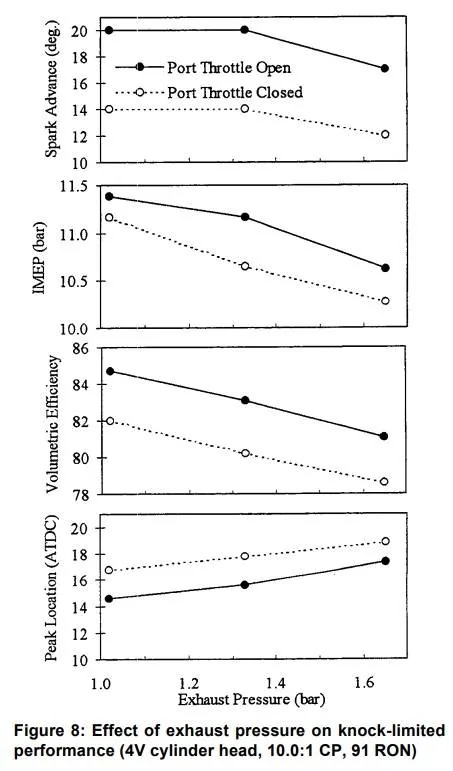
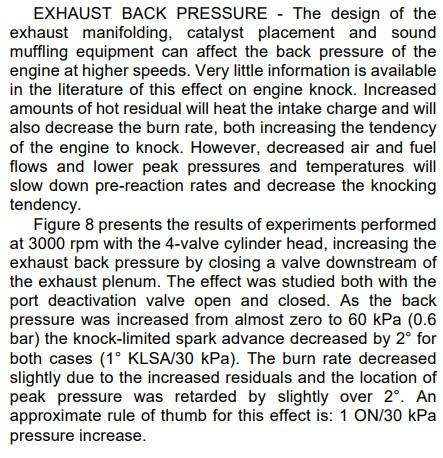
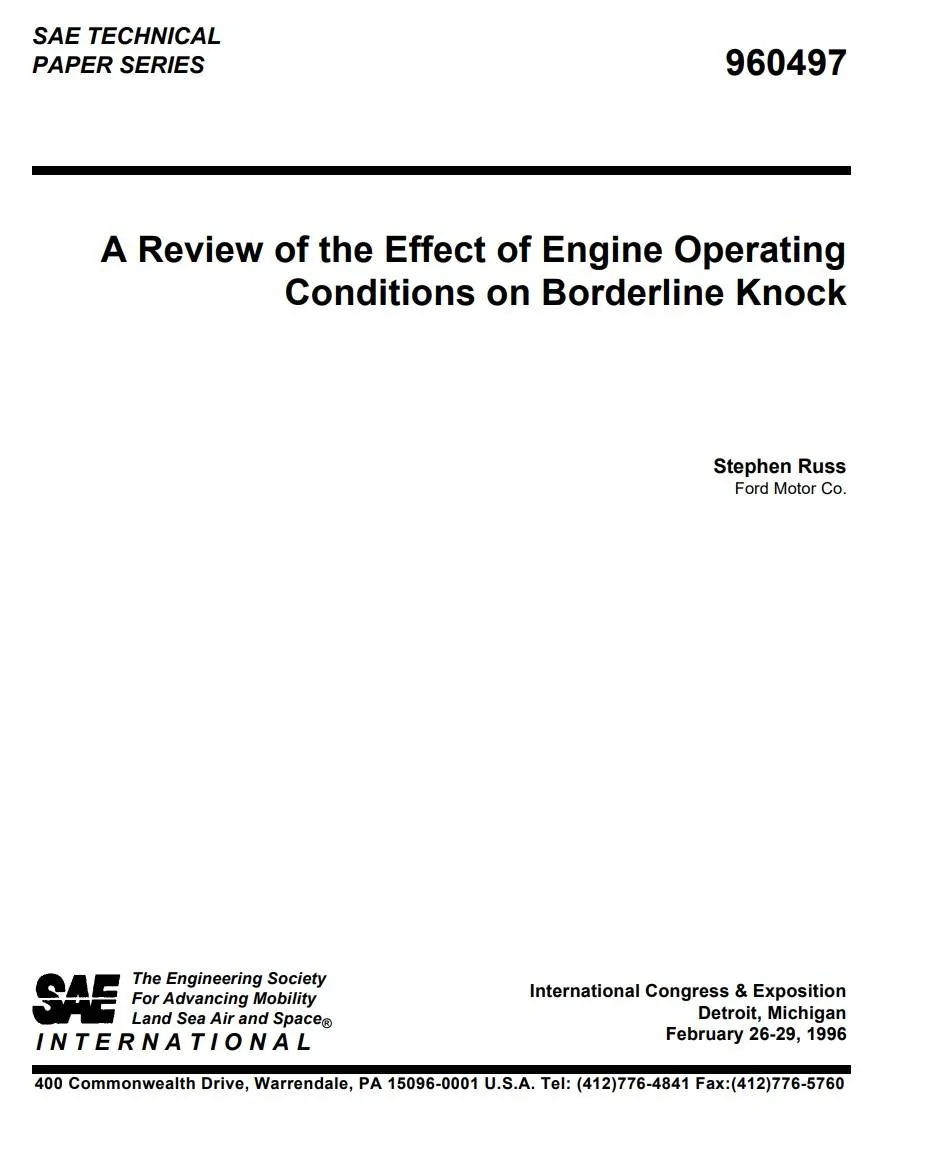
But, I found the table in it that backed up what you said. So I had to trace the source of that information down. I did to an early 1996 SAE paper, what it says is in the attached pictures. Mind you this widely cited and used rule of thumb, comes from a test done at a single RPM. They even say very little information is available in the literature back then, and I dont think much more has been published since. They also provided very little information from the test and to me, clearly, the wrong conclusion. The spark advace has a curve and is not linear in both open and closed port, so saying 1° KLSA/30 kPa or 1 ON/30 kPa pressure increase was a poor conclusion for this paper. Too many papers cite this table, and not enough do their own testing.

I still don't think looking at exhaust pressure only says much. You have to measure pressure and temperature to really know whats happening with a gas.

SAE 960497 Fig. 8.webp


SAE 960497 EBP knock effect.jpg


SAE 960497 page 1.webp
 
OP
OP

engineermike

Well-Known Member
Joined
Jul 15, 2018
Threads
31
Messages
6,188
Reaction score
6,447
Location
La
Vehicle(s)
2018 GTPP A10
I wasn't satisfied with the reference you provided for this correlation between exhaust pressure and timing advance. The paper cited said "Compared to other factors that influence knock, exhaust back pressure does not have as dramatic of an effect, but it is still worthwhile to consider"

But, I found the table in it that backed up what you said. So I had to trace the source of that information down. I did to an early 1996 SAE paper, what it says is in the attached pictures. Mind you this widely cited and used rule of thumb, comes from a test done at a single RPM. They even say very little information is available in the literature back then, and I dont think much more has been published since. They also provided very little information from the test and to me, clearly, the wrong conclusion. The spark advace has a curve and is not linear in both open and closed port, so saying 1° KLSA/30 kPa or 1 ON/30 kPa pressure increase was a poor conclusion for this paper. Too many papers cite this table, and not enough do their own testing.
The increase in power due to knock margin is a bonus of lowering backpressure, but far from the sole reason. It's tough to find the quality of data you are looking for to prove a side-benefit of the efforts, but I used what I had to get an idea. Anecdotally, you can see that the ecoboost engines run into knock at really low spark-timing in spite of low compression ratio and GDI. One might deduce this to be caused by the high exhaust pressure. Plus as I also said, and unfortunately I can't share much about this, I consult with an OEM engine calibrator who also told me that reduced backpressure increased knock margin in development engines. Whether it's 0 deg, 1/2 a deg, or 2 deg of margin really doesn't make the effort any less worth-while to me, so the exact effects on knock aren't really work arguing over.

I still don't think looking at exhaust pressure only says much. You have to measure pressure and temperature to really know whats happening with a gas.
It's a fairly common practice to measure pressures in a piping system to determine how much loss there is and where effort should be placed to address it. That's all I'm doing. I can't tell if you don't agree that lowering backpressure is beneficial or if measuring backpressure doesn't tell you the location of the restrictions. What I do know is that piping system losses reduce engine efficiency and I can't think of a better way to identify the losses than to measure the pressures.

This is actually the 3rd vehicle I've done such an exercise on. The first one gained 40 rwhp and 4 mph at the strip by dropping exhaust collector pressure from 9 psi to 5 psi. The second one was a turbo car and I did both the intake and exhaust sides, ultimately dropping exhaust pressure from 48 psi to 34, which allowed me to make the same power at 4 psi less boost. I have enough experience and data to know that the method was appropriate to attain my goal.
 

Buldawg76

Well-Known Member
Joined
Jan 11, 2022
Threads
3
Messages
1,312
Reaction score
1,174
Location
Alabama,USA
First Name
Mike
Vehicle(s)
2020 Ecoboost Premium, 76 FXE shovel, 77 KZ1000
Anecdotally, you can see that the ecoboost engines run into knock at really low spark-timing in spite of low compression ratio and GDI. One might deduce this to be caused by the high exhaust pressure.
I own an ecoboost and your above comment on excessive exhaust backpressure causing knock even at low timing numbers has me interested in your thoughts. I have a 3" aftermarket catted down pipe that I have yet to install since I have been told by tuners that installing it requires a tune to keep the engine calibration running at safe limits.

I already have a MBRP 3" cat back race system on the car along with a CVFab street IC and hot/cold charge pipes and GFB DV+ bypass valve kit with K&N filter in stock airbox. I also have an AFE cold air intake tube on the way.

I would like to hear your thoughts on me installing the 3" catted down pipe to the cat back exhaust so it would a full 3" exhaust from turbo back and if doing this would indeed require a custom tune to keep engine in safe limits or is the stock calibration capable of compensating for increased flow from above mods.

I also have a ford performance tune I will be installing once I get the AFE intake tube installed. The FP tune must relearn the best settings after installing it and I wanted all the mods in place before installing tune so it would be learning new setting with mods installed.

Your thoughts would be much appreciated. I am a retired ASE master tech with 50 years of repair experience on vehicles of 4/2 wheel varieties just not an engineer.

BD
 
OP
OP

engineermike

Well-Known Member
Joined
Jul 15, 2018
Threads
31
Messages
6,188
Reaction score
6,447
Location
La
Vehicle(s)
2018 GTPP A10
@Buldawg76 fundamentally, relieving back pressure from the turbine will increase the turbine Pressure Ratio, which will create more shaft power to the compressor. Way before the ecoboost days, I blew both head gaskets learning this the hard way. A lot has changed since then.

Reducing turbine outlet pressure will most certainly change the characteristics of turbocharger control. All of these pressures are modelled, such that feed-forward control can take place, which is followed by feedback. I'm no ecoboost tuner but I have been impressed by the speed at which the airflow is measured and throttle angle adjusted to correct. There's a good chance that the feedback control works fast enough to correct errors in the model.

That said, all tuners are not created equal. I'm 100% certain that some very popular professional tuners don't have a clue how all these models work. So just know that whatever tuner you use may just be guessing at this stuff or just play with it until the driver can't tell the difference.

One other comment; you mentioned increased flow. Most ecoboost tunes control to a flow specified by the calculations to achieve a target torque. They don't just open the throttle all the way. If yours is like most ecoboost tunes, you aren't actually enjoying any additional flow from your mods.
Sponsored


Top