Sponsored

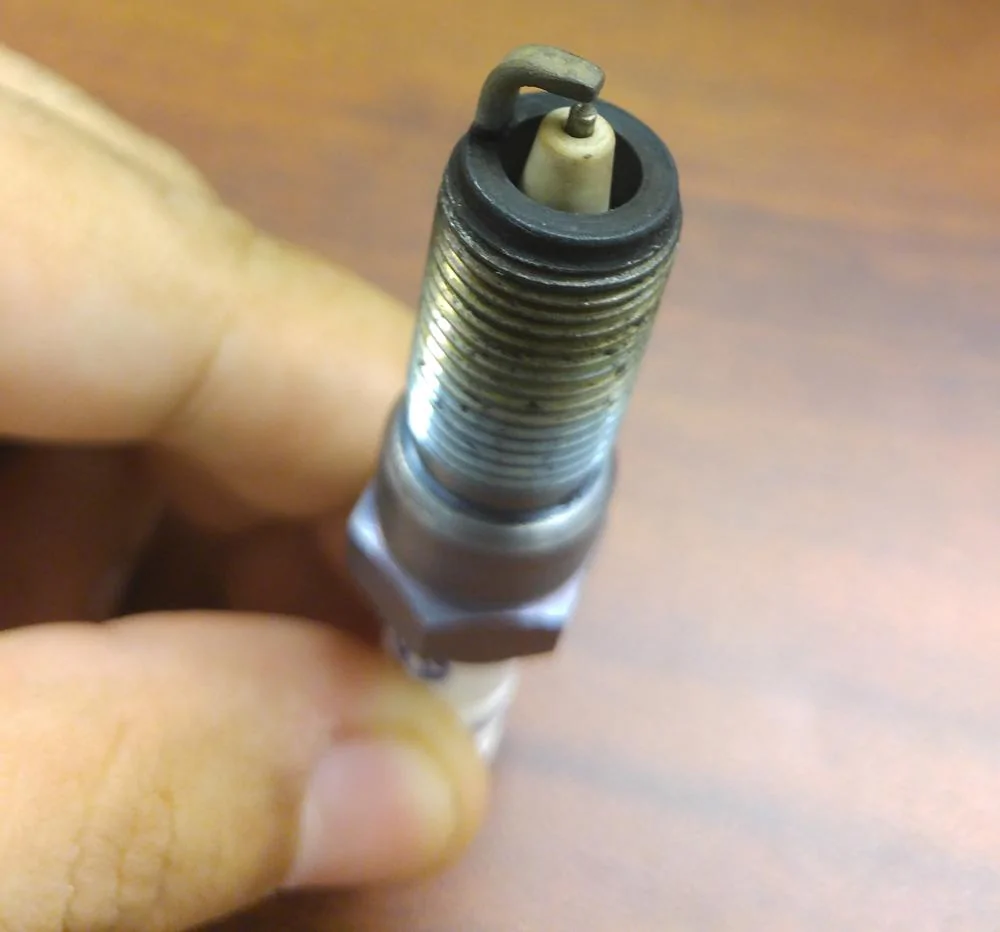
Cracked Plug Insulator

ypena02

Well-Known Member
Joined
Nov 14, 2015
Threads
27
Messages
789
Reaction score
203
Location
Massachusetts
Vehicle(s)
2017 Mustang GT
In fact this is often something that's misunderstood. Exhaust temps actually decrease with detonation / knock, not increase. People assume because it's running cooler it's always better...the most common failure of detonation is broken insulators as we have all stated.

Basically the remaining fuel residing close to the piston head detonates after the bulk of the fuel has detonated. The piston is still traveling downward at this point, so some of the force can be absorbed by transfer to the crank and to the wheels. Essentially the blast of the second smaller detonation happens very rapidly and "hammers" the top of the piston head. This can be caused by hot spots or inadequate thermal management OR inconsistent octane ratings. Run 87 octane with a Tune+ or LMS 93 tune and see what happens...

On high boosted or high power density engines it can result in damage if it occurs continually over just a few minutes and timing isn't adjusted accordingly. So far I don't think we have had a single 2016 fail, I have a may 2016 build and certainly have taken quite a few steps many others have not to mitigate heat (160F thermostat, 2" Mishimoto radiator, 1 step colder plugs, FMIC). Most people do just plugs and a FMIC but leave the radiator and thermostat stock, so I think Juben may be right, it's more fuel related and from what he stated about Adam's testing, there may be something to it.
Do you know what your coolant temps are during a typical 3rd or 4th gear pull?
Sponsored

 
OP
OP
TheLion

TheLion

Well-Known Member
Joined
Jul 1, 2016
Threads
68
Messages
1,621
Reaction score
601
Location
US
Vehicle(s)
Ruby Red 2016 Mustang GT PP 6-MT
Do you know what your coolant temps are during a typical 3rd or 4th gear pull?
Typically cylinder head temps are reported at 180~190. I don't think I've ever broken 200 with the LMS tunes and 160F thermostat. Cylinder head temps are a better metric than coolant temps as coolant temps can lag the immediate cylinder head temps (aka thermal lag, it takes time to transfer the heat).


Thanks for reaching out to us.

It is very difficult to diagnose what happened remotely but I can say in all honesty that we have never used Brisk spark plugs in any of our performance builds, the factory iridium plugs are more than adequate.

It looks like a pretty bad spark plug failure. If we had problems with knocking it wouldn't be unique to your situation and we would be in contact with many Ecoboost Mustang owners, so from my knowledge it looks as though the plug was bad.

If we can help with anything please don't hesitate to reach out to us.
According to LMS, they seem to think it's related to a plug defect, which MAY have some merit (more plug type than defect though). Remember the stock Iridium is a NON-projected tip, which will run cooler than a projected tip. The RR14YS is a projected tip where the RR14S is a non-projected tip. The YS will absorb more heat than the S variant. As you can see in my earlier post, Brisk suggests the YS for low boost or NA applications where they suggest the S for high boost, nitrous and other similar applications. Their tech support recommended the YS, but I'm starting to wonder if that was not the correct plug.

This may be a combination of multiple things going on here rather than just a single cause (usually the case in my experience, a compounding effect). I think it could be a result of both fuel characteristics and plug type. I think if I change both I may be back in the region of safe operation. I could also stick with 91 tune for a while and then move back up to 93 if there are no issues with 91.
 

xXANCHORMONXx

Well-Known Member
Joined
Nov 3, 2014
Threads
54
Messages
1,375
Reaction score
828
Location
SF CA
Vehicle(s)
2016 GT350 Track Pack
I think that you have made a two page thread about a bad set of plugs.

Buy the NGK 6510 or Denso 5340.
 
OP
OP
TheLion

TheLion

Well-Known Member
Joined
Jul 1, 2016
Threads
68
Messages
1,621
Reaction score
601
Location
US
Vehicle(s)
Ruby Red 2016 Mustang GT PP 6-MT
I think that you have made a two page thread about a bad set of plugs.

Buy the NGK 6510 or Denso 5340.
Lol. Just trying to flesh out all possibilities and reduce the possible re-occurrence of this. Like I've said before, for a street car it's a balancing act of performance vs. reliability / safety margins.

What I"m trying to figure out is if I've eaten into the reliability / safety margin side of things via the tune / fuel or if this was more of a plug defect / issue.
 

ypena02

Well-Known Member
Joined
Nov 14, 2015
Threads
27
Messages
789
Reaction score
203
Location
Massachusetts
Vehicle(s)
2017 Mustang GT
Typically cylinder head temps are reported at 180~190. I don't think I've ever broken 200 with the LMS tunes and 160F thermostat. Cylinder head temps are a better metric than coolant temps as coolant temps can lag the immediate cylinder head temps (aka thermal lag, it takes time to transfer the heat).
FYI, I have a completely stock cooling system and my cylinder head temps are very similar to yours.
 

Sponsored

xXANCHORMONXx

Well-Known Member
Joined
Nov 3, 2014
Threads
54
Messages
1,375
Reaction score
828
Location
SF CA
Vehicle(s)
2016 GT350 Track Pack
Lol. Just trying to flesh out all possibilities and reduce the possible re-occurrence of this. Like I've said before, for a street car it's a balancing act of performance vs. reliability / safety margins.

What I"m trying to figure out is if I've eaten into the reliability / safety margin side of things via the tune / fuel or if this was more of a plug defect / issue.
You definitely have. I have had a lot of turbo cars. Including the Ecoboost Mustang.

With being a mechanic for quite some time as well I have found the culprit in most turbo cars are the modifications. When someone brings in a car with issues, I always go to the aftermarket parts first.

There are exceptions ofcourse
 

TEXAS HEAT

Well-Known Member
Joined
May 25, 2016
Threads
37
Messages
706
Reaction score
281
Location
TEXAS
Vehicle(s)
2019 Mustang GT PP1 A10
I don't think this was pre-ignition, but rather detonation:

https://www.briskracing.com/spark-plug-diagnosis

I did notice the surface of piston #4 looked a bit rough in a few spots, there where several spots which reflected the scope camera's light and appeared to glow, two or three spots at the center of the piston, one towards the outer area, but not at the edge. There's only one reason I would see this in the camera, light is reflecting at a different angle in those areas due to deformation of the aluminum (it's not chunks blown away, but compression divets)

These are from the detonation event or several of them one of which finally broke the camel's back so to speak (the spark plug insulator). Detonation is far less concerning than pre-ignition if you resolve the cause.

So from the evidence I now have, it appears I have experienced a few detonation events and not pre-ignition. Knock is detonation, not pre-ignition which almost always results in cracked pistons, bent rods / bearings or damaged wrist pins.

So way back in my TST optimization thread before I got greedy...I was going to run a 91 tune but use 93 octane as a buffer (probably the most important aspect) to essentially eliminate any risk or pre-ignition or knock (detonation) as neither is exactly desirable. Unless there is some other way to mitigate this risk (aka, LMS may adjust their software on their 93 tune a bit if I present this evidence), I think the most I can reliably run is a 91 tune, given the variations if fuel octane (while it's highly controlled, it's not 100%, there is some permissible variation and running on the ragged edge may cause issues).

From what I see on Brisk's diagnosis, knock is not caused by the plug, but by the fuel octane rating variances and the sensitivity of the knock sensors (or in the case of PCM software, how it manages knock based on the knock sensor feedback).


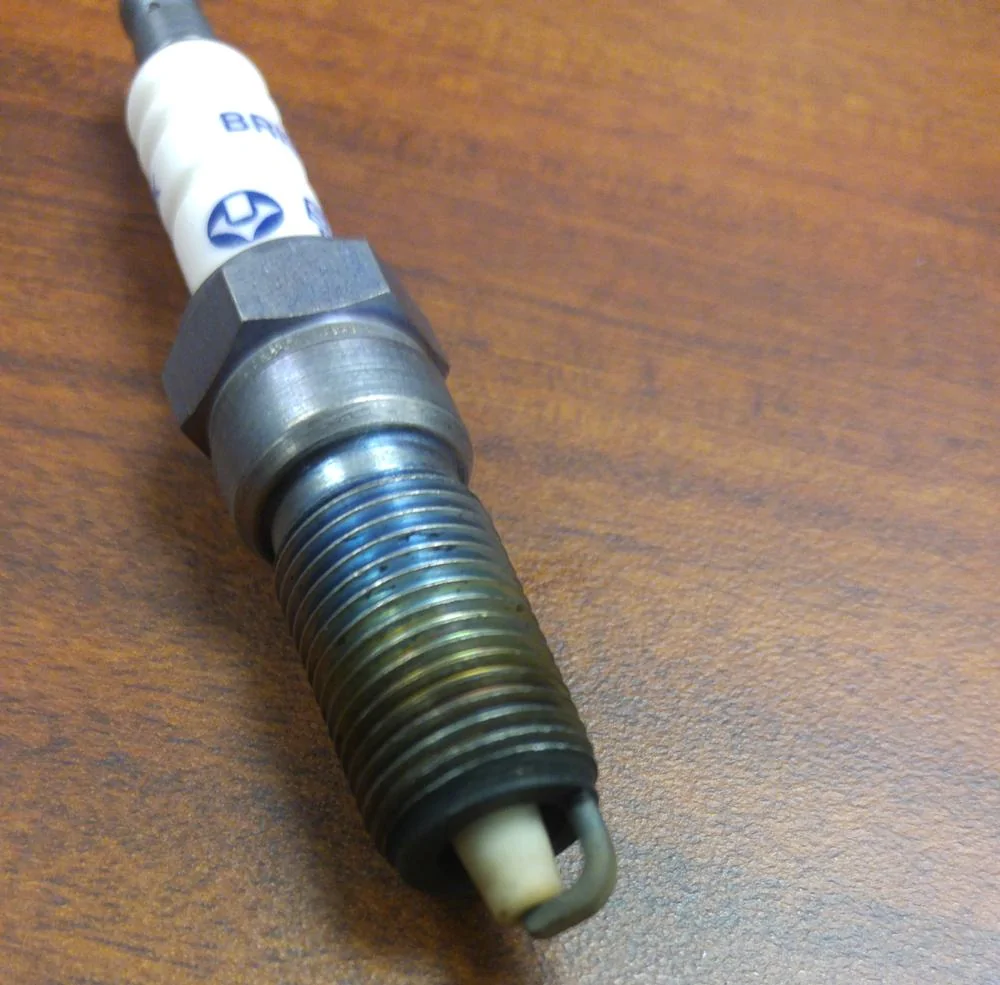
Here are the plugs, they appear to be in the proper heat range as far as I can tell.


The broken ground electrode concerns me. It looks to be a heat related fracture, not a clean break. It appears to have occurred over time, hence the pitting at the fracture point. What's more concerning is where is that broken piece now, inside the cylinder? To me, this looks to be inadequate octane, excessive cc temps and detonation, especially if you have two different types of damage to the plugs. Likely, too much timing advance for the fuel you were running.

I agree with Juben that Shell is one of the worst performing fuels. Also, I always try to limit the number of places I buy fuel, and always from the same vendor. In my case Valero. I monitor knock events and negative ignition corrections and know immediately if I run into a bad batch of fuel. I recently tried Sunoco 93 and immediately noticed an increase in knock activity and negative ignition corrections. Went back Valero and all symptoms were gone. Not all 93 octane is the same.

I don't have a long history of running Brisk plugs, as I'm on my first set, but so far so good. I normally ran NGK's in my Mazdaspeed and never had any plug issues FWIW.

I would definitely try to monitor negative ignition corrections and OAR which is the learned parameter value the PCM uses for its timing strategy.
 

speedfrk

Well-Known Member
Joined
Sep 11, 2015
Threads
37
Messages
988
Reaction score
426
Location
Atlanta
Website
www.nationalsuperbike.com
First Name
Curt
Vehicle(s)
2023 F150
Lol. Just trying to flesh out all possibilities and reduce the possible re-occurrence of this. Like I've said before, for a street car it's a balancing act of performance vs. reliability / safety margins.

What I"m trying to figure out is if I've eaten into the reliability / safety margin side of things via the tune / fuel or if this was more of a plug defect / issue.
Of course you've eaten into the safety margin... I'd take the LMS advice and install the stock plugs, properly gapped, 93 octane gas from BP or a large 2nd tier brand like Hess or Valero with little to no extra additives, and the 91 tune. The closer you get to the edge, the more likely you will fall off... As an ex flight test engineer, I'm definitely a diminishing returns guy. You always pay for that "last little bit" and it is always expensive.

I'd love to see side by side dyno runs on the LMS tune and the FR tune when it finally comes out. I bet they are very close.
 

CustomS550

Well-Known Member
Joined
May 10, 2016
Threads
51
Messages
335
Reaction score
77
Location
South Carolina
Vehicle(s)
2016 EB Mustang
I believe that he cut the electrode off to expose the break point.

I went through exactly the same issue not too long ago during a 5th gear dyno pull, but mine occurred in cylinder 3 as I had found out after I got the misfire codes.

Similarities are;

- Brisk plugs
- 93 Octane
- Aftermarket IC

Differences are;

- MMR Intake
- Turbo-back exhaust w/high flow cat
- Unleashed tune (Builds up to ~23psi vs 20psi for LMS)
- Stock thermostat

Looking at the dyno run datalog it looks like the computer was pulling up to a maximum of 2 degs. of timing at peak loads with the most being pulled within the 3500-4300 rpm range.

After I swapped in an older set of Denso ITV22s in there and switched to LMS' tuning (rather not push 23+ psi on a daily basis) everything has been OK for the last 1k miles. I also sent Blackstone Labs a 3k mile oil sample and they've responded with outstanding results - the cleanest 2.3L EB they've tested yet with only a slight thinning of the viscosity.

Mine and TheLion's circumstances are pretty varied so this would seem like a case of either QC issues at Brisk or an incorrect Brisk plug choice, however other EB mustangs with the same issue were not using Brisk plugs.

HERE's One Example

The broken ground electrode concerns me. It looks to be a heat related fracture, not a clean break. It appears to have occurred over time, hence the pitting at the fracture point. What's more concerning is where is that broken piece now, inside the cylinder? To me, this looks to be inadequate octane, excessive cc temps and detonation, especially if you have two different types of damage to the plugs. Likely, too much timing advance for the fuel you were running.

I agree with Juben that Shell is one of the worst performing fuels. Also, I always try to limit the number of places I buy fuel, and always from the same vendor. In my case Valero. I monitor knock events and negative ignition corrections and know immediately if I run into a bad batch of fuel. I recently tried Sunoco 93 and immediately noticed an increase in knock activity and negative ignition corrections. Went back Valero and all symptoms were gone. Not all 93 octane is the same.

I don't have a long history of running Brisk plugs, as I'm on my first set, but so far so good. I normally ran NGK's in my Mazdaspeed and never had any plug issues FWIW.

I would definitely try to monitor negative ignition corrections and OAR which is the learned parameter value the PCM uses for its timing strategy.
20161017_124750.webp
20161017_124806.webp
 
Last edited:
OP
OP
TheLion

TheLion

Well-Known Member
Joined
Jul 1, 2016
Threads
68
Messages
1,621
Reaction score
601
Location
US
Vehicle(s)
Ruby Red 2016 Mustang GT PP 6-MT
Of course you've eaten into the safety margin... I'd take the LMS advice and install the stock plugs, properly gapped, 93 octane gas from BP or a large 2nd tier brand like Hess or Valero with little to no extra additives, and the 91 tune. The closer you get to the edge, the more likely you will fall off... As an ex flight test engineer, I'm definitely a diminishing returns guy. You always pay for that "last little bit" and it is always expensive.

I'd love to see side by side dyno runs on the LMS tune and the FR tune when it finally comes out. I bet they are very close.
That's just what I was thinking about the LMS 91 and FR tune. The FR tune is for 91 octane. As I stated, I was originally going to run their 91 tune but use 93 as a hedge against knock for long term reliability. But this appears to be my mistake, here's what happened:

When I first started modding, I was not going to use any aftermarket software until the FR tune came out. But The FR tune kept getting delayed and delayed and it's still not out to this day...so I looked at alternatives and LMS was darn close, worked with FP / FR for R&D as well Ford on OE testing, their track record and performance etc...it was the best alternative I felt (not going to debate Tune+, Lund etc., not knocking them or any other, LMS was my choice however based my research and personal criteria I felt mattered).

That being said, the plugs, FMIC and BOV were the first upgrades. Ran that for a thousand or miles and finally decided to go further then with a tune, thermostat and radiator upgrade. But I NEVER re-examined the plugs and weather or not they were appropriate for the application as the application now changed! :doh:

Thank you for the information this helps a lot. If you go back and visit your original email which you disclosed that the car was "The car is mostly stock other than an upgraded inter cooler" and was the basis for a recommendation of the 1 heat range colder Projected Tip RR14YS recommendation.


Additionally we noted when recommending the RR14YS spark plug that if there were additional modifications that a colder heat range plug may be needed. "Here is the factory replacement recommendation for your engine, if modified it may need a colder heat range:" If I need to can forward you both emails for your reference.


I understand that there was no disclosure because the parts from Livernois, whom we are familiar with and have done business with in the past, were not equipped on the car at that time.


These engines are sensitive to spark plug heat range and also susceptible to knock which you are correct does tend to occur more frequently under partial load but does also occur under WOT. Ambient temperatures are also often deceitful.. hotter air temperatures means that the air is less dense and dryer.. cooler air temperatures create a more dense air composition and actually can result in an increase in IATs.


This is not the plugs fault or a defect of manufacturing, the torque setting you used was appropriate but the heat range was not... the cracked ceramic is going to be a result of engine knock. Based on your modifications listed now we would most definitely recommend a non-projected spark plug and may even suggest going to a colder heat range - how much horsepower are you making on the current set up?


We apologize for the inconvenience and would like you to be happy with our products as we have had excellent feedback with the EcoBoost market in all platforms. We can offer you a substantial discount for a replacement set as a gesture of customer satisfaction. The spark plugs would be $6.50/each opposed to the retail price of $10.99/each. Please let us know if you would be interested in taking advantage of this.


If you could please let us know how much power you are making currently so we can get an idea of what the car is making now with the power adder modifications!


Best Regards,


Bret Lednicky

Office Manager

Brisk USA Enterprises LLC.

North American Market Division

www.BriskUSA.com

Cell: 281-299-1095

Tel. 713-459-6977

Fax. 866-583-6239
I started to come to that conclusion myself after my "colorful" post which described the different applications. The projected tip design was no longer appropriate and is likely absorbing too much heat. I will probably just use stock or if I take Brisk up on their offer, I'll go with two step colder and non-projected tip. That should take car of this issue (and I'll probably just run BP or large volume speedway gas). Still debating on weather I want to keep using 93 tune or have a bit more head room with 91 tune + 93 gas.
 

Sponsored

TEXAS HEAT

Well-Known Member
Joined
May 25, 2016
Threads
37
Messages
706
Reaction score
281
Location
TEXAS
Vehicle(s)
2019 Mustang GT PP1 A10
That's just what I was thinking about the LMS 91 and FR tune. The FR tune is for 91 octane. As I stated, I was originally going to run their 91 tune but use 93 as a hedge against knock for long term reliability. But this appears to be my mistake, here's what happened:

When I first started modding, I was not going to use any aftermarket software until the FR tune came out. But The FR tune kept getting delayed and delayed and it's still not out to this day...so I looked at alternatives and LMS was darn close, worked with FP / FR for R&D as well Ford on OE testing, their track record and performance etc...it was the best alternative I felt (not going to debate Tune+, Lund etc., not knocking them or any other, LMS was my choice however based my research and personal criteria I felt mattered).

That being said, the plugs, FMIC and BOV were the first upgrades. Ran that for a thousand or miles and finally decided to go further then with a tune, thermostat and radiator upgrade. But I NEVER re-examined the plugs and weather or not they were appropriate for the application as the application now changed! :doh:


I started to come to that conclusion myself after my "colorful" post which described the different applications. The projected tip design was no longer appropriate and is likely absorbing too much heat. I will probably just use stock or if I take Brisk up on their offer, I'll go with two step colder and non-projected tip. That should take car of this issue (and I'll probably just run BP or large volume speedway gas). Still debating on weather I want to keep using 93 tune or have a bit more head room with 91 tune + 93 gas.
IIRC, @Juben stated he tried running the RR12YS which in his application was too cold of a plug, therefore he switched to the non-projected tip of the RR14YS and is seeing no issues. I will say this though, had you not had the projected tip to "catch" the insulator, that could've ended up in your combustion chamber. Your pictures of the plugs did appear to have suffered from some elevated cylinder temps, pressures and detonation.
 

ypena02

Well-Known Member
Joined
Nov 14, 2015
Threads
27
Messages
789
Reaction score
203
Location
Massachusetts
Vehicle(s)
2017 Mustang GT
I believe that he cut the electrode off to expose the break point.

I went through exactly the same issue not too long ago during a 5th gear dyno pull, but mine occurred in cylinder 3 as I had found out after I got the misfire codes.

Similarities are;

- Brisk plugs
- 93 Octane
- Aftermarket IC

Differences are;

- MMR Intake
- Turbo-back exhaust w/high flow cat
- Unleashed tune (Builds up to ~23psi vs 20psi for LMS)
- Stock thermostat

After I swapped in an older set of Denso ITV22s in there and switched to LMS' tuning (rather not push 23+ psi on a daily basis) everything has been OK for the last 1k miles. I also sent Blackstone Labs a 3k mile oil sample and they've responded with outstanding results - the cleanest 2.3L EB they've tested yet with only a slight thinning of the viscosity.

Mine and TheLion's circumstances are pretty varied so this would seem like a case of either QC issues at Brisk or an incorrect Brisk plug choice, however other EB mustangs with the same issue were not using Brisk plugs.

HERE's One Example
Which oil are you using?
 
OP
OP
TheLion

TheLion

Well-Known Member
Joined
Jul 1, 2016
Threads
68
Messages
1,621
Reaction score
601
Location
US
Vehicle(s)
Ruby Red 2016 Mustang GT PP 6-MT
Here's what I got from Brisk on their latest response:

Thank you for the information, it is alright it was just a miscommunication, the RR14YS looks like it was burning really cleanly, but was just a bit too warm in a projected tip format for the additional power made. a 90 ft/lbs torque increase is HUGE and makes a ton of more heat, even with supporting cooling system mods it was still just a little on the hot side.

Would recommend to go with a non-projected configuration the RR14S will be a good fit and will combat the knock issue you are occuring if you do not plan on increasing in power. If you plan on increasing power and pushing the car harder, would probably recommend going another step colder in heat range to the RR12S.

Please let us know when you would like to get the new set on order.
According to them my particular engine is very clean burning, but if you notice there is a yellowish discoloration of the ceramic, aka heat discoloration. I asked them about the RR12S, but I'm guessing they will reply those are likely too cold.

BTW, I bent the ground electrode back to let the insulator slide out, it didn't come out of the engine like that. All three photos are of the same plug, in one photo I tipped plug up so the insulator slide back up and I could see the electrode. The other I tipped it down so the insulator slid back down. Then I pried the ground electrode up so I could see down inside the plug to see if I had blow out.

The knock event was certainly severe enough to crack the insulator that's for sure. My oil is definitely getting dirty (dark brown, but not black), 8200 miles now on the factory fill, yah yah yah, some of you will say I'm crazy, but I want those bearings / cams to be broken in.

Oil indicator still seems on par for a 10k change (says 20%), user manual doesn't call for first change until 10k or oil light and I have upgraded cooling. Also I've only used about a 1/2 quart, all of which pretty much ended up in the UPR can. Currently the oil level is right at the top of the hatch.
 
Last edited:
OP
OP
TheLion

TheLion

Well-Known Member
Joined
Jul 1, 2016
Threads
68
Messages
1,621
Reaction score
601
Location
US
Vehicle(s)
Ruby Red 2016 Mustang GT PP 6-MT
IIRC, @Juben stated he tried running the RR12YS which in his application was too cold of a plug, therefore he switched to the non-projected tip of the RR14YS and is seeing no issues. I will say this though, had you not had the projected tip to "catch" the insulator, that could've ended up in your combustion chamber. Your pictures of the plugs did appear to have suffered from some elevated cylinder temps, pressures and detonation.
BTW, now you know, if you go with a 93 tune of any type you need to change out your RR14YS plugs for RR14S. The "Y" denotes projected tip.

Both the OE iridium and RR14S are non-projected tip, but RR14S is listed as 1 step colder than stock, which would mainly be due to the thermal properties of the sliver electrode as otherwise they are pretty similar in shape. The YS variant is also listed as 1 step colder, but it seems to have the net effect of making it in practical application 2 steps hotter just due to the tip being exposed more...interesting.
Sponsored


Top