Sponsored

Breather experts come in

OP
OP

SHFTN6

Well-Known Member
Joined
Dec 31, 2014
Threads
34
Messages
278
Reaction score
45
Location
Belleville, il
First Name
Tyler
Vehicle(s)
2015 Premium GT Performance Pack
Sorry to revive an old thread but I was wondering if anyone had a problem with excessive blow-by and primarily smoke out of the exhaust until this was corrected? I've order the JDM setup because I'm not fully comfortable with just jamming a screwdriver into the pcv piece *unless I'm supposed to go from the underside and push it out*. However, after the turbo install, I'm not getting a small to moderate amount of smoke from the tail pipe (normally white) that smells likes burnt oil when I come to a stop and blows forward. I've noticed that my driver's side breather is showing the exact same signs as the OP so I'm wondering if this will correct it. Any input would be greatly appreciated.

Thank you.
Pcv spins out of valve cover then gut it
Sponsored


pwny

Well-Known Member
Joined
Jan 1, 2016
Threads
0
Messages
106
Reaction score
32
Location
Sterling Heights, Michigan
Vehicle(s)
2016 GT PP
Okay. So I can just straight up jam a screwdriver in from behind without repercussion?
 
OP
OP

SHFTN6

Well-Known Member
Joined
Dec 31, 2014
Threads
34
Messages
278
Reaction score
45
Location
Belleville, il
First Name
Tyler
Vehicle(s)
2015 Premium GT Performance Pack
Okay. So I can just straight up jam a screwdriver in from behind without repercussion?
Once you have the pcv valve in your hand you'll know which way to take the parts out. There will be no loose pieces it comes apart nicely.
 

TooSoonJunior

Well-Known Member
Joined
Feb 10, 2017
Threads
79
Messages
823
Reaction score
175
Location
Southern CT
Vehicle(s)
2015 Mustang GT PP M6
Just a personal note here, unless you are extremely high boost pressure/power say greater than 900whp, there is nothing better than a closed loop style PCV setup (ie like factory with passenger side under vacuum during idling cruising, closed during WOT, driver side connected to intake tube (small venturi effect)).

To keep this setup on a FI vehicle you would want to run two catch cans, one on each side, with the factory PCV valve still in place. Majority of oil accumulation occurs during regular and moderate driving and is eliminated by evacuating the crankcase pressure; vented to pure atmosphere you are doing nothing but allowing excess pressure out, but are not actually drawing in any fresh air nor evacuating any of those nasty oil vapors. For those guys running straight to atmosphere, after a good WOT run after lift off, the quick burst of crank case pressure will carry all that accumulated vapor that you never evacuated and give you a nice big blast of oily air. A properly evacuated system will have the same big blast, but itll be way less oily air, mostly fresh air.
 

pwny

Well-Known Member
Joined
Jan 1, 2016
Threads
0
Messages
106
Reaction score
32
Location
Sterling Heights, Michigan
Vehicle(s)
2016 GT PP
Just a personal note here, unless you are extremely high boost pressure/power say greater than 900whp, there is nothing better than a closed loop style PCV setup (ie like factory with passenger side under vacuum during idling cruising, closed during WOT, driver side connected to intake tube (small venturi effect)).

To keep this setup on a FI vehicle you would want to run two catch cans, one on each side, with the factory PCV valve still in place. Majority of oil accumulation occurs during regular and moderate driving and is eliminated by evacuating the crankcase pressure; vented to pure atmosphere you are doing nothing but allowing excess pressure out, but are not actually drawing in any fresh air nor evacuating any of those nasty oil vapors. For those guys running straight to atmosphere, after a good WOT run after lift off, the quick burst of crank case pressure will carry all that accumulated vapor that you never evacuated and give you a nice big blast of oily air. A properly evacuated system will have the same big blast, but itll be way less oily air, mostly fresh air.
Okay. That's definitely a little more re-assuring. I just gutted the pcv and I'm going to test it later on today. However, when driving over the past week it definitely seems to have a decent amount of oil accumulation in the exhaust. I just polished the tips on Saturday and they're already pretty dark again. I would've run a catch can system but honestly, the Hellion setup was already so cramped I just wanted a little breathing room in there. I just haven't seen a lot of videos or posts about an excessive amount of oil being burned through this system. It's boosting great and it's intermittent, so I'm doubtful that it's a head gasket or piston ring (I haven't even been to 10lbs yet).
 

Sponsored

TooSoonJunior

Well-Known Member
Joined
Feb 10, 2017
Threads
79
Messages
823
Reaction score
175
Location
Southern CT
Vehicle(s)
2015 Mustang GT PP M6
What you are describing sounds like some oil seepage in the journals of the turbos. Do you have a turbo timer? Double check your oil line returns, make sure nothing is kinked or off kilter.
 

pwny

Well-Known Member
Joined
Jan 1, 2016
Threads
0
Messages
106
Reaction score
32
Location
Sterling Heights, Michigan
Vehicle(s)
2016 GT PP
I do not have a turbo timer installed at the moment. I typically part and let it run with the hood up for at least a minute or two when I get home though before shutting it off. I'll have to double check the lines. There very well could be something kinked then with how cramped this setup is.
 

whatsup62

Well-Known Member
Joined
Sep 16, 2015
Threads
129
Messages
2,046
Reaction score
525
Location
Jupiter
Vehicle(s)
2015 Mustang GT PP (Gone but not forgotten).
Just a personal note here, unless you are extremely high boost pressure/power say greater than 900whp, there is nothing better than a closed loop style PCV setup (ie like factory with passenger side under vacuum during idling cruising, closed during WOT, driver side connected to intake tube (small venturi effect)).

To keep this setup on a FI vehicle you would want to run two catch cans, one on each side, with the factory PCV valve still in place. Majority of oil accumulation occurs during regular and moderate driving and is eliminated by evacuating the crankcase pressure; vented to pure atmosphere you are doing nothing but allowing excess pressure out, but are not actually drawing in any fresh air nor evacuating any of those nasty oil vapors. For those guys running straight to atmosphere, after a good WOT run after lift off, the quick burst of crank case pressure will carry all that accumulated vapor that you never evacuated and give you a nice big blast of oily air. A properly evacuated system will have the same big blast, but itll be way less oily air, mostly fresh air.
So...not totally understanding this...here is why I went with breathers...if there is a better way of eliminating my main goal..all ears.
Main goal - Eliminate oil in intake manifold.
Before when I was NA I had the JLT seperator on the PCV line. I would empty a teaspoon or two out of it every 2-3k miles. When I installed my Procharger (required taking off TB) I reached into the intake manifold and felt A LOT of oil. Took a rag in there and soaked up a shit ton of oil (translation A LOT).
I went and purchased an expensive catch can set-up specifically designed for the PC and installed it. After a couple thousand miles I emptied it and there was probably an ounce of watery nasty stuff...now I am thinking I'm Golden. Settle in and just drive the car now not looking under the hood very often. Went and did an oil change on the car. Noticed a lot of oily residue on the left side of the Procharger head unit and support bracket. Started to panic a bit and thought the head unit was leaking oil...made a post on here about it. Procharger Tech made a response in the thread that they have very little issue with leaks, what he suggested was excessive oil vapor was coming back through the intake tube and the Procharger has no way of returning that oil...it starts to accumulate and leaks out the impeller area on the head unit.
I wasn't totally buying that because I just spent some serious cash for a catch can and was seeing it catch stuff. I continued this way for a short time then installed the MAK inlet tube. When I pulled the original PC tube off i discovered PC tech was correct ...the tube was coated with oil, my filter was nasty and the head unit had oil in the rotor vane area. Figured this was a good time to swap intake manifolds. Took the stock intake off and it was just as oily as it was the first time I had the JLT can on there. Put on the new Edelbrock intake and installed breathers. It been that way for about 2-3k miles. Two weeks ago i did some routine maintenance and decided to pull of the TB. The inside of the intake was absolutely spotless...just like it was when I installed it. I am running 10psi and am sure getting the oil out of the intake has improved the performance of the car.
Sorry for the long post...wanted to explain how I got to where I am at. If I went back to your suggestion I feel I would be back to trying to eliminate my main goal. Cruising down the hwy I see 22 inches of vacuum.
 

15GTPP

Well-Known Member
Joined
Jan 13, 2015
Threads
36
Messages
428
Reaction score
223
Location
El Paso
First Name
Chris
Vehicle(s)
2019 GT
So...not totally understanding this...here is why I went with breathers...if there is a better way of eliminating my main goal..all ears.
Main goal - Eliminate oil in intake manifold.

Sorry for the long post...wanted to explain how I got to where I am at. If I went back to your suggestion I feel I would be back to trying to eliminate my main goal. Cruising down the hwy I see 22 inches of vacuum.
I'm surprised by your results. I've always wanted to test some breathers out but just went with the upr catch can. Do you have anything connected to the bung on the intake pipe or do you just let it vent as well? Did you have to do anything to the pcv system?

Also what breathers are you using?

Sorry for all the questions :headbonk:
 

TooSoonJunior

Well-Known Member
Joined
Feb 10, 2017
Threads
79
Messages
823
Reaction score
175
Location
Southern CT
Vehicle(s)
2015 Mustang GT PP M6
So...not totally understanding this...here is why I went with breathers...if there is a better way of eliminating my main goal..all ears.
Main goal - Eliminate oil in intake manifold.
Not surprised at all with your results. The main goal of any PCV system is to eliminate crank case pressure and evacuate the oil vapors (spent gases from the combustion process mixed with your oil). There are many ways to go about it, unfortunately any that utilize the motors vacuum it naturally produces will face the risk of sucking the same vapors right back through the combustion process. In fact factory systems are designed to burn off the excess vapors, and so are designed to let the oil vapors pass right through and into the intake. And as preached (correctly so) this can and will hurt performance.

But if you set aside your failed result in a factory-style routing, think about it this way...you have four choices in how to relieve and/or evacuate your crank case. (1) Factory vacuum on one side, vent on other side, (2) open to atmosphere on both sides, (3) vent to exhaust (creates venturi effect as exhaust has velocity and with suck out the vapors as it passes by the connection point), or (4) some sort of mechanical vacuum source such as a electric or belt driven vacuum pump.

Option (1) provides THE BEST evacuation, as you will be constantly applying vacuum to the crankcase on the passenger side and pulling in fresh air from the driver side. However, you have THE HIGHEST chance of putting oil residue right back into the motor. There are some pretty fancy oil catch cans out there, if you found that you were still blowing vapors into the intake, well then sorry to say that catch can isn't living up to its job. I have used MANY different brand catch cans over the years on some very high horsepower setups...my findings were BIGGER is better, and any design where the inlet and outlet of the catch can are horizontally aligned, no bueno. The volume of crank case pressure after a full throttle pull is nearly impossible for this type of design to accommodate, coupled with the fact that the instant you let off the throttle you also are applying MAXIMUM vacuum on the port of the catch can directly across from the port that the huge amount of oil vapor is coming in. You have to dig into the design too, some catch cans appear to have the inlet/outlet aligned but when you open it up, some have machined a passage that makes the outlet vent from the bottom of the can, this is GOOD. No stainless mesh filled catch can will be able to cope with that scenario, either. Further, the stainless mesh designs will release oil vapor over time as the catch can heats up and you apply vacuum under regular driving.

The best designed cans for option (1) have been universal (even ebay ok) where the top of the can has two vertical inlet/outlets, with a mesh filling, that has a separate side for inlet and outlet (like a divider between). The other name brand I have seen is made for the Hemi platform made by API, their design is the best I have seen, inlet goes to a spiral machined path way packed with mesh, deposits to the can below, the outlet is venting from the can and has a oil resistant mesh filter before the air exits as extra precaution. This design worked the BEST on the DRIVER side, which is where the big blast of air will come after a full throttle pull, if you have your factory PCV valve still installed. I haven't found many basic catch cans that couldn't do the job on the passenger side, but still need to run a good quality one with easy drain.

If you want to just ensure you have a 100% clean intake, and don't allow excess crankcase pressure, and dont want smokey pipes after a full throttle pull (happens with (3)) then a vent to atmosphere is your next best option (2). However, a simple filter on each valve cover is NOT GOOD. In less than 1000 miles you will likely oil soak the filter, which will DRASTICALLY reduce its breathing ability, and without knowing you could actually be not venting ANY pressure anymore, really wont know until you start seeing smoke out the tail pipe or leaky valve cover gaskets. Best to get a large overflow style tank, and route both valve cover vents, with passenger PCV valve gutted, to the large tank, which should come fitted with a large filter on the top. Its a BIG looking setup, but works very well if your primary concern is oil vapor.

Option (3) is very basic, works better than (2) both during cruising and WOT but isn't as good as (1) for cruising and idling. You WILL see smoke after a pass on the highway or hard WOT pull. Most universal exhaust vent kits include an oil accumulator that installs in the vent lines on both sides, but are designed to puke whatever is in them after ever full throttle run and burn the oil off through the exhaust.

Option (4) is expensive and really doesn't work well on more modern cars.

Hope that helps a bit....
 

Sponsored

rredd14

Well-Known Member
Joined
Oct 9, 2015
Threads
14
Messages
157
Reaction score
16
Location
Mississippi
First Name
Robert
Vehicle(s)
Magnetic 2018 GT A10
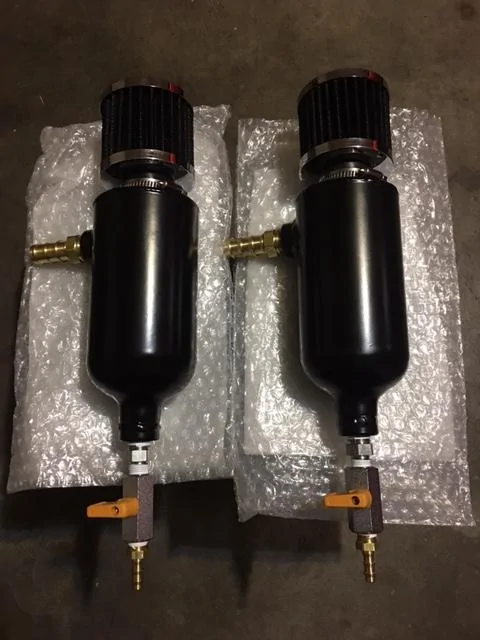
I put these together and ended up just mounting 1 in the driverside
front fender well area. I ran 5/8" hose from the passenger valve cover
and tied in with a "T" to the driverside valve cover and ran a single hose
to the breather can. The drain hose comes out just behind the air diverter
under the front end.

IMG_2857.webp
 

doodguy

Well-Known Member
Joined
Jul 8, 2015
Threads
249
Messages
1,566
Reaction score
156
Location
Ruskin, FL
Vehicle(s)
2015 Roush Stage 1 Supercharged Mustang GT
I put these together and ended up just mounting 1 in the driverside
front fender well area. I ran 5/8" hose from the passenger valve cover
and tied in with a "T" to the driverside valve cover and ran a single hose
to the breather can. The drain hose comes out just behind the air diverter
under the front end.

IMG_2857.webp
Where did you get these? Cost?
 

whatsup62

Well-Known Member
Joined
Sep 16, 2015
Threads
129
Messages
2,046
Reaction score
525
Location
Jupiter
Vehicle(s)
2015 Mustang GT PP (Gone but not forgotten).
I'm surprised by your results. I've always wanted to test some breathers out but just went with the upr catch can. Do you have anything connected to the bung on the intake pipe or do you just let it vent as well? Did you have to do anything to the pcv system?

Also what breathers are you using?

Sorry for all the questions :headbonk:
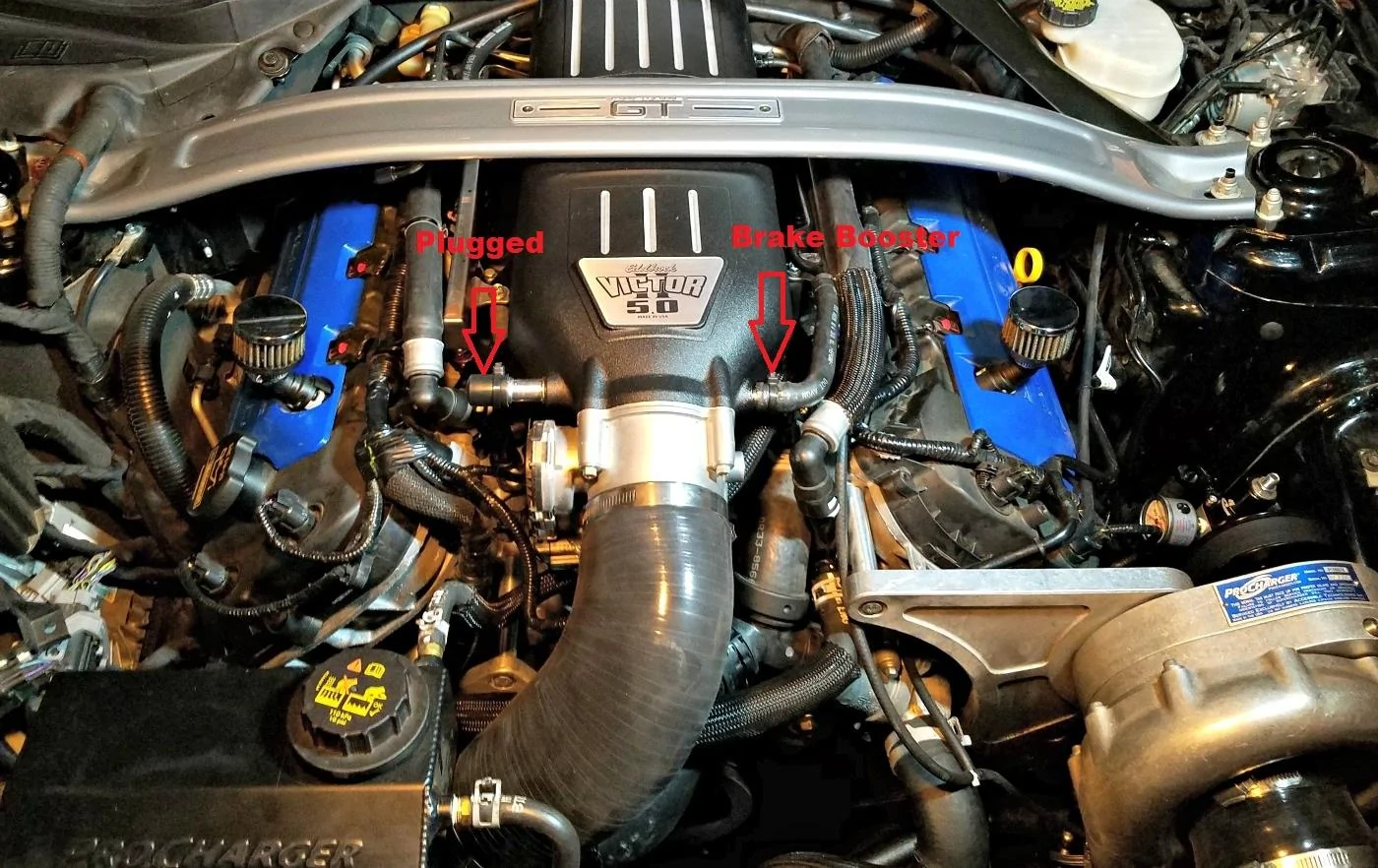
Only two bungs on the intake as shown in pic. One is capped off the other is routed to the brake vacuum booster.
Breathers - http://www.teamjdm.com/2011-2015-mustang-gt-boss-coyote-engine-breather-kit-by-jdm/

Best to get a large overflow style tank, and route both valve cover vents, with passenger PCV valve gutted, to the large tank, which should come fitted with a large filter on the top. Its a BIG looking setup, but works very well if your primary concern is oil vapor.
Hope that helps a bit....
It does..thanks....I like the tank idea.
Victor_line.webp
 

TooSoonJunior

Well-Known Member
Joined
Feb 10, 2017
Threads
79
Messages
823
Reaction score
175
Location
Southern CT
Vehicle(s)
2015 Mustang GT PP M6
Most of the time, when you have a good quality catch can on the passenger side, adding a good quality one on the driver side or adding an overflow can to the driver side will fix 99% of the problem.
 

rredd14

Well-Known Member
Joined
Oct 9, 2015
Threads
14
Messages
157
Reaction score
16
Location
Mississippi
First Name
Robert
Vehicle(s)
Magnetic 2018 GT A10
Where did you get these? Cost?
HotRod99 Aluminum breather can. Single 1/2 NPT fitting. #9423-1-2-BK
Ordered from Amazon. The fittings came from a local fittings store.
$56.00 for the breather and $40.00 for the fittings.
Sponsored


Top