Sponsored

Another oil question.

robvas

Well-Known Member
Joined
Nov 18, 2023
Threads
15
Messages
3,483
Reaction score
3,272
Location
MI
Vehicle(s)
2011 GT
If you could read you would see that cranking the engine doesn't do what you think it does. It doesn't turn the pump fast enough. It's not a small block ford. You must prime the engine in a different way.

but your engine isn't dry after three months anyways, it doesn't need "primed", so if you want to keep doing that, go right ahead

Just trying to help others out with factual information
Sponsored
 

sk47

Well-Known Member
Joined
Nov 12, 2020
Threads
32
Messages
6,806
Reaction score
3,156
Location
North Eastern TN
First Name
Jeff
Vehicle(s)
Chevy Silverado & Nissan Sentra SE
If you could read you would see that cranking the engine doesn't do what you think it does. It doesn't turn the pump fast enough. It's not a small block ford. You must prime the engine in a different way.

but your engine isn't dry after three months anyways, it doesn't need "primed", so if you want to keep doing that, go right ahead

Just trying to help others out with factual information
Hello; A point we can agree on. A consumer's private car which has been driven for eight to nine months and then parked for three or four is not the same as a new or rebuilt engine.
Such a parked engine is not going to be exactly dry as there will be oil in small pockets in the upper parts of the engine and the oil pan will hold oil.

I cannot attest that in three months all the oil film from upper engine parts has drained away but do figure most has. Such is one of the big questions - does the oil film last and for how long. My thinking is during that initial few seconds after a start up some upper engine parts will be briefly without oil.

I also suspect that some bearing surfaces which need oil pressure (crank bearings, connecting rod bearings, camshaft bearings) will not have much oil pressure immediately after three months. My unproven logic is if we can spin the starter a few seconds without ignition at the very least some oil will make its way into these bearings and coat the surfaces without the punishing pounding of a combustion stroke. That some members have reported an oil pressure reading from just spinning the starter is a strong clue. Not full oil pressure to be sure but likely enough to help mitigate.
Say we pull the injector fuse then spin the starter 10 to 20 seconds. In the time it takes to get out of the car and replace the fuse all oil pressure is gone. Same as anytime we shut off an engine. We replace the fuse and moments later fire up the engine after three months. At least all the surfaces are coated with an oil film.

We agree on one other point. Those who wish to try the pre-oil methods can do so. Those who do not do not have to.
 

Robottrainer

Well-Known Member
Joined
Apr 25, 2021
Threads
79
Messages
992
Reaction score
421
Location
Canada
First Name
John
Vehicle(s)
2018 Ford Escape. 2020 Jeep Cherokee. 2021 Ford Mustang GT Stage 2 Roush
Hello; This is a method used on new engines or rebuilt engines which have never been run has been my take. The new engines do not have a distributor so the old school methods do not work. I have looked at engine building videos during which such a device was used just prior to a start up.
During assembly of a new or rebuilt engine I imagine all use some form of assembly lube. I also assume most soak hydraulic lifters in a container of oil for a n hour or few during assembly.

For the sake of this discussion I suppose such a pressure vessel could be attached to an engine which has merely been sitting a few months. Likely would be a serious pain to do but the obvious benefit would be oil on all internal moving surfaces. Such a thing might be impractical on every single car but not a wrong thing to do.
The crux of this particular topic is we have two practical alternatives we can easily use. Any of us can pull a fuse. Those with the "food clear" programing built into the engine control can use that feature.

The back and forth with you (robvas) appears to me to be more that the notion is something you do not like. Let me lump in prefilling an oil filter before instillation which you have also rejected.

I get the point you are trying to make in that the last line in the above link is do not prime the engine by cranking it. Again this is for new or rebuilt engines is my take. The flaw in the argument is you contend we should just crank and start up an engine which has sat for four months without any pre oiling. How is this any different than pulling a fuse and cranking the engine over for a few seconds? The same oil pump spins and pushes oil in both cases.

Those reading this and the other thread can think about it and decide for themselves. I welcome any insight as to what the flaws are in my arguments. I do not want to hurt my engine.
Not looking for an argument. Its more of a fwiw moment. I would agree, for a dry engine that has never run and doesn't have a distributor drive. This or an accusump system would be needed. With an engine already in service, it's a bit different.

Seeing it's Ford Performance and from the description, this appears to be a freshly assembled crate engine.

Can you show us evidence in the S550 service manual or owners manual with the same warning regarding after storage start up?

Oil is already on the bearing and contact surfaces. All you are really doing is pressurizing the lifters. You already know the oil pressure was good before storing the car.

Here's alogical question. Is it better to have the full force and elevated rpm on an engine that hasn't run in months or 30 seconds of compression/intake load at 100rpm? Will there be wear? If their is, I'll bet it's more with a running engine with no oil pressure for 5-10 seconds.

How many of us have one of these oil pressurization systems at their home garage or is going to pull the oil pressure sending unit to hook it up?

I've been doing this a very long time even when I raced. Tearing down the engine every year did not reveal a problems.

At the end of the day it's your choice.
If you could read you would see that cranking the engine doesn't do what you think it does. It doesn't turn the pump fast enough. It's not a small block ford. You must prime the engine in a different way.

but your engine isn't dry after three months anyways, it doesn't need "primed", so if you want to keep doing that, go right ahead

Just trying to help others out with factual information
Reading and comprehension are two different things my friend. The oil pressure guage doesn't lie. It does turn fast enough to build oil pressure unless your oil pump rotors are completely whipped. And again comprehension...it's more a method to get the lifters pumped up so they don't chatter like party teeth and it doesn't run like dog crap when you first fire it. I did mention that didn't I? I'll post a nice video for you in March.
 

Robottrainer

Well-Known Member
Joined
Apr 25, 2021
Threads
79
Messages
992
Reaction score
421
Location
Canada
First Name
John
Vehicle(s)
2018 Ford Escape. 2020 Jeep Cherokee. 2021 Ford Mustang GT Stage 2 Roush
Hello; A point we can agree on. A consumer's private car which has been driven for eight to nine months and then parked for three or four is not the same as a new or rebuilt engine.
Such a parked engine is not going to be exactly dry as there will be oil in small pockets in the upper parts of the engine and the oil pan will hold oil.

I cannot attest that in three months all the oil film from upper engine parts has drained away but do figure most has. Such is one of the big questions - does the oil film last and for how long. My thinking is during that initial few seconds after a start up some upper engine parts will be briefly without oil.

I also suspect that some bearing surfaces which need oil pressure (crank bearings, connecting rod bearings, camshaft bearings) will not have much oil pressure immediately after three months. My unproven logic is if we can spin the starter a few seconds without ignition at the very least some oil will make its way into these bearings and coat the surfaces without the punishing pounding of a combustion stroke. That some members have reported an oil pressure reading from just spinning the starter is a strong clue. Not full oil pressure to be sure but likely enough to help mitigate.
Say we pull the injector fuse then spin the starter 10 to 20 seconds. In the time it takes to get out of the car and replace the fuse all oil pressure is gone. Same as anytime we shut off an engine. We replace the fuse and moments later fire up the engine after three months. At least all the surfaces are coated with an oil film.

We agree on one other point. Those who wish to try the pre-oil methods can do so. Those who do not do not have to.
Synthetic oil is very tenacious. It stays put for a very long time. Especial the premium stuff like Red Line or Amsoil Signature series. There will be a film of oil on the bearings. Remember how this works. It's a hyrodynamic wedge created by the oil film and a spinning crank. There is only .002" clearance. Starting it without priming it, when it's an already in service engine isn't really that detrimental to the bearings or cylinder walls. The lifters, however, will bleed down. Having the rockers and cam phasers flopping around for 5 seconds at 2000rpm, in my opinion, is a bigger issue which, again in my opinion, can be resolved by winging the engine over until the guage starts moving...roughly 15 to 30 seconds. I do it in stages. 5 seconds on the starter..off. 5 seconds on the starter....off. until the guage starts moving
 

robvas

Well-Known Member
Joined
Nov 18, 2023
Threads
15
Messages
3,483
Reaction score
3,272
Location
MI
Vehicle(s)
2011 GT
Your gauge can say 500 psi

the 150rpm you get from cranking is not going to get oil going through the entire engine
 

Sponsored

sk47

Well-Known Member
Joined
Nov 12, 2020
Threads
32
Messages
6,806
Reaction score
3,156
Location
North Eastern TN
First Name
Jeff
Vehicle(s)
Chevy Silverado & Nissan Sentra SE
Not looking for an argument. Its more of a fwiw moment.
Here's alogical question. Is it better to have the full force and elevated rpm on an engine that hasn't run in months or 30 seconds of compression/intake load at 100rpm?
Synthetic oil is very tenacious. It stays put for a very long time.
Hello; I think we are on the same page. I agree with the points you have made. I do think some form of pre-oiling must be beneficial before starting an engine which has sat for months.

robvas is the one arguing against the practice.
 

sk47

Well-Known Member
Joined
Nov 12, 2020
Threads
32
Messages
6,806
Reaction score
3,156
Location
North Eastern TN
First Name
Jeff
Vehicle(s)
Chevy Silverado & Nissan Sentra SE
Your gauge can say 500 psi

the 150rpm you get from cranking is not going to get oil going through the entire engine
I do not think this statement is correct. I do think spinning an engine at low RPM's can move oil thru an engine. The last engine I rebuilt was the old school type with a distributor. I used an electric drill with a modified screwdriver to spin the oil pump. I had the valve covers off and did spin the drill until I saw oil on the rocker arms. It was a 1979 Ford 351 Windsor V8. Best I can recall it did not take very long.
I do think it will take longer to get the oil throughout the entire engine using a starter. I like the five seconds on then rest the starter method mentioned.
can be resolved by winging the engine over until the guage starts moving...roughly 15 to 30 seconds. I do it in stages. 5 seconds on the starter..off. 5 seconds on the starter....off. until the guage starts moving
 

SheepDog

Well-Known Member
Joined
Nov 3, 2018
Threads
26
Messages
4,188
Reaction score
5,248
Location
Colorado
First Name
Dax
Vehicle(s)
Iconic Silver 2022 MACH 1 HP, 2023 F150 Powerboost
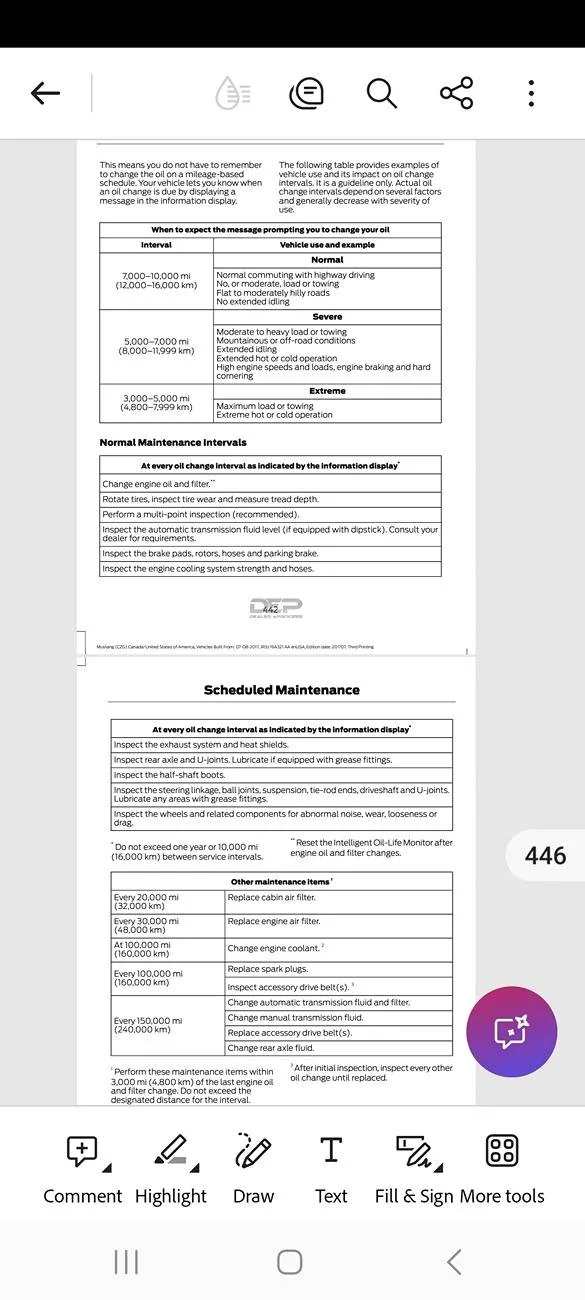
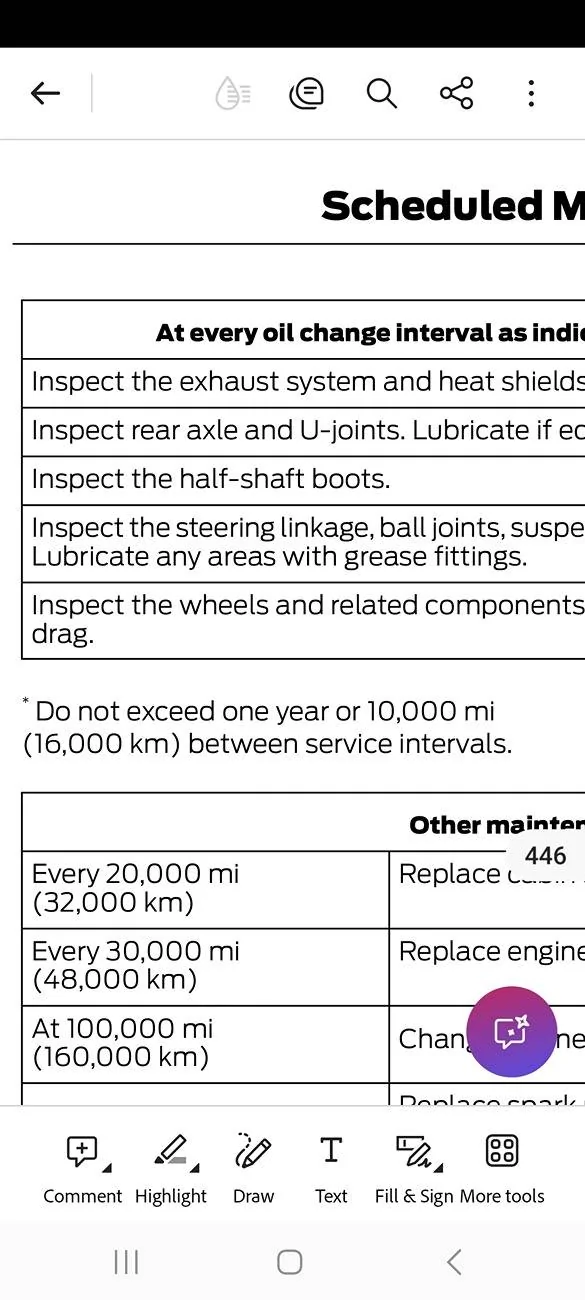
I'm not sure why Ford said yearly oil changes are too much? The owners manual clearly says not to exceed 10k miles or 1 year between service intervals.
Screenshot_20250124_210202_Adobe Acrobat.jpg
Screenshot_20250124_210227_Adobe Acrobat.jpg
There's no such thing as too many oil changes, only too few.
 

Robottrainer

Well-Known Member
Joined
Apr 25, 2021
Threads
79
Messages
992
Reaction score
421
Location
Canada
First Name
John
Vehicle(s)
2018 Ford Escape. 2020 Jeep Cherokee. 2021 Ford Mustang GT Stage 2 Roush
Your gauge can say 500 psi

the 150rpm you get from cranking is not going to get oil going through the entire engine
That is incorrect. I get 20psi on a 30 second crank. Hot idle oil pressure is around 20 to 22 with the variable regulator and 5W50 oil
 

Robottrainer

Well-Known Member
Joined
Apr 25, 2021
Threads
79
Messages
992
Reaction score
421
Location
Canada
First Name
John
Vehicle(s)
2018 Ford Escape. 2020 Jeep Cherokee. 2021 Ford Mustang GT Stage 2 Roush
I do not think this statement is correct. I do think spinning an engine at low RPM's can move oil thru an engine. The last engine I rebuilt was the old school type with a distributor. I used an electric drill with a modified screwdriver to spin the oil pump. I had the valve covers off and did spin the drill until I saw oil on the rocker arms. It was a 1979 Ford 351 Windsor V8. Best I can recall it did not take very long.
I do think it will take longer to get the oil throughout the entire engine using a starter. I like the five seconds on then rest the starter method mentioned.
Correct
 

Sponsored

robvas

Well-Known Member
Joined
Nov 18, 2023
Threads
15
Messages
3,483
Reaction score
3,272
Location
MI
Vehicle(s)
2011 GT
That is incorrect. I get 20psi on a 30 second crank. Hot idle oil pressure is around 20 to 22 with the variable regulator and 5W50 oil
And it's probably 80psi at idle with cold oil of that weight
 

526 HRSE

Well-Known Member
Joined
Jun 4, 2020
Threads
22
Messages
1,664
Reaction score
1,909
Location
California
Vehicle(s)
2017 GT350 Grabber Blue
Vehicle Showcase
1
You'd think each and every single person on this board has had an engine fail due to bad oil. :lipssealed:
 

Robottrainer

Well-Known Member
Joined
Apr 25, 2021
Threads
79
Messages
992
Reaction score
421
Location
Canada
First Name
John
Vehicle(s)
2018 Ford Escape. 2020 Jeep Cherokee. 2021 Ford Mustang GT Stage 2 Roush
And it's probably 80psi at idle with cold oil of that weight
Sometime 50 sometimes 90 at fast idle warm up. Depends what the pcm commands
 

sk47

Well-Known Member
Joined
Nov 12, 2020
Threads
32
Messages
6,806
Reaction score
3,156
Location
North Eastern TN
First Name
Jeff
Vehicle(s)
Chevy Silverado & Nissan Sentra SE
You'd think each and every single person on this board has had an engine fail due to bad oil. :lipssealed:
Hello; Modern full synthetic oils from a quality company are very good. Very likely over 99% of ICE owners never do more than the recommended oil changes. Engines now last a long time with minimal service. On one side of the ledger are all those vehicles which do not get any special care and literally go on for lots of miles. So, I get the pushback that extra ordinary procedures are not needed and just start up an engine which has sat for a long time. No real question many get away with just that.

On the other side of the ledger are the apparently many fewer who do want to take extra precautions such as pre filling an oil filter or pulling an injector fuse and turning the engine over some before a first fire up after a long time parked. May turn out to be such makes no difference, but such just makes sense to me. I have no proof other than the traditional practice i learned decades go about starting up a rebuilt engine.
 

Schuvwj

Well-Known Member
Joined
Jan 12, 2023
Threads
4
Messages
82
Reaction score
49
Location
Florida
First Name
William
Vehicle(s)
2025 Mustang 60th Anniversary Convertible
This why I always hate to seeing another oil topic discussed here!!!!
The outcome is always the same, bad!
Sponsored


Top