Sponsored

Aces IV additive/octane enhancer

Hazmat SRT

Member
Joined
May 31, 2017
Threads
0
Messages
22
Reaction score
4
Location
Detroit Metro
First Name
Andy
Vehicle(s)
Mopars
That above was with VP100 and 3.5" pulley. This picture below is with 93 and ACES with 3.5" pulley. I realize the rpm and Boost are not equal but this illustrates what's going on.

Almost 5 degrees positive knock and 5 subtracted from the base 18.

So if I read that correctly it's giving one degree of timing retard to approximately one degree of knock detection.

This makes me wonder, in a perfect world where no knock is detected, how far the PCM and tune will go in terms of advancing timing. For example, at what point does the computer no longer add timing advance in the presence of no knock? What's the max advance the PCM will shoot for?

There's a law of diminishing return when it comes to adding timing and it would be great to know what that value is for the Coyote under boost. Based on what you're showing me, this correlates to the idea that the system is always working to adjust for maximum advance based on the knock values and pulling back when it sees some to keep the engine safe. That aligns with what Whipple is telling you guys about how their tune works.

From my perception, it's always riding the ragged edge and doing everything that it can to maximize power. This is where a custom dyno tune with HP tuners might be more helpful to find a more narrow range of values and limit spark advance. My rule when tuning was always to find the point at which light knock occurs and then back down 1-2 degrees of advance while keeping boost the same in a specific AF:R range (usually 11-11.5:1 based on the engine).
Sponsored


Roh92cp

Well-Known Member
Joined
Jun 27, 2015
Threads
79
Messages
2,896
Reaction score
1,173
Location
Fort Kent Maine
First Name
Shawn
Vehicle(s)
OW GTPP Whipple
So if I read that correctly it's giving one degree of timing retard to approximately one degree of knock detection.

This makes me wonder, in a perfect world where no knock is detected, how far the PCM and tune will go in terms of advancing timing. For example, at what point does the computer no longer add timing advance in the presence of no knock? What's the max advance the PCM will shoot for?

There's a law of diminishing return when it comes to adding timing and it would be great to know what that value is for the Coyote under boost. Based on what you're showing me, this correlates to the idea that the system is always working to adjust for maximum advance based on the knock values and pulling back when it sees some to keep the engine safe. That aligns with what Whipple is telling you guys about how their tune works.

From my perception, it's always riding the ragged edge and doing everything that it can to maximize power. This is where a custom dyno tune with HP tuners might be more helpful to find a more narrow range of values and limit spark advance. My rule when tuning was always to find the point at which light knock occurs and then back down 1-2 degrees of advance while keeping boost the same in a specific AF:R range (usually 11-11.5:1 based on the engine).
Whipple's calibration can advance timing as far as 22 degrees without the presence of knock, if knocker is always happy. Other calibrations such as Lund I've heard may be in the 18 degree max range, but some may have more now. It's my understanding that Whipple's calibration is one of the higher calibrations for max timing.
 

Super Werty

Well-Known Member
Joined
May 15, 2015
Threads
41
Messages
806
Reaction score
229
Location
AZ
Vehicle(s)
2015 PP GT
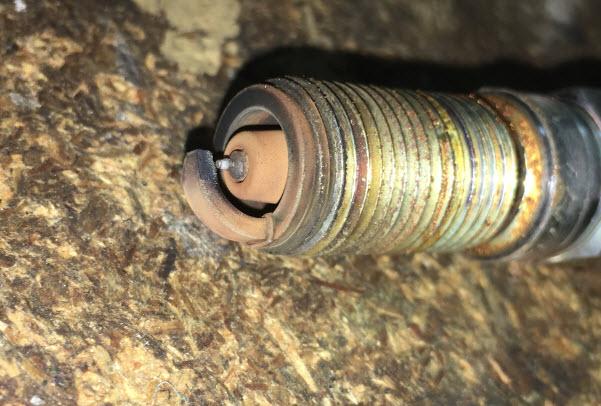
So I checked my plugs... Glad I did. Edit: after doing some more research I found several other forums talking about this orange effect from octanium and torco. Some guy even took off his head and found it all over the valves. But I couldn't find a single failure and every thread out there agreed it was just mmt coating and not to worry about it.
image hosting websites
 
Last edited:

Bartly

Well-Known Member
Joined
Oct 25, 2015
Threads
94
Messages
1,527
Reaction score
221
Location
Out West
Vehicle(s)
2016 Mustang GT
So I checked my plugs... Glad I did. Edit: after doing some more research I found several other forums talking about this orange effect from octanium and torco. Some guy even took off his head and found it all over the valves. But I couldn't find a single failure and every thread out there agreed it was just mmt coating and not to worry about it.
image hosting websites
I pulled mine after 3k miles on them with only adding an MMT additive a couple of times to probably a total of 10 gallons of gas. Looks like it starts coating them right off the bat. Would imagine mine would look like yours soon enough.
plug small.jpg
 

Hazmat SRT

Member
Joined
May 31, 2017
Threads
0
Messages
22
Reaction score
4
Location
Detroit Metro
First Name
Andy
Vehicle(s)
Mopars
Whipple's calibration can advance timing as far as 22 degrees without the presence of knock, if knocker is always happy. Other calibrations such as Lund I've heard may be in the 18 degree max range, but some may have more now. It's my understanding that Whipple's calibration is one of the higher calibrations for max timing.
22 degrees max with 12-13 lbs. of boost is an awful lot to try for which explains why you guys are seeing such high RWHP. The other alternative if you don't want to mess with anything beyond 93 and fuel additives would be methanol injection.

You could even run distilled water and forego the methanol and still see great results. Even the M4 GTS comes from the factory with water injection now.
 

Sponsored

Roh92cp

Well-Known Member
Joined
Jun 27, 2015
Threads
79
Messages
2,896
Reaction score
1,173
Location
Fort Kent Maine
First Name
Shawn
Vehicle(s)
OW GTPP Whipple

Hazmat SRT

Member
Joined
May 31, 2017
Threads
0
Messages
22
Reaction score
4
Location
Detroit Metro
First Name
Andy
Vehicle(s)
Mopars
I pulled mine after 3k miles on them with only adding an MMT additive a couple of times to probably a total of 10 gallons of gas. Looks like it starts coating them right off the bat. Would imagine mine would look like yours soon enough.
Found something on the web. It's a bit of a long read but it talks about some of the effects of MMT buildup on plugs.

Enjoy.
 

Attachments

rio16

MAD_50HH
Joined
Jan 8, 2015
Threads
98
Messages
2,048
Reaction score
801
Location
Bay Area SJ, CA
First Name
Rio
Vehicle(s)
2015 Mustang GT Whippled Competition Orange
That above was with VP100 and 3.5" pulley. This picture below is with 93 and ACES with 3.5" pulley. I realize the rpm and Boost are not equal but this illustrates what's going on.

Almost 5 degrees positive knock and 5 subtracted from the base 18.

OMG close to 5 degrees of Knock :doh: can't wait to see how much i have w the 91 :brokenheart:
 

markmurfie

Well-Known Member
Joined
Jun 6, 2015
Threads
15
Messages
1,320
Reaction score
625
Location
Hawaii
First Name
Mark
Vehicle(s)
2015 Ford Mustang GT
So if I read that correctly it's giving one degree of timing retard to approximately one degree of knock detection.

This makes me wonder, in a perfect world where no knock is detected, how far the PCM and tune will go in terms of advancing timing. For example, at what point does the computer no longer add timing advance in the presence of no knock? What's the max advance the PCM will shoot for?

There's a law of diminishing return when it comes to adding timing and it would be great to know what that value is for the Coyote under boost. Based on what you're showing me, this correlates to the idea that the system is always working to adjust for maximum advance based on the knock values and pulling back when it sees some to keep the engine safe. That aligns with what Whipple is telling you guys about how their tune works.

From my perception, it's always riding the ragged edge and doing everything that it can to maximize power. This is where a custom dyno tune with HP tuners might be more helpful to find a more narrow range of values and limit spark advance. My rule when tuning was always to find the point at which light knock occurs and then back down 1-2 degrees of advance while keeping boost the same in a specific AF:R range (usually 11-11.5:1 based on the engine).
The stock tune can advance up to 10* from the base borderline table. There is a difference between 11-14 and 15+ knock sensor systems in the 15+ can determine the intensity of knock. From this it can pull a certain amount of timing. If a 15+ is reducing the knock value by 0.5* it is sensing the borderline of the fuel you are running. This is essentially as you describe with advancing till you saw knock then pulling back 1-2 * but done in real time constantly by the computer with much more precision. Tuners can gain power from the stock ignition by pushing the system closer the the borderline it can sense, but this limits the lowest octane you can run.

I should add if you are seeing positive knock values, you are below your designated borderline and the ECU assumes any knock is an intense knock event and max retard will be applied. So when some one says its acceptable to see up to 2* positive knock they are not tuning to take advantage of the knock system correctly to get optimal borderline timing.
 
Last edited:

Sponsored

Roh92cp

Well-Known Member
Joined
Jun 27, 2015
Threads
79
Messages
2,896
Reaction score
1,173
Location
Fort Kent Maine
First Name
Shawn
Vehicle(s)
OW GTPP Whipple
The stock tune can advance up to 10* from the base borderline table. There is a difference between 11-14 and 15+ knock sensor systems in the 15+ can determine the intensity of knock. From this it can pull a certain amount of timing. If a 15+ is reducing the knock value by 0.5* it is sensing the borderline of the fuel you are running. This is essentially as you describe with advancing till you saw knock then pulling back 1-2 * but done in real time constantly by the computer with much more precision. Tuners can gain power from the stock ignition by pushing the system closer the the borderline it can sense, but this limits the lowest octane you can run.

I should add if you are seeing positive knock values, you are below your designated borderline and the ECU assumes any knock is an intense knock event and max retard will be applied. So when some one says its acceptable to see up to 2* positive knock they are not tuning to take advantage of the knock system correctly to get optimal borderline timing.
This is really informative, and I thank you for your input. So your saying above .5 is considered outside of borderline knock control logic which optimizes power and above that point it starts going into a very protective knock strategy effecting power. The information I got from Whipple was that 2 degrees knock or less was acceptable, is it possible Whipple's calibration is different in how it deals with borderline knock.
 

markmurfie

Well-Known Member
Joined
Jun 6, 2015
Threads
15
Messages
1,320
Reaction score
625
Location
Hawaii
First Name
Mark
Vehicle(s)
2015 Ford Mustang GT
This is really informative, and I thank you for your input. So your saying above .5 is considered outside of borderline knock control logic which optimizes power and above that point it starts going into a very protective knock strategy effecting power. The information I got from Whipple was that 2 degrees knock or less was acceptable, is it possible Whipple's calibration is different in how it deals with borderline knock.
It is possible they use different values from the stock strategy that ford uses. Either way if the knock goes into positive numbers the ECU considers this a very big problem and aggressively limits ignition performance. The system pushing up the timing until knock the ECU knows why the knock is happening. If it sees too much knock or too intense it will slow down the advance or pull as appropriate. Any other time there's knock where there shouldnt be and while it's not doing this it goes to aggressive knock reduction mode.
 

RockStang

Well-Known Member
Joined
May 15, 2015
Threads
123
Messages
1,276
Reaction score
216
Location
AA county MD
First Name
Joe
Vehicle(s)
2016 GT Whippled
I will just add that if I get even .5 knock my PBD tune starts pulling timing. Ken does not appear to allow the tune to add timing though. It's capped at whatever he sets it to. I cannot see -knock values with his tune. Unless it's something with the SCT config
 

Roh92cp

Well-Known Member
Joined
Jun 27, 2015
Threads
79
Messages
2,896
Reaction score
1,173
Location
Fort Kent Maine
First Name
Shawn
Vehicle(s)
OW GTPP Whipple
It is possible they use different values from the stock strategy that ford uses. Either way if the knock goes into positive numbers the ECU considers this a very big problem and aggressively limits ignition performance. The system pushing up the timing until knock the ECU knows why the knock is happening. If it sees too much knock or too intense it will slow down the advance or pull as appropriate. Any other time there's knock where there shouldnt be and while it's not doing this it goes to aggressive knock reduction mode.
I reached out to Whipple again asking further about their borderline knock threshold, and at what knock value it starts reducing knock aggressively. I'll LUK when I get a response.
 

Hazmat SRT

Member
Joined
May 31, 2017
Threads
0
Messages
22
Reaction score
4
Location
Detroit Metro
First Name
Andy
Vehicle(s)
Mopars
I will just add that if I get even .5 knock my PBD tune starts pulling timing. Ken does not appear to allow the tune to add timing though. It's capped at whatever he sets it to. I cannot see -knock values with his tune. Unless it's something with the SCT config
This is one of the advantages of a custom tune in that it's not seeking a moving target and only reacting to knock in order to limit ignition advance. It sets a safe max limit and allows you to fuel tune without having to worry that it's always riding the ragged edge.

I'd feel much safer with something like this...

Thanks for the info.
Sponsored


Top