
Sponsored


EFI
Well-Known Member
- Joined
- May 19, 2015
- Threads
- 65
- Messages
- 5,287
- Reaction score
- 4,733
- Location
- Masshole central
- Vehicle(s)
- 5.Br0
That's also used to keep radiant heat from heating up the diff.

Jmeo
You said member ;)
- Joined
- May 28, 2014
- Threads
- 252
- Messages
- 8,777
- Reaction score
- 9,908
- Location
- Massachusetts
- First Name
- Jaime
- Vehicle(s)
- 2020 GT500, 2023 F150 Raptor
- Vehicle Showcase
- 2
Nice job Tom. This alone has proved to make a difference for you, and I am hopeful that after the upgraded axles are installed, this will be the one-two punch toward preventing another axle failure.

AngelDeath
Well-Known Member
- Joined
- May 5, 2016
- Threads
- 58
- Messages
- 1,529
- Reaction score
- 1,272
- Location
- CH, New Jersey
- First Name
- Mike
- Vehicle(s)
- '20 Shelby GT500 Rapid Red / '01 Metallic Red C5 / '17 White Overland
Not that this will ever apply to me, but how much could it cost to add a heatshield in that area to prevent this? I think its far more cost effective then claiming its a track car bound for failure at the track.

gfcobra04
Well-Known Member
Was it the outside wheel Cv joint or both? I had similar issues with my 2000R running TWS clockwise. The outside cv joint boot would heat up and expand rub on something and spit grease everywhere. However I never had that issue running counter clockwise.
Sponsored

Warpath
Well-Known Member
- Joined
- Aug 24, 2020
- Threads
- 3
- Messages
- 578
- Reaction score
- 801
- Location
- Springfield, MO
- Vehicle(s)
- 2020 Ford GT500, 2021 Jeep Trackhawk
Damn, that is a disaster.
AngelDeath
Well-Known Member
- Joined
- May 5, 2016
- Threads
- 58
- Messages
- 1,529
- Reaction score
- 1,272
- Location
- CH, New Jersey
- First Name
- Mike
- Vehicle(s)
- '20 Shelby GT500 Rapid Red / '01 Metallic Red C5 / '17 White Overland
AngelDeath
Well-Known Member
- Joined
- May 5, 2016
- Threads
- 58
- Messages
- 1,529
- Reaction score
- 1,272
- Location
- CH, New Jersey
- First Name
- Mike
- Vehicle(s)
- '20 Shelby GT500 Rapid Red / '01 Metallic Red C5 / '17 White Overland
No, Billy Johnson. And yes, he can drive.
Again, I think the reason for this is cost cutting on the part of ford


The Chairman
Well-Known Member
Thanks Tom. I am surprised they have heat shields all the way from the engine to the end of the driveshaft, protecting the trans and fuel tanks, etc. But nothing protecting the diff or the inboard CV joints…
We run flat out at COTA, but it’s mostly on the flat straights, and we only hit about 160. So I don’t know of anyone experiencing your problem.
However, makes sense to implement your fix to help diff longevity.
- How long are those pieces of wrap?
- It appears you placed 3 zip ties on each end?

Strokerswild
Shallow and Pedantic
- Joined
- Nov 7, 2014
- Threads
- 76
- Messages
- 7,131
- Reaction score
- 6,513
- Location
- Southern MN
- First Name
- Dave
- Vehicle(s)
- Things With Wheels
I'd suggest not only a high-temp grease, but a synthetic one also.
We use various Dow Corning Molykote greases at work in severe service applications, and it never gives up.
We use various Dow Corning Molykote greases at work in severe service applications, and it never gives up.
Sponsored

Epiphany
Well-Known Member
I like the idea of wrap and have used it successfully on a number of different applications. It does tend to break down though with moisture from rain, etc, and continual heat cycles. No matter how tight or how well clamped, it eventually breaks down. It definitely helps though when used in the proper application.
Lately I've been using heat shielding, ala the way the OEM's favor, with much success.
With respect to the area of concern in Tom's case, the exhaust tubing is low and in the undercar airstream. At speed, the flow of air is constant, which helps to keep things cool - generally speaking. When stopped or at very low speeds, that is temps can rise rapidly. Of importance, the CV joints are not seeing heat via conduction (the transfer of heat/energy from direct contact). Nor is it from convection (heat transfer within a fluid - the differential may see this though from hot gear lubricant). The idea is to protect them from radiant heat, where no physical contact is necessary. That said, I like the idea of heat shielding in this spot. It can be used with or without wrap.

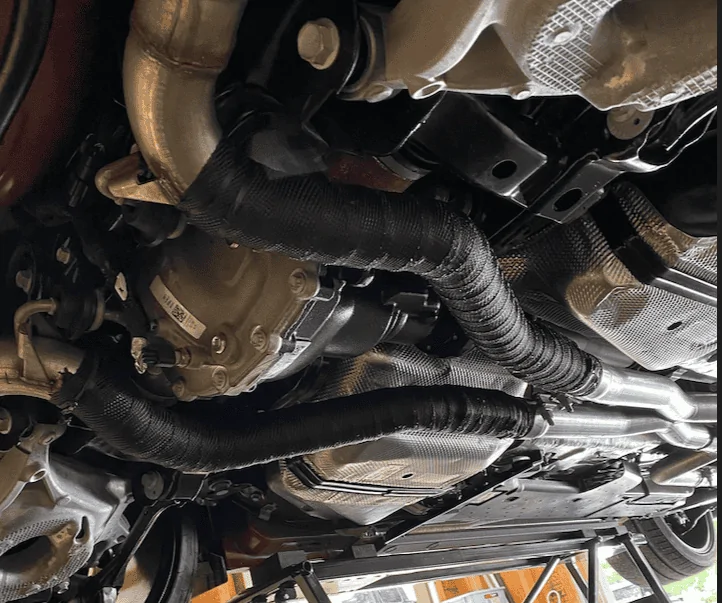
I'm a huge fan of DEI's stuff which is what you see in the shot above. Without direct contact it uses air as an insulator and as DEI puts it the "outer layer is made from pulverized and stranded lava rock into a proprietary tightly woven weave for durability and strength. The inside material is made of a special high temperature resistant fabric (89% silica) designed to withstand 350 degrees more heat than glass fiber. This proprietary fiber technology combined with DEI's unique shield standoff bracket design provides an air gap between the shield and pipe that together provides the maximum potential for cooling and heat dissipation." It can provide heat protection up to 1350°F.
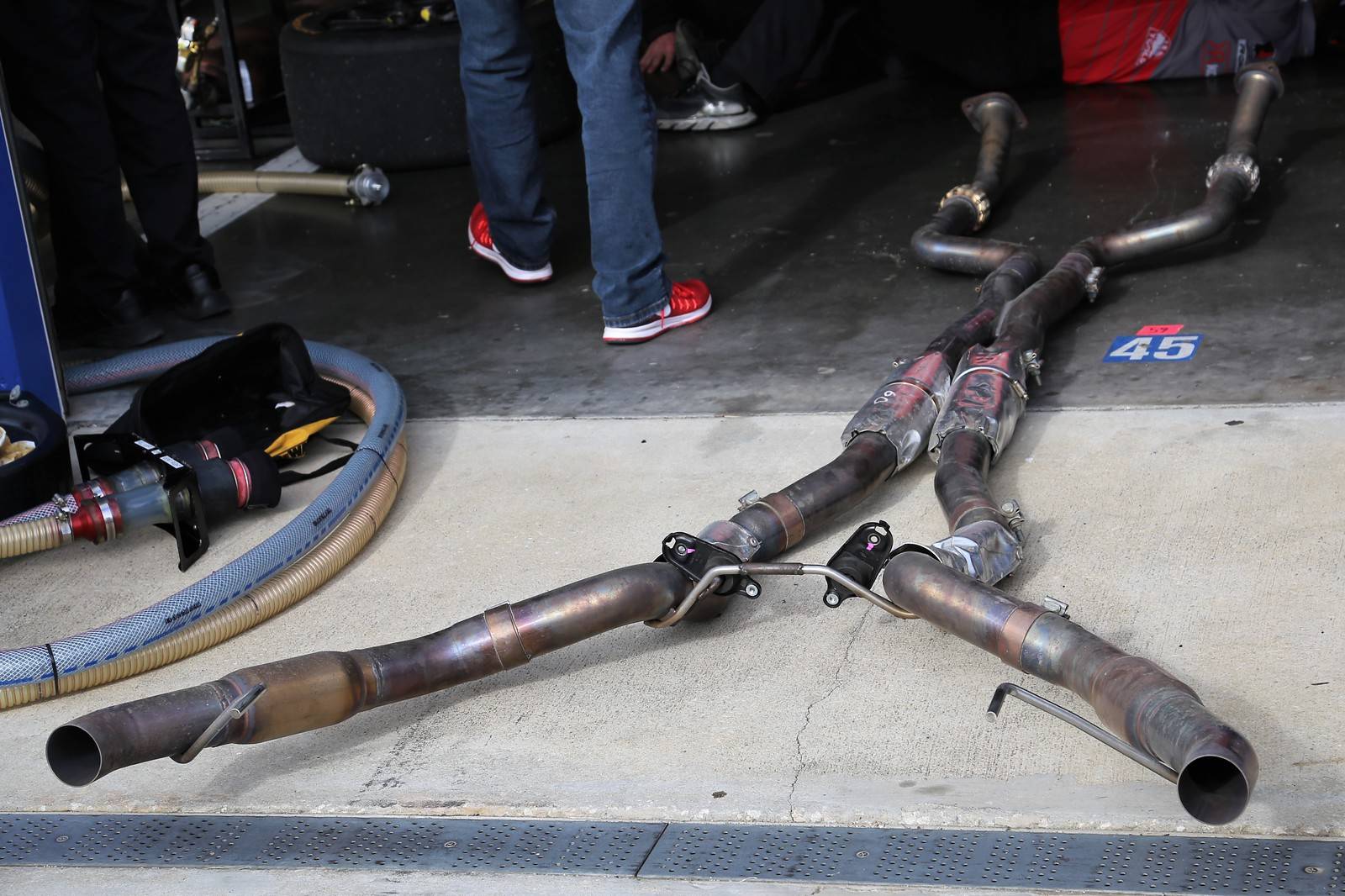
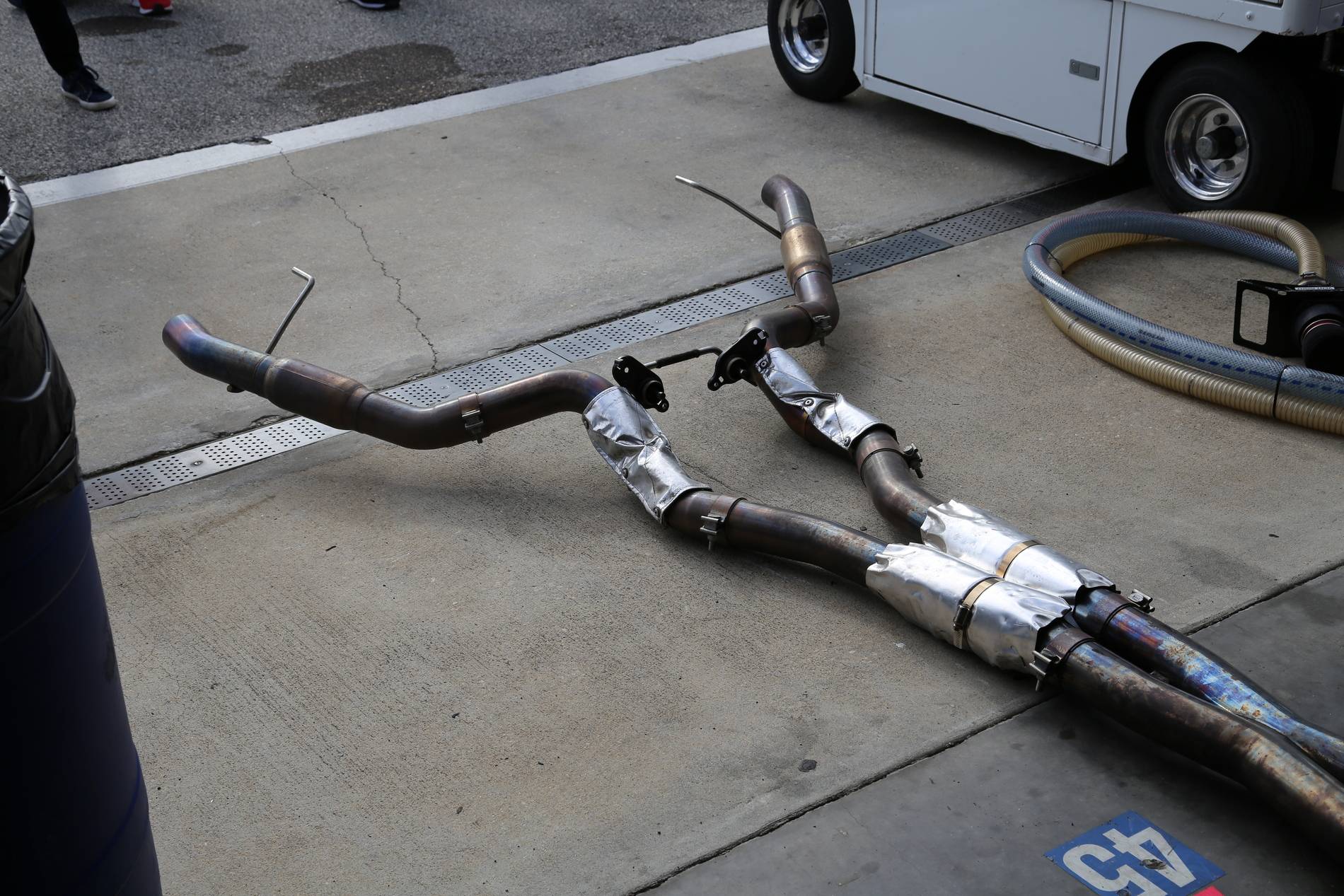
I was at Daytona with Kohr and they needed to swap driveshafts just prior to the race. I took a few shots of the exhaust system. You can see a foil based material clamped towards the middle of the exhaust but relevant to my point, look further aft and you can see shields clamped in place in the area that falls beneath the CV joints that we are discussing here.


Just a suggestion...
Lately I've been using heat shielding, ala the way the OEM's favor, with much success.
With respect to the area of concern in Tom's case, the exhaust tubing is low and in the undercar airstream. At speed, the flow of air is constant, which helps to keep things cool - generally speaking. When stopped or at very low speeds, that is temps can rise rapidly. Of importance, the CV joints are not seeing heat via conduction (the transfer of heat/energy from direct contact). Nor is it from convection (heat transfer within a fluid - the differential may see this though from hot gear lubricant). The idea is to protect them from radiant heat, where no physical contact is necessary. That said, I like the idea of heat shielding in this spot. It can be used with or without wrap.
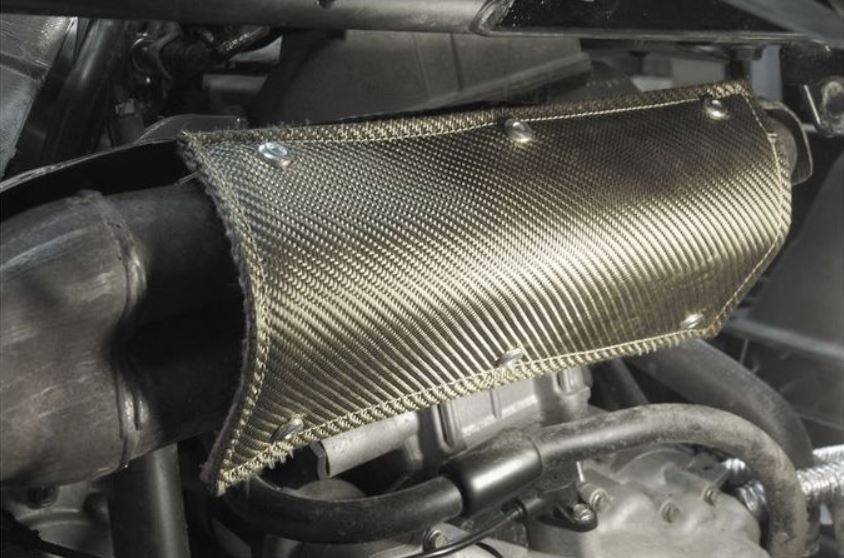
I'm a huge fan of DEI's stuff which is what you see in the shot above. Without direct contact it uses air as an insulator and as DEI puts it the "outer layer is made from pulverized and stranded lava rock into a proprietary tightly woven weave for durability and strength. The inside material is made of a special high temperature resistant fabric (89% silica) designed to withstand 350 degrees more heat than glass fiber. This proprietary fiber technology combined with DEI's unique shield standoff bracket design provides an air gap between the shield and pipe that together provides the maximum potential for cooling and heat dissipation." It can provide heat protection up to 1350°F.
I was at Daytona with Kohr and they needed to swap driveshafts just prior to the race. I took a few shots of the exhaust system. You can see a foil based material clamped towards the middle of the exhaust but relevant to my point, look further aft and you can see shields clamped in place in the area that falls beneath the CV joints that we are discussing here.
Just a suggestion...
Caballus
Well-Known Member
- Joined
- Jan 24, 2016
- Threads
- 43
- Messages
- 3,613
- Reaction score
- 2,088
- Location
- Over Yonder
- Vehicle(s)
- GT350
Confused. I understand the effects of not completing a cool down lap. However, in general, when does the exhaust have an opportunity overheat components (e.g., CV joints). As long as the car is moving, which it always is on track, doesn't airflow cool those components?I like the idea of wrap and have used it successfully on a number of different applications. It does tend to break down though with moisture from rain, etc, and continual heat cycles. No matter how tight or how well clamped, it eventually breaks down. It definitely helps though when used in the proper application.
Lately I've been using heat shielding, ala the way the OEM's favor, with much success.
With respect to the area of concern in Tom's case, the exhaust tubing is low and in the undercar airstream. At speed, the flow of air is constant, which helps to keep things cool - generally speaking. When stopped or at very low speeds, that is temps can rise rapidly. Of importance, the CV joints are not seeing heat via conduction (the transfer of heat/energy from direct contact). Nor is it from convection (heat transfer within a fluid - the differential may see this though from hot gear lubricant). The idea is to protect them from radiant heat, where no physical contact is necessary. That said, I like the idea of heat shielding in this spot. It can be used with or without wrap.
I'm a huge fan of DEI's stuff which is what you see in the shot above. Without direct contact it uses air as an insulator and as DEI puts it the "outer layer is made from pulverized and stranded lava rock into a proprietary tightly woven weave for durability and strength. The inside material is made of a special high temperature resistant fabric (89% silica) designed to withstand 350 degrees more heat than glass fiber. This proprietary fiber technology combined with DEI's unique shield standoff bracket design provides an air gap between the shield and pipe that together provides the maximum potential for cooling and heat dissipation." It can provide heat protection up to 1350°F.
I was at Daytona with Kohr and they needed to swap driveshafts just prior to the race. I took a few shots of the exhaust system. You can see a foil based material clamped towards the middle of the exhaust but relevant to my point, look further aft and you can see shields clamped in place in the area that falls beneath the CV joints that we are discussing here.
Just a suggestion...
Rapid Red
Well-Known Member
- Joined
- Nov 4, 2019
- Threads
- 45
- Messages
- 5,049
- Reaction score
- 4,096
- Location
- Woodstock GA
- First Name
- Greg
- Vehicle(s)
- GT PP2 RaceRed Roush> Steeda> preformance
- Vehicle Showcase
- 2
Good the know Tom,
Did the same on my car keeping the rear gear oil from cooking. DEI stranded lava rock .

Did the same on my car keeping the rear gear oil from cooking. DEI stranded lava rock .
Epiphany
Well-Known Member
It does indeed. I think Tom has been careful here say what he can say and he's addressing the issue with a two pronged attack. The wrap being one and the joint itself being the other. It quickly becomes a bit complicated what with boot design and grease performance under extreme duress becoming the crux of the issue. So you have the joint and its internal issues being exacerbated by radiant heat. Again, I believe the bulk of the damage from external heat is when pitting or from too quick of a cool down. The grease literally bakes when the car is not moving. At least the rear diff has a pump to circulate gear oil. The cv joint is not so lucky and struggles to vent and to keep cool...
Rapid Red
Well-Known Member
- Joined
- Nov 4, 2019
- Threads
- 45
- Messages
- 5,049
- Reaction score
- 4,096
- Location
- Woodstock GA
- First Name
- Greg
- Vehicle(s)
- GT PP2 RaceRed Roush> Steeda> preformance
- Vehicle Showcase
- 2
You have to use stainless steel zip ties. Those look plastic.
Also, they make a silicon based high temp paint to go over the wrap to protect it.
Not, bought the kit & tool. Seems logical one should not consider plastic zip ties. For such an application & environment .
Did not know about silicon high temp paint, interesting .... tks
Sponsored