
Sponsored
Blew up my gen3 motor and don’t know where to go from here

Zrussian13
Well-Known Member
The spray in liners are stronger and more wear resistant. I think ford even stated somewhere around 40-50% stronger than the gen 2 but dont quote me on that number. Yes they are one and done though, ill give you that.Spray in cylinder liners are more fragile than thicker iron liners. Thin, hard coatings are never the best solution for wear surfaces. Yes, they can work ok, especially in the short term and with frequent service, but iron liners are superior. Ford cheaped out in my opinion. They save a few pennies and we get non-serviceable engine blocks.
Direct injection pumps and injectors are more likely to break on an engine that has them. Port injection is superior in simplicity, reliability and serviceability. DI is a solution for a non-existent problem.
Plastic oil pans are straight up garbage.
Gen 3 has higher compression which will increase wear. Gen 3 has a higher lift camshaft which increases wear.
DI is what allows the extra compression reliably on the gen 3 and superior fuel control when tuned properly. I'd love to see examples of it failing on a coyote.
Yes the plastic oil pan is questionable.
The higher compression and lift is why the gen 3 makes more power. Anytime you add power you increase the chance of wear. Still don't see gen 3s shitting the bed at low mileage very often.
engineermike
Well-Known Member
GDi improves both knock resistance and volumetric efficiency. I could cite numerous technical articles, but the proof is in the stock calibration. The calibration tells us GDi can change borderline knock timing by up to 6 deg, but typically more like 2-4 deg. The calibration also tells us GDi improves volumetric efficiency as much as 30% but more like 8% at high rpm WOT, where it matters.

Hack
Well-Known Member
- Joined
- Nov 26, 2014
- Threads
- 86
- Messages
- 12,868
- Reaction score
- 8,293
- Location
- Minneapolis
- Vehicle(s)
- Mustang, Challenger
Definitely lighter and I believe it might run slightly cooler, although those are miniscule differences. According to official numbers, the weight of the 2017 vs. 2018 manual transmission GTs are essentially identical, so there's no gain in that area if you are comparing cars. It will take a while for Coyotes to get to 200k in large numbers, if they ever do. If the failure rate is low, that will be great. Hopefully bore scoring will be rare in Fords.A little lighter, runs a little cooler, durable to 200k
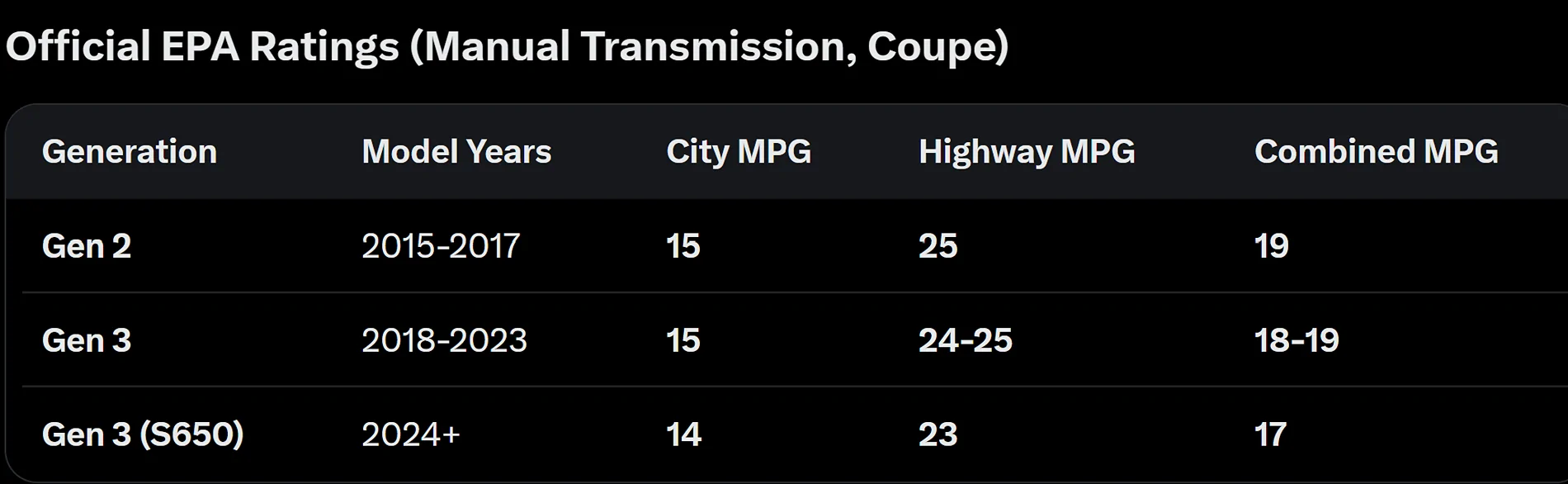
I understand the decision to go DI in our current world. I would prefer more cubic inches vs. DI.. Gen 3 has a 25 hp increase over Gen 2, which is less than 6%. The increase in volumetric efficiency didn't translate to better fuel economy, either.GDi improves both knock resistance and volumetric efficiency. I could cite numerous technical articles, but the proof is in the stock calibration. The calibration tells us GDi can change borderline knock timing by up to 6 deg, but typically more like 2-4 deg. The calibration also tells us GDi improves volumetric efficiency as much as 30% but more like 8% at high rpm WOT, where it matters.
Injecting fuel in the intake ports has a cooling effect which improves volumetric efficiency vs. direct injection. With direct injection the charge is already in the chamber and so the cooling doesn't help at all to get more air into the engine.
Volumetric efficiency doesn't seem very important to me if a 30% or even 8% improvement provides the difference in performance that we see between Gen 2 and 3 Coyotes - keeping in mind there were a number of other improvements.
If Ford had changed the bore spacing slightly and gone to a 6 liter engine, they would have gotten a much more dramatic improvement in performance. And longevity and reliability could be better at any power level.
robvas
Well-Known Member
Can't change the bore spacing without retooling the entire engine line plus enlarging the engine bay
the plasmas arc liners let them get away with a slightly larger bore too since the iron liners have a minimum size
the plasmas arc liners let them get away with a slightly larger bore too since the iron liners have a minimum size
Sponsored
Hack
Well-Known Member
- Joined
- Nov 26, 2014
- Threads
- 86
- Messages
- 12,868
- Reaction score
- 8,293
- Location
- Minneapolis
- Vehicle(s)
- Mustang, Challenger
Yes Ford should retool their engine casting components like GM does over and over again on performance V8s. It's not that big of a deal if a company wants to produce a better car. The bore size change from PTWA isn't worth it in my opinion.Can't change the bore spacing without retooling the entire engine line plus enlarging the engine bay
the plasmas arc liners let them get away with a slightly larger bore too since the iron liners have a minimum size
You can get a lot of additional displacement from a small change in engine size. A 6 liter version of the Coyote would only be about 1 3/4" longer and wider. I'd say it would be worth it for 20% more displacement. I bet if they worked on the heads they could reduce the width change and keep it to 1 inch or less.
If Ford put a 6 liter Coyote making 580 hp or so in the Mustang, it would sell a lot better than the current S650. If they didn't gunk the car up with too many electronics I would buy one.
Pistol_91
Well-Known Member
- Joined
- Oct 25, 2023
- Threads
- 13
- Messages
- 1,431
- Reaction score
- 1,457
- Location
- Clearwater
- Vehicle(s)
- 2020 mustang GT
Yes yes these engines are spec'd so tightly. Modding these engines is ridiculous! That's why Ford warranty's slapping a whipple on any coyote at the the dealership, truck or car. *sarcasm*.
Sheesh what an echo chamber of nonsense. We get it, some of you guys want to keep your warranty until you sell your car and never rev it past 6k rpm.
Sheesh what an echo chamber of nonsense. We get it, some of you guys want to keep your warranty until you sell your car and never rev it past 6k rpm.

2015 Silver GT
Well-Known Member
- Joined
- Jul 5, 2015
- Threads
- 6
- Messages
- 1,429
- Reaction score
- 647
- Location
- East Haven Connecticut
- Vehicle(s)
- 2022 Oxford White GT Premium
Someone got worked up!🫢Yes yes these engines are spec'd so tightly. Modding these engines is ridiculous! That's why Ford warranty's slapping a whipple on any coyote at the the dealership, truck or car. *sarcasm*.
Sheesh what an echo chamber of nonsense. We get it, some of you guys want to keep your warranty until you sell your car and never rev it past 6k rpm.
engineermike
Well-Known Member
There are a lot of other factors that go into power rating "at the brochure". Also keep in mind that a VE improvement just means that more air that's in the plenum makes it's way into the cylinder. This neglects other restrictions such as the air filter, TB, MAF, etc. So 8% increase in VE doesn't ever translate into 8% more hp.Gen 3 has a 25 hp increase over Gen 2, which is less than 6%.
Never does. VE is only helpful for WOT torque. Case in point is the IMRC, which drastically reduce VE but improves fuel economy.The increase in volumetric efficiency didn't translate to better fuel economy, either.
That's pretty much exactly the opposite of how it works. Again, I could cite numerous research publications which go deeply into this subject. The problem with PFI is that the evaporative cooling effect mostly cools the port wall and valve since the fuel is sprayed onto metal surfaces. With GDi, you're spraying fuel at much higher pressure into the large cylinder volume, so most of the fuel vaporizes before it reaches a surface. In this way, the cooling is applied to the air, not the metal parts. This is the primary advantage of GDi and the mechanism by which is suppresses knock.Injecting fuel in the intake ports has a cooling effect which improves volumetric efficiency vs. direct injection. With direct injection the charge is already in the chamber and so the cooling doesn't help at all to get more air into the engine.
Pistol_91
Well-Known Member
- Joined
- Oct 25, 2023
- Threads
- 13
- Messages
- 1,431
- Reaction score
- 1,457
- Location
- Clearwater
- Vehicle(s)
- 2020 mustang GT
This is my normal attitude... Its hereditary. LOL.Someone got worked up!🫢
Sponsored
Hack
Well-Known Member
- Joined
- Nov 26, 2014
- Threads
- 86
- Messages
- 12,868
- Reaction score
- 8,293
- Location
- Minneapolis
- Vehicle(s)
- Mustang, Challenger
Yes GDI suppresses knock. I agree 100% with that. It's pretty much the only significant positive factor about GDI. Everything else GDI does is negative or can be neglected due to how small the impact is.With GDi, you're spraying fuel at much higher pressure into the large cylinder volume, so most of the fuel vaporizes before it reaches a surface. In this way, the cooling is applied to the air, not the metal parts. This is the primary advantage of GDi and the mechanism by which is suppresses knock.
Meatball
Well-Known Member
Does VE change at different rpm’s? I know there are other factors but I assume it’s at its max at max torque. The stock gen2 manifold is a very compromised at higher rpm…in boosting the low end for the “world market” they sapped some of the higher rpm potential from the Boss 302 bits they put in. The gen3 has more torque I assume mostly from CR and maybe the 307 vs 302 ci so they could boost the high end more, incl the intake manifold.There are a lot of other factors that go into power rating "at the brochure". Also keep in mind that a VE improvement just means that more air that's in the plenum makes it's way into the cylinder. This neglects other restrictions such as the air filter, TB, MAF, etc. So 8% increase in VE doesn't ever translate into 8% more hp.
Never does. VE is only helpful for WOT torque. Case in point is the IMRC, which drastically reduce VE but improves fuel economy.
That's pretty much exactly the opposite of how it works. Again, I could cite numerous research publications which go deeply into this subject. The problem with PFI is that the evaporative cooling effect mostly cools the port wall and valve since the fuel is sprayed onto metal surfaces. With GDi, you're spraying fuel at much higher pressure into the large cylinder volume, so most of the fuel vaporizes before it reaches a surface. In this way, the cooling is applied to the air, not the metal parts. This is the primary advantage of GDi and the mechanism by which is suppresses knock.
engineermike
Well-Known Member
Yes, VE changes with dynamic effects of rpm, cam position, coolant temp, charge temp, the difference between the two, map, exhaust map, dfi blend, ethanol blend, etc. It also changes with static effects such as displacement, runner and port geometry, valve size, cam duration and lift. I dug insanely deep into ford’s ve math, which has to be very accurately predict charge mass for accurate fueling in speed density applications. However, I can’t say that max torque is at max ve rpm. Ve has lots of influence on peak torque but map, exhaust map, friction, etc also have a vote.Does VE change at different rpm’s? I know there are other factors but I assume it’s at its max at max torque.

compprep
Well-Known Member
- Joined
- Apr 24, 2019
- Threads
- 25
- Messages
- 2,859
- Reaction score
- 12,385
- Location
- Central, New York
- First Name
- Jim
- Vehicle(s)
- 19 GT PP1, 86 SVO, 24 S5, 74 MGB GT
Check Philadelphida craig's list. A wrecking yard or recycler has a number of engines, (some W/trannies) etc. on sale with warranty. About $6K.

SCP440
Well-Known Member
- Joined
- Nov 18, 2024
- Threads
- 2
- Messages
- 219
- Reaction score
- 209
- Location
- Oxfordshire UK
- First Name
- Steve
- Vehicle(s)
- 2019 Mustang GT, Jensen Interceptor, Ford Capri 3.0 Ghia
Ford like all manufacturers have to balance power, economy and emissions. All these things they put on a moderm engine are to find the best compromise.
If our cars did 12mpg we would need a bigger fuel tank so more weight. If the engine produced 650hp out of the showroom they would need bigger brakes and better suspension so would cost more and potetially the engine would not last as longs. If the emissions were worse they would struggle to sell so many cars..
DI helps with all the above and the port injection allows for more revs and keeps the inlet valves clean. Higher compression aids economy, emissions and produces more torque lower down the rev range. The variable valve timing pulls all these features together and we have an engine that starts easily, idles at a sensible speed, pulls well from just off idle, will rev to 7500 rpm and not destroy itself and the emissions are very low.
Like I have said before if you want your car to go like a Ferrari go and buy a Ferrari.
Back in the 70's if you had a car that produced 450hp it did 12mpg, would rev to 5500rpm, had very little bottom end torque and was probably terrible to drive to work.
If our cars did 12mpg we would need a bigger fuel tank so more weight. If the engine produced 650hp out of the showroom they would need bigger brakes and better suspension so would cost more and potetially the engine would not last as longs. If the emissions were worse they would struggle to sell so many cars..
DI helps with all the above and the port injection allows for more revs and keeps the inlet valves clean. Higher compression aids economy, emissions and produces more torque lower down the rev range. The variable valve timing pulls all these features together and we have an engine that starts easily, idles at a sensible speed, pulls well from just off idle, will rev to 7500 rpm and not destroy itself and the emissions are very low.
Like I have said before if you want your car to go like a Ferrari go and buy a Ferrari.
Back in the 70's if you had a car that produced 450hp it did 12mpg, would rev to 5500rpm, had very little bottom end torque and was probably terrible to drive to work.
Sponsored
Last edited:
Similar threads

- Replies
- 11
- Views
- 2,187

- Replies
- 20
- Views
- 4,397


