Sponsored

From where does the Voodoo oil consumption come from?

JAJ

Well-Known Member
Joined
Apr 9, 2016
Threads
4
Messages
2,225
Reaction score
1,979
Location
Vancouver BC
Vehicle(s)
2016 GT350 Track Pack
As far as i understand, the oil blow by must be send back to burn. I've changed my oil before after being a couple quarts low and it was very VERY frothy - prior to separators. I can only imagine what that does to low tension rings. My opinion is, that's why oil consumption gets worse over time. Rings get gummed up and less springy. It's a vicious cycle that tends not to end well.

This is all a common sense guess on my part. I believe Ford 'fixed' this issue with their 'gen2' motor by putting in a higher tension ring (at the cost of HP?)
Well, there's a lot of debate on this topic, but having done separators and their maintenance on various cars since 2011, as well as looked at how it's done on BMW M engines since 2003, I've concluded that there are two separate issues involved in crankcase ventilation. The first is blowby gases from combustion. The gases that get past the rings are basically air mixed with exhaust and partially burned fuel plus a tiny bit of evaporated oil from the cylinder walls. This gas mixture is toxic and should be sent back through the intake system so that partial combustion becomes complete combustion. That's PCV's core mission.

The second issue is oil droplets that are entrained (the way that dust is carried by the wind) in the crankcase gases. That liquid oil is just plain ordinary oil and it can, in fact should, be returned to the crankcase for further use. It's possible that it becomes unsuitable for use if it sits too long in a container that has a constant flow of partially burned fuel going through it, but if it gets back to the crankcase in a reasonable time (by draining back from the separator like it does in the GT500 system or in BMW M engines) then it's the exact same oil as in the crankcase and it's fine for continued use.
Sponsored

 

526 HRSE

Well-Known Member
Joined
Jun 4, 2020
Threads
22
Messages
1,664
Reaction score
1,909
Location
California
Vehicle(s)
2017 GT350 Grabber Blue
Vehicle Showcase
1
Well, there's a lot of debate on this topic, but having done separators and their maintenance on various cars since 2011, as well as looked at how it's done on BMW M engines since 2003, I've concluded that there are two separate issues involved in crankcase ventilation. The first is blowby gases from combustion. The gases that get past the rings are basically air mixed with exhaust and partially burned fuel plus a tiny bit of evaporated oil from the cylinder walls. This gas mixture is toxic and should be sent back through the intake system so that partial combustion becomes complete combustion. That's PCV's core mission.

The second issue is oil droplets that are entrained (the way that dust is carried by the wind) in the crankcase gases. That liquid oil is just plain ordinary oil and it can, in fact should, be returned to the crankcase for further use. It's possible that it becomes unsuitable for use if it sits too long in a container that has a constant flow of partially burned fuel going through it, but if it gets back to the crankcase in a reasonable time (by draining back from the separator like it does in the GT500 system or in BMW M engines) then it's the exact same oil as in the crankcase and it's fine for continued use.
Not sure if i'm following correctly, but a mixture of oil and combustion being sent back is only going to make things worse. Yes, SMOG laws want it to be burned again, but for our cars (high compression/low tension rings) it's a nightmare waiting to happen.

Low tension rings (gen1) need to be clean - perfectly clean - to work correctly. I still believe that sending this mixture back to be re-burned is causing a snowball effect. At first, they get a little gummed up, by 20k miles, you're not only losing power, but allowing much more oil to pass.

"At first i was losing 1 qt every 1500 miles, but over the years, i'm now losing 1 qt every 300 miles".

Dirty rings.
 

tdstuart

Well-Known Member
Joined
Apr 6, 2021
Threads
72
Messages
2,567
Reaction score
1,292
Location
Arizona
First Name
Triston
Vehicle(s)
2015 Mustang Gt Premium
I broke my car in easy, never have redlined it and it does not use
any oil. Over 7k miles now.
Never redlining the car and driving it easy will help with it not consuming oil.

But seriously go redline the car... whats the point of having these cool cars if you don't drive them. Might as well go get an EcoBoost.
 

sk47

Well-Known Member
Joined
Nov 12, 2020
Threads
32
Messages
6,820
Reaction score
3,162
Location
North Eastern TN
First Name
Jeff
Vehicle(s)
Chevy Silverado & Nissan Sentra SE
Not sure if i'm following correctly, but a mixture of oil and combustion being sent back is only going to make things worse. Yes, SMOG laws want it to be burned again, but for our cars (high compression/low tension rings) it's a nightmare waiting to happen.

Low tension rings (gen1) need to be clean - perfectly clean - to work correctly. I still believe that sending this mixture back to be re-burned is causing a snowball effect. At first, they get a little gummed up, by 20k miles, you're not only losing power, but allowing much more oil to pass.

"At first i was losing 1 qt every 1500 miles, but over the years, i'm now losing 1 qt every 300 miles".

Dirty rings.
Hello; A thing is we had build up on rings before PCV valves were invented. I always figured it was the bit of oil which worked its way past the best of rings in an engine. I figured some oil got into the lands of the piston and cooked off from combustion heat. Anyway, I have scrapped carbon from out of ring lands.
Modern oils are likely to help keep the rings clean.
"...following correctly, but a mixture of oil and combustion being sent back is only going to make things worse."
Hello; My take is when a PCV valve is working properly not much oil gets vacuumed into the intake manifold. It is when a PCV fails that the oil can be pulled thru. I do not doubt a small amount of vaporized oil can be part of the mix but suspect not a lot.

Hello; Have not done this in a long time. My father would put about a quart of kerosine in the engine oil with the engine warm to hot. He would let it idle maybe five to ten minutes then drain the oli. I have two very old quarts of an engine flush which use to be sold and used in the same way. I have long suspected it may be largely kerosine.

There are aftermarket additives which claim to dissolve carbon. I have tried some when cleaning parts. Perhaps we could list those here or in another thread.
 

Mrhavasu

Well-Known Member
Joined
Jan 17, 2020
Threads
11
Messages
217
Reaction score
120
Location
So Cal
First Name
Terry
Vehicle(s)
GT350
Never redlining the car and driving it easy will help with it not consuming oil.

But seriously go redline the car... whats the point of having these cool cars if you don't drive them. Might as well go get an EcoBoost.
I certainly drive and have fun with it, I just do not beat on it.
 

Sponsored

526 HRSE

Well-Known Member
Joined
Jun 4, 2020
Threads
22
Messages
1,664
Reaction score
1,909
Location
California
Vehicle(s)
2017 GT350 Grabber Blue
Vehicle Showcase
1
Hello; A thing is we had build up on rings before PCV valves were invented. I always figured it was the bit of oil which worked its way past the best of rings in an engine. I figured some oil got into the lands of the piston and cooked off from combustion heat. Anyway, I have scrapped carbon from out of ring lands.
Modern oils are likely to help keep the rings clean.
"...following correctly, but a mixture of oil and combustion being sent back is only going to make things worse."
Hello; My take is when a PCV valve is working properly not much oil gets vacuumed into the intake manifold. It is when a PCV fails that the oil can be pulled thru. I do not doubt a small amount of vaporized oil can be part of the mix but suspect not a lot.

Hello; Have not done this in a long time. My father would put about a quart of kerosine in the engine oil with the engine warm to hot. He would let it idle maybe five to ten minutes then drain the oli. I have two very old quarts of an engine flush which use to be sold and used in the same way. I have long suspected it may be largely kerosine.

There are aftermarket additives which claim to dissolve carbon. I have tried some when cleaning parts. Perhaps we could list those here or in another thread.
But with super high compression and low tension rings oil usage was a trade off and expected.

I recently used ATS Chemical 505. Of course, without tearing apart the engine, i can't be positive it works. It has very good reviews so i guess it can't hurt.
 

sk47

Well-Known Member
Joined
Nov 12, 2020
Threads
32
Messages
6,820
Reaction score
3,162
Location
North Eastern TN
First Name
Jeff
Vehicle(s)
Chevy Silverado & Nissan Sentra SE
But with super high compression and low tension rings oil usage was a trade off and expected.

I recently used ATS Chemical 505. Of course, without tearing apart the engine, i can't be positive it works. It has very good reviews so i guess it can't hurt.
Hello; Many decades ago my four door 1957 chevy was badly wrecked. I had swapped a chevy small block into it to replace the straight six. I got a 1957 Pontiac so gave the engine to a friend. He built it for racing on a local dirt track just outside Tazewell TN.
He did not put in a hoop to catch the driveshaft so of course the front universial joint broke. The driveshaft dug in and pole vaulted him some distance. He lived. The engine wound up in a 65 Malibu.
He built the engine loose with rings similar to what you describe. I think it also had some other such tricks. He had to carry a case of oil as it used the stuff up in a hurry, but ran good.
 

TonyNJ

Well-Known Member
Joined
Jul 14, 2021
Threads
52
Messages
2,467
Reaction score
3,701
Location
Northern NJ
Website
www.instagram.com
First Name
Tony
Vehicle(s)
22 GT500HE Black Stripes, 20 GT350HE, 16 GT350R Ba
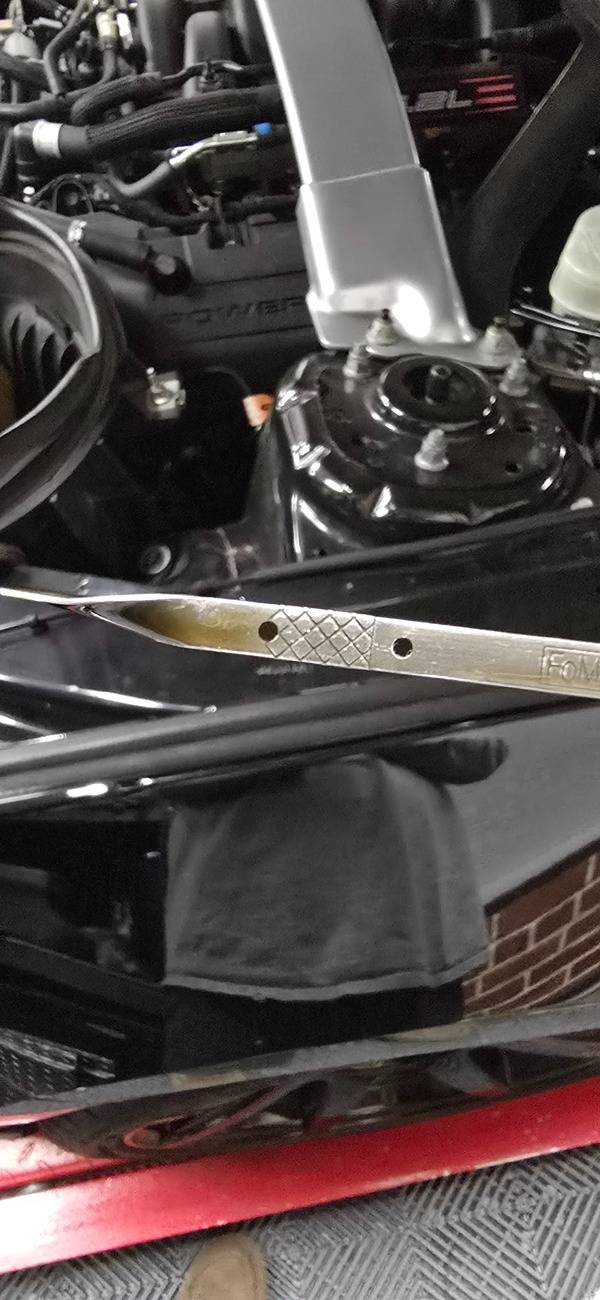
Here's the amount of oil consumed by a Gen1 350R voodoo after 3000 well driven miles, as well as four 20 minute track sessions. Car has a total of 33k on it. Original engine.

20250312_203114.jpg


Doesn't seem that bad to me. Down to the bottom of the mark, and it's due for an oil change.
 

Inthehighdesert

Well-Known Member
Joined
Apr 9, 2017
Threads
48
Messages
4,576
Reaction score
5,859
Location
NM
First Name
Charlie
Vehicle(s)
2020 HE GT350R, 2022 HE Gt500 Cftp
Dohhh!:captain:

Here's the amount of oil consumed by a Gen1 350R voodoo after 3000 well driven miles, as well as four 20 minute track sessions. Car has a total of 33k on it. Original engine.

20250312_203114.jpg


Doesn't seem that bad to me. Down to the bottom of the mark, and it's due for an oil change.
 

Sponsored

wingnutt

Well-Known Member
Joined
Oct 1, 2020
Threads
5
Messages
3,408
Reaction score
6,238
Location
@FL410
First Name
michael
Vehicle(s)
350R Procharged w/P1X
Here's the amount of oil consumed by a Gen1 350R voodoo after 3000 well driven miles, as well as four 20 minute track sessions. Car has a total of 33k on it. Original engine.

Doesn't seem that bad to me. Down to the bottom of the mark, and it's due for an oil change.
1741867530926-c2.webp
 

K4fxd

Well-Known Member
Joined
Apr 2, 2020
Threads
121
Messages
13,455
Reaction score
12,262
Location
NKY
First Name
Dan
Vehicle(s)
2017 gt, 2002 FXDWG, 2008 C6,
I don't have a 350 but I think it mostly comes down to break in. Either you do a proper low tension ring seat or you baby it.

Possible some got properly broken in by the train crews at the factory.
 

BlueBarchetta

Member
Joined
Jan 28, 2025
Threads
1
Messages
10
Reaction score
9
First Name
Dave
Vehicle(s)
2015 Kona Blue 50-Year Limited Edition GT
Hello; As to where the oil is going, Hack has the right idea I think. Oil burns in the combustion chamber along with the fuel. A few years ago Ferrari ad it's f1 cars using a lot of oil during a race. If memory serves they had to fix that as it was deemed an advantage in terms of extra energy.

As to negative side effects I suspect a few. Cost for one thing of course. While oil does burn, I do not think it burns cleanly like gasoline. I imagine the exhaust valves and even the top of a piston might wind up with hard carbon deposits. Such carbon deposits on a piston can become a "hot" spot retaining enough heat to trigger pre-ignition (knock)(detonation).
The rings possibly could have a build up but i am not sure about this. I have seen rings & lands with such buildup in the past in worn engines, but have not have a newer motor apart.

There are aftermarket additives which claim to remove carbon build up. Even if an engine is not an oil burner the direct injection engines no longer have raw fuel washing the back of the intake valves. The emission system (crankcase gases routed to the intake) means oil vapors wind up in the intake system.

Last thing today is the catalytic converter. I do not know of excess oil affecting a converter but my imagination goes to there. A converter is essentially a stove designed to burn any excess fuels which do not burn in the combustion chamber. They (converters) get in theory hot enough to more thoroughly burn that fuel. Not clear to me what excess oil will do.
I dated a girl who had a 3.4 litre 2000 Grand Am sedan. It burned oil, and the oil clogged up the catalytic converter so bad that it impeded on the motor and destroyed its performance:
Because it was running worse and worse and I had a theory, I limped it to an exhaust shop. It barely made it to that shop... and when it did, it blew a small coolant line off the rear of the motor that I ended up having to replace.
The shop replaced the catalytic converter and the car ran like brand new. The owner of the shop- also the guy who does all the work- said "yep, that's your problem" as he showed me the inside of the converter/honeycomb within.

Lots of cars run fine burning oil for years and years. But I can tell you that GM eventually clogged up because of it. Lucky that I got it to the shop before the back pressure/heat got bad enough to blow something other than the coolant line.
 

NPTR

Well-Known Member
Joined
Feb 15, 2024
Threads
19
Messages
355
Reaction score
696
Location
Long Island, NY
First Name
Chris
Vehicle(s)
2020 Shelby GT350R HEP
So funny how this topic is incredibly controversial on 350s but seen as quite normal / accepted on others. For example, my R8…car is as precise as German engineering can get, it’s a legit masterpiece…but as the manual states, and as all owners know and accept, the car burns oil at varying rates and requires regular checking. Only difference is, there’s a sensor that warns you before you get dangerously low, but still, it’s just a fact of life for certain high strung performance engines.

Why our cars burn at varying rates, that’s a debate - my gut is brake in and use case, but that’s just my gut…
 
OP
OP
T7TheLama

T7TheLama

Well-Known Member
Joined
Jan 28, 2021
Threads
9
Messages
117
Reaction score
352
Location
Austria
First Name
Philip
Vehicle(s)
2016 GT350 Track Pack
Long term report.
I can say that after more than 10k km my GT350 consumes 0 oil anymore, considering it was burning a liter every few hundred kilometers
Sponsored


Top