Sponsored

Exhaust Pressure Testing

GregO

Well-Known Member
Joined
Mar 5, 2018
Threads
41
Messages
3,320
Reaction score
2,470
Location
Illinois
Vehicle(s)
S550 GTPP
There’s a simple explanation on the flow difference.
The straight pipe isn’t expanded on the air draw through end whereas the muffler has both ends expanded for slip connections.
If the 18” straight tube had both ends expanded exactly like the muffler the air flow measurement would be nearly identical.
Just my observation.
Sponsored

 

Angrey

Well-Known Member
Joined
Jun 21, 2020
Threads
104
Messages
2,794
Reaction score
2,984
Location
Coral Gables
Vehicle(s)
2016 GT350
There’s a simple explanation on the flow difference.
The straight pipe isn’t expanded on the air draw through end whereas the muffler has both ends expanded for slip connections.
If the 18” straight tube had both ends expanded exactly like the muffler the air flow measurement would be nearly identical.
Just my observation.
That's not really it. The lack of a slight flare on the exit end will have a very minor/negligible impact on flow. Even if you were to take that length and create a perfect coned diffuser it's not enough to account for 5% flow improvement.

He explains it KINDA okay in the video, but essentially by creating small voids in the tubing all, once the pressure in the chamber matches the pressure through the tube column, the air is slipping past with less friction and disruption as it slides past other air molecules rather than against the tubing wall. It's a similar principle as to why dimpled golf balls achieve a higher velocity and maintain their velocity better than a smooth golf ball.

We also observe this in fish and torpedoes. Sharks have very tiny nodules on their skin which help to break up the water as it flows by and that increases their kinetic efficiency in the water. Similarly, it's counter intuitive, but if you take a jet nozzle and redirect some of a torpedo's thrust to to the front of the torpedo (a small portion) even though it's aimed in the opposite line of travel, it helps to create enough fluid turbulence that the fluid experiences less friction as it passes along the body of the torpedo. TOTALLY counterintuitive to what you would expect, but it works, the result is torpedoes that have that run slightly faster than the same torpedo without it.


GregO

Well-Known Member
Joined
Mar 5, 2018
Threads
41
Messages
3,320
Reaction score
2,470
Location
Illinois
Vehicle(s)
S550 GTPP
That's not really it. The lack of a slight flare on the exit end will have a very minor/negligible impact on flow. Even if you were to take that length and create a perfect coned diffuser it's not enough to account for 5% flow improvement.

He explains it KINDA okay in the video, but essentially by creating small voids in the tubing all, once the pressure in the chamber matches the pressure through the tube column, the air is slipping past with less friction and disruption as it slides past other air molecules rather than against the tubing wall. It's a similar principle as to why dimpled golf balls achieve a higher velocity and maintain their velocity better than a smooth golf ball.

We also observe this in fish and torpedoes. Sharks have very tiny nodules on their skin which help to break up the water as it flows by and that increases their kinetic efficiency in the water. Similarly, it's counter intuitive, but if you take a jet nozzle and redirect some of a torpedo's thrust to to the front of the torpedo (a small portion) even though it's aimed in the opposite line of travel, it helps to create enough fluid turbulence that the fluid experiences less friction as it passes along the body of the torpedo. TOTALLY counterintuitive to what you would expect, but it works, the result is torpedoes that have that run slightly faster than the same torpedo without it.

Until they test that straight pipe expanded on both ends the test is inconclusive.
I agree, dimpling the surface reduces boundary layer friction. Expanding the inlet also moves the boundary layer away from the flow column resulting in a flow increase. To what percent we won’t know until that test is performed with both ends expanded.
The flow bench is draw through not blow through. That straight pipe has a lot working against it getting the air to draw into it.

Maybe someone can do a CFD on a 3” tube with inlet straight vs. expanded at the tested CFM.
 

Angrey

Well-Known Member
Joined
Jun 21, 2020
Threads
104
Messages
2,794
Reaction score
2,984
Location
Coral Gables
Vehicle(s)
2016 GT350
Until they test that straight pipe expanded on both ends the test is inconclusive.
I agree, dimpling the surface reduces boundary layer friction. Expanding the inlet also moves the boundary layer away from the flow column resulting in a flow increase. To what percent we won’t know until that test is performed with both ends expanded.
The flow bench is draw through not blow through. That straight pipe has a lot working against it getting the air to draw into it.

Maybe someone can do a CFD on a 3” tube with inlet straight vs. expanded at the tested CFM.
It's not going to result in 35 cfm difference. Like I said, you could take either pipe, take the extruded length and make it a perfect cone diffuser and it's not going to improve CFM by 35 cfm.

While I don't disagree with your apples/oranges catch, the idea that what's making the muffler flow better is a 3 inch section that's been flared 1/8" is MORE dubious that just recognizing the principle they're trying to show. I don't think they're intentionally trying to be deceptive or misleading.

If flaring the end of a straight pipe resulted in 35 cfm improvement (at test pressure) you'd see everyone in the world with flared ends on everything.
 

GregO

Well-Known Member
Joined
Mar 5, 2018
Threads
41
Messages
3,320
Reaction score
2,470
Location
Illinois
Vehicle(s)
S550 GTPP
While I don't disagree with your apples/oranges catch, the idea that what's making the muffler flow better is a 3 inch section that's been flared 1/8" is MORE dubious that just recognizing the principle they're trying to show. I don't think they're intentionally trying to be deceptive or misleading.
Correct, not deceptive or misleading. Simply an oversight and lack of understand the dynamics of airflow eddying at the blunt end tube inlet.
Expanding the inlet for a distance of 3” by just .125” in diameter will result in an airflow improvement IMO.
 
Last edited:

Sponsored

Ryan410

Member
Joined
Mar 16, 2017
Threads
1
Messages
13
Reaction score
4
Location
21078
Vehicle(s)
2015 Mustang GT PP
Thanks for this thread. I found myself in the 'it's too loud club' after installing headers. This jones muffler brought the sound back down to a good spot. Just a hair under what it was with the corsa extreme and stock headers.

The jones inlets and outlets slid over my existing 3" pipes just perfect. I cut slots in the ends of the jones inlets and outlets so I could install with band clamps.

2f9a623e-7d15-4d0d-ab62-801a9157ea97.jpeg
Do you have any sound clips? also did you have the 3" connection from your LTH's?

Im in the same boat at the moment trying to reduce some rasp from my LTH + corsa setup w/ a whipple
 

gps550

Member
Joined
Jul 20, 2024
Threads
1
Messages
13
Reaction score
11
Location
NA
Vehicle(s)
2016 GT
Hey y'all, thanks a ton for all the info shared in this thread (with a special thanks to @engineermike for all the testing and results sharing)!

I have an ESS G3 kit on the way for my 2016 GT and trying to plan out the exhaust components to go with the build.

My goal would be to:
  • keep the noise increase to a minimum (strict noise limits at the tracks in my region)
  • eliminate the stock cats (reading about clogged cats blowing up s/c engines has me a bit paranoid)
  • put in some aftermarket cats further downstream (as a bit of a compromise between cat longevity and efficiency?)
  • locate the cats downstream of a crossover point so if one cat dies first there's some "early warning" (vs instantly damaging the corresponding cylinder bank?)
Here's what I'm thinking of going with:
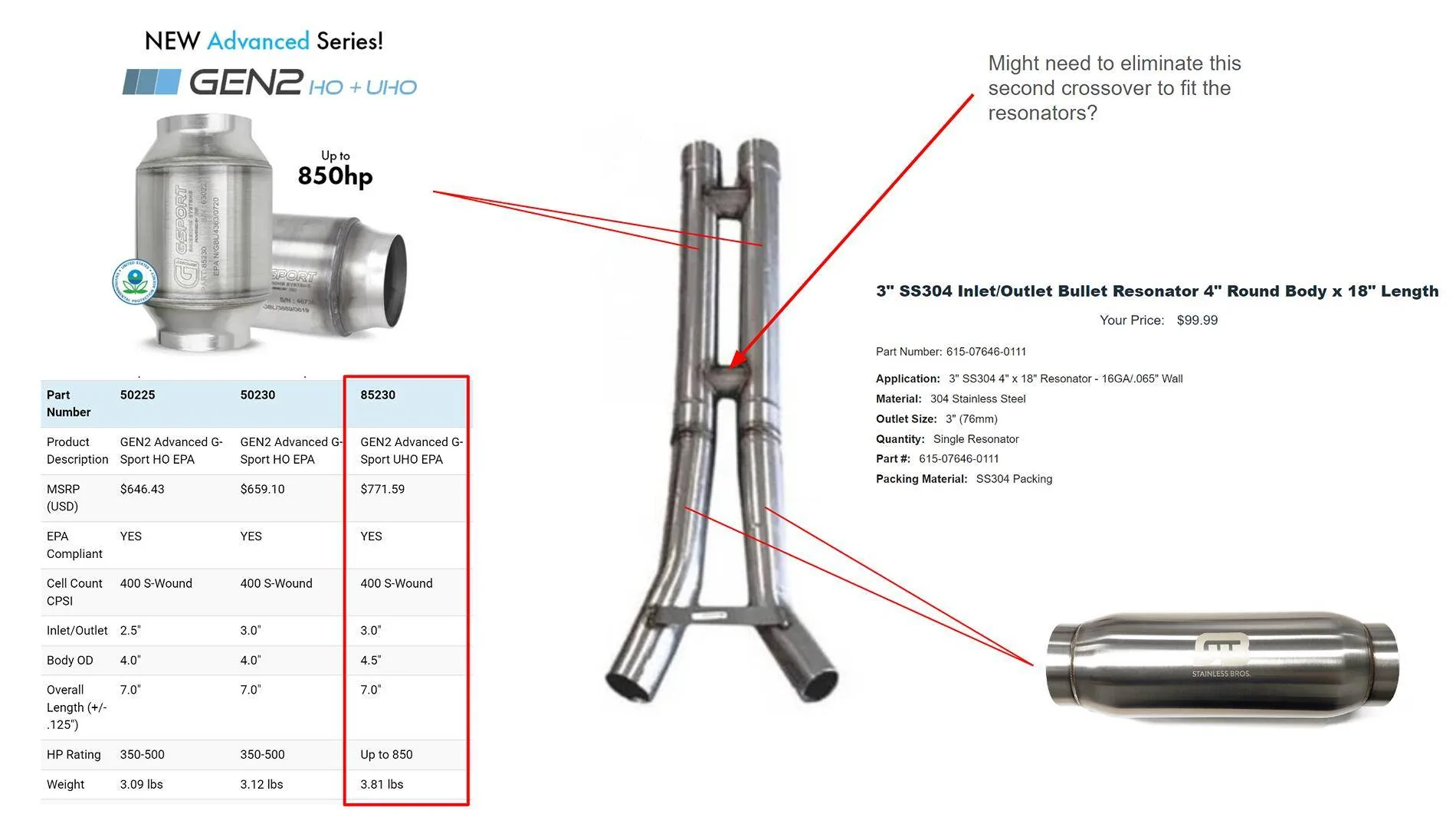
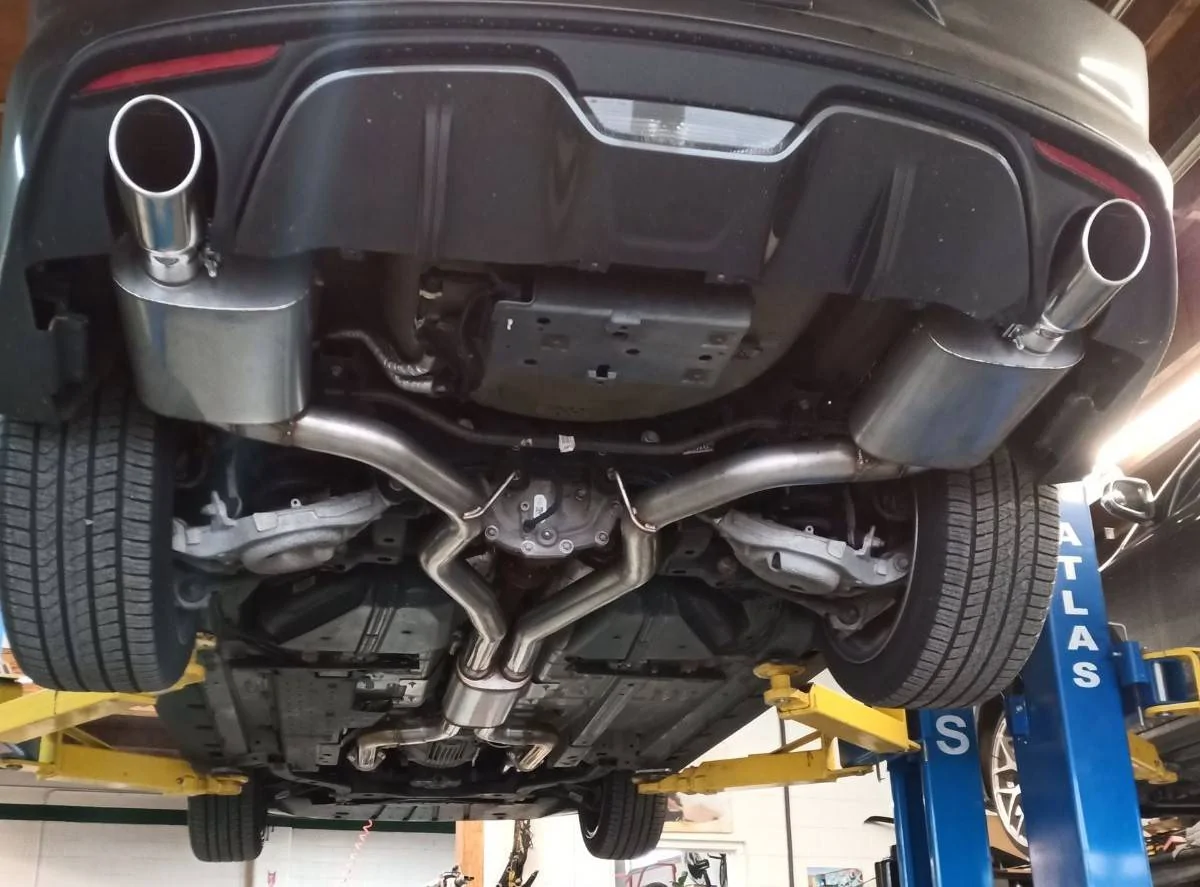
In terms of location of the cats & resonators, I'm thinking of getting a shop to weld them in like so:
1727333471541-qk.webp


Would this have a reasonable chance of achieving my goals? Any feedback/suggestions would be much appreciated!
 

cbrtrx

Well-Known Member
Joined
Nov 23, 2014
Threads
33
Messages
956
Reaction score
635
Location
tampa fl
Vehicle(s)
2016 mustang gt
Hey y'all, thanks a ton for all the info shared in this thread (with a special thanks to @engineermike for all the testing and results sharing)!

I have an ESS G3 kit on the way for my 2016 GT and trying to plan out the exhaust components to go with the build.

My goal would be to:
  • keep the noise increase to a minimum (strict noise limits at the tracks in my region)
  • eliminate the stock cats (reading about clogged cats blowing up s/c engines has me a bit paranoid)
  • put in some aftermarket cats further downstream (as a bit of a compromise between cat longevity and efficiency?)
  • locate the cats downstream of a crossover point so if one cat dies first there's some "early warning" (vs instantly damaging the corresponding cylinder bank?)
Here's what I'm thinking of going with:
In terms of location of the cats & resonators, I'm thinking of getting a shop to weld them in like so:
1727333471541-qk.webp


Would this have a reasonable chance of achieving my goals? Any feedback/suggestions would be much appreciated!
That setup would work but me personally with boost if you don't need to have cats I wouldn't run them, the failure rate is just too high to chance. Also I see no need to spend about $650 on the double h pipe because you'll be cutting most of it up.

I did longtubes with the 3 inch Jones X muffler with a custom made mid pipe into a corsa touring axleback. Others here have done the same. The sound is great in my opinion with zero drone and not too loud at all.
 

gps550

Member
Joined
Jul 20, 2024
Threads
1
Messages
13
Reaction score
11
Location
NA
Vehicle(s)
2016 GT
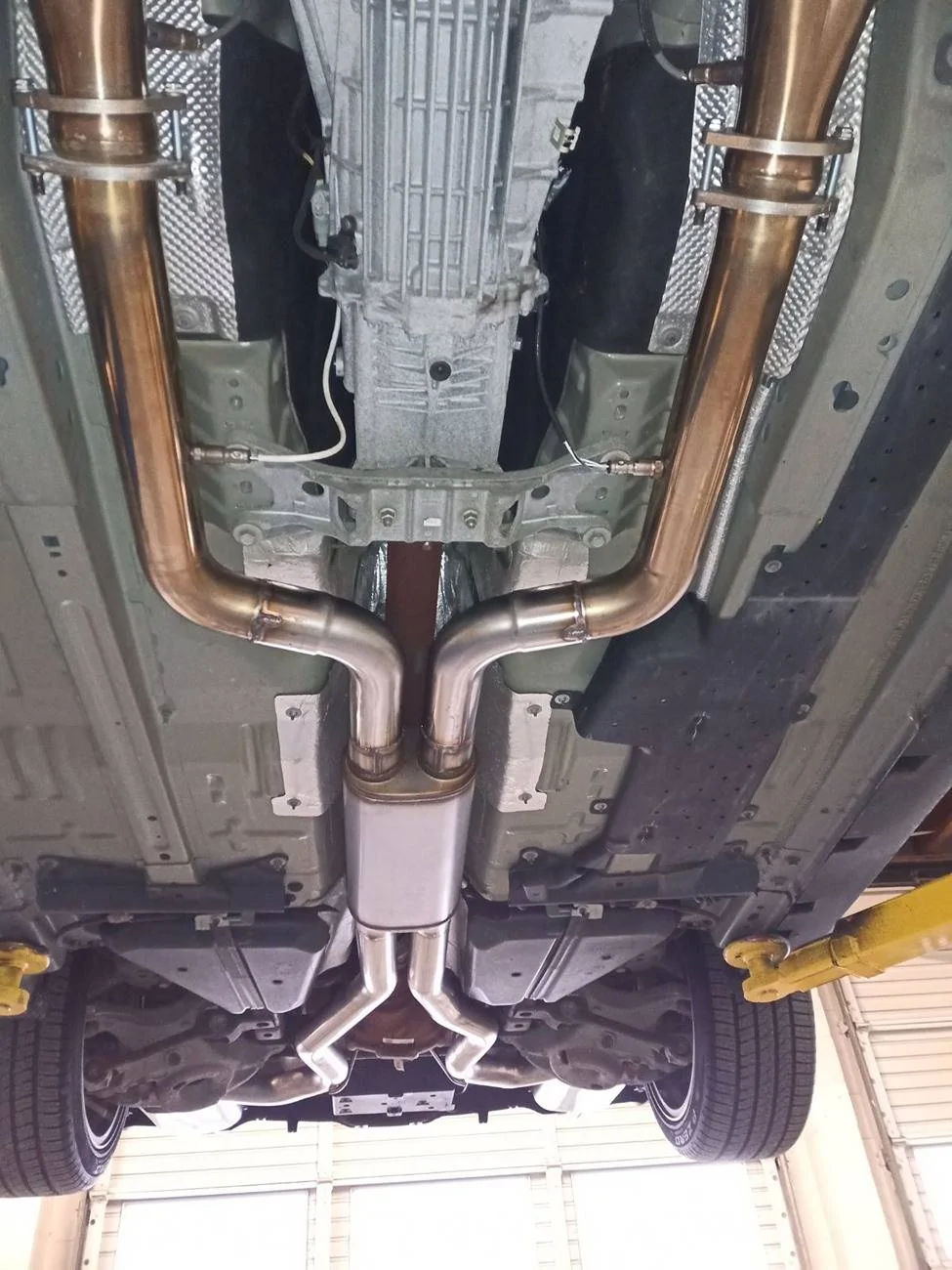
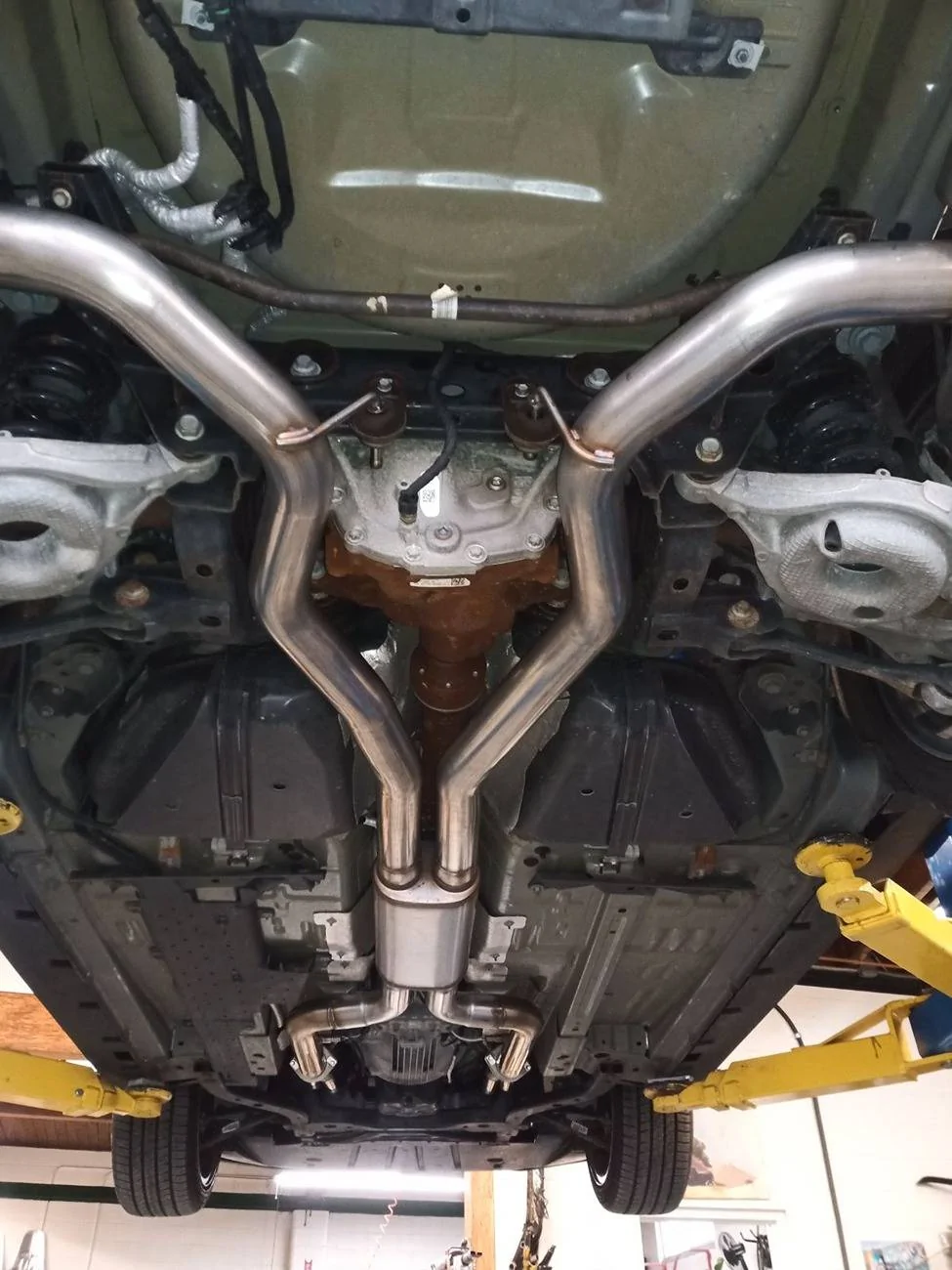
Thanks again to everyone for the discussion and info shared in this thread. Got my exhaust setup finished today after ordering the Steeda 3" catback system during their BF sale.

Asked a local shop to weld all the components together and modify the Steeda pipes to work with the Jones MF2469 X muffler in place of the Steeda X-pipe.

Sounds great and not too loud at all considering how free flowing the system should be. I had a terrible resonance at ~2500RPM with the stock catback + Kooks LTH which has been eliminated.

Can't wait to let it rip on track next season!

IMG_20241206_131549.webp

IMG_20241206_131553.webp

IMG_20241206_131557.webp
 

cbrtrx

Well-Known Member
Joined
Nov 23, 2014
Threads
33
Messages
956
Reaction score
635
Location
tampa fl
Vehicle(s)
2016 mustang gt
Thanks again to everyone for the discussion and info shared in this thread. Got my exhaust setup finished today after ordering the Steeda 3" catback system during their BF sale.

Asked a local shop to weld all the components together and modify the Steeda pipes to work with the Jones MF2469 X muffler in place of the Steeda X-pipe.

Sounds great and not too loud at all considering how free flowing the system should be. I had a terrible resonance at ~2500RPM with the stock catback + Kooks LTH which has been eliminated.

Can't wait to let it rip on track next season!

IMG_20241206_131549.jpg

IMG_20241206_131553.jpg

IMG_20241206_131557.jpg
Yeah I run the Jones as well with corsas, I love it. I've heard many setups on these cars and I really like what I'm running now the best.
 

Sponsored

80FoxCoupe

Well-Known Member
Joined
Mar 28, 2018
Threads
51
Messages
5,466
Reaction score
6,156
Location
Cincy, OH
Vehicle(s)
16 GT, 80 Fox
Yeah I run the Jones as well with corsas, I love it. I've heard many setups on these cars and I really like what I'm running now the best.
Saw some videos of folks having those Jones mufflers splitting. Keep an eye out for that.
 

cbrtrx

Well-Known Member
Joined
Nov 23, 2014
Threads
33
Messages
956
Reaction score
635
Location
tampa fl
Vehicle(s)
2016 mustang gt
Saw some videos of folks having those Jones mufflers splitting. Keep an eye out for that.
I have been looking at mine everytime I'm under the car. I think it was the Stainless Bros that were cracking but I'm sure the Jones could crack as well. I will say the Jones is 16 gauge were many others are 18 gauge.
 

K4fxd

Well-Known Member
Joined
Apr 2, 2020
Threads
121
Messages
13,455
Reaction score
12,262
Location
NKY
First Name
Dan
Vehicle(s)
2017 gt, 2002 FXDWG, 2008 C6,
I think it was the Stainless Bros that were cracking but I'm sure the Jones could crack as well.
It was stainless brothers.

The Jones I have wasn't welded very well on the inside.
 

80FoxCoupe

Well-Known Member
Joined
Mar 28, 2018
Threads
51
Messages
5,466
Reaction score
6,156
Location
Cincy, OH
Vehicle(s)
16 GT, 80 Fox
I have been looking at mine everytime I'm under the car. I think it was the Stainless Bros that were cracking but I'm sure the Jones could crack as well. I will say the Jones is 16 gauge were many others are 18 gauge.
Ah, I got them mixed up.
 
OP
OP

engineermike

Well-Known Member
Joined
Jul 15, 2018
Threads
31
Messages
6,180
Reaction score
6,431
Location
La
Vehicle(s)
2018 GTPP A10
I have an early stainless bros that’s held up well, but my friends stainless bros split and cracked to bits. It think they cheaped out on material. We replaced his with a jones and it’s been fine ever since. The jones appears to be thicker material.
Sponsored


Top