Sponsored

ESS G3 60-130 8 psi

OP
OP

Brad1810r80

Well-Known Member
Joined
Jul 22, 2021
Threads
16
Messages
517
Reaction score
496
Location
Huntsville AL
First Name
Brad
Vehicle(s)
2018 Mustang 2018 F150
good question, id like to know that also.

Question for anyone more knowledgeable than me with logging. When you look at air load are you taking the highest value through the pull? Or the value at max rpm?
Sponsored

 

Angrey

Well-Known Member
Joined
Jun 21, 2020
Threads
104
Messages
2,794
Reaction score
2,984
Location
Coral Gables
Vehicle(s)
2016 GT350
I’ve been enjoying reading this thread and also enjoy the data being provided. There’s some smart guys in this thread!

I would like to make a comment on the boost pressure Brad is seeing. We rate and have tested extensively the 125mm pulley that he runs at ~7psi @7200rpm. This is our largest pulley and is specifically made for Gen 3 customers cars that live on 91 octane pump fuel. Now he is of course revving higher than 7200 which explains why he sees the 8psi figure. Not only is this accurate from our real world experience and testing.. it must be accurate because of the simple fact that now hundreds of our customers run this pulley on their Gen 3 12:1 compression engines on 91 octane fuel. If this pulley made anywhere near 14 psi on 91 octane fuel you would see extreme detonation and engine failures. Here in Arizona we have many local customers with the 125mm pulley running the worst 91 octane fuel in the nation with 110+ ambient temps in their Gen 3 coyotes. All of them consistently see between 6-8 psi depending on setup and RPM.
I feel like we've covered this ground before in the other threads. So let's do some simple physics.

8 psi gauge is approximately 54% more air (STP) than the motor would be drawing at STP.

If we approximate his power from the 60-130 to 725, that equates AT PERFECT EFFICIENCY (I can't emphasize this enough, if the ENTIRE SYSTEM GENERATED 100% of the additional air toward usable power) then that means his car would have to be running 471 to the wheels on pump gasoline.

A) Does anyone think a Gen3 on pump gas with headers and a GT350 intake makes 470 to the wheels? Or does that seem a little on the happy side?

B) Okay, is it possible to make 470 to the wheels on pump gas, overspinning it.....maybe.

C) Even if you assume the car is making that much steam, IT IS THERMODYNAMICALLY IMPOSSIBLE FOR A SUPERCHARGER SYSTEM TO OPERATE AT 100% ADIABATIC EFFICIENCY.

So something is off. Could he be making 725 to the wheels? Absolutely. NOTHING implausible there.

Could he be making 470 to the wheels on pump gas with only headers and a GT350 intake, overspinning? Maybe. It's not impossible, but it's dubious and would be an outlier.

So in order to maintain the claim of 8 psi, we have to assume a very rosey pre-blower motor capability and then we have to pair it with an IMPOSSIBLE efficiency.

I don't normally like to rely upon inferred outputs, but the computer is definitely "inferring" MUCH more boost than 8 psi. I'm open to the idea that the computer is inaccurate. And if the computer was just calculating a few % over, or a coupe psi, maybe we could chalk it up to that. But it's giving an output MUCH higher than the 8 psi claim. Which isn't definitive, but not helpful to the 8 psi claim.

Again, I'm open to the idea that maybe it's a measurement disparity. Maybe it's where the sensor is located. (I'm totally grasping at straws with this idea, just trying any which way to maintain the idea that it's not intentional or deceptive).

I know ESS is making good stuff. I'm not trying to claim it's not. But you have to admit, if you're any sort of knowledgeable in the industry that the boost numbers are NOT normal with the outputs being documented.
 
OP
OP

Brad1810r80

Well-Known Member
Joined
Jul 22, 2021
Threads
16
Messages
517
Reaction score
496
Location
Huntsville AL
First Name
Brad
Vehicle(s)
2018 Mustang 2018 F150
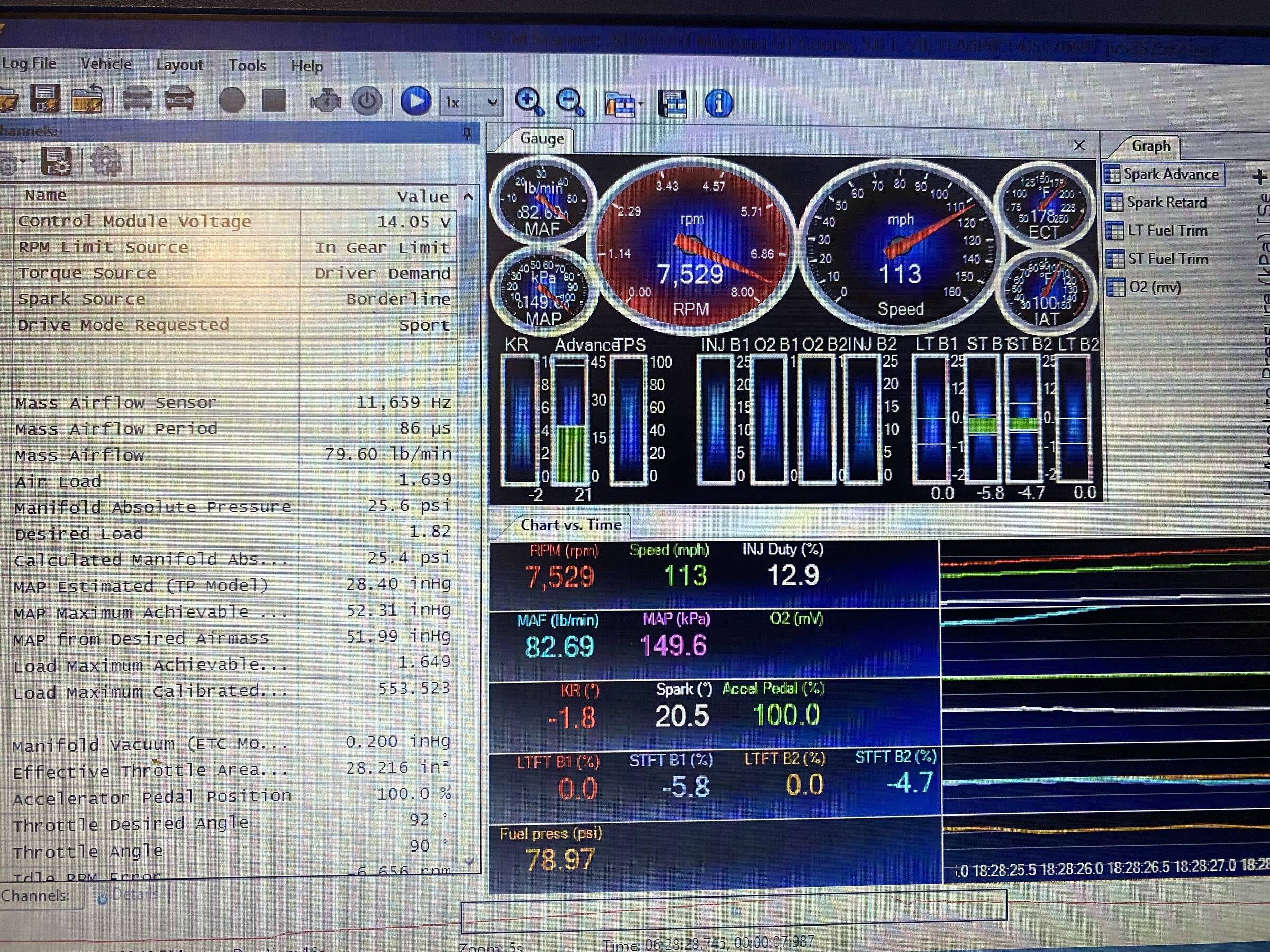
Here is another picture from a log I just did. My tuner actually order one of these kits and found some things in the tune to make a little more power. Still 125mm pulley. 81 degs outside 5th gear pull.

073122CE-70EF-44F7-922E-5C652E59183E.jpeg
 

pittzy23

Well-Known Member
Joined
Mar 29, 2021
Threads
3
Messages
77
Reaction score
55
Location
Wisconsin
First Name
Corey
Vehicle(s)
2020 Mustang GT
Well I really didn’t want to get embroiled into the ess debate….I looked at Brad’s log and there’s nothing magic happening. It’s a solid pull with a solid tune. Everything lines up as it should…1.7 load, .8-.85 lambda, 20-21 deg timing (e30 fuel iirc), cam timing doing what you would expect, COT disabled, 60-130 in about 6.2 seconds which equates to about 138 mph in the quarter. This all adds up. The part that doesn’t add up is that the ess website lists the 125 mm pullley as 7 psi and Brad’s gauge roughly agrees, but everything in the log and performance seems to indicate 13-14 psi which I can’t explain.
I'm no tuner for sure, but looking at his log I came to the same conclusion. lambda right where it should be, timing is more than reasonable (targeting around 19 but typically seeing around 21), air load typically in the 1.54 area so 8 psi sounds about right. highest MAF reading I saw was around 85 lbs/min towards the top of 3rd and 4th (7500ish rpm). about 6 seconds 60-130. Fuel rail pressure also really stable / good and the injectors are barely working (15% at peak RPM). would guess around the 720 whp range. thing just moves out. think the 3.55s help things get moving off the rip (assuming 3.55s based on the shifting speeds and a 28" tire)
 
OP
OP

Brad1810r80

Well-Known Member
Joined
Jul 22, 2021
Threads
16
Messages
517
Reaction score
496
Location
Huntsville AL
First Name
Brad
Vehicle(s)
2018 Mustang 2018 F150
An car should be able to run a 5.9 60-130 with just 700 whp I would think.
 

Sponsored

Angrey

Well-Known Member
Joined
Jun 21, 2020
Threads
104
Messages
2,794
Reaction score
2,984
Location
Coral Gables
Vehicle(s)
2016 GT350
Here is another picture from a log I just did. My tuner actually order one of these kits and found some things in the tune to make a little more power. Still 125mm pulley. 81 degs outside 5th gear pull.

073122CE-70EF-44F7-922E-5C652E59183E.jpeg
So it's inferring 10.7-10.9 lbs. (sea level or DA 0).
 
OP
OP

Brad1810r80

Well-Known Member
Joined
Jul 22, 2021
Threads
16
Messages
517
Reaction score
496
Location
Huntsville AL
First Name
Brad
Vehicle(s)
2018 Mustang 2018 F150
Yes sir 3.55 gears


I'm no tuner for sure, but looking at his log I came to the same conclusion. lambda right where it should be, timing is more than reasonable (targeting around 19 but typically seeing around 21), air load typically in the 1.54 area so 8 psi sounds about right. highest MAF reading I saw was around 85 lbs/min towards the top of 3rd and 4th (7500ish rpm). about 6 seconds 60-130. Fuel rail pressure also really stable / good and the injectors are barely working (15% at peak RPM). would guess around the 720 whp range. thing just moves out. think the 3.55s help things get moving off the rip (assuming 3.55s based on the shifting speeds and a 28" tire)
 

larr12

Well-Known Member
Joined
Jul 9, 2020
Threads
17
Messages
1,123
Reaction score
1,723
Location
USA
First Name
Alberto
Vehicle(s)
2020 Mustang PP1
I think the headers are a factor here. Alex from Lund gained 50whp with headers on his vortech. Another m6g made 75whp.
 
OP
OP

Brad1810r80

Well-Known Member
Joined
Jul 22, 2021
Threads
16
Messages
517
Reaction score
496
Location
Huntsville AL
First Name
Brad
Vehicle(s)
2018 Mustang 2018 F150
I swear mine got faster when I went from stock cat back to magnaflow full 3” I even removed the bottle neck section near the x pipe that goes down 2 1/4”.

I think the headers are a factor here. Alex from Lund gained 50whp with headers on his vortech. Another m6g made 75whp.
 

Brevin@ESS

Well-Known Member
Joined
Feb 7, 2022
Threads
2
Messages
143
Reaction score
379
Location
Chandler, AZ
Vehicle(s)
17 Mustang GT
I feel like we've covered this ground before in the other threads. So let's do some simple physics.

8 psi gauge is approximately 54% more air (STP) than the motor would be drawing at STP.

If we approximate his power from the 60-130 to 725, that equates AT PERFECT EFFICIENCY (I can't emphasize this enough, if the ENTIRE SYSTEM GENERATED 100% of the additional air toward usable power) then that means his car would have to be running 471 to the wheels on pump gasoline.

A) Does anyone think a Gen3 on pump gas with headers and a GT350 intake makes 470 to the wheels? Or does that seem a little on the happy side?

B) Okay, is it possible to make 470 to the wheels on pump gas, overspinning it.....maybe.

C) Even if you assume the car is making that much steam, IT IS THERMODYNAMICALLY IMPOSSIBLE FOR A SUPERCHARGER SYSTEM TO OPERATE AT 100% ADIABATIC EFFICIENCY.

So something is off. Could he be making 725 to the wheels? Absolutely. NOTHING implausible there.

Could he be making 470 to the wheels on pump gas with only headers and a GT350 intake, overspinning? Maybe. It's not impossible, but it's dubious and would be an outlier.

So in order to maintain the claim of 8 psi, we have to assume a very rosey pre-blower motor capability and then we have to pair it with an IMPOSSIBLE efficiency.

I don't normally like to rely upon inferred outputs, but the computer is definitely "inferring" MUCH more boost than 8 psi. I'm open to the idea that the computer is inaccurate. And if the computer was just calculating a few % over, or a coupe psi, maybe we could chalk it up to that. But it's giving an output MUCH higher than the 8 psi claim. Which isn't definitive, but not helpful to the 8 psi claim.

Again, I'm open to the idea that maybe it's a measurement disparity. Maybe it's where the sensor is located. (I'm totally grasping at straws with this idea, just trying any which way to maintain the idea that it's not intentional or deceptive).

I know ESS is making good stuff. I'm not trying to claim it's not. But you have to admit, if you're any sort of knowledgeable in the industry that the boost numbers are NOT normal with the outputs being documented.
I hear you, but you also have to keep in mind that with increased effective compression ratio also comes increased engine efficiency. Why do you think a 11:1 CR engine makes more than the exact same engine with 9:1? Increased efficiency as long as the fuel used still supports optimal timing. When you add boost, effective compression ratio goes up exponentially so the same basic engine calculations of VE no longer applies 100% as it's now more efficient.

The volumetric efficiency of an engine is the extent to which the cylinder is completely filled by the air/ fuel mixture that enters on each exhaust stroke. This measures the ability of an engine to breathe freely. The easier the engine breathes, the greater its volumetric efficiency, and the more power it produces.

But again, I will ask. If this nearly 5” (125mm pulley) really does generate 14psi of boost how is it possible that hundreds of customers are running it @7500 rpm on 91 pump fuel on a 12:1 CR coyote engine? It has been well documented by now the limits of the gen 3 coyote and pump fuel. 14 psi on 91 octane would be certain death to that engine. How is it that every major tuner in the game has not noticed that issue? Again, that is our largest pulley we offer. If these calculations were correct then by default our kit could not be supported on pump fuel without complete engine failure or at the bare minimum some extremely pissed off knock sensors. This is not the case. All of the major tuners have had great success tuning and keeping these engines and knock sensors happy. The real world data speak for itself and is irrefutable. Too much boost+pump fuel=Disaster.
 
Last edited:

Sponsored

Ronlowen

Active Member
Joined
Jun 27, 2021
Threads
2
Messages
39
Reaction score
57
Location
Iowa
First Name
Ron
Vehicle(s)
2018 401a a10 3.15 gears
I swear mine got faster when I went from stock cat back to magnaflow full 3” I even removed the bottle neck section near the x pipe that goes down 2 1/4”.
Alex picked up like 20 hp from his catback
 

pittzy23

Well-Known Member
Joined
Mar 29, 2021
Threads
3
Messages
77
Reaction score
55
Location
Wisconsin
First Name
Corey
Vehicle(s)
2020 Mustang GT
I swear mine got faster when I went from stock cat back to magnaflow full 3” I even removed the bottle neck section near the x pipe that goes down 2 1/4”.
On Alex Flores' vortech car he made an additional 20 wheel / torque by adding the x-pipe and catback, so i think what you felt is valid. on a NA car the stock exhaust (even headers) is not good HP per dollar value. at your power levels is when the little things come into play.
 

Angrey

Well-Known Member
Joined
Jun 21, 2020
Threads
104
Messages
2,794
Reaction score
2,984
Location
Coral Gables
Vehicle(s)
2016 GT350
I hear you, but you also have to keep in mind that with increased effective compression ratio also comes increased engine efficiency. Why do you think a 11:1 CR engine makes more than the exact same engine with 9:1? Increased efficiency as long as the fuel used still supports optimal timing. When you add boost, effective compression ratio goes up exponentially so the same basic engine calculations of VE no longer applies 100% as it's now more efficient.

The volumetric efficiency of an engine is the extent to which the cylinder is completely filled by the air/ fuel mixture that enters on each exhaust stroke. This measures the ability of an engine to breathe freely. The easier the engine breathes, the greater its volumetric efficiency, and the more power it produces.

But again, I will ask. If this nearly 5” (125mm pulley) really does generate 14psi of boost how is it possible that hundreds of customers are running it @7500 rpm on 91 pump fuel on a 12:1 CR coyote engine? It has been well documented by now the limits of the gen 3 coyote and pump fuel. 14 psi on 91 octane would be certain death to that engine. How is it that every major tuner in the game has not noticed that issue? Again, that is our largest pulley we offer. If these calculations were correct then by default our kit could not be supported on pump fuel without complete engine failure or at the bare minimum some extremely pissed off knock sensors. This is not the case. All of the major tuners have had great success tuning and keeping these engines and knock sensors happy. The real world data speak for itself and is irrefutable. Too much boost+pump fuel=Disaster.
Even if I accept a large increase in VE (enough to overcome any parasitic losses from the blower and additional heat inefficiencies) that would be true for every other compressor system as well. So you're left inferring that either VE increases for ESS but not others. Or it increases for everyone and ESS has no parasitic losses.

Has anyone bothered to test the pressure in any other way that the BOV? It could be as simple as the fitting and the readings off that port are restrictive and not giving full boost to the gauge.
 

Brevin@ESS

Well-Known Member
Joined
Feb 7, 2022
Threads
2
Messages
143
Reaction score
379
Location
Chandler, AZ
Vehicle(s)
17 Mustang GT
Even if I accept a large increase in VE (enough to overcome any parasitic losses from the blower and additional heat inefficiencies) that would be true for every other compressor system as well. So you're left inferring that either VE increases for ESS but not others. Or it increases for everyone and ESS has no parasitic losses.

Has anyone bothered to test the pressure in any other way that the BOV? It could be as simple as the fitting and the readings off that port are restrictive and not giving full boost to the gauge.
Our head unit has significantly less parasitic loss than you might think. We have achieved this in a few different ways. 12mm wide optimized gears, SKF ultra precision/low friction bearings, a patented oiling system with minimal friction losses. Etc..

This paired with a state of the art impeller/volute design and efficient intercooler and pressure path all make a difference.

I believe from the results Brad has posted we are seeing all of these things come together. With less parasitic loss the engine can produce better results on similar boost levels to what everyone is used to.

I don’t post this to come off arrogant or brag about our product. There are people with genuine questions on how these results are being achieved. All of these things come together and make a difference in the final results.

However, I still ask the golden question.. and would genuinely like to know how these pulleys are being ran safely on pump 91 fuel if they are over boosting by several PSI? Why aren’t tuners having issues with this? And why don’t we see logs showing people having issues with their car pulling timing and detonating like crazy because their 7psi pump gas pulley is actually making 12-14 psi.. ?
 

engineermike

Well-Known Member
Joined
Jul 15, 2018
Threads
32
Messages
6,307
Reaction score
6,637
Location
La
Vehicle(s)
2018 GTPP A10
Respectfully, I haven’t seen a 91 octane log along with performance figures yet, so I dont know what load, timing, and power they are accomplishing. FWIW, you can easily run 14 psi on 91 with the right spark timing. Brad’s example was solid but he’s running e30 and 21 deg timing.
Sponsored


Top