Sponsored

1st UPR Procharger Catch Can Drain and....nothing

Bartly

Well-Known Member
Joined
Oct 25, 2015
Threads
94
Messages
1,527
Reaction score
221
Location
Out West
Vehicle(s)
2016 Mustang GT
Just bumping this. Wondering if anyone else has any ideas why the OP isn't getting any oil collected when his looks to be routed the same as the other user who's can was nearly full?
Sponsored


 
OP
OP

Phill The Greek

Well-Known Member
Joined
Oct 2, 2014
Threads
24
Messages
144
Reaction score
22
Location
Virginia
Vehicle(s)
2015 Oxford White GTPP
Thanks. I'm still wondering what''s the cause and appreciate your bump.
 

UPRjoe

Well-Known Member
Diamond Sponsor
Joined
Dec 19, 2014
Threads
24
Messages
592
Reaction score
260
Location
750 S. Eastcoast St, Lake Worth Fl. 33460
Website
www.uprproducts.com
First Name
Joe
Vehicle(s)
UPR 2015 Ecoboost Mustang
Just catching up on this and would like to get pictures of the original installation sent to [email protected]

The reason the catch can is set up as a low vacuum breather is if we route it correctly the tune for the vehicle will have to be redone from scratch. YES, it's much better to have the vacuum source connected and not plugged to get the very best evacuation for the engine. ProCharger routes their hoses this way and it works like a very low vacuum PCV.

We never have any issues with oil pull through unless the system is routed incorrectly. Also, when the system is setup like this it does not require a check valve. You only require a check valve when you don't block off the vacuum at the front of the manifold.

As simple as breathers are to slap on. They completely eliminate any evacuation from the crankcase, then your engine has to force the air out without any vacuum. When you eliminate the vacuum there is a difference in the heat generated and the crankcase will see hotter temps with breathers. Lastly, any bit of crisp throttle response and MPG that was occurring from the vacuum will be completely removed and that's going away from late model technology and performance.

We offer breather cans and catch can in the full plug n play™ form. I personally run breathers on our street or race cars. Our 2.3L Ecoboost Mustang runs two catch cans. We run a full dirty side catch can system and a full clean side catch can to ensure the most power. Many tuners and engine builders also prefer full catch cans that don't bypass the vacuum source to be able to have a cleaner and stronger running vehicle.

Feel free to email PM for help and I'm sorry I got here so late.

( I have seen plenty of catch cans that just get a mist or vapor in them because the vacuum is so weak at the inlet of the blower )

I would still like to be able to see everything and help get this resolved.

Joe

 
Last edited:

TooSoonJunior

Well-Known Member
Joined
Feb 10, 2017
Threads
79
Messages
823
Reaction score
175
Location
Southern CT
Vehicle(s)
2015 Mustang GT PP M6
Just catching up on this and would like to get pictures of the original installation sent to [email protected]

The reason the catch can is set up as a low vacuum breather is if we route it correctly the tune for the vehicle will have to be redone from scratch. YES, it's much better to have the vacuum source connected and not plugged to get the very best evacuation for the engine. ProCharger routes their hoses this way and it works like a very low vacuum PCV.

We never have any issues with oil pull through unless the system is routed incorrectly. Also, when the system is setup like this it does not require a check valve. You only require a check valve when you don't block off the vacuum at the front of the manifold.

Feel free to email PM for help and I'm sorry I got here so late.

( I have seen plenty of catch cans that just get a mist or vapor in them because the vacuum is so weak at the inlet of the blower )

I would still like to be able to see everything and help get this resolved.

Joe
It would not require a retune if the customer installed a second catch can on the driver side and left all routing 100% stock, with each catch in line with the valve cover lines each on the driver and passenger side.

Even if you left everything 100% stock routing and only spliced in one catch can to the passenger side line, left the driver side going to the intake, wouldn't require a retune and would catch 80-90% of the oil vapor. The stock PCV valve does just fine from what I understand under moderate boost in closing and keeping boost out of the crank case.
 

UPRjoe

Well-Known Member
Diamond Sponsor
Joined
Dec 19, 2014
Threads
24
Messages
592
Reaction score
260
Location
750 S. Eastcoast St, Lake Worth Fl. 33460
Website
www.uprproducts.com
First Name
Joe
Vehicle(s)
UPR 2015 Ecoboost Mustang
We have done hundreds of procharger cars over the years and the problem is that the blower tune is done with a blocked PCV system and you cannot route the PCV back to stock unless you get a retune. You cannot run the same tune in a car with the PCV blocked and then go back to the factory PCV routing without a lot of tune and driveability issues. We had three project cars over the last year that all experienced the same problem until they were retuned.

It seems most of the top mount blower tuners do not have the same issues as they generally leave the PCV operational. As for the stock PCV it seals about 50% on boosted engines and does not matter with normally aspirated setups.

We tune all our setups without blocking the PCV as they perform so much better.

My reference is with the procharger tuneup.

Joe

 

Sponsored

OP
OP

Phill The Greek

Well-Known Member
Joined
Oct 2, 2014
Threads
24
Messages
144
Reaction score
22
Location
Virginia
Vehicle(s)
2015 Oxford White GTPP
Just catching up on this and would like to get pictures of the original installation sent to [email protected]

The reason the catch can is set up as a low vacuum breather is if we route it correctly the tune for the vehicle will have to be redone from scratch. YES, it's much better to have the vacuum source connected and not plugged to get the very best evacuation for the engine. ProCharger routes their hoses this way and it works like a very low vacuum PCV.

We never have any issues with oil pull through unless the system is routed incorrectly. Also, when the system is setup like this it does not require a check valve. You only require a check valve when you don't block off the vacuum at the front of the manifold.

As simple as breathers are to slap on. They completely eliminate any evacuation from the crankcase, then your engine has to force the air out without any vacuum. When you eliminate the vacuum there is a difference in the heat generated and the crankcase will see hotter temps with breathers. Lastly, any bit of crisp throttle response and MPG that was occurring from the vacuum will be completely removed and that's going away from late model technology and performance.

We offer breather cans and catch can in the full plug n play™ form. I personally run breathers on our street or race cars. Our 2.3L Ecoboost Mustang runs two catch cans. We run a full dirty side catch can system and a full clean side catch can to ensure the most power. Many tuners and engine builders also prefer full catch cans that don't bypass the vacuum source to be able to have a cleaner and stronger running vehicle.

Feel free to email PM for help and I'm sorry I got here so late.

( I have seen plenty of catch cans that just get a mist or vapor in them because the vacuum is so weak at the inlet of the blower )

I would still like to be able to see everything and help get this resolved.

Joe
Thanks for stepping in. I posted my pic in post #39. It is installed as your instructions prescribe. Any help is much appreciated.
 

ahl395

Well-Known Member
Joined
Dec 30, 2015
Threads
42
Messages
2,816
Reaction score
1,219
Location
NJ
First Name
Allan
Vehicle(s)
2017 Mustang GT, 2006 Infiniti G35X
We have done hundreds of procharger cars over the years and the problem is that the blower tune is done with a blocked PCV system and you cannot route the PCV back to stock unless you get a retune. You cannot run the same tune in a car with the PCV blocked and then go back to the factory PCV routing without a lot of tune and driveability issues. We had three project cars over the last year that all experienced the same problem until they were retuned.

It seems most of the top mount blower tuners do not have the same issues as they generally leave the PCV operational. As for the stock PCV it seals about 50% on boosted engines and does not matter with normally aspirated setups.

We tune all our setups without blocking the PCV as they perform so much better.

My reference is with the procharger tuneup.

Joe

Interesting. Thanks for explaining

Can you explain how to route it the "better" way?
What do we need to ask to be changed in the tune?
 

donmcgowen

Well-Known Member
Joined
Dec 13, 2016
Threads
24
Messages
266
Reaction score
42
Location
Chicago
Vehicle(s)
2015 Mustang GT, D1 Procharger Stage 2
So I want to know, running a breather system seems to defeat the purpose of a catch can all together. Isn't a catch can always recommended on Boosted motors? I prefer breathers if it wouldn't matter, but just about everyone recommends a catch can for boost. My last car they wouldn't even give me the tune with pics of me having dual catch cans on a 2.0 turbo motor.
 

donmcgowen

Well-Known Member
Joined
Dec 13, 2016
Threads
24
Messages
266
Reaction score
42
Location
Chicago
Vehicle(s)
2015 Mustang GT, D1 Procharger Stage 2
What is the best way to run a PCV setup.
 

UPRjoe

Well-Known Member
Diamond Sponsor
Joined
Dec 19, 2014
Threads
24
Messages
592
Reaction score
260
Location
750 S. Eastcoast St, Lake Worth Fl. 33460
Website
www.uprproducts.com
First Name
Joe
Vehicle(s)
UPR 2015 Ecoboost Mustang
The best way to setup your PCV is the same as the factory routing. The only change is to that is ever suggested is to delete the PCV if your engine is pushing a lot of oil out of the clean side / driver side.

The PCV is so restrictive on boosted engines that it will almost always push oil out the Clean / Driver side until it has been upgraded to a UPR Billet PCV delete. The can will need to be checked more frequently as it will now be capturing the majority of the oil.

Best part is the PCV mod will allow the dirty side to be the main outlet that oil will flow through as it now becomes the path with the least resistance. We have worked closely with on all the boosted cars and trucks over the last three years.

The system we prefer for the primary catch can for this application is the UPR Plug n Play™ 5030-98 2.5" Diameter Catch Can so it will have the correct volume to do the best job and then we just run a UPR Plug n Play™ CSS.

Joe
 

Sponsored

francisco511

Well-Known Member
Joined
Aug 7, 2014
Threads
8
Messages
177
Reaction score
16
Location
Los Angeles
Vehicle(s)
2015 Mustang GT PP
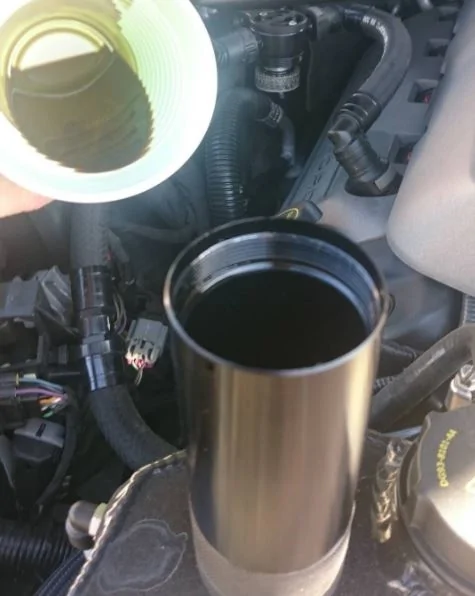
Emptied out my catch can for the first time after a whole year this is what was inside. It was mostly a thin liquid (coolant?) with some oil.
Is that normal?


IMG_2530.webp
 

ahl395

Well-Known Member
Joined
Dec 30, 2015
Threads
42
Messages
2,816
Reaction score
1,219
Location
NJ
First Name
Allan
Vehicle(s)
2017 Mustang GT, 2006 Infiniti G35X
That doesnt look like very much for a whole year. How many miles was that?

The watery part I believe is condensation. Mine was definitely darker and had more oil in it, and the smell of fuel.
 

mustank

Well-Known Member
Joined
May 23, 2016
Threads
12
Messages
184
Reaction score
40
Location
APO
Vehicle(s)
2016 mustang gt
Figured I would add to the thread.
This is my catch can after about 4000 miles.
35913444255_e0bb6ee80d_o_d.webp


if you look, you can see how/where I mounted it.
 

whatsup62

Well-Known Member
Joined
Sep 16, 2015
Threads
129
Messages
2,046
Reaction score
525
Location
Jupiter
Vehicle(s)
2015 Mustang GT PP (Gone but not forgotten).
~6k miles
For shits and giggles ( if you have time) you should yank the TB off and reach into your intake and see how well its working....Thats why I went to breathers....yours may be fine.
Sponsored


Top