
Sponsored

Tuning/boost question....

Dark Pony

Well-Known Member
Joined
Jun 19, 2019
Threads
32
Messages
152
Reaction score
33
Location
Ohio
First Name
Ramsey
Vehicle(s)
2015 mustang GT
This is a question I have had for a while, and have attempted to Google the answer, but I can't seem to find anything that really answered it, accept for AI, and we know how trustworthy that is.

Anyway, my question is this: If a person has a stock motor, exhaust, headers, exhaust, etc, with just a supercharger added, and is running what might be considered a safe amount of boost, let's say 10psi. Since boost pressure is a measure of restriction, the person reduces some of the restriction by adding a free flowing exhaust, headers, and a cam, and effectively lowers the boost being read on the gauge, let's say now showing 8PSI, would it still be safe to pulley down to get back to 10PSI on 93 octane, provided the motor could handle the extra power it made? We know the supercharger isn't flowing any less CFM, so is adding more to get back to 10PSI going to be any issue?

I can think of reasons why it would be ok, and reasons why it wouldn't be ok. For the record, googles AI says it is generally considered safe. Not really debating on the merits of pump gas or e85 or anything, just trying to understand the limitations of things and the theories or what not associated with it. Sorry if this is a dumb question, just one I have had for a while.
Sponsored

 
OP
OP

Dark Pony

Well-Known Member
Joined
Jun 19, 2019
Threads
32
Messages
152
Reaction score
33
Location
Ohio
First Name
Ramsey
Vehicle(s)
2015 mustang GT

5.0_Lojos

Well-Known Member
Joined
Feb 17, 2023
Threads
13
Messages
368
Reaction score
230
Location
Miami FL
First Name
Carlos
Vehicle(s)
2016 Mustang GT Premium
"Probably"

if your tuner says it's safe

The most accurate answer for sure. "The tuner" Will guide you in the direction, assuming he is a good tuner of course. Excellent question for the tuner is responsible in tuning your application.
 

Sponsored

engineermike

Well-Known Member
Joined
Jul 15, 2018
Threads
31
Messages
6,192
Reaction score
6,461
Location
La
Vehicle(s)
2018 GTPP A10
This is interesting, but for starters, boost isn't a measure of restriction. Maybe back in the 80's when trying to squeeze air through a tiny SBF port and valve, it was. But with the coyote the intake, head, and cams actually exceed 100% VE. Air is being pressurized into a closed-ended cylinder and increases the density of the charge.

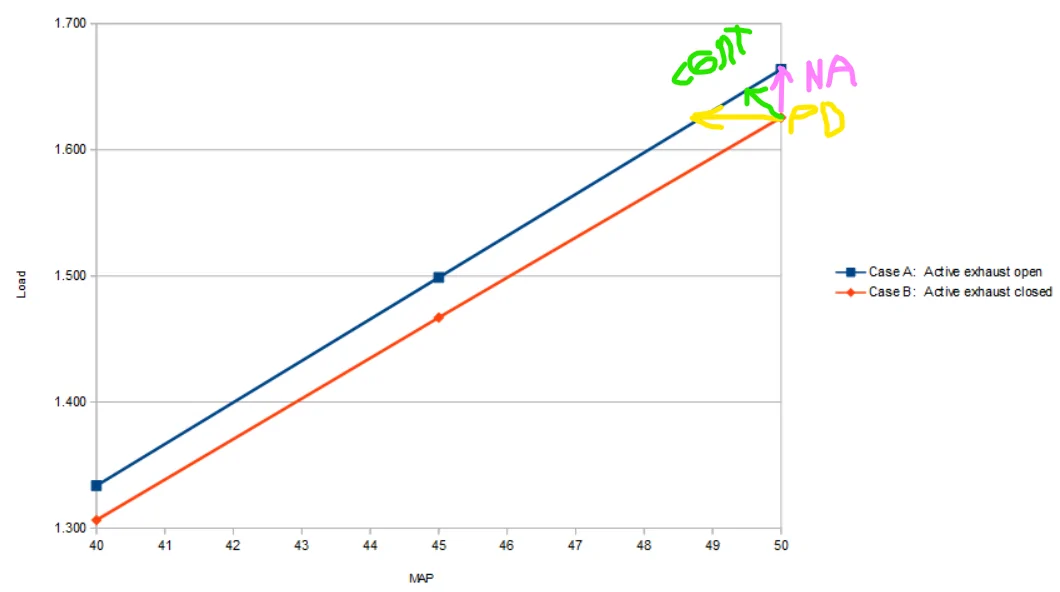
That said, I modeled the OEM speed density calculations of a Gen3 coyote in the boost range with active exhaust open and closed to demonstrate the difference it makes to VE:

1781452371423-n6.webp


With active exhaust open, you get more load for any given manifold pressure. It took a second for that to sink in. Basically, if you reduce exhaust backpressure, for any given manifold pressure, more air makes it into the cylinder, not less. This means less backpressure leads to more cylinder pressure, more propensity to knock, higher stresses, etc. Yes, it seems backwards at first, I will admit. Then again, with an NA engine, you would expect it to flow more air if you reduce backpressure, so why would boosted be any different. The purple arrow above shows what happens to air load when you open the active exhaust on a stock engine (imagine it's at 27 inHg), as the manifold pressure stays essentially the same thanks to the atmospheric nature, and you get a vertical increase in load.

But when you toss a supercharger into the mix, it gets even more confusing. A PD blower doesn't care too much how much pressure it's pumping into; it does practically the same flow regardless. Since cylinder air load = MAF/rpm/4/.0017, that means that the load does not change at all if you reduce exhaust restriction (yellow arrow in graph). But a centrif is different, being a dynamic compressor if you reduce the pressure it's pushing into, it actually flows more air similar to NA. So, with a centrif, much like NA, reducing exhaust restriction results in more air load, more cylinder pressure, etc. However, due to the nature of the centrifugal compressor curve (lower pressure means more flow, but due to compressor limitations it's not a vertical line) you get some increase in flow, and thus load, for the decrease in manifold pressure (green arrow).

In summary, if you reduce restriction and increase boost to get back to original levels, it's not getting you back to the same safety level as prior. It's actually pushing you in the less safe direction twice instead of once.
 
OP
OP

Dark Pony

Well-Known Member
Joined
Jun 19, 2019
Threads
32
Messages
152
Reaction score
33
Location
Ohio
First Name
Ramsey
Vehicle(s)
2015 mustang GT
This is interesting, but for starters, boost isn't a measure of restriction. Maybe back in the 80's when trying to squeeze air through a tiny SBF port and valve, it was. But with the coyote the intake, head, and cams actually exceed 100% VE. Air is being pressurized into a closed-ended cylinder and increases the density of the charge.

That said, I modeled the OEM speed density calculations of a Gen3 coyote in the boost range with active exhaust open and closed to demonstrate the difference it makes to VE:

1781452371423-n6.webp


With active exhaust open, you get more load for any given manifold pressure. It took a second for that to sink in. Basically, if you reduce exhaust backpressure, for any given manifold pressure, more air makes it into the cylinder, not less. This means less backpressure leads to more cylinder pressure, more propensity to knock, higher stresses, etc. Yes, it seems backwards at first, I will admit. Then again, with an NA engine, you would expect it to flow more air if you reduce backpressure, so why would boosted be any different. The purple arrow above shows what happens to air load when you open the active exhaust on a stock engine (imagine it's at 27 inHg), as the manifold pressure stays essentially the same thanks to the atmospheric nature, and you get a vertical increase in load.

But when you toss a supercharger into the mix, it gets even more confusing. A PD blower doesn't care too much how much pressure it's pumping into; it does practically the same flow regardless. Since cylinder air load = MAF/rpm/4/.0017, that means that the load does not change at all if you reduce exhaust restriction (yellow arrow in graph). But a centrif is different, being a dynamic compressor if you reduce the pressure it's pushing into, it actually flows more air similar to NA. So, with a centrif, much like NA, reducing exhaust restriction results in more air load, more cylinder pressure, etc. However, due to the nature of the centrifugal compressor curve (lower pressure means more flow, but due to compressor limitations it's not a vertical line) you get some increase in flow, and thus load, for the decrease in manifold pressure (green arrow).

In summary, if you reduce restriction and increase boost to get back to original levels, it's not getting you back to the same safety level as prior. It's actually pushing you in the less safe direction twice instead of once.
This the kind of answer I was looking for....and one I'm going to have to read over a few times to really understand! Lol. Thank you.
Sponsored


Top