Sponsored

Max RPMs when only 170F?

Droopy1592

Well-Known Member
Joined
Apr 11, 2019
Threads
10
Messages
398
Reaction score
186
Location
Atlanta
First Name
Damien
Vehicle(s)
2017 GT350
Even here in GA some mornings are cold enough I’m barely getting up to 170F even on a long drive. I still find myself needing enough to pass or get going at a decent pace but scared to really give it any gas unless I’m slowly working her up to 190 somehow. Is there a comfort level at 170F? I don’t really go past 4000 and may have hit 4700 once or twice until I recognized my sins.
Sponsored


 

Andy13186

Well-Known Member
Joined
Sep 19, 2018
Threads
110
Messages
2,523
Reaction score
1,565
Location
Florida
Vehicle(s)
2018 Mustang GT 10speed Aluminator Whippled
when oil temp says normal you should be good to go
 

firestarter2

Well-Known Member
Joined
Jun 16, 2016
Threads
69
Messages
3,207
Reaction score
1,163
Location
NYC
Vehicle(s)
RR G350 Track
i wait till 180 in NYC with sub zero it will get there eventually but that may be because im in traffic.
 

oldbmwfan

Well-Known Member
Joined
Oct 19, 2016
Threads
0
Messages
789
Reaction score
947
Location
Chicagoland
Vehicle(s)
2017 GT350R
You are totally over-thinking this. 170F is 77C.

Motorcraft 5W-50 Full Synthetic viscosity from the product data page:
@ -30C viscosity = 5900 cSt (pour point is -42C so this is near-gel consistency)
@ 40C viscosity = 146 cSt
@ 100C viscosity = 21 cSt

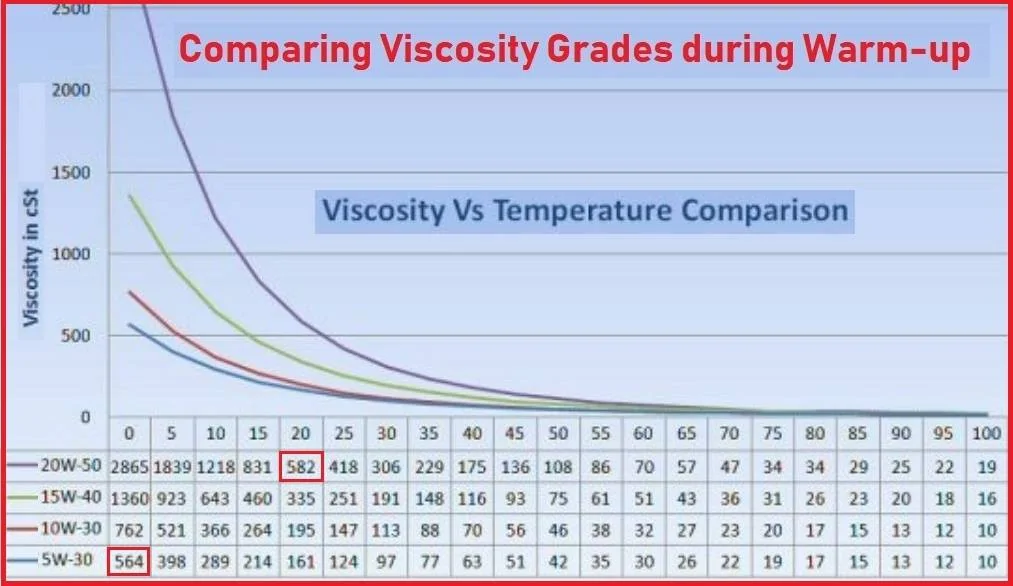
If you look at the chart below, there is very little change in viscosity between 70-100C for a 20W-50 oil. Wherever your oil temp stabilizes after 15-20 minutes of driving is "normal operating temp," unless it isn't getting north of 130-150F in which case you may have a problem with over-cooling. The other signal is oil pressure, don't want to rev the motor hard while it's still got high pressure at idle.

main-qimg-55e2f34762b56c2a9ff03d2a5b9fd769.webp
 

JAJ

Well-Known Member
Joined
Apr 9, 2016
Threads
4
Messages
2,221
Reaction score
1,976
Location
Vancouver BC
Vehicle(s)
2016 GT350 Track Pack
Even here in GA some mornings are cold enough I’m barely getting up to 170F even on a long drive. I still find myself needing enough to pass or get going at a decent pace but scared to really give it any gas unless I’m slowly working her up to 190 somehow. Is there a comfort level at 170F? I don’t really go past 4000 and may have hit 4700 once or twice until I recognized my sins.
If you do a track day in the PNW in May, you're in a similar situation - you start the first lap of the first session with the engine oil around 160 or so. By getting firmly on the throttle and shifting around 6500, about a mile into the first lap, you're up to 180 and you're good to go. So, you're probably being a bit more cautious than you need to be.
 

Sponsored

EFI

Well-Known Member
Joined
May 19, 2015
Threads
65
Messages
5,287
Reaction score
4,732
Location
Masshole central
Vehicle(s)
5.Br0
You are totally over-thinking this. 170F is 77C.

If you look at the chart below, there is very little change in viscosity between 70-100C for a 20W-50 oil.
main-qimg-55e2f34762b56c2a9ff03d2a5b9fd769.webp
It's not so much the oil viscosity but more the size of the pistons in relation to the bore/block at almost 40* less than the normal expected operating range. This is moreso the case with forged pistons that expand more than hypereutectics, so the Voodoo piston has alot more to room to grow in the last 30-40*. High RPM and load with a piston that hasn't expanded to its full size will lead to scoring on the piston skirts and cylinder liner.

Now it's not really as big of an issue as it might seem, but repeated high RPM use at that temp will definitely have an adverse effect over the long run.
 

Alain

Well-Known Member
Joined
Jan 24, 2018
Threads
18
Messages
754
Reaction score
332
Location
Northern NJ
First Name
Alain
Vehicle(s)
2016 Challenger Hellcat / 2019 350R #413
You are totally over-thinking this. 170F is 77C.

Motorcraft 5W-50 Full Synthetic viscosity from the product data page:
@ -30C viscosity = 5900 cSt (pour point is -42C so this is near-gel consistency)
@ 40C viscosity = 146 cSt
@ 100C viscosity = 21 cSt

If you look at the chart below, there is very little change in viscosity between 70-100C for a 20W-50 oil. Wherever your oil temp stabilizes after 15-20 minutes of driving is "normal operating temp," unless it isn't getting north of 130-150F in which case you may have a problem with over-cooling. The other signal is oil pressure, don't want to rev the motor hard while it's still got high pressure at idle.

main-qimg-55e2f34762b56c2a9ff03d2a5b9fd769.webp
That graph makes no sense at all to me. Can anyone explain what we are looking at here.
 
OP
OP
Droopy1592

Droopy1592

Well-Known Member
Joined
Apr 11, 2019
Threads
10
Messages
398
Reaction score
186
Location
Atlanta
First Name
Damien
Vehicle(s)
2017 GT350
It's not so much the oil viscosity but more the size of the pistons in relation to the bore/block at almost 40* less than the normal expected operating range. This is moreso the case with forged pistons that expand more than hypereutectics, so the Voodoo piston has alot more to room to grow in the last 30-40*. High RPM and load with a piston that hasn't expanded to its full size will lead to scoring on the piston skirts and cylinder liner.

Now it's not really as big of an issue as it might seem, but repeated high RPM use at that temp will definitely have an adverse effect over the long run.
This is more of what I’m looking for, just trying to figure how much I can push it when needing to pass when the cooling is so effective on a cold morning. How much is the forged piston expanding between 170 and 190F
 

oldbmwfan

Well-Known Member
Joined
Oct 19, 2016
Threads
0
Messages
789
Reaction score
947
Location
Chicagoland
Vehicle(s)
2017 GT350R
Okay, that's a fair point re. the piston/cylinder mating being more critical than the oil itself. My point was that at 77C, the oil is doing its job in "normal range" and the properties of the oil won't change much between 170F and 210F, which is the range I see in normal use in different traffic and temperature conditions. As we know, the oil is good to go a fair bit hotter than that but you start to get into thermal breakdown which is why track use merits frequent changes.

I don't have good data on piston sealing by temperature; have anything to share on that point? I'd be interested in seeing how much it does vary in that operating range.

It's not so much the oil viscosity but more the size of the pistons in relation to the bore/block at almost 40* less than the normal expected operating range. This is moreso the case with forged pistons that expand more than hypereutectics, so the Voodoo piston has alot more to room to grow in the last 30-40*. High RPM and load with a piston that hasn't expanded to its full size will lead to scoring on the piston skirts and cylinder liner.

Now it's not really as big of an issue as it might seem, but repeated high RPM use at that temp will definitely have an adverse effect over the long run.
 

oldbmwfan

Well-Known Member
Joined
Oct 19, 2016
Threads
0
Messages
789
Reaction score
947
Location
Chicagoland
Vehicle(s)
2017 GT350R
This is more of what I’m looking for, just trying to figure how much I can push it when needing to pass when the cooling is so effective on a cold morning. How much is the forged piston expanding between 170 and 190F
I think the point from JAJ was that putting more load into the motor will help heat it up. You can do that with more throttle opening at mid-range RPM without worrying about winding it out to 8k, if you're worried about piston slap. But honestly, I'd be surprised if you're doing any harm with quick bursts to 6k or 7k with the engine at that temp.
 

Sponsored

oldbmwfan

Well-Known Member
Joined
Oct 19, 2016
Threads
0
Messages
789
Reaction score
947
Location
Chicagoland
Vehicle(s)
2017 GT350R
That graph makes no sense at all to me. Can anyone explain what we are looking at here.
It's a graph showing viscosity by temperature for different oil weights. The graph sucks a bit because the x-axis (temp in *C) isn't actually labeled. The person who made the chart was obviously thinking more about cold start oil properties, but for this discussion, the relevant part is how much is the oil changing viscosity over the normal operating range of the engine. The closest oil grade to our 15W-50 on the chart is 20W-50, so I referenced that line. Viscosity changes very little once north of ~155F through 212F, so in practice, once your oil temps are north of150F you should be seeing normal oil pressures and getting good flow through all the oil passages.

As other posters have pointed out, there may be other reasons to consider the engine not fully warmed up yet, but I would want some data to show that anything bad is happening at 170F (which is easy to see on the highway on a cool day even after a full warm-up) vs. 190F-210F (which is the "usual" range these motors live in on the street). When I'm at the track, I try to be sure the temps are above 160F before entering the track, and I short-shift around 6k-6.5k RPM until it's fully warmed up (which is usually within a lap). On the street, a quick blast to accelerate past someone at 170F is unlikely to do harm, IMO, but I'm open to evidence that suggests I'm wrong. My car is never gets driven on short trips, so this is 100% academic to me.
 

Hack

Well-Known Member
Joined
Nov 26, 2014
Threads
86
Messages
12,798
Reaction score
8,206
Location
Minneapolis
Vehicle(s)
Mustang, Challenger
I would be interested to know the details about piston fit by temperature in a spray bore aluminum block. I would think that the spray bores expand a lot more than an iron liner would, and so I would think the pistons have less slop than typical. However, the forged pistons designed for heavy use would require a looser fit than other passenger cars.

I didn't really see a reason to spin the engine to high revs when it was cold outside, because the tires typically aren't hooking anyway. I wasn't as worried about scoring bores or any of that. But I typically wouldn't use revs unless I was trying to accelerate. I wouldn't cruise with the engine turning at high revs.
 

oldbmwfan

Well-Known Member
Joined
Oct 19, 2016
Threads
0
Messages
789
Reaction score
947
Location
Chicagoland
Vehicle(s)
2017 GT350R
But I typically wouldn't use revs unless I was trying to accelerate. I wouldn't cruise with the engine turning at high revs.
Exactly. A quick pull isn't going to hurt if the engine is 85% of the way to optimal temp. Extended pulls might hurt, but after a couple extended pulls you're already at full operating temp ...

As a general rule, high RPM with low load is bad.
 

Andy13186

Well-Known Member
Joined
Sep 19, 2018
Threads
110
Messages
2,523
Reaction score
1,565
Location
Florida
Vehicle(s)
2018 Mustang GT 10speed Aluminator Whippled
Exactly. A quick pull isn't going to hurt if the engine is 85% of the way to optimal temp. Extended pulls might hurt, but after a couple extended pulls you're already at full operating temp ...

As a general rule, high RPM with low load is bad.
I think low RPM with high load is worse actually, like going full throttle in 5th or 6th at 30 mph
 

oldbmwfan

Well-Known Member
Joined
Oct 19, 2016
Threads
0
Messages
789
Reaction score
947
Location
Chicagoland
Vehicle(s)
2017 GT350R
I think low RPM with high load is worse actually, like going full throttle in 5th or 6th at 30 mph
Yes, lugging the motor is bad, but it seemed both so obvious and not relevant to the discussion at hand (how high can I spin at 170F oil temp) that I decided to omit that.

Point being, lots of thought going into RPM limits at a slightly sub-optimal operating temp, when the real answer is "drive the car, don't do dumb things like revving the motor at a light, and if you rev it up under load, it will also build up temp quickly." The extra cautious driver might want to impose a slightly lower rev limit until at full operating temp.

In another similar thread, I posted a pic of a BMW E39 M5 tach, which has progressive "yellow line" lights that go out as the engine warms up. Different motor, but also a relatively high-revving V8, and it gives you the green light to use the full 7k RPM rev range when the oil is still ~40 degrees below ideal operating temp.
Sponsored


Top