Sponsored

Finally broken in. Red line question

OP
OP

Alberto

Well-Known Member
Joined
Dec 23, 2018
Threads
7
Messages
97
Reaction score
75
Location
San Jose
First Name
Albert
Vehicle(s)
2019 Mustang GT
Vehicle Showcase
1
Alberto, I know this thread has gone well past your OP and fortunately, it has basically answered your question but unfortunately, not all in one post. ;-)

Long story short: You're fine to run it to redline whenever you want, with a few caveats.
  • Best to let it warm up a little before going there, start the car and drive it. Optimally, you'd want it to be at full operating temperature before long heavy throttle, but anything other than dead-cold won't damage the engine, just expose it to accelerated wear, just like driving at 85mph continually generates more wear than at 65mph (all other things being equal). For what you have described, you are fine.
  • Startup for any engine creates the greatest amount of wear (vs time) for an engine. There is very little one can do to diminish this. Starting it and running it right away is better than starting it and letting it idle which is better than starting it and running it hard right away. All of these have varying degrees. Starting your car at 32F with the OE oil and driving it right away is fine (see bottom of post).
  • Keep in mind that there is a difference between what is referred to as the redline and the rev-limiter. Playing around with the redline is fine, with a warmed-up engine. Bouncing it off the rev-limiter doesn't really hurt your pistons, etc., but isn't something to do on a regular basis. There is absolutely no need for running to/at the limiter unless one is racing and needs to hold a gear for an extra second. I built a car that took two National Titles (Autoslalom and TimeAttack) and it didn't hit the rev-limiter more than 1-2 per year. Your car is quicker shifting before the limiter.

Long story long: As for the oil issue, there are as many "opinions" out there as there are folks on the internet, however, the following should cover what you need to know.

The OE oil is a synthetic-blend 5W-20, which means it is a multi-grade oil. Contrary to what has been mentioned, there is absolutely no need to change your oil weight unless you are going to be regularly starting it in -20 weather. 5W mineral oil is good to -25C (-13F). As Lime1GT says, most folks are over-analysing things here with what often appears to be very little actual knowledge on the subject but plenty of "thoughts/ideas".

Also, contrary to what was mentioned in an earlier post, 5W-20 and 5W-30 will flow virtually identical when cold. The 5W (in 5W-20 and 5W-30) refers to the oil's cold temperature performance and is a measurement of how it flows. The "W" stands for winter but really just means cold temperatures. Any quality 5W oil whether it is a straight-weight 5W or a 5W-20 or 5W-30 should flow exactly the same when cold. The first # before the W, in this case, 5W, has it's viscosity measured at 40C (104F). All have the viscosity characteristics of a 5 weight motor oil at 40C. Having said that, a 5W synthetic-blend flows better at -20 than 5W mineral oil (lower limit is -30C vs -25C) and a 5W full synthetic will flow best of all (lower limit is -35C = -31F). This is because the viscosity of synthetic oil is affected less by cold than mineral oil is.

The 20 and 30 in 5W-20 and 5W-30 identify how the oil flows (it's viscosity) at 100°C. Normal operating oil temp for most cars today, including the Mustang, is around 110°C-125°C, half the upper operating limit for the OE synthetic-blend 5W-20 which has a very good initial flow rate when cold. There are a few of reasons 100C (212F) is used. First, the soot and water byproducts of combustion get dealt with (to some degree) at and above 100C. Another is that back when the SAE standards were set engines typically ran cooler, but modern materials, oils, etc., plus our power, fuel economy and emissions goals all are easier to achieve with the hotter running engines.

Finally, while it may take a while to get oil completely circulated through an engine (perhaps 10-20 seconds for the 10L to all flow through at normal speed), your engine is being lubricated by the oil itself, not always directly or exactly by the circulation of the oil. Other than your cylinder walls, most other places that require oil either already have some there while they are stopped, or have an oil supply within a few milliseconds of startup. The oil in an engine doesn't all disappear and drain back to the sump when it is stopped. Some stays adhered to the metal (ready to lubricate), some stays in oil galleys, oil troughs, and oil lines, etc., (ready to deliver in milliseconds). That is why when you rebuild an engine you need to use a lube assembly oil and also turn the engine over (without fuel or ignition) sufficiently to prime the oil pump and lines - there isn't oil already throughout the system and coating most everything. This is a close to, not equivalent to, having as much oil in the system as you have with a used engine on startup. The only way to get better than that is to use a pre-oiling system like Accusump, but on a street car, it is a waste of time, money and energy.

As others have said, get in, start it up, count to 2 or 3 if you like, and drive. The 5W-20 is so thin when cold that you will have good flow as well as pressure before you are out of your driveway and if you need to get up to speed on an on-ramp it might mean the difference between getting 180,000 miles vs 181,000 out of the engine (or not). The ECU, injectors, etc., are so precise and fast today and the build materials including the plasma transferred wire arc coating on the cylinder walls are such that some of what was true even just 3-5 years ago has changed today. Have fun.
Sponsored
 
OP
OP

Alberto

Well-Known Member
Joined
Dec 23, 2018
Threads
7
Messages
97
Reaction score
75
Location
San Jose
First Name
Albert
Vehicle(s)
2019 Mustang GT
Vehicle Showcase
1
Thanks AC53 as well as everyone else who replied. Love the passion.
Great, top-notch info.
I have enjoyed the hell out of taking up to the red line, and am ready to bounce over it with all this info.

This car is ridiculously fast compared to my '98 Cobra, +150hp will do that :-).
Loving every second of it.

Couldn't be happier with my purchase. Was worth the pain of waiting on the special order, and walking out of 4-5 dealerships that were treating me like I was an idiot.
 

AC53

Well-Known Member
Joined
Apr 25, 2018
Threads
2
Messages
139
Reaction score
89
Location
NS
First Name
Alan
Vehicle(s)
VW Touareg TDI, Lincoln MKZ, F-350 TD
Thanks AC53 as well as everyone else who replied. Love the passion.
Great, top-notch info.
I have enjoyed the hell out of taking up to the red line, and am ready to bounce over it with all this info.

This car is ridiculously fast compared to my '98 Cobra, +150hp will do that :-).
Loving every second of it.

Couldn't be happier with my purchase. Was worth the pain of waiting on the special order, and walking out of 4-5 dealerships that were treating me like I was an idiot.
Have fun Alberto.

One of the things I really like about the Bullitt is its balance for the street. Providing the pavement temps are reasonable, it does a great job of getting the power to the ground. I sent two days driving some phenomenally great back roads that were narrow, very twisty and had almost constant elevation changes along with a friend whose Gen5 GT dynos out at 529-HP at the rear wheels. He never pulled away (other than the initial lead time) from me and after that weekend trip decided to add a supercharger! My reaction (unspoken) was, buy a Bullitt or 2018+ GT with PP1 and some add-ons.

I used to own a race car that took two National Class Titles in TimeAttack and Autoslalom missed a third due to a blown diff. That car was outpowered by perhaps 20% of its competitors, but I built it to get more of its power to the ground than most. I've seen and driven many high-horsepower cars that were very fast in a straight line and some that could pull impressive G's on a flat skip-pad but didn't do as well on the street where there is often less than ideal conditions including uneven and sometimes rough pavement. For me, the first spirited drive in the Bullitt reminded me of that car's balance without the track-oriented sacrifices. Going to a PP2 or GT350 would give me more ultimate performance, but almost all of that would be lost on the street and the track-oriented sacrifices of those two avenues are not what I was looking for. Everyone has a different perspective and a different set of wants, etc., so we all find the mix that suits us best. For me, the Bullitt puts a smile on my face every time I drive it.
 
OP
OP

Alberto

Well-Known Member
Joined
Dec 23, 2018
Threads
7
Messages
97
Reaction score
75
Location
San Jose
First Name
Albert
Vehicle(s)
2019 Mustang GT
Vehicle Showcase
1
Have fun Alberto.

One of the things I really like about the Bullitt is its balance for the street. Providing the pavement temps are reasonable, it does a great job of getting the power to the ground. I sent two days driving some phenomenally great back roads that were narrow, very twisty and had almost constant elevation changes along with a friend whose Gen5 GT dynos out at 529-HP at the rear wheels. He never pulled away (other than the initial lead time) from me and after that weekend trip decided to add a supercharger! My reaction (unspoken) was, buy a Bullitt or 2018+ GT with PP1 and some add-ons.

I used to own a race car that took two National Class Titles in TimeAttack and Autoslalom missed a third due to a blown diff. That car was outpowered by perhaps 20% of its competitors, but I built it to get more of its power to the ground than most. I've seen and driven many high-horsepower cars that were very fast in a straight line and some that could pull impressive G's on a flat skip-pad but didn't do as well on the street where there is often less than ideal conditions including uneven and sometimes rough pavement. For me, the first spirited drive in the Bullitt reminded me of that car's balance without the track-oriented sacrifices. Going to a PP2 or GT350 would give me more ultimate performance, but almost all of that would be lost on the street and the track-oriented sacrifices of those two avenues are not what I was looking for. Everyone has a different perspective and a different set of wants, etc., so we all find the mix that suits us best. For me, the Bullitt puts a smile on my face every time I drive it.
Fortunately, I live in San Jose, CA. The temps are always favorable seeing as the coldest it gets during the day is in the 50s/winter and it is generally 75-80 during the summer. There are some beautiful windy mountain roads here that are perfectly banked. With this magna ride suspension and the manual stick- this car is pure heaven. So tight and nimble, light feeling, with all that power. Slightly less than your Bullitt- but still up there. Some of my gear-head friends said I should get the PP2, but the more I read about that car, the more it sounded like it was made for the track. I love the fact that I can put this in the normal suspension, sport or track, depending on my mood. I love the exhaust modes and that magna ride.
I've owned a few sporty cars, not as intense as yours- but I do have a small sample set to compare to- none have come close to this. I had a '78 Z28 when I was young, a '95 Mustang GT, and the '98 Must Cobra convertible. This thing is off the charts compared to those, and I just started getting into it.
I stomped on it pretty hard one day with my girlfriend riding shotgun and after I slowed down she said, 'that just gave me a boner' lol
 

AC53

Well-Known Member
Joined
Apr 25, 2018
Threads
2
Messages
139
Reaction score
89
Location
NS
First Name
Alan
Vehicle(s)
VW Touareg TDI, Lincoln MKZ, F-350 TD
... Some of my gear-head friends said I should get the PP2, but the more I read about that car, the more it sounded like it was made for the track...
That's my feeling as well Alberto, and everyone has their own idea of what they want. For me, unless most of your driving is done on smooth roads and freeways (why???), then the 305/30/19 tires up front on the PP2 are going to wander and follow the road far more than the 255/40/19 PP1 setup. Don't even think about the differences in the rain with hydroplaning (not an issue for some locations but definitely for mine). I love a square setup (same size front and rear) and set my race car up to run that but when I got the big front on there and the track setup it was nowhere near as enjoyable for regular driving and became a far more single-purpose car.

I think the biggest actual difference folks notice isn't from the size change but the actual tire compound. The Michelin Pilot Sport Cup 2 tires are not just stickier than the Pilot Sport 4S but also more immediate in their reaction and provide more feedback. All one needs to do is run a 265/35/19 up front and a 285/35/19 rear in the Cup 2 on the PP1 (can't get them in PP1 sizes) and you'll have all you need for the street at well into the "arrest me and take me straight to jail" point. I've been hauled over a few times at very close to those limits (and given tickets that required court appearances) and it is not just a real bummer but gets pretty expensive pretty quickly. Far cheaper to buy a set of dedicated PP2 tires and rims and use them for Track Days. ;-)

... I stomped on it pretty hard one day with my girlfriend riding shotgun and after I slowed down she said, 'that just gave me a boner' lol
In that case, I'd say both the car and the girlfriend are definite keepers! ;-)
 

Sponsored

rocky5517

Well-Known Member
Joined
Aug 5, 2018
Threads
26
Messages
310
Reaction score
149
Location
north jersey
First Name
sam
Vehicle(s)
ford explorer 67 riviera
While you're watching the oil temp, don't forget to keep your eye on the trans oil temp. I was really surprised to see how long the trans takes to warm up; takes a good 10 minutes of driving to get it into the "blue" range.
 

Norm Peterson

corner barstool sitter
Joined
Jul 22, 2013
Threads
11
Messages
8,852
Reaction score
4,652
Location
On a corner barstool not too far from I-95
First Name
Norm
Vehicle(s)
'08 GT #85, '19 WRX
While you're watching the oil temp, don't forget to keep your eye on the trans oil temp. I was really surprised to see how long the trans takes to warm up; takes a good 10 minutes of driving to get it into the "blue" range.
Which transmission? MT or AT?


Norm
 

Coyote Red

Well-Known Member
Joined
Oct 9, 2016
Threads
8
Messages
1,249
Reaction score
371
Location
Port Lavaca,Tx.
First Name
Alan
Vehicle(s)
2016 5.0 Coyote Red
Vehicle Showcase
1
I believe it's a manual Norm. I am about to service my trans "auto" 6r80 and next week I change gear oil to B&G 75w 140w from the oem grade oil with a gear oil kit from Optimum Performance in Florida. The kit comes with a pump for the task. I have this pony "on it's way to being track worthy". Have a great day Norm!
 

AC53

Well-Known Member
Joined
Apr 25, 2018
Threads
2
Messages
139
Reaction score
89
Location
NS
First Name
Alan
Vehicle(s)
VW Touareg TDI, Lincoln MKZ, F-350 TD
I believe it's a manual Norm. I am about to service my trans "auto" 6r80 and next week I change gear oil to B&G 75w 140w from the oem grade oil with a gear oil kit from Optimum Performance in Florida. The kit comes with a pump for the task. I have this pony "on it's way to being track worthy". Have a great day Norm!
Coyote Red, just wondering why you are looking at switching to 75W-140? Other than the heat in Texas, which a 75W-90 is fully capable of handling, especially quality gear-oil like Redline, are you drag racing or road racing the car?

The reason I ask is that while it is common for folks to think that the difference between a 90 vs 140 for kinematic viscosity is important, they often get it wrong in that they focus on just the viscosity values at the high-end, to the exclusion of everything else. I'm definitely not saying that is the case with your decision, merely wanting to know if there are known issues with the IRS diff running a high-quality 75W-90, and if so, can't they be addressed with say a Redline 75W-110 or do they actually require one to move to a 75W-140?

I have run 75W-90, 75W-110, and 75W-140 in race cars (Amsoil, Elf, Liqui Moly, and Redline) and have some of each in my garage now. All were correct for the job and operating in the same temperatures but running different differentials. The 75W-140 was recommended by the diff builder (who does nothing but build hundreds of racing diffs every year for many winning teams) used in a custom built BMW M3 diff that I raced locally and nationally. That same builder spec'd 75W-110 for my Quaife LSD (very much like our Torsen diffs). These were spec'd for full track use where temps were extreme. For street/track I've never had a problem with Redline 75W-90 and a catch-can. However, that was with diffs other than the Mustang IRS Torsen, so that is why I was wondering if there was an issue that needed addressing. I just got my Mustang 6-months ago and haven't gotten caught up on what the various weak points might be.

There are penalties that come from running a 140 above and beyond the typical slight power robbing quality of the 140. The two areas of most concern are the reduced flow at anything below racing applications, and the second and least known is that the heavier the diff fluid the "ropier" it becomes. What I mean by ropier is that the thicker a gear oil is the more it will act/look like a rope while working in the diff. this can be seen around the 4:45-minute mark in the video below. I've included the video, even though it focuses on a different aspect of the dangers of making changes to the design specs without doing a lot of research, it is very good at showing the desire for a specific "ropiness" in diff fluid. This ropiness is actually a desired quality to lubricate specific areas in a specific manner. However, too little or too much has been shown to cause premature failures in older BMW motorcycle final drives. These are more fragile than a Mustang final drive and therefore will show failures due to improper lubrication quicker than the Mustang would.


For those who aren't familiar with Gale Banks, he is not just legendary, but also very knowledgeable in a variety of high-performance areas.
 

rocky5517

Well-Known Member
Joined
Aug 5, 2018
Threads
26
Messages
310
Reaction score
149
Location
north jersey
First Name
sam
Vehicle(s)
ford explorer 67 riviera
Which transmission? MT or AT?


Norm
the automatic; it takes a good 10 minutes of light driving to get it into the "blue" part of the gauge. you can switch back and forth to note the actual trans oil temp, or the operating range in colors. Glad I learned this, because I thought once thr temp gauge was up, she was ready to go. The temp of the water is apparently a let different then the trans oil temp. Be careful not jump bang it around for a good 10 minutes.
 

Sponsored

Coyote Red

Well-Known Member
Joined
Oct 9, 2016
Threads
8
Messages
1,249
Reaction score
371
Location
Port Lavaca,Tx.
First Name
Alan
Vehicle(s)
2016 5.0 Coyote Red
Vehicle Showcase
1
In response to the 140w gear oil, I drive my pony for work as a medical tech over six counties, sometimes 6 days a week. I log 60-150 miles a day driving 75 mph through Texas hill country and on the coastal bend hwy's. It's like I am on a long road course for 1-2 hrs. It's never over-heated, water or trans but I wanted to address the harsh conditions I tend to put the pony thru. I drive it like I stole it, everyday. Roping is a concern, but I feel the 75w 140w will work best for me. Time will tell. B&G states on their website this weight oil will adapt to the driving conditions as I put the pony thru it's paces.
 
Last edited:

AC53

Well-Known Member
Joined
Apr 25, 2018
Threads
2
Messages
139
Reaction score
89
Location
NS
First Name
Alan
Vehicle(s)
VW Touareg TDI, Lincoln MKZ, F-350 TD
the automatic; it takes a good 10 minutes of light driving to get it into the "blue" part of the gauge. you can switch back and forth to note the actual trans oil temp, or the operating range in colors. Glad I learned this, because I thought once thr temp gauge was up, she was ready to go. The temp of the water is apparently a let different then the trans oil temp. Be careful not jump bang it around for a good 10 minutes.
Each of those components is seperate from the other so they heat up independently of each other for the most part. The primary reasons that the water temperature rises so much quicker than say engine oil, tranny, diff, etc., is that:
  • the single biggest heat source on the car is the combustion chamber and specifically the exhaust valve area. Combustion temperatures can exceed 4,000-F.
  • water is a better conductor of heat than oil (it absorbs the heat around it quicker)
  • water jackets channel a significant volume of coolant directly around and very close to, the valve seats to remove as much heat as possible
  • only a small portion of engine oil is in close proximity to the combustion cycle and it loses some of that heat to the water cooling
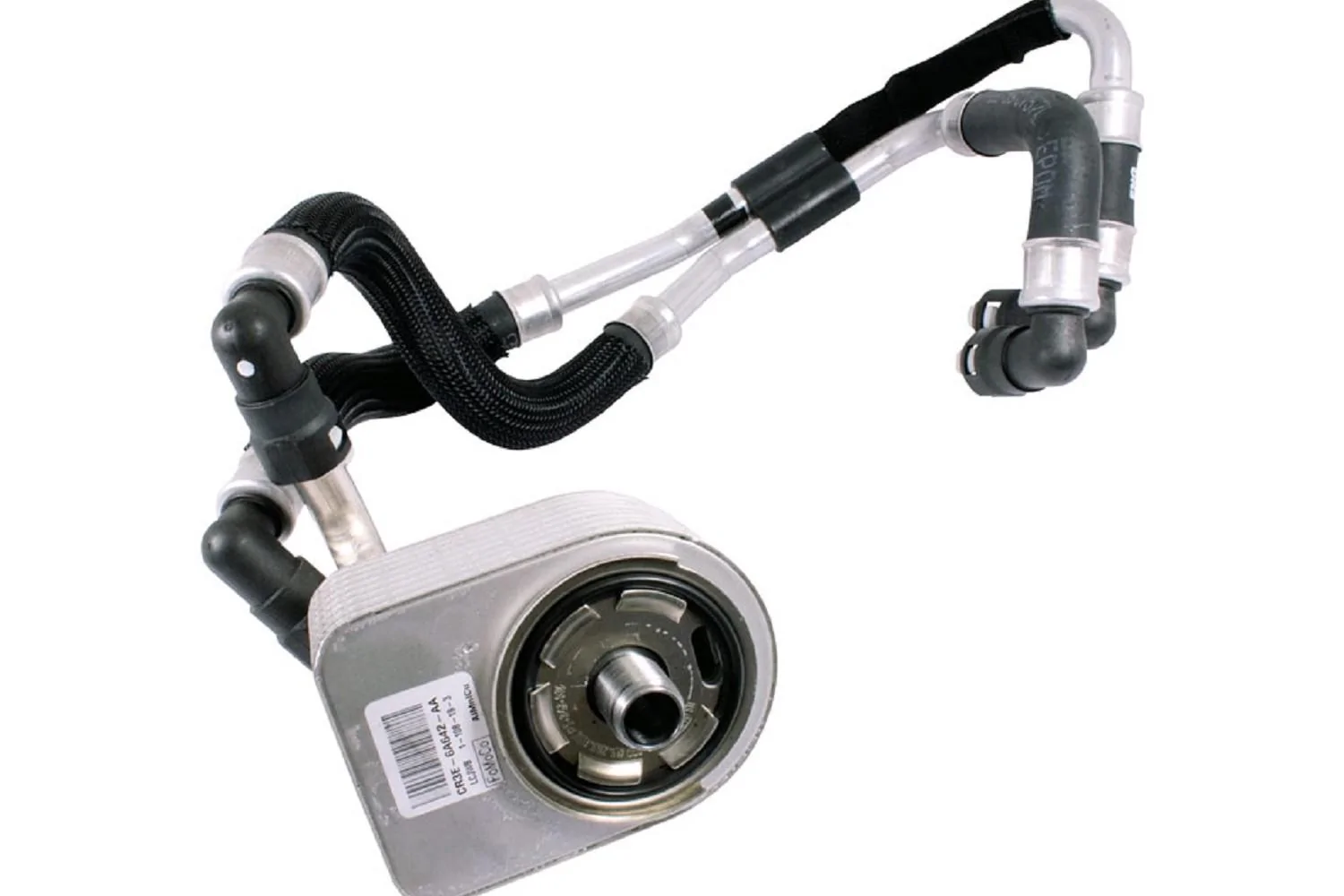
I've had a couple of high-performance Fords in the past where Ford actually had the coolant lines running through an adaptor on the engine block where the oil filter threads in. Their police vehicles also used to have this as standard equipment. The idea is that you get a two-fold benefit. First, with a cold engine start-up, the coolant will bring the engine oil up to operating temperature quicker. That is better for the engine lubrication, fuel consumption, emissions, etc. Second, once the engine is hot, the coolant will help draw excess heat from the oil acting as an oil cooler albeit one that is at the operating temperature of the engine. Here's a photo of one the many versions of the Ford Performance Parts:
161-m-6642-mb.webp


... I drive it like I stole it, everyday...
Proper thing. I try to do that as often as possible, but also have to try and keep my license. It's been taken away so many times that I actually moved completely across the continent to avoid a six-month suspension. :-(
 

rocky5517

Well-Known Member
Joined
Aug 5, 2018
Threads
26
Messages
310
Reaction score
149
Location
north jersey
First Name
sam
Vehicle(s)
ford explorer 67 riviera
Each of those components is seperate from the other so they heat up independently of each other for the most part. The primary reasons that the water temperature rises so much quicker than say engine oil, tranny, diff, etc., is that:
  • the single biggest heat source on the car is the combustion chamber and specifically the exhaust valve area. Combustion temperatures can exceed 4,000-F.
  • water is a better conductor of heat than oil (it absorbs the heat around it quicker)
  • water jackets channel a significant volume of coolant directly around and very close to, the valve seats to remove as much heat as possible
  • only a small portion of engine oil is in close proximity to the combustion cycle and it loses some of that heat to the water cooling
I've had a couple of high-performance Fords in the past where Ford actually had the coolant lines running through an adaptor on the engine block where the oil filter threads in. Their police vehicles also used to have this as standard equipment. The idea is that you get a two-fold benefit. First, with a cold engine start-up, the coolant will bring the engine oil up to operating temperature quicker. That is better for the engine lubrication, fuel consumption, emissions, etc. Second, once the engine is hot, the coolant will help draw excess heat from the oil acting as an oil cooler albeit one that is at the operating temperature of the engine. Here's a photo of one the many versions of the Ford Performance Parts:
161-m-6642-mb.webp


Proper thing. I try to do that as often as possible, but also have to try and keep my license. It's been taken away so many times that I actually moved completely across the continent to avoid a six-month suspension. :-(
Good info!!
 

BrettT

Well-Known Member
Joined
Apr 20, 2018
Threads
24
Messages
780
Reaction score
581
Location
Richmond, BC
First Name
Brett
Vehicle(s)
2019 Bullitt, 2006 Jetta 2.0T, 2013 Escape SEL
Proper thing. I try to do that as often as possible, but also have to try and keep my license. It's been taken away so many times that I actually moved completely across the continent to avoid a six-month suspension. :-(
Then you will proud of me. Got my first speeding ticket in nearly 20 years......and it wasn't even in the Bullitt…..not even it my next most fun car, '06 Jetta 2.0T. No it was in my '13 Escape.....

It was a cheap one. On the newer Hwy 17 (South Fraser Perimeter). It's a dual carriage way. The section (10+ km long) on was on has no traffic lights or intersections, but the speed limit is 80kph, and I got nailed at 111 kph. Drove it again yesterday and I has cruise set at 108kph and 75% of the traffic was passing me.....Just bad luck on my part. It was dusk and I was probably his last ticket, before he went home for the day...….

At least I won the bet with my wife. She expected I would already have a ticket in the Bullitt…...Only drove it for two months before I effectively put it away for the winter.....
Sponsored


Top