ammoman
Well-Known Member
- Thread starter
- #1
I finally got around to installing my ESS supercharger! Well, mostly - it's all installed, just waiting for one piece for the fuel pump.
One of my biggest concerns with going FI is the added heat load on the stock cooling system. I've read numerous posts on the road course forum of individuals having engine cooling issues, even with the larger PP1 radiator at stock power levels. I figured if they have issues without the added power (aka heat) of FI, then with FI I would need to do something different!
When installing the ESS kit, the two plastic side pieces and the bottom piece that help direct air through the radiator are removed to make room for the charge pipes and intercooler. I didn't care for that because it left large areas for air to flow around the radiator, instead of through it. That would make the stock radiator even less efficient when I need even more cooling!
To address that, I cut up the factory pieces and shaped some left over Kydex to cover the remaining holes. I also trimmed the lower piece since the intercooler sits slightly below it. I had to mount/unmount the front bumper what felt like a dozen times until it fit perfectly. I plan on using some black duct tape to seal it up even tighter, but here are pics before that step:


(Don't mind the brackets and bolts attached to the upside down crash bar - those are for the front splitter support rods. And no, they don't touch the intercooler - there is a 1" gap between them that can't be seen with the flash. That is still a work in progress)
The other item I wanted to address was oil cooling. With the added heat, I wanted to cool the oil separately from the engine coolant. I looked at all the different oil cooler kits on the market, but they all put the oil cooler in front of the radiator, which means the air flowing into the radiator would be hotter, decreasing its efficiency. (the air is already going to be warmer after going through the intercooler, although hopefully not by a lot) I really wanted to cool it somewhere other than the main cooling stack.
Looking at the GT500, Ford added an oil cooler mounted in front of the driver's side tire. With the air filter from the ESS sitting there, that wouldn't work, so I looked at the passenger side. Unfortunately that side has a massive windshield washer reservoir taking up most the space. Also, one big difference between the GT and the GT500 is that there is very minimal air flow through that area on the GT. I could have cut holes or installed an open lower radiator grill, but I really did not want to change the aerodynamics of the front too much as this is my DD and frequently goes on long highway drives.
What I ended up doing was replacing the windshield washer reservoir with a universal one from Amazon. (I had to modify it to add the fluid level sensor and wire up the new plug for the pump) That made space to add an oil cooler below it. However, because there isn't a ton of air flow on the GT bumper, I decided to mount an oil cooler with dual fans. That way it can create its own airflow!
For all this to work, I removed the stock oil cooler and installed a Mishimoto sandwich plate with thermostat. (I also installed a temperature sensor connected to an AeroForce gauge to monitor the actual oil temp) I ran 10AN lines from it to the new cooler, with a Setrab inline temperature switch on the hot side. The switch will automatically turn on the fans when the incoming oil gets to 200 degrees.
My aluminum brackets aren't exactly pretty, but they get the job done! I will post back with updates once I finally get it on the road. The fuel pump part was suppose to be here last Saturday, but apparently the package was "lost". (and the seller is being less than helpful!)
One of my biggest concerns with going FI is the added heat load on the stock cooling system. I've read numerous posts on the road course forum of individuals having engine cooling issues, even with the larger PP1 radiator at stock power levels. I figured if they have issues without the added power (aka heat) of FI, then with FI I would need to do something different!
When installing the ESS kit, the two plastic side pieces and the bottom piece that help direct air through the radiator are removed to make room for the charge pipes and intercooler. I didn't care for that because it left large areas for air to flow around the radiator, instead of through it. That would make the stock radiator even less efficient when I need even more cooling!
To address that, I cut up the factory pieces and shaped some left over Kydex to cover the remaining holes. I also trimmed the lower piece since the intercooler sits slightly below it. I had to mount/unmount the front bumper what felt like a dozen times until it fit perfectly. I plan on using some black duct tape to seal it up even tighter, but here are pics before that step:
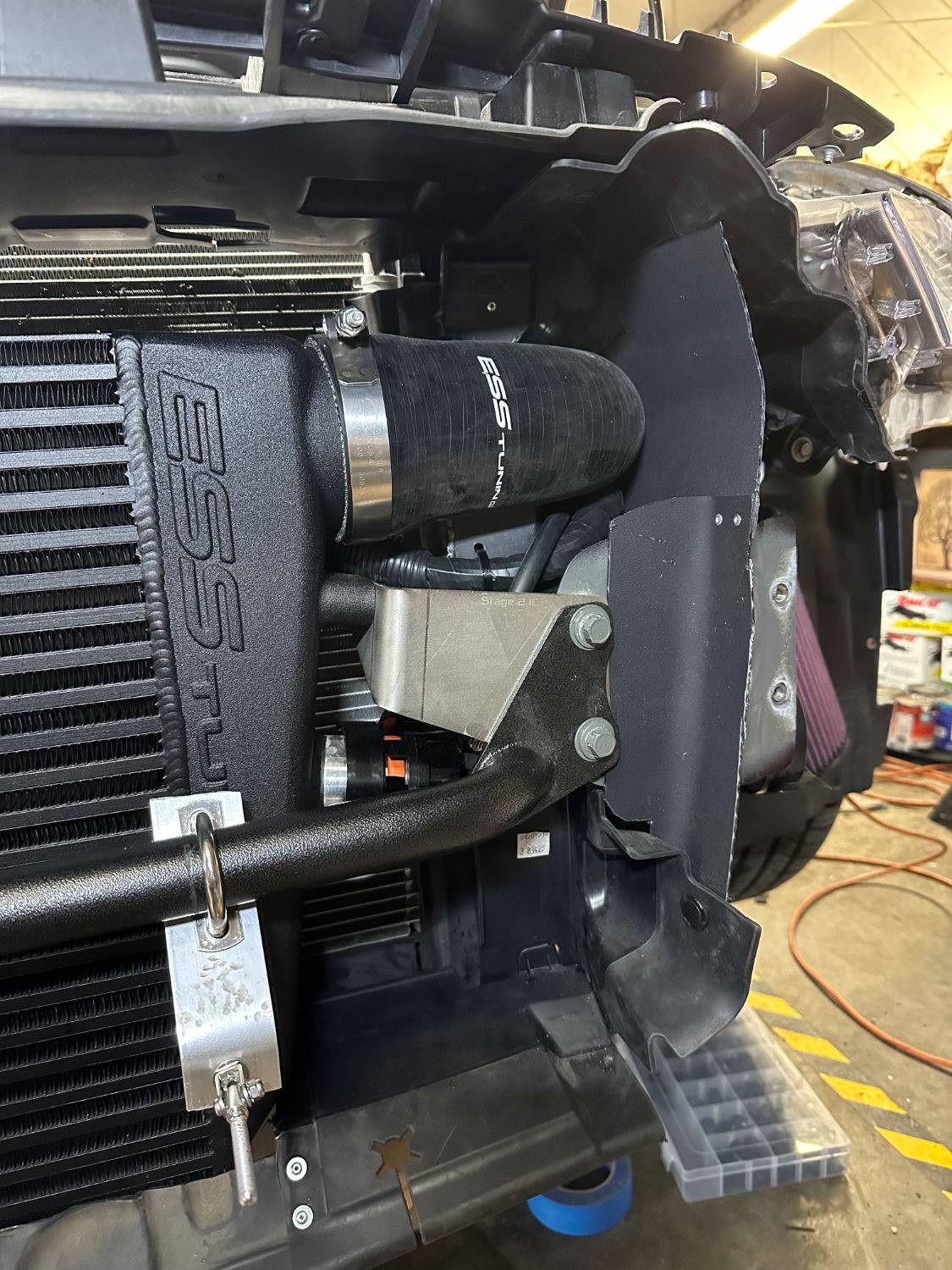
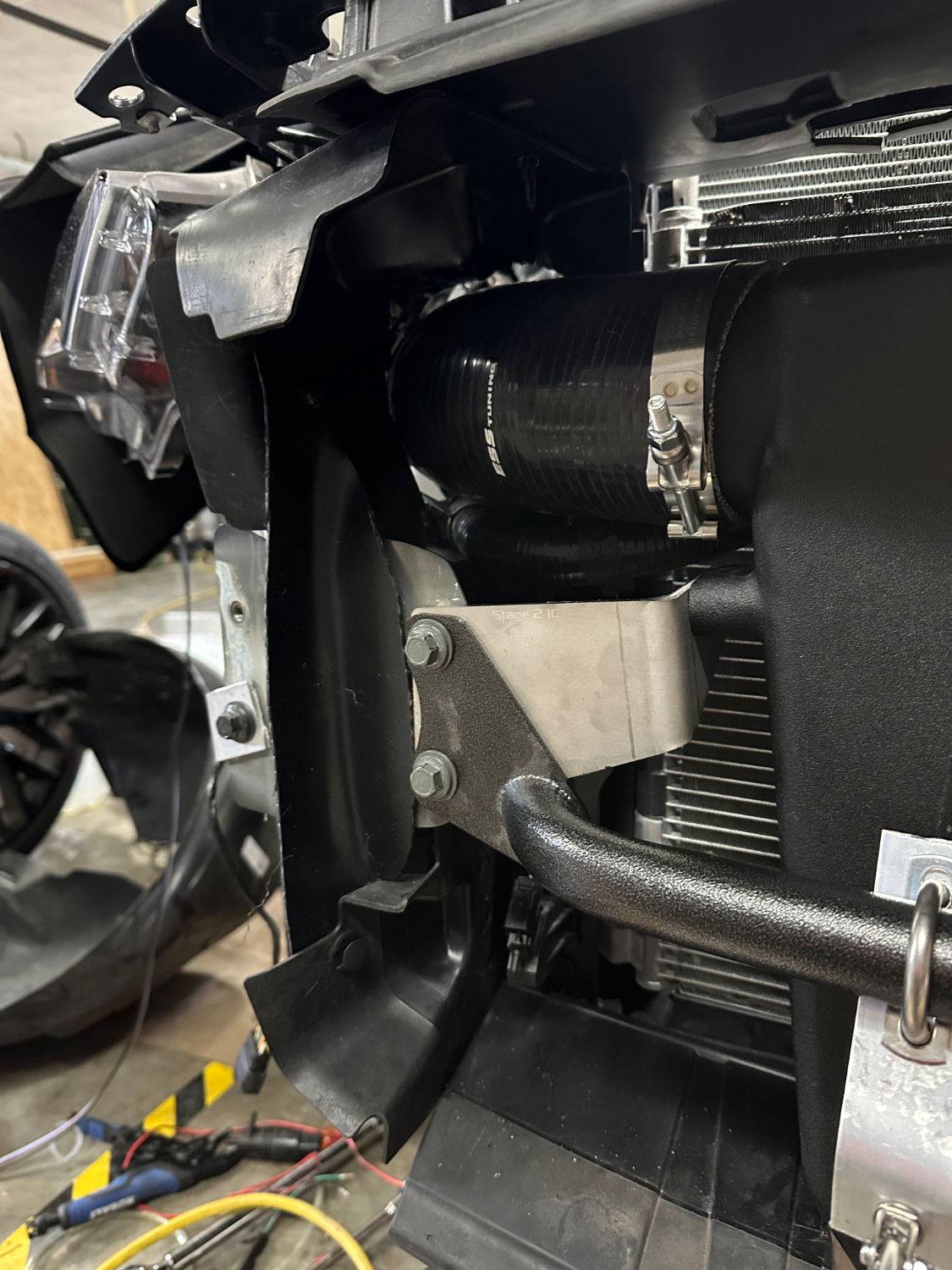
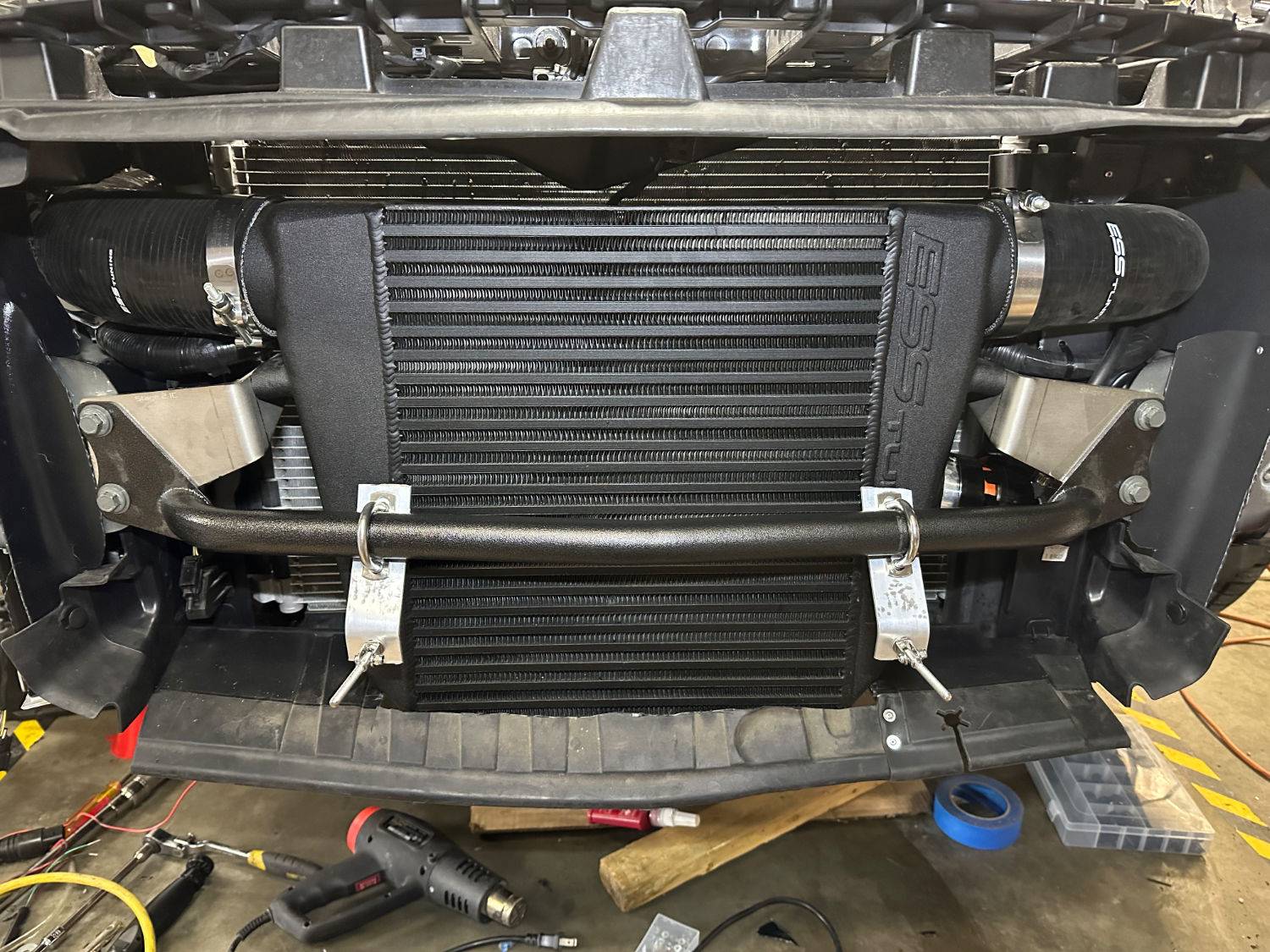
(Don't mind the brackets and bolts attached to the upside down crash bar - those are for the front splitter support rods. And no, they don't touch the intercooler - there is a 1" gap between them that can't be seen with the flash. That is still a work in progress)
The other item I wanted to address was oil cooling. With the added heat, I wanted to cool the oil separately from the engine coolant. I looked at all the different oil cooler kits on the market, but they all put the oil cooler in front of the radiator, which means the air flowing into the radiator would be hotter, decreasing its efficiency. (the air is already going to be warmer after going through the intercooler, although hopefully not by a lot) I really wanted to cool it somewhere other than the main cooling stack.
Looking at the GT500, Ford added an oil cooler mounted in front of the driver's side tire. With the air filter from the ESS sitting there, that wouldn't work, so I looked at the passenger side. Unfortunately that side has a massive windshield washer reservoir taking up most the space. Also, one big difference between the GT and the GT500 is that there is very minimal air flow through that area on the GT. I could have cut holes or installed an open lower radiator grill, but I really did not want to change the aerodynamics of the front too much as this is my DD and frequently goes on long highway drives.
What I ended up doing was replacing the windshield washer reservoir with a universal one from Amazon. (I had to modify it to add the fluid level sensor and wire up the new plug for the pump) That made space to add an oil cooler below it. However, because there isn't a ton of air flow on the GT bumper, I decided to mount an oil cooler with dual fans. That way it can create its own airflow!
For all this to work, I removed the stock oil cooler and installed a Mishimoto sandwich plate with thermostat. (I also installed a temperature sensor connected to an AeroForce gauge to monitor the actual oil temp) I ran 10AN lines from it to the new cooler, with a Setrab inline temperature switch on the hot side. The switch will automatically turn on the fans when the incoming oil gets to 200 degrees.
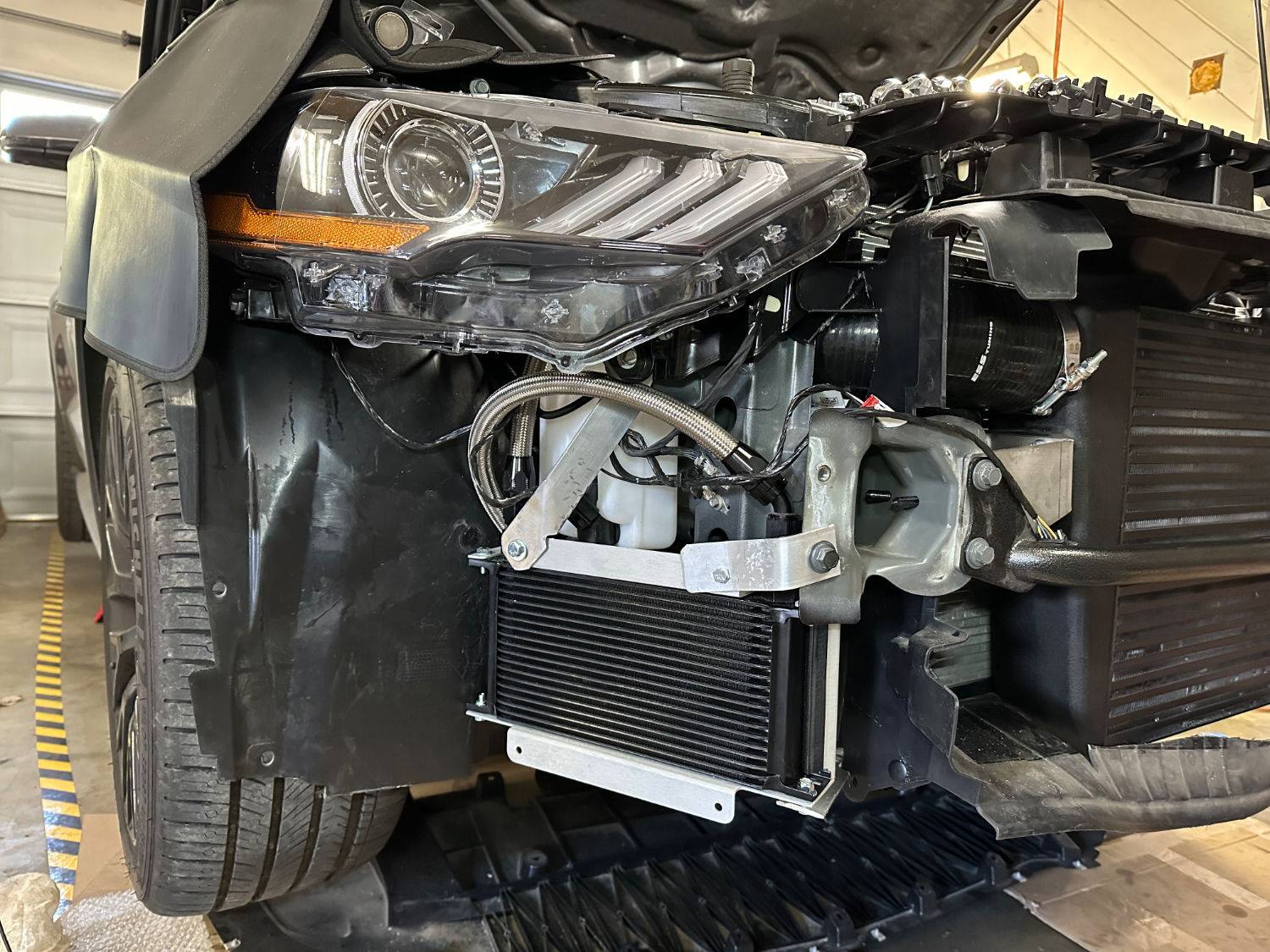
My aluminum brackets aren't exactly pretty, but they get the job done! I will post back with updates once I finally get it on the road. The fuel pump part was suppose to be here last Saturday, but apparently the package was "lost". (and the seller is being less than helpful!)
Sponsored


 . That is a big ass intercooler
  . one more thing you might want to think about is how you will manage hot air extraction from engine bay area.