Sponsored

Chassis Stiffening importance...?

TeeLew

Banned
Banned
Banned
Joined
Apr 27, 2020
Threads
15
Messages
3,396
Reaction score
2,609
Location
So Cal
First Name
Tim
Vehicle(s)
Honda Odyssey, Toyota Tacoma, 89 GT project, 2020 Magnetic EB HPP w/ 6M
Unless you are some kind of hard-core track fiend, the base car out of the box is really quite adequate for street driving. The GT and especially PP1 handle very well, but nearly every time you improve handling, you sacrifice comfort or ride. And sometimes you can improve raw lateral G numbers and reduce actual real world performance where you're not on a smooth race track.

Food for thought.
I tend to agree in general, but I also see the alternate view, specifically on chassis stiffness. I find that stiffening the chassis, as opposed to stiffening the suspension, gives better driver feedback and overall chassis composure when hustling the car with minimal NVH effects, depending on what you've modified. Steeda and BMR both make rear subframe location pieces which add control without NVH. Strut tower/K-member bracing is a similar story. It makes the car feel 'better' without making it more noisy or harsh.

Aluminum subframe or differential mounts will be a different NVH story altogether, but there are things you can do which have very few downsides while providing a noticeable improvement on your average twisty back road.
Sponsored

 
OP
OP
sredish

sredish

Well-Known Member
Joined
Oct 7, 2016
Threads
15
Messages
78
Reaction score
6
Location
Phoenix, AZ
Vehicle(s)
'16 Mustang Ecoboost
there's also the extra load and stress on one part can and often will translate into more stress and load down the line. some of you want to say how its a waste and zero gains and i'm very savvy on cost / gains and handling characteristics, my initial curiosity was on the load transference to other components resulting in excessive wear or extra load it wasn't intended for leading to problems, like the strut tower keeping the engine bay supported. The ride is already compromised with the GT350R suspension under it, lol.

I think i'll work on getting the strut brace and maybe rear IRS stiffeners and see where that puts me. but when I'm mid turn and hit a small bump and can hear the wind noise increase through the door from the bump, that's not placebo, that's chassis flex and it wasn't there prior to the suspension work. I'm also starting to notice a few other little creaks here and there.

I drive my car quite hard, I race off road desert and am not a weekend warrior looking to take out a honda. i drive how i drive and it's pretty hard with a stiff suspension on an otherwise stock chassis EB car. I can't imagine a little stiffening would hurt.
 

Norm Peterson

corner barstool sitter
Joined
Jul 22, 2013
Threads
11
Messages
8,852
Reaction score
4,652
Location
On a corner barstool not too far from I-95
First Name
Norm
Vehicle(s)
'08 GT #85, '19 WRX
Norm, I'm not sure what your engineering background is, but the s550 is a monocoque. The (very long) engine bay is an open 'U' without any bracing.
Civil/structural, by education and most of a career. I've done enough finite element work to be able to picture what's going on with most structural arrangements. I've done dynamic analysis, which generates structural vibration modeshapes (of which the average car chassis/body would have hundreds, even thousands). So I think I've got at least as good a handle on this stuff as anybody else here.

I suppose you could call the Mustang chassis a 'monocoque', but it's really more of a unitized (aka unibody) chassis. Not that it matters, because that doesn't change the understanding of things like overall torsional stiffness.


The engine is not a stressed member, which means it is only adding load to the front structure. All this adds up to a situation where the whole front of the car wants to fold in on itself. The front suspension connects to this very flexible section. Adding the strut tower/cowl brace absolutely will, and does, improve the handling characteristics. If it had no benefit, a strut tower brace wouldn't be included in every performance trim from the Ecoboost to the GT500.
To be blunt, I'm afraid you're letting aftermarket advertising grab your imagination and run away with it. Since I've been through this same topic a number of times elsewhere (and once very recently), I'm just going to cut this post short and do some copy/paste. Bear with me.


Norm
 
Last edited:

Sponsored

Norm Peterson

corner barstool sitter
Joined
Jul 22, 2013
Threads
11
Messages
8,852
Reaction score
4,652
Location
On a corner barstool not too far from I-95
First Name
Norm
Vehicle(s)
'08 GT #85, '19 WRX
Garage Time link is Strut Tower Brace or Towel Bar? Engineering Explained - YouTube


You're going to feel more difference - subjectively - with any of the usual STBs than you'll actually gain in terms of chassis stiffness.

Chassis torsional stiffness is a problem in 3 dimensions, and the best that any 2-point STB can do is close in the chassis structure at a single longitudinal location. You do see this stiffening effect gradually diminish over perhaps a few inches either side of the STB location, but it's still correct to consider this stiffening effect to be localized.

In other words, you're stiffening only a single vertical-transverse plane along the car's entire wheelbase, and if you're effectively stiffening, say, 6" of length out of a Mustang's 107" wheelbase, you're not increasing the stiffness of the other 101" at all. Adding a diagonal brace in that same vertical-transverse plane does make that plane stiffer, but still won't do anything for the other 101".

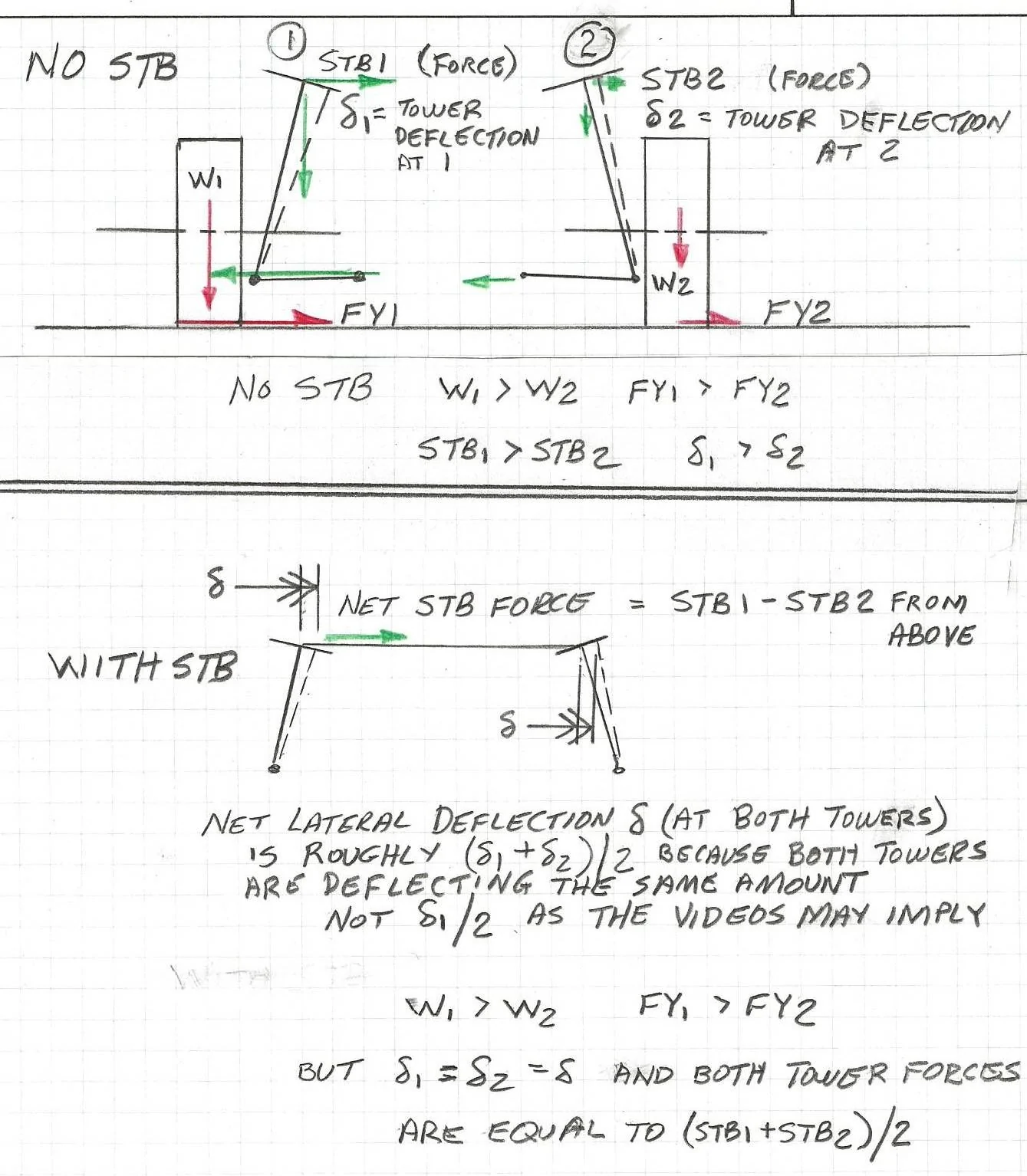
Both the Garage Time guy and the Engineering Explained guy note that when you tie the two towers together that you get to use both towers' stiffnesses. Which is true as far as it goes, but does not tell the whole story (or even the most useful part of it). I think I'm going to have to draw some pictures before it'll make sense, but it has to do with the fact that the inside and outside tires are not loaded equally and do not produce equal cornering forces.

Garage Time guy's measured results weren't the least bit surprising. A different kind of 3-point brace would most likely have shown considerably more improvement.


Back to the subjective part . . . one thing that even light-duty stiffeners can do is change the structural vibration picture. They can chase more noticeable vibration modes out of the picture completely, where you're left with less noticeable modeshapes. You have to be visualizing the car structure vibrating like a massively complex tuning fork here, that when you tie off a point that's vibrating a lot relative to another point to that other point you change that vibration shape completely. A little like grabbing the tips of a simple tuning fork between your fingers, actually.

Vibrations are a part of what you perceive as "chassis solidity", which isn't the same thing as chassis stiffness (though there is a loose relationship between the two). That's why it 'feels' better, the car doesn't feel as "loosey-goosey" as it might have before. This concept can and should be extended to many of the other add-on stiffening that's available.


Sketches are going to take some time. Maybe I'll include a sketch suggesting the possible benefit of running a 2-point STB specifically for hard braking . . . and I have at least one thought related to stiffnesses in general.


I've been down this road before (a number of times, on various forums). As a structural analyst/engineer, this kind of stuff is very much in my wheelhouse. I'm retired these days, but I didn't suddenly forget everything I knew about the concepts.


Norm
 

Norm Peterson

corner barstool sitter
Joined
Jul 22, 2013
Threads
11
Messages
8,852
Reaction score
4,652
Location
On a corner barstool not too far from I-95
First Name
Norm
Vehicle(s)
'08 GT #85, '19 WRX
Seems my layout, sketch, and lettering skills aren't what they once were. Sorry.

Notes on STBs web.webp


If you care to try some rough numbers, let FY1 = 1700 lbs, FY2 = 300 lbs, STB1 = 570 lbs, STB2 = 100 lbs, displacement at tower 1 (unbraced) = 0.057" and displacement at tower 2 (unbraced) = 0.010" for a tower stiffness of 10,000 lb/in.

Those are just numbers for illustration but are at least in the ballpark for about 1g cornering.


Norm
 

Norm Peterson

corner barstool sitter
Joined
Jul 22, 2013
Threads
11
Messages
8,852
Reaction score
4,652
Location
On a corner barstool not too far from I-95
First Name
Norm
Vehicle(s)
'08 GT #85, '19 WRX
On chassis torsional stiffnesses in general - adding more definitely gets into the "realm of diminishing returns" as the original stiffness goes up.

A wet-noodle chassis like the 2003 Mustang convertible (at about 3500 ft*lbs/degree torsional stiffness) needs a lot of help if you're going to tune the handling via spring and sta-bar stiffnesses . . . otherwise you lose a lot of what you're trying to do when the load transfer you're trying to move from one end to the other evaporates as the chassis deflects torsionally. A little like pushing on a rope, actually.

The S197 is much stiffer at around 15,500 ft*lbs/degree, so there just isn't nearly as much to be gained mechanically . . . we're looking at less than a quarter of a degree of torsional deflection here (less, once you include tire flexibility). But the improvement in subjective feel is there, and the improvement in driver confidence coming from that.


Norm
 

Norm Peterson

corner barstool sitter
Joined
Jul 22, 2013
Threads
11
Messages
8,852
Reaction score
4,652
Location
On a corner barstool not too far from I-95
First Name
Norm
Vehicle(s)
'08 GT #85, '19 WRX
On the usual insistence that driver composure is the same thing as "palcebo effect" . . .


"Placebo" really isn't the right word for what's really going on here - a placebo effect would be entirely imaginary, like a sugar pill in medical drug testing.

But if you're linking 'placebo' to a belief that actual performance has improved "because a little stiffness was added", then yeah. That would be the usual belief, encouraged by what advertising either states or implies. I'll just say that having an engineering outlook does help you filter the BS out from the real tech.

A more solid-feeling chassis is a matter of real perception - the change in vibration modeshapes is strictly a physical phenomenon. There's no imagination involved as long as you keep the ideas of "solid-feeling" and "improved performance" separate like you should.


Some years ago I spent some time working at a local Chevy dealership. I'm mentioning this because it got me out on the shop floor from time to time, where I once specifically noticed an OE STB fitted to a near-luxury level GM car (Buick or Olds, not sure which any more). You know it wasn't there for performance, or for showing off at car shows, which leaves mainly the 'V' part of NVH.


Norm
 

Norm Peterson

corner barstool sitter
Joined
Jul 22, 2013
Threads
11
Messages
8,852
Reaction score
4,652
Location
On a corner barstool not too far from I-95
First Name
Norm
Vehicle(s)
'08 GT #85, '19 WRX
For clarity I'm including a little more than just my own response in this one . . .

xxx said: ↑
Hahaha! I hooked you [there is 2 relevant words overlooked highlighted below]
I have seen "atom polarizers" and "turbonators" lower lap times with novice drivers
Trust me, I did not overlook 'street vehicle'. What you'd feel is still real even in normal street driving.

The engineering advantages aren't limited to performance driving; you need to look at what else they do. I'm going to refer you back to that Olds/Buick here, as GM wouldn't have included an STB for hard-driving performance reasons in those cars. Added for a more refined, upscale ride, sure.


On a race car with very high roll stiffness , the "bullshit bar" will help [especially early Mustangs where you need really stiff springs because of the motion ratio to get a decent wheel rate]
But the real frame torsional stiffness comes from a decent multi-point roll cage
Agreed. But now you're getting into doing a full-blown FEM dynamic analysis.

You might be interested in reading this paper, which is basically looking for "soft regions" in a fairly serious cage.

983051.fm (clemson.edu)


Norm
 

Sponsored

Norm Peterson

corner barstool sitter
Joined
Jul 22, 2013
Threads
11
Messages
8,852
Reaction score
4,652
Location
On a corner barstool not too far from I-95
First Name
Norm
Vehicle(s)
'08 GT #85, '19 WRX
xxx said: ↑
One such method of evaluating components, such as this, would be anchoring three points of the chassis, at the suspension points, then loading the fourth point while measuring deflection. Finally, it is up to the end user to determine if the compromise between rigidity, weight, and cost justify the use. Does the increase in rigidity outweigh the cost in dollars and weight?
It's a huge (and in my opinion unrealistic) assumption to expect most people to be able to reach such conclusions independently from their own knowledge and understanding.


OR, this part looks so cool, I can't live without it!
I'm afraid that for the vast majority of DIY chassis & suspension modifiers this one aspect outweighs all else.

You have to know how to analyze what's going on before you can make any conclusion that doesn't start out with "it looks like it will _____ " (fill in the blank).

Or avoid making conclusions that swap cause with effect (where the visible effect is what causes the actual cause to happen) <sigh>


Norm
 

Norm Peterson

corner barstool sitter
Joined
Jul 22, 2013
Threads
11
Messages
8,852
Reaction score
4,652
Location
On a corner barstool not too far from I-95
First Name
Norm
Vehicle(s)
'08 GT #85, '19 WRX
As garage guy's video shows, tensile or compressive loads in the brace really aren't that high. Meaning that it's not going to take a huge amount of joint friction coming from the bolt clamp loads to hold the ends in place.

If clamp loads couldn't hold the brace still, you would get clunking as the bolts take up the bolt to hole clearances first one way and then the other way as one end or the other of the brace slid across its tower a little. Guaranteed there'd be at least one new thread every week about "STB clunking", and people would be throwing them in the trash out of frustration.


Norm
 

Norm Peterson

corner barstool sitter
Joined
Jul 22, 2013
Threads
11
Messages
8,852
Reaction score
4,652
Location
On a corner barstool not too far from I-95
First Name
Norm
Vehicle(s)
'08 GT #85, '19 WRX
FWIW, at least some of what I posted elsewhere got an unofficial peer review by a very successful car modification shop entity that has engineers on staff.


Norm
 

TeeLew

Banned
Banned
Banned
Joined
Apr 27, 2020
Threads
15
Messages
3,396
Reaction score
2,609
Location
So Cal
First Name
Tim
Vehicle(s)
Honda Odyssey, Toyota Tacoma, 89 GT project, 2020 Magnetic EB HPP w/ 6M
FWIW, at least some of what I posted elsewhere got an unofficial peer review by a very successful car modification shop entity that has engineers on staff.


Norm
I've played around with this type of stuff a bit over the years. I agree with your pencil/paper analysis. I think it's correct, at least directionally, for the static case.

Where I think most people will actually feel it is dynamically. If we consider a 3-point brace, then we're stiffening both the 'folding' mode of the front subframe about a longitudinal and vertical axis as well as the beaming mode of the entire car. Considering the engine bay is essentially an open square from plan view, I see this as an important area to stiffen. If you're loaded heavily into a corner and a series of bumps is able to excite one of these modes, it's not going to feel good. If we can stiffen things up, then hopefully, its resonant will be above the range where road inputs can 'ring the bell.' *If* we're able to eliminate this type of thing, whether or not you go faster, the car will feel better.

To touch on the subject of stiffening small sections of the chassis, I think that's to be expected. If we were to measure how the torsional stiffness changes along the longitudinal axis of the car, I bet we'd find the unibody is probably fairly stiff and a couple areas, such as the front subframe, which have a lot of deflection relative to the whole. I've found that the more consistent the torsional stiffness of the chassis is from end to end, the better it generally feels to the driver.
Sponsored

 
Last edited:


Top