
Zitrosounds
Well-Known Member
- Joined
- Oct 20, 2015
- Threads
- 67
- Messages
- 3,407
- Reaction score
- 2,164
- Location
- Madison, AL
- First Name
- Harold
- Vehicle(s)
- 16 GT350R/16 GT350TP/15 GT-PP/12 GT-PP
- Thread starter
- #1
Worried about durability? Longevity? How much faster are they really? give this a read,
Carbon Revolution’s Carbon Fiber Wheel Test: Faster At The Track?
Carbon Fiber is a material most of us associate with race car monocoques and aerodynamic wings. It was developed in the 1960s and is known for being lightweight and very strong–in fact the strength and stiffness of carbon fiber is what makes it ideal for motorsport applications. The fiber can be woven and formed into almost any shape allowing most if not all high performance cars on the road, to incorporate carbon fiber in some fashion. From wings to body panels to complete chassis, carbon fiber is synonymous with performance in the auto and motorsport industry. So why has it taken so long for us to see carbon fiber wheels on car?
First Carbon Wheels On A Road Car
Did you know the first set of carbon fiber wheels were produced for racing in 1971? French manufacturer, Citroën was using their SM coupe for the World Rally Championship and the heavy grand touring coupe of 3,300 pounds needed to shave weight to be competitive, and they soon started searching places to cut down the the weight. Citroën partnered with Michelin’s competition department and developed the world’s first carbon-reinforced resin wheels.

The wheels were one piece and featured small, steel, triangular-shaped, plates which were used for reinforcement around the mounting holes. Although they resembled standard alloy wheels, the total weight came in under 10 pounds each, which was half the weight of the steel wheels they replaced. These wheels proved successful in racing on the SM coupe, winning the Morocco Rally of 1971.
Citroën was so happy with these wheels, they started offering them on their road cars, until the end of 1972 and only in the European market. Due to the rarity, these wheels will fetch over $7,000 a set. Even more amazing, Citroën service centers have stated that even with over 40 years of use, the carbon wheels showed no sign of structural fatigue. It has been said that Citroën, and in particular the DS/SM models were ahead of their time and we can’t help but agree.
Enter Carbon Revolution
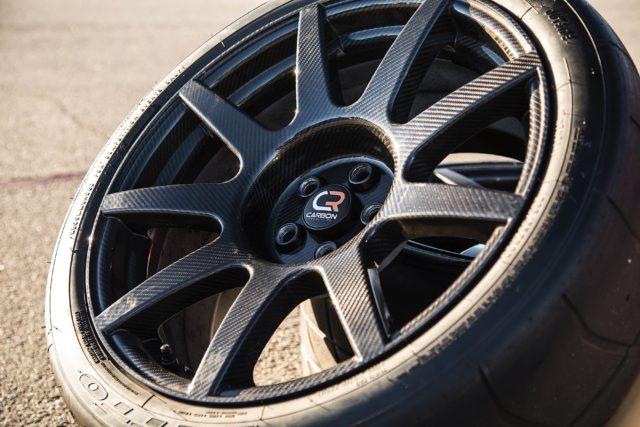
Fast forward to 2012, Australian company Carbon Revolution releases the first production, one-piece, carbon fiber, wheel for the automotive market. Carbon Revolution developed the one-piece design to increase the strength and rigidity of the wheel through a variety of methods, including the use of hollow spokes. When compared, the CR9 weighs on average 25-30 percent lighter than a standard “lightweight” aftermarket aluminum wheel. In addition, this weight savings is in the most critical place, the outside of the wheel where there is the most rotational mass. It affects a cars acceleration, braking, steering, cornering, and overall handling due to their light and stiff nature.

Carbon Fiber Advantages
Even the strongest metal wheels will have deflection and flex under load. In a race car, in which all of the rubber bushings is removed from the suspension and replaced with spherical joints the only flex a driver will feel in the car is from the wheels deflecting. In order to be lighter, the metal must be made thinner, thereby reducing the ability of the metal to resist deflection and flex. Carbon fiber is extremely stiff and does not suffer from deflection under the same conditions other wheels suffer from which allows the suspension of the car to work more efficiently and give the car greater stability in cornering loads. So they are really light and stiff, but they can’t be as durable as a forged wheel, right?
Carbon Fiber Durability And Strength
Carbon Revolution used the most advanced computer modeling the CR9, in developing its design for strength and durability. They tested the wheels to meet the very strict TÜV European standards to ensure utmost safety and road compliance. The CR9 was built to exceed these standards, and it did so by over 30 percent. During testing, Carbon Revolution put the wheels through extreme testing including harsh impacts, like ones you encounter on road and at the race track. The integrity of the wheels has been proven to hold up to the challenge, so much in fact that in 2015 Ford decided the CR9 was up to their OEM standards and would be used on their GT350R Mustang.
OEM Carbon Fiber Wheels
Ford partnered with Carbon Revolution to build a version of the CR9 for the Shelby GT350R which journalist rave about when comparing to the standard GT350. Topping that off, customers seem to love the added benefit of exclusivity when ordering their car. As of right now, the GT350R is the only production car with OEM carbon fiber wheels under $100,000.

Carbon Revolution isn’t alone in the carbon fiber wheel game, however. BMW has developed a set of wheels for their i3, but they have yet to be offered as an option in the US. Hypercar maker Koenigsegg, started offering their own carbon fiber wheels, but at the price tag of over two million dollars, is out of reach for most. In addition to the Swedish hypercar, Porsche announced this year they will be offering carbon fiber wheels as an $18,000 option for the 911 Turbo. At the end of the day, carbon fiber wheels are an expensive option, but what do they really gain when you put them on the track back-to-back with an aluminum wheel and is it worth it?
The Track

To find out just what difference a set of carbon fiber wheels could make, Carbon Revolution invited us out to the track. Heading out to Desert Center, California we found the home of Chuckwalla Valley Raceway which is a 2.68 mile road course that offers a variety of corner types from sweeping double apexes, a mini corkscrew and a banked bowl. This track is used by manufactures and publications to test vehicle performance, and would be the perfect location to torture some wheels. So we have a track–what about a driver?
The Driver

Test driver and Time Attack champion Dieter-Heinz Kijora is selected for behind the wheel duty. With his “day job” being a driving instructor for Porsche at their Experience Center in Carson, CA and supporting drivers and their cars in the Porsche GT3 Cup series through HG Trackside, we’re certain he’s up to the task. Wrapping things up, he’s gained a lot of experience at Chuckwalla and is capable of some very consistent numbers on the track. With the track and driver selected, all we need is a car.
The Car
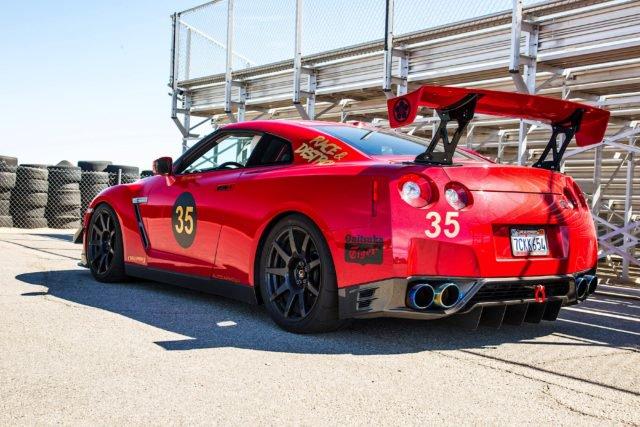
Godzilla is our vehicle of choice, a 2014 Nissan GTR in Vibrant Red to be exact. With rather mild tuning for a GTR, it sports only basic bolt-ons. Although an ECU flash on the car supported E85 or 91, 91 octane was selected for the test. To provide a touch more power, this GTR also has a catless midpipe and exhaust to help the turbos flow freely. In the aerodynamic department we find a carbon fiber front lip, canards, rear diffuser, and wing from Bulletproof Automotive. It doesn’t stop at just aero, and modifications to the suspension have been purposely kept minor and are purely to allow more adjustment for a track oriented alignment. To keep things more or less simple, it sits on KW coilover lowering sleeves which utilize the factory shocks attached to a set of SPL control arms.
The Aluminum Wheels
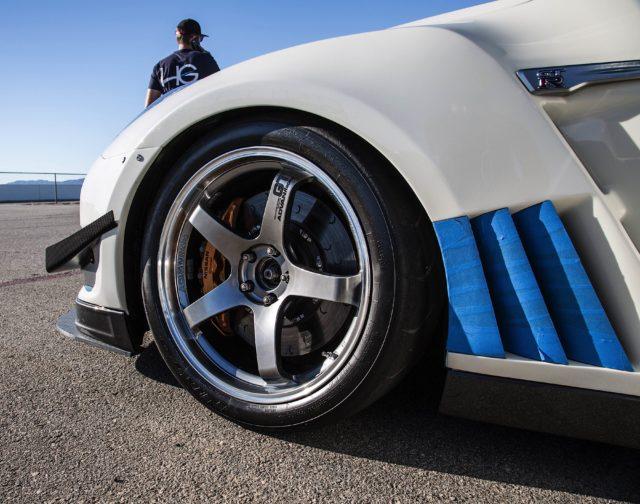
A close eye might spot that the gold Advan Racing wheels shown above is wearing a set of Toyo R888R tires. For the purpose of comparing wheels to wheels, the same size Nitto NT01 tires were installed on both the Advan GT and Carbon Revolution CR9 wheels.
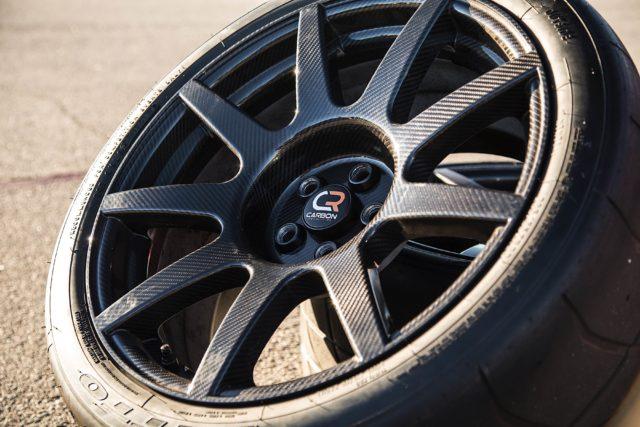
In addition to these modifications, and like most owners who track their cars, it has a set of lightweight aftermarket wheels. This particular GTR is sporting a set of Advan Racing GT wheels that measure in at 20×10 up front and 20×12 in the rear. Without tires these wheels weigh 21 pounds for the fronts and 23 pounds for the rears–which isn’t too bad considering their size. On the other end of our comparison scale is the CR9 Carbon Revolution wheels which weigh 20 pounds each, and run a square 20×10.5 setup. Saving one to three pounds depending on the wheel we compare to might not seem like much, but this is rotational weight and should have a larger effect when it comes to braking, accelerating, or changing direction.

Aluminum Results
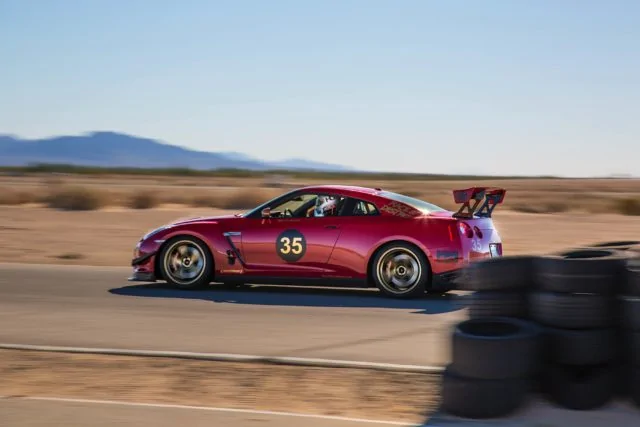
The testing was held in 30 minute sessions allowing the driver to get familiar with the car before putting down “official” timed hot laps. First to roll out on the track was the GTR on Advan wheels–and they did not disappoint. Dieter worked his way into the tires, getting them warm on the the first few laps before it was time a full 10/10ths lap. With the pedal down, the Advan wheels performed well and Dieter reported, “The GTR was stable in the corners.” The fastest lap time was a blistering 2:00.18, which is very fast. To put that in reference, Randy Pobst was just a hair slower when testing the new Alfa Romeo Giulia QV at the same track. How much time could the carbon fiber wheels really subtract, if any?

Now For The Carbon Revolution
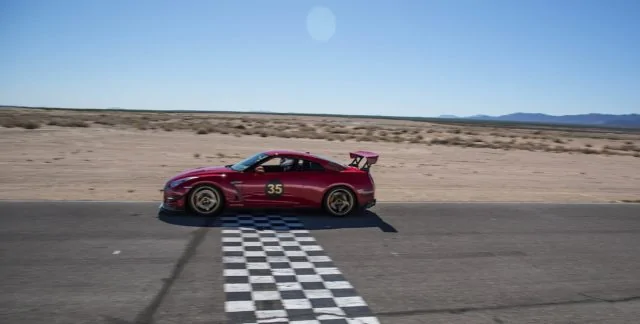
In the pits, the Advan GTs came off and the Carbon Revolution wheels went on. As we mentioned earlier the CR9 wheels for the GTR measure in at 20×10.5 on this square setup. A short time later with lugs torqued, tire pressures checked, and the GTR headed back on track. Dieter expressed an immediate difference in the way the car felt. After putting in a few laps to get comfortable with the carbon wheels, he came around for a hot one. As he flew through the finish line, the stopwatch read an astonishing 1:58.01. Just over two seconds faster, in the same car with the same tires. Of course the time is just part of the story, we wanted to know how it felt behind the wheel.
Driver Impressions
We spoke with Dieter in the pits and he had nothing but good things to say about the Carbon Revolution wheels stating, “You really notice the difference under load. On acceleration the car seems to pick up speed a bit quicker. On initial turn-in, the car wants to bite in more and it feel like it wants to stay tucked in versus pushing to the outside. It feels very planted and changes direction a lot easier. It is very impressive how much of a difference it makes…and two seconds in the same car, is a pretty big difference for just a set of wheels and only 8 pounds in weight (total weight loss).” Although that sounds promising and we had proof to back it, we had to see for ourselves behind the wheel.
Our Impressions
The Nissan GTR is an interesting car to drive on a racetrack. Between the power and the computer controlled all wheel drive it’s an easy car to drive fast; and although it may be fast it isn’t the most involved car to drive. On the aftermarket Advan wheels the GTR felt as if it had a bit of mid corner push and it wanted to head to the outside of the corner. While the car did feel planted and confidence inspiring, it also felt heavy. Once we swapped to the Carbon Revolution wheels, it felt like the GTR started to come alive. Although small, the weight difference really showed strides in the overall feel.
It felt eager to accelerate and the braking felt sharper. We could also feel what Dieter had talked about in the corner; the turn-in felt a bit more crisp. You can feel the lighter weight every time you crank the wheel a different direction. Wheel weight wasn’t the only contributing factor here either, as the stiffer carbon fiber may have also helped how the car felt mid-corner.
Conclusion
Overall the results we had with the Carbon Revolution wheels were impressive. We can’t wait to see more of these type of wheels on production cars in the future. With that said, there are a few limiting factors to point out. First being cost, although we’re seeing these on the high end supercars, we haven’t had many options trickle down the car line until the Ford GT350R. Additionally, wheels sizing and fitments is limited as each set is individually tested and developed for each specific vehicle application.
Current tooling for this process is also time and cost intensive on the manufacturing side, but as we see more of these produced overall costs will go down. Heat is another questionable point, but Carbon Revolution has been proactive in preventative methods to help protect their wheels. At the end of the day, the real World changes to the feel of the vehicle and decreases in lap times have been proven themselves where it counts-with lap times.
http://www.turnology.com/news/carbon-revolutions-carbon-fiber-wheel-test-faster-at-the-track/
Carbon Revolution’s Carbon Fiber Wheel Test: Faster At The Track?
Carbon Fiber is a material most of us associate with race car monocoques and aerodynamic wings. It was developed in the 1960s and is known for being lightweight and very strong–in fact the strength and stiffness of carbon fiber is what makes it ideal for motorsport applications. The fiber can be woven and formed into almost any shape allowing most if not all high performance cars on the road, to incorporate carbon fiber in some fashion. From wings to body panels to complete chassis, carbon fiber is synonymous with performance in the auto and motorsport industry. So why has it taken so long for us to see carbon fiber wheels on car?
First Carbon Wheels On A Road Car
Did you know the first set of carbon fiber wheels were produced for racing in 1971? French manufacturer, Citroën was using their SM coupe for the World Rally Championship and the heavy grand touring coupe of 3,300 pounds needed to shave weight to be competitive, and they soon started searching places to cut down the the weight. Citroën partnered with Michelin’s competition department and developed the world’s first carbon-reinforced resin wheels.
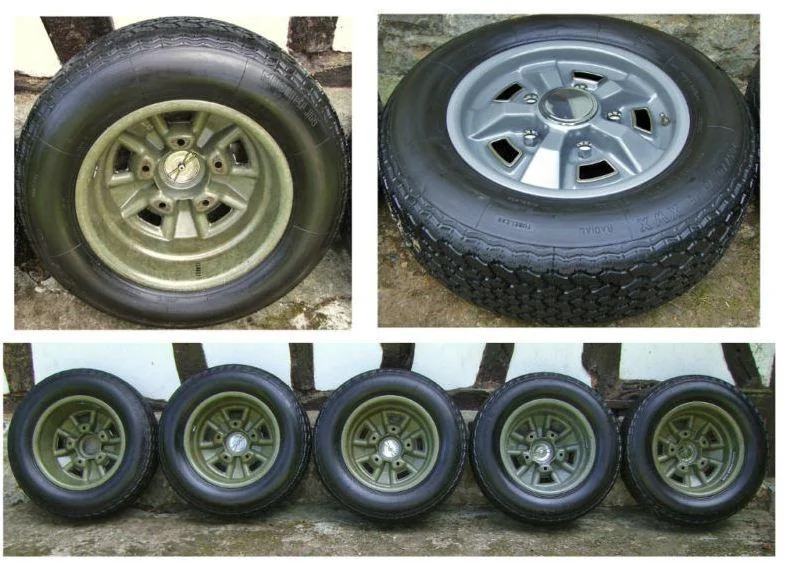
The wheels were one piece and featured small, steel, triangular-shaped, plates which were used for reinforcement around the mounting holes. Although they resembled standard alloy wheels, the total weight came in under 10 pounds each, which was half the weight of the steel wheels they replaced. These wheels proved successful in racing on the SM coupe, winning the Morocco Rally of 1971.
Citroën was so happy with these wheels, they started offering them on their road cars, until the end of 1972 and only in the European market. Due to the rarity, these wheels will fetch over $7,000 a set. Even more amazing, Citroën service centers have stated that even with over 40 years of use, the carbon wheels showed no sign of structural fatigue. It has been said that Citroën, and in particular the DS/SM models were ahead of their time and we can’t help but agree.
Enter Carbon Revolution
Fast forward to 2012, Australian company Carbon Revolution releases the first production, one-piece, carbon fiber, wheel for the automotive market. Carbon Revolution developed the one-piece design to increase the strength and rigidity of the wheel through a variety of methods, including the use of hollow spokes. When compared, the CR9 weighs on average 25-30 percent lighter than a standard “lightweight” aftermarket aluminum wheel. In addition, this weight savings is in the most critical place, the outside of the wheel where there is the most rotational mass. It affects a cars acceleration, braking, steering, cornering, and overall handling due to their light and stiff nature.
Carbon Fiber Advantages
Even the strongest metal wheels will have deflection and flex under load. In a race car, in which all of the rubber bushings is removed from the suspension and replaced with spherical joints the only flex a driver will feel in the car is from the wheels deflecting. In order to be lighter, the metal must be made thinner, thereby reducing the ability of the metal to resist deflection and flex. Carbon fiber is extremely stiff and does not suffer from deflection under the same conditions other wheels suffer from which allows the suspension of the car to work more efficiently and give the car greater stability in cornering loads. So they are really light and stiff, but they can’t be as durable as a forged wheel, right?
Carbon Fiber Durability And Strength
Carbon Revolution used the most advanced computer modeling the CR9, in developing its design for strength and durability. They tested the wheels to meet the very strict TÜV European standards to ensure utmost safety and road compliance. The CR9 was built to exceed these standards, and it did so by over 30 percent. During testing, Carbon Revolution put the wheels through extreme testing including harsh impacts, like ones you encounter on road and at the race track. The integrity of the wheels has been proven to hold up to the challenge, so much in fact that in 2015 Ford decided the CR9 was up to their OEM standards and would be used on their GT350R Mustang.
OEM Carbon Fiber Wheels
Ford partnered with Carbon Revolution to build a version of the CR9 for the Shelby GT350R which journalist rave about when comparing to the standard GT350. Topping that off, customers seem to love the added benefit of exclusivity when ordering their car. As of right now, the GT350R is the only production car with OEM carbon fiber wheels under $100,000.

Carbon Revolution isn’t alone in the carbon fiber wheel game, however. BMW has developed a set of wheels for their i3, but they have yet to be offered as an option in the US. Hypercar maker Koenigsegg, started offering their own carbon fiber wheels, but at the price tag of over two million dollars, is out of reach for most. In addition to the Swedish hypercar, Porsche announced this year they will be offering carbon fiber wheels as an $18,000 option for the 911 Turbo. At the end of the day, carbon fiber wheels are an expensive option, but what do they really gain when you put them on the track back-to-back with an aluminum wheel and is it worth it?
The Track

To find out just what difference a set of carbon fiber wheels could make, Carbon Revolution invited us out to the track. Heading out to Desert Center, California we found the home of Chuckwalla Valley Raceway which is a 2.68 mile road course that offers a variety of corner types from sweeping double apexes, a mini corkscrew and a banked bowl. This track is used by manufactures and publications to test vehicle performance, and would be the perfect location to torture some wheels. So we have a track–what about a driver?
The Driver

Test driver and Time Attack champion Dieter-Heinz Kijora is selected for behind the wheel duty. With his “day job” being a driving instructor for Porsche at their Experience Center in Carson, CA and supporting drivers and their cars in the Porsche GT3 Cup series through HG Trackside, we’re certain he’s up to the task. Wrapping things up, he’s gained a lot of experience at Chuckwalla and is capable of some very consistent numbers on the track. With the track and driver selected, all we need is a car.
The Car
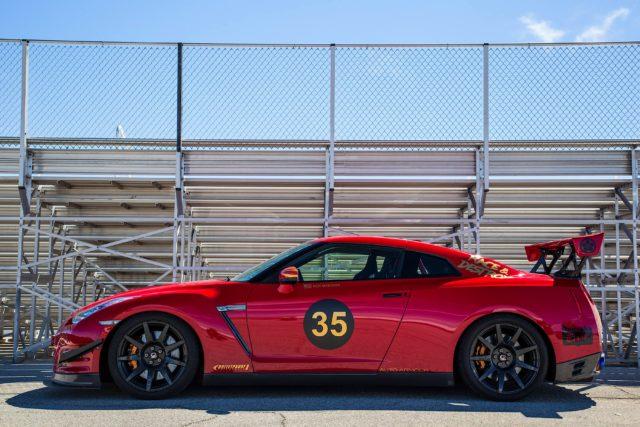
Godzilla is our vehicle of choice, a 2014 Nissan GTR in Vibrant Red to be exact. With rather mild tuning for a GTR, it sports only basic bolt-ons. Although an ECU flash on the car supported E85 or 91, 91 octane was selected for the test. To provide a touch more power, this GTR also has a catless midpipe and exhaust to help the turbos flow freely. In the aerodynamic department we find a carbon fiber front lip, canards, rear diffuser, and wing from Bulletproof Automotive. It doesn’t stop at just aero, and modifications to the suspension have been purposely kept minor and are purely to allow more adjustment for a track oriented alignment. To keep things more or less simple, it sits on KW coilover lowering sleeves which utilize the factory shocks attached to a set of SPL control arms.
The Aluminum Wheels
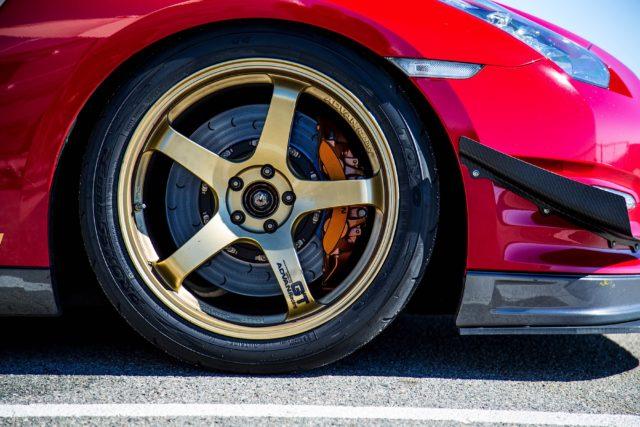
In addition to these modifications, and like most owners who track their cars, it has a set of lightweight aftermarket wheels. This particular GTR is sporting a set of Advan Racing GT wheels that measure in at 20×10 up front and 20×12 in the rear. Without tires these wheels weigh 21 pounds for the fronts and 23 pounds for the rears–which isn’t too bad considering their size. On the other end of our comparison scale is the CR9 Carbon Revolution wheels which weigh 20 pounds each, and run a square 20×10.5 setup. Saving one to three pounds depending on the wheel we compare to might not seem like much, but this is rotational weight and should have a larger effect when it comes to braking, accelerating, or changing direction.
Aluminum Results
The testing was held in 30 minute sessions allowing the driver to get familiar with the car before putting down “official” timed hot laps. First to roll out on the track was the GTR on Advan wheels–and they did not disappoint. Dieter worked his way into the tires, getting them warm on the the first few laps before it was time a full 10/10ths lap. With the pedal down, the Advan wheels performed well and Dieter reported, “The GTR was stable in the corners.” The fastest lap time was a blistering 2:00.18, which is very fast. To put that in reference, Randy Pobst was just a hair slower when testing the new Alfa Romeo Giulia QV at the same track. How much time could the carbon fiber wheels really subtract, if any?
Now For The Carbon Revolution
In the pits, the Advan GTs came off and the Carbon Revolution wheels went on. As we mentioned earlier the CR9 wheels for the GTR measure in at 20×10.5 on this square setup. A short time later with lugs torqued, tire pressures checked, and the GTR headed back on track. Dieter expressed an immediate difference in the way the car felt. After putting in a few laps to get comfortable with the carbon wheels, he came around for a hot one. As he flew through the finish line, the stopwatch read an astonishing 1:58.01. Just over two seconds faster, in the same car with the same tires. Of course the time is just part of the story, we wanted to know how it felt behind the wheel.
Driver Impressions
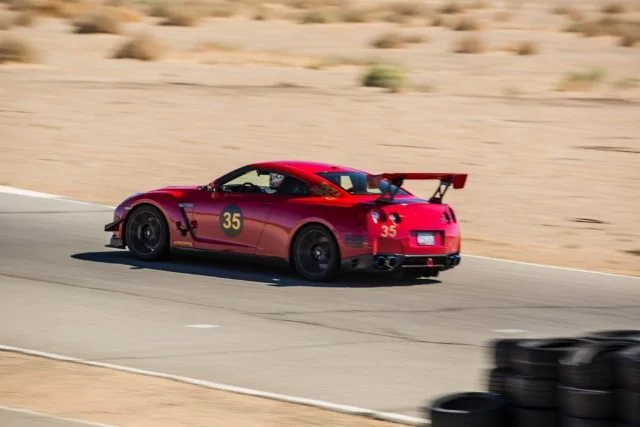
We spoke with Dieter in the pits and he had nothing but good things to say about the Carbon Revolution wheels stating, “You really notice the difference under load. On acceleration the car seems to pick up speed a bit quicker. On initial turn-in, the car wants to bite in more and it feel like it wants to stay tucked in versus pushing to the outside. It feels very planted and changes direction a lot easier. It is very impressive how much of a difference it makes…and two seconds in the same car, is a pretty big difference for just a set of wheels and only 8 pounds in weight (total weight loss).” Although that sounds promising and we had proof to back it, we had to see for ourselves behind the wheel.
Our Impressions
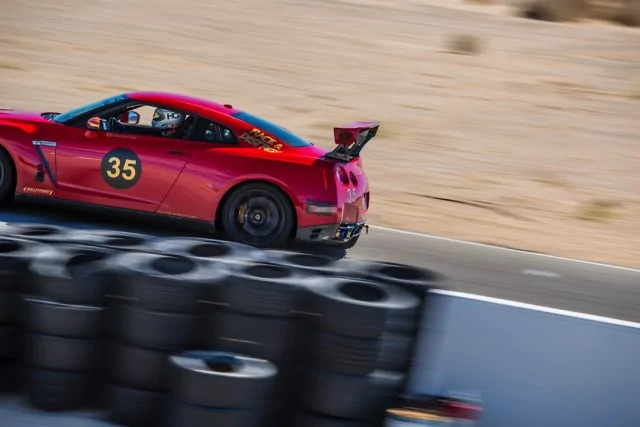
The Nissan GTR is an interesting car to drive on a racetrack. Between the power and the computer controlled all wheel drive it’s an easy car to drive fast; and although it may be fast it isn’t the most involved car to drive. On the aftermarket Advan wheels the GTR felt as if it had a bit of mid corner push and it wanted to head to the outside of the corner. While the car did feel planted and confidence inspiring, it also felt heavy. Once we swapped to the Carbon Revolution wheels, it felt like the GTR started to come alive. Although small, the weight difference really showed strides in the overall feel.
It felt eager to accelerate and the braking felt sharper. We could also feel what Dieter had talked about in the corner; the turn-in felt a bit more crisp. You can feel the lighter weight every time you crank the wheel a different direction. Wheel weight wasn’t the only contributing factor here either, as the stiffer carbon fiber may have also helped how the car felt mid-corner.
Conclusion
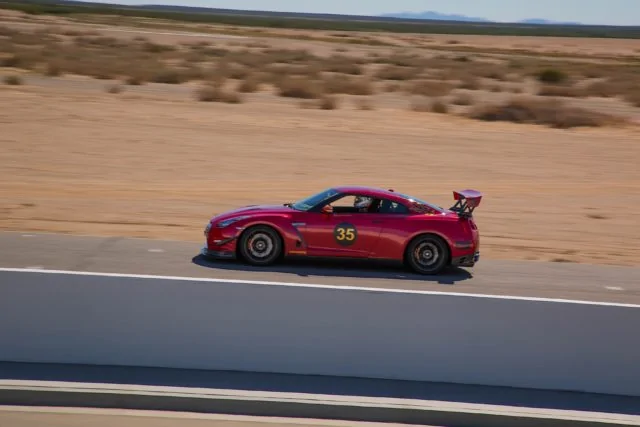
Overall the results we had with the Carbon Revolution wheels were impressive. We can’t wait to see more of these type of wheels on production cars in the future. With that said, there are a few limiting factors to point out. First being cost, although we’re seeing these on the high end supercars, we haven’t had many options trickle down the car line until the Ford GT350R. Additionally, wheels sizing and fitments is limited as each set is individually tested and developed for each specific vehicle application.
Current tooling for this process is also time and cost intensive on the manufacturing side, but as we see more of these produced overall costs will go down. Heat is another questionable point, but Carbon Revolution has been proactive in preventative methods to help protect their wheels. At the end of the day, the real World changes to the feel of the vehicle and decreases in lap times have been proven themselves where it counts-with lap times.
http://www.turnology.com/news/carbon-revolutions-carbon-fiber-wheel-test-faster-at-the-track/
Sponsored