Sponsored

Anyone run 5w30?

mustang_guy

Well-Known Member
Joined
Jun 29, 2015
Threads
12
Messages
5,721
Reaction score
1,330
Location
United States
Vehicle(s)
it has an engine!
I run 0w40 in my new motor.

For a stock motor, I personally prefer 5w30.

I have never run the 5w20 in the modular engines, even after they changed the "oil cap" in the late 90's from 5w30, to 5w20 (out of nowhere - thanks CAFE)
THIS
Sponsored


ForTehNguyen

Well-Known Member
Joined
Apr 23, 2015
Threads
17
Messages
2,247
Reaction score
693
Location
Houston, Texas
Vehicle(s)
15 GT
synthetic oil has a shelf life of about 5 years according to M1
 

Walt1120

Well-Known Member
Joined
May 30, 2015
Threads
2
Messages
120
Reaction score
30
Location
New Jersey
Vehicle(s)
2015 Mustang GT Premium PP 50th Anniversary
I run 0W-30 Amsoil in my 15
 

McCarthy

Well-Known Member
Joined
Oct 16, 2014
Threads
6
Messages
188
Reaction score
51
Location
Canada
Vehicle(s)
2014 Mustang
I switched from 5w20 to 5w30 and noticed a big improvement in wear metals according to blackstone.
 

m6pwr

Well-Known Member
Joined
Jan 17, 2015
Threads
5
Messages
87
Reaction score
34
Location
San Diego, CA
First Name
Richard
Vehicle(s)
2015 Mustang GT Performance Pkg,Recaros
Just curious: What drain intervals are you using and what was the drain interval and car mileage between the 5w20 and 5w30, and can you give some particulars on how much improved the wear metals were?
 

Sponsored

McCarthy

Well-Known Member
Joined
Oct 16, 2014
Threads
6
Messages
188
Reaction score
51
Location
Canada
Vehicle(s)
2014 Mustang
Just curious: What drain intervals are you using and what was the drain interval and car mileage between the 5w20 and 5w30, and can you give some particulars on how much improved the wear metals were?

No problem.

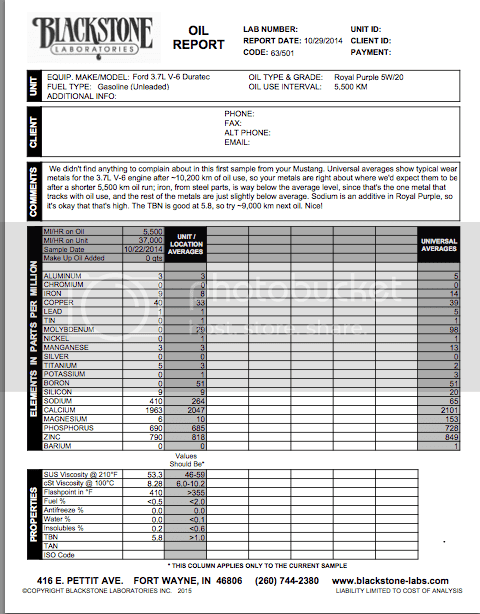
I bring you to sample # 1 , Royal purple 5W20, summer 2014. larger text link: http://www.blackstone-labs.net/(izs24i451ofjpjz2kxamzz55)/oilreports.aspx?cid=G42167


Shot%202015-10-29%20at%2010.34.09%20PM_zpslsvglwc2.png


This sample has 5,500km on it. Zero track days, a couple autocross, and the rest street driving. Good sample, nothing "wrong" per say, however I bring you to iron, at "9". Still below and average and very good, but remember that number. Iron is from wearing parts inside the engine. Lower is much, much better, obviously.

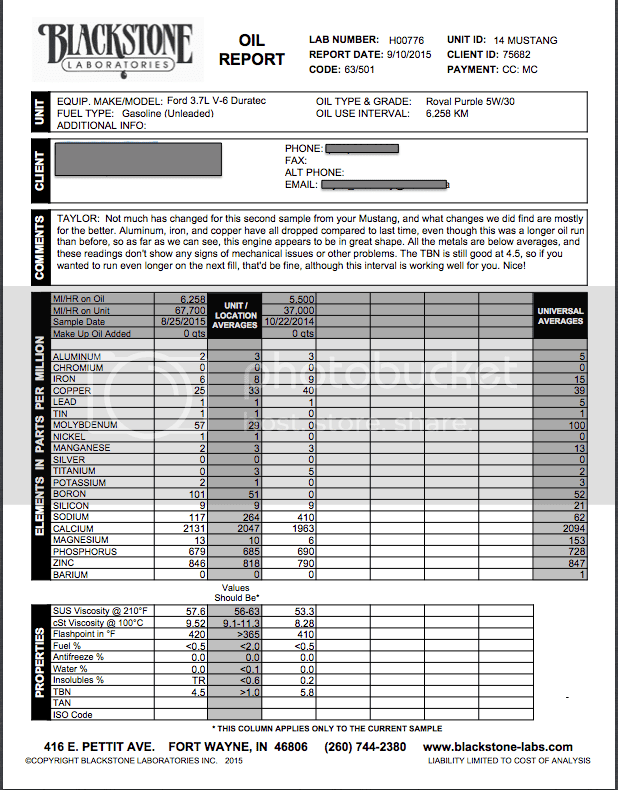
I now bring us to sample # 2. Royal Purple 5W30, Summer 2015. Link: http://www.blackstone-labs.net/(gfklwc45amtjoj55tgdqfe45)/oilreports.aspx?cid=H00776


0Shot%202015-09-10%20at%202.01.08%20PM_zpslevbs0lu.png


This one has 6,300km on it, and the big news, a bunch of autocross', and TWO track days, each with 7 x 25 minute sessions. A.K.A this sample was run longer, and should show FAR more wear than the other one, right? Wrong. Iron is down to "6". EVERYTHING else is also better, however the sample was obviously run much harder. Only thing that changed? 5W30 instead of 5W20. I'll leave you to draw your own conclusions.

EDIT: Oh yeah. Forgot to mention the biggest change from 20-30 weight oil, look at copper. On the 5W20 no track day sample, copper is "40". Copper is from wear on crankshaft journal bearings, connecting rod bearings, camshaft bushings, piston wrist pin bushings, etc. On the 5W30 sample with track days, copper is "25" Interesting.
 

jasonstang

Well-Known Member
Joined
Oct 23, 2015
Threads
23
Messages
5,571
Reaction score
1,307
Location
Denver, CO
Vehicle(s)
2017 GB GT/CS 6MT
No problem.

I bring you to sample # 1 , Royal purple 5W20, summer 2014. larger text link: http://www.blackstone-labs.net/(izs24i451ofjpjz2kxamzz55)/oilreports.aspx?cid=G42167


This sample has 5,500km on it. Zero track days, a couple autocross, and the rest street driving. Good sample, nothing "wrong" per say, however I bring you to iron, at "9". Still below and average and very good, but remember that number. Iron is from wearing parts inside the engine. Lower is much, much better, obviously.

I now bring us to sample # 2. Royal Purple 5W30, Summer 2015. Link: http://www.blackstone-labs.net/(gfklwc45amtjoj55tgdqfe45)/oilreports.aspx?cid=H00776


This one has 6,300km on it, and the big news, a bunch of autocross', and TWO track days, each with 7 x 25 minute sessions. A.K.A this sample was run longer, and should show FAR more wear than the other one, right? Wrong. Iron is down to "6". EVERYTHING else is also better, however the sample was obviously run much harder. Only thing that changed? 5W30 instead of 5W20. I'll leave you to draw your own conclusions.

EDIT: Oh yeah. Forgot to mention the biggest change from 20-30 weight oil, look at copper. On the 5W20 no track day sample, copper is "40". Copper is from wear on crankshaft journal bearings, connecting rod bearings, camshaft bushings, piston wrist pin bushings, etc. On the 5W30 sample with track days, copper is "25" Interesting.
Interesting how moly shot up changing from RP 5w20 to 5W30.
Do they have a different blend for the 5W30. It's rare to use moly unless in break-in oils.
 

m6pwr

Well-Known Member
Joined
Jan 17, 2015
Threads
5
Messages
87
Reaction score
34
Location
San Diego, CA
First Name
Richard
Vehicle(s)
2015 Mustang GT Performance Pkg,Recaros
First of all, I definitely agree with Blackstone's comments that your motor appears to be in great shape - - regardless of whether you're using 5w20 or 5w30. Wow! Going from 9 ppm iron to 6 ppm is like talking about how many angels can dance on the head of a pin (why even bother with uoa's). Most labs/oem's use a wear limit of 150 ppm iron.

Using the uoa's you've posted, at a sampling interval of nearly 20,000 mi, it is to be expected that wear metals will decrease. The same would have happened if both uoa's were done with 5w20 in the crankcase. That's the nature of wear in a healthy engine - - the wear generally trends downward as the engine "wears in" (although there is some natural or standard deviation up or down). You can't attribute the decrease soley to using 5w30. At 75,000 miles, iron wear may be even less. PPM copper by the way typically drops significantly from one uoa to the next, particularly at a sampling interval of 20,000 miles. Some ppm copper may come from bushings, bearings, etc., but most typically comes from copper leached out of the oil cooler.
 
Last edited:

McCarthy

Well-Known Member
Joined
Oct 16, 2014
Threads
6
Messages
188
Reaction score
51
Location
Canada
Vehicle(s)
2014 Mustang
First of all, I definitely agree with Blackstone's comments that your motor appears to be in great shape - - regardless of whether you're using 5w20 or 5w30. Wow! Going from 9 ppm iron to 6 ppm is like talking about how many angels can dance on the head of a pin (why even bother with uoa's). Most labs/oem's use a wear limit of 150 ppm iron.

Using the uoa's you've posted, at a sampling interval of nearly 20,000 mi, it is to be expected that wear metals will decrease. The same would have happened if both uoa's were done with 5w20 in the crankcase. That's the nature of wear in a healthy engine - - the wear generally trends downward as the engine "wears in" (although there is some natural or standard deviation up or down). You can't attribute the decrease soley to using 5w30. At 75,000 miles, iron wear may be even less. PPM copper by the way typically drops significantly from one uoa to the next, particularly at a sampling interval of 20,000 miles. Some ppm copper may come from bushings, bearings, etc., but most typically comes from copper leached out of the oil cooler.
Good info, I think this also helps those people who say driving a car hard is "bad"... Can't drive a car much harder than a race track!

I suspect (not certain) the reason the wear metals are so low (among other things) is that I will start the car, and wait for it to idle down before moving, then drive under 2,000rpms until oil is up to temp. Nothing worse than those idiots who fire her up after 8 hours parked and lay strips leaving the parking lot!
 

dubster99

Well-Known Member
Joined
Aug 12, 2014
Threads
45
Messages
2,517
Reaction score
437
Location
Nor*Cal
Vehicle(s)
2015 Ingot Silver GT PP
I run 5w30 RP, will be sending in a sample to Blackstone here shortly.
 

Sponsored

drabon74

Well-Known Member
Joined
Sep 19, 2014
Threads
65
Messages
920
Reaction score
171
Location
Conway, SC
Vehicle(s)
2018 GT Premium 401a
I am running 5w30 penzoil full syn
 

daltron

Rowing All Day
Joined
Apr 29, 2015
Threads
52
Messages
2,539
Reaction score
786
Location
California
First Name
Jonathan
Vehicle(s)
2016 GT PP
Sending my factor fill in @ 1,058 today. Changed out to AMSOIL SS and will be doing an analysis on that as well after 5K.
 

CompO5.sl0w

GTFO_0021
Joined
Sep 11, 2015
Threads
21
Messages
1,237
Reaction score
685
Location
Martinsburg, WV
First Name
Trevor
Vehicle(s)
2016 Mustang GT/PP / 2015 Jeep Rubicon
Ran 7 quarts RP 5W-30 and 1 Quart Lucas Full-Synthetic Stabilizer for 4 years/50k miles on my 2011. Ran great with no issues. Plan on doing the same on this car.
 

TorkN8R

Well-Known Member
Joined
Jun 14, 2014
Threads
48
Messages
740
Reaction score
122
Location
Northern California Bay Area
Vehicle(s)
2016 Mustang GT Premium Ingot Silver Auto W/3.55's
New 2016 GT. Changed oil at 2,000 miles from OEM 5W-20 to AMSOIL 5W-30. Reason being is that I figured the 5-20 was for cafe milage, that and the fact that I wanted 5W for start up, and 30W for a bit more temp protection. I dont track but from time to time a do some fairly sprited driving on the back roads. I did a little research about synthetic oils and the following is what I discovered:

Here's what I found out recently. It could be right or wrong...who knows.
AMSOIL was the first 100% Synthetic oil created in 1972. In 1973, Mobile 1 came out. When Mobile 1 first came out they made claims that they no longer make.

Truth in advertising...Mobile 1 has on its label "Full Synthetic" in the whats allowed world of advertising...that means that as long as in contains any amount of Synthetic oil over 50%, it can be labeled as "Full Synthetic" If it contains any amount of synthetic oil less than 50%, it has to be labeled as "Synthetic Blend" I know right? ....who knew?

AMSOIL is 100% Synthetic Oil. Not Full Synthetic, Not Synthetic Blend.

I don't own AMSOIL stock, I don't sell AMSOIL, I'm not even recommending it. It is just information that can use to make your own decision.

It just seed to me that if I'm going to buy expensive synthetic oil, I might as well get the real deal...100% Synthetic.
 

m6pwr

Well-Known Member
Joined
Jan 17, 2015
Threads
5
Messages
87
Reaction score
34
Location
San Diego, CA
First Name
Richard
Vehicle(s)
2015 Mustang GT Performance Pkg,Recaros
New 2016 GT. Changed oil at 2,000 miles from OEM 5W-20 to AMSOIL 5W-30. Reason being is that I figured the 5-20 was for cafe milage, that and the fact that I wanted 5W for start up, and 30W for a bit more temp protection. I dont track but from time to time a do some fairly sprited driving on the back roads. I did a little research about synthetic oils and the following is what I discovered:

Here's what I found out recently. It could be right or wrong...who knows.
AMSOIL was the first 100% Synthetic oil created in 1972. In 1973, Mobile 1 came out. When Mobile 1 first came out they made claims that they no longer make.

Truth in advertising...Mobile 1 has on its label "Full Synthetic" in the whats allowed world of advertising...that means that as long as in contains any amount of Synthetic oil over 50%, it can be labeled as "Full Synthetic" If it contains any amount of synthetic oil less than 50%, it has to be labeled as "Synthetic Blend" I know right? ....who knew?

AMSOIL is 100% Synthetic Oil. Not Full Synthetic, Not Synthetic Blend.

I don't own AMSOIL stock, I don't sell AMSOIL, I'm not even recommending it. It is just information that can use to make your own decision.

It just seed to me that if I'm going to buy expensive synthetic oil, I might as well get the real deal...100% Synthetic.
The term 100% synthetic, as you often see it on motor oil bottles and in mfr.'s marketing literature, isn't what you think it is.

Back sometime in the '80's, ExxonMobil persuaded the National Advertising Council that a highly refined (i.e. highly chemically and physically modified) oil made from crude oil pumped out of the ground could be marketed/sold as "synthetic". So, any engine oil made by that process could be represented as "100% synthetic".

A better guide to the nature of the base stock in motor oil is the system of classification established by the Society of Automotive Engineers (SAE). Briefly: group III base stock is the highly modified/highly refined base stock made from oil pumped out of the ground. Group IV is a base stock made in the test tube, so to speak, and in that sense a true synthetic product. Chemically, grip IV base stocks are known as PAO base stock (polyalphaolefins). Group V base stock is made from chemical and vegetable esters. Probably the most famous grp V (or at least the original anyway) is Castrol R racing oil made from the vegetable ester of the castor bean (like castor oil). Grp IV and V oils are the only true synthetic motor oils.

Grp V oils were originally developed in Germany before WWII. They were the only oils at that time that could stand up to the very high heat and very high rpm's of the newly developed jet engines. Grp V oils did have some drawbacks. They aged or oxidized and thickened rather rapidly and they were expensive to make.

Grp IV PAO's were next. The are close to grp V in performance and less expensive to make.

When Joe Amatuzzi, a former Air Force jet jockey, founded Amsoil back in the 70's he was well aware of the performance benefits of grp V ester oils, which is why the original Amsoil motor oil was a grp V ester oil and advertised as such. Incidentally, two chemists from Amsoil left and formed their own company specializing in ester based motor oils called Redline. Somewhere along the way Amsoil motor oils transitioned to grp IV base stock and were advertised as PAO's. They've since dropped that in their advertising and are most probably grp III+ base stock.

Unless they are specifically advertised or touted as grp IV or V, you can figure that any "100% synthetic" oil in question is grp III+. Grp III+ oils are made from high quality base stocks that are close to or equal to PAO's in their performance. Almost all syn motor oils today are grp III+ and the reason is simple: grip III+ oils, together with the advanced additive packs of today, are more than good enough for most any passenger car application, and that includes high performance applications.
Sponsored

 
Last edited:


Top