Sponsored

Alignment specs

17GT350

Active Member
Joined
Sep 25, 2018
Threads
11
Messages
43
Reaction score
21
Location
Fayetteville, NC
First Name
Will
Vehicle(s)
2017 Ford Mustang Shelby GT350
What alignment specs are you using for street driving? I am using R specs currently. I do not want my tires to wear out fast but do want them to handle well in the curbs when I do them.
Sponsored


 

NightmareMoon

Well-Known Member
Joined
Nov 22, 2015
Threads
62
Messages
7,053
Reaction score
6,314
Location
Austin
Vehicle(s)
2016 Mustang GT PP w/ Voodoo
Vehicle Showcase
1
You can go with more camber than the R specs if you like, they're still on the conservative side. Are these the numbers you're using?

GT350R (with OEM plates)
Front
Camber -2.20°
Caster 6.92°
Toe - Total 0.10° toe in

Rear
Camber -1.60°
Toe - Total 0.30° toe in

The toe is fine, and caster is generally not adjustable, so we're left with camber, which is only adjustable in the front if you have camber plates, do you?

For corner carving, if you can handle a neutral balanced RWD car and don't need it conservatively tuned for understeer, then you should try for a front/rear bias of 0.5 degrees or more (more camber on the front than the rear, like the above GT350R specs with a +0.6 degree F bias). For a more stable understeering car, OEMs will flip that and tune it for more rear camber than front (as on the GTs and GT350 non-R). You could run 2.4/1.8, 2.6/2.0, etc... You can go more than 0.5 bias to the front (like 3.0/2.0) but I would try to keep it at least +F0.5. The front limit with camber plates (without modifying your strut tower holes) would be ~2.6 or so.

Don't worry, daily tire wear will be fine IF you maintain your toe regularly and keep it close to 0-0.05 in per side on the front.

Toe kills tires, not camber. Generally you can think of toe determining how fast a tire will wear and camber affects where it will wear. If you're tracking the car you need a bunch of negative camber to keep the outside shoulders from wearing, while on the street that camber will show up on the inside shoulders, but how fast it wears on the inside when daily driving is heavily influenced by your toe. If your dynamic toe is zero (i.e. your toe with road force deflecting the bushings and all that), your tires will still last a very long time because while they're tilted, they're still rolling straight and not scrubbing along as they go. The OEM specs of 0.05 toe in per side are about right to get dynamic toe of very close to zero.

The other issue is tire construction, so I'll just call out the Michelin MPSS and MP4S for bad inside edge wear patterns. No matter what you do or what alignment you run, they always seem to wear through on the inside edge first at around 20k miles. Chasing conservative camber settings won't change that. Other tires (and other models of Michelin tires) won't have that issue unless your toe settings are off, but its routine for the MPSS/MP4S.
 
Last edited:

TonyNJ

Well-Known Member
Joined
Jul 14, 2021
Threads
52
Messages
2,451
Reaction score
3,666
Location
Northern NJ
Website
www.instagram.com
First Name
Tony
Vehicle(s)
22 GT500HE Black Stripes, 20 GT350HE, 16 GT350R Ba
I do not want my tires to wear out fast but do want them to handle well in the curbs when I do them.
I'm guessing you meant curves, not curbs. Doing curbs is pretty easy in these cars when parallel parking regardless of camber.
 

JAJ

Well-Known Member
Joined
Apr 9, 2016
Threads
4
Messages
2,220
Reaction score
1,971
Location
Vancouver BC
Vehicle(s)
2016 GT350 Track Pack
What alignment specs are you using for street driving? I am using R specs currently. I do not want my tires to wear out fast but do want them to handle well in the curbs when I do them.
What @NightmareMoon says above is pretty much dead-on. I run -2.2 degrees camber, 0.00 degrees toe up front and -1.65 degrees camber and 0.30 degrees toe-in at the rear on my 2016 GT350. I run (heavy but structurally rigid) OEM GT350 rims front and rear on mine at all times and those settings work great on the street and on the track for the same reason as they work great on the GT350R with it's (super light but structurally rigid) CF wheels.
 
OP
OP

17GT350

Active Member
Joined
Sep 25, 2018
Threads
11
Messages
43
Reaction score
21
Location
Fayetteville, NC
First Name
Will
Vehicle(s)
2017 Ford Mustang Shelby GT350
I'm guessing you meant curves, not curbs. Doing curbs is pretty easy in these cars when parallel parking regardless of camber.
Lol. I guess that is what I get for not proofreading.
 
OP
OP

17GT350

Active Member
Joined
Sep 25, 2018
Threads
11
Messages
43
Reaction score
21
Location
Fayetteville, NC
First Name
Will
Vehicle(s)
2017 Ford Mustang Shelby GT350
You can go with more camber than the R specs if you like, they're still on the conservative side. Are these the numbers you're using?

GT350R (with OEM plates)
Front
Camber -2.20°
Caster 6.92°
Toe - Total 0.10° toe in

Rear
Camber -1.60°
Toe - Total 0.30° toe in

The toe is fine, and caster is generally not adjustable, so we're left with camber, which is only adjustable in the front if you have camber plates, do you?

For corner carving, if you can handle a neutral balanced RWD car and don't need it conservatively tuned for understeer, then you should try for a front/rear bias of 0.5 degrees or more (more camber on the front than the rear, like the above GT350R specs with a +0.6 degree F bias). For a more stable understeering car, OEMs will flip that and tune it for more rear camber than front (as on the GTs and GT350 non-R). You could run 2.4/1.8, 2.6/2.0, etc... You can go more than 0.5 bias to the front (like 3.0/2.0) but I would try to keep it at least +F0.5. The front limit with camber plates (without modifying your strut tower holes) would be ~2.6 or so.

Don't worry, daily tire wear will be fine IF you maintain your toe regularly and keep it close to 0-0.05 in per side on the front.

Toe kills tires, not camber. Generally you can think of toe determining how fast a tire will wear and camber affects where it will wear. If you're tracking the car you need a bunch of negative camber to keep the outside shoulders from wearing, while on the street that camber will show up on the inside shoulders, but how fast it wears on the inside when daily driving is heavily influenced by your toe. If your dynamic toe is zero (i.e. your toe with road force deflecting the bushings and all that), your tires will still last a very long time because while they're tilted, they're still rolling straight and not scrubbing along as they go. The OEM specs of 0.05 toe in per side are about right to get dynamic toe of very close to zero.

The other issue is tire construction, so I'll just call out the Michelin MPSS and MP4S for bad inside edge wear patterns. No matter what you do or what alignment you run, they always seem to wear through on the inside edge first at around 20k miles. Chasing conservative camber settings won't change that. Other tires (and other models of Michelin tires) won't have that issue unless your toe settings are off, but its routine for the MPSS/MP4S.
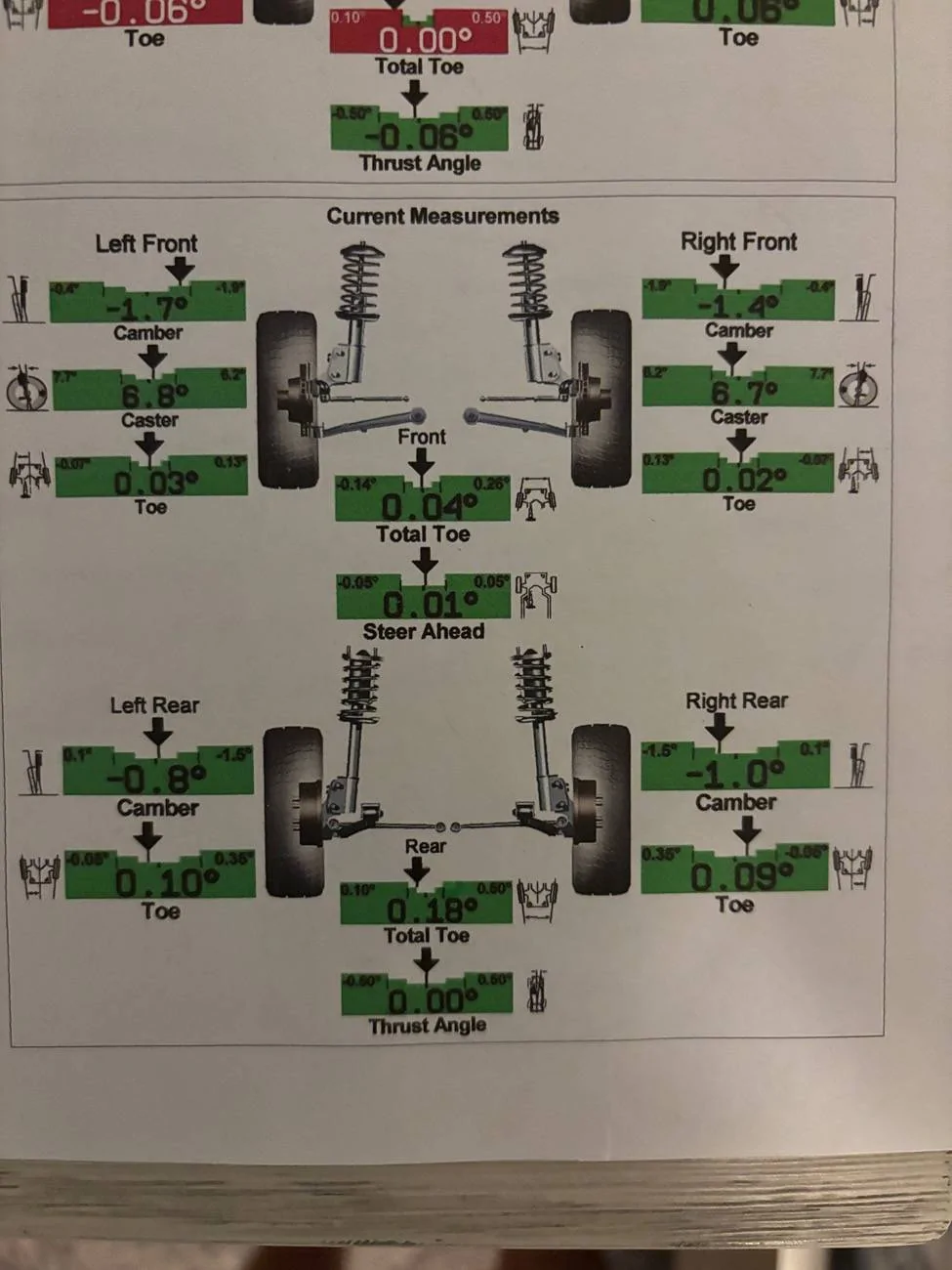
What do you think of these adjustments for the street?

IMG_9973.webp
Sponsored


Top