Sponsored

WSJ/Dan Niel Review (EcoBoost)

martin

Well-Known Member
Joined
Jul 24, 2014
Threads
147
Messages
677
Reaction score
102
Location
New England
Vehicle(s)
Ecoboost; coupe; guard; dark-saddle; MT; PP; Nav;
WSJ/Dan Niel review of eco-boost: nice overview

http://online.wsj.com/articles/the-new-ford-mustang-proves-muscle-cars-arent-dead-1412972392

The New Ford Mustang Proves Muscle Cars Aren’t Dead

Automakers like Ford, Chevy and Dodge have found they can achieve blazing performance and still meet higher environmental standards, writes Dan Neil. Get ready to burn rubber responsibly

IT WASN’T SUPPOSED to be this way. Tighter carbon-emission standards around the world and higher fuel-economy rules in the U.S. were to mean the end of muscle cars, or at least affordable ones. But, pleasant surprise, cars have actually gotten stronger, quicker, faster. Overall, performance is cheaper, more efficient and reliable than ever. It’s the Golden Age of Horsepower, and the horses are eating diet hay.

Do you like acceleration, Johnny? Dodge will sell you a Challenger SRT Hellcat with 707 hp and an eight-speed transmission, a car that will lay down 11-second quarter-mile passes until they turn the track’s floodlights off. A roaring Mopar fever dream. Chevrolet purveys a 580-hp Camaro ZL1 with Recaro seats, six-speed manual and a clutch, offering a top speed of 184 mph. Some exotic European brands are selling “megawatt” cars, with engine outputs of more than 1,341 hp.

All of these cars and engines have one thing in common: forced induction. Instead of breathing at atmospheric pressure like the rest of us, these engines are force-fed air through spooling, high-velocity turbines, either turbochargers or superchargers. Combustion-wise, the effect is like turning a leaf blower on a bonfire.

From Ford to Ferrari, Audi to Volvo, auto makers are being obliged to move to smaller, forced-induction engines to make power while still lowering emissions. As they do, the character, the sinew, even the sound of performance is changing. And nowhere is the effect more striking than in the Ford Mustang, with its 2.3-liter EcoBoost engine. It’s kind of the New Fast.

A latte salute might be in order. The 2015 model represents the sixth generation of Dearborn’s beloved Pony Car and marks the 50th anniversary of America’s budget-style champion (for reference, the base price of an EcoBoost Fastback, $25,170, is a little more than tenfold the face value of what a 1965 Fastback sold for). On a good year Ford will sell 80,000 to 90,000 coupes and convertibles, with 4-, 6-, and 8-cylinder engines, and final assembly in Flat Rock, Mich. The Mustang is bedrock American car culture, from East L.A. to the flatlands of Minnesota.

Ford will export the cars to the demanding European market, and for once, the Mustang is a thoroughly modern automobile. The latest iteration is at last fitted with an independent rear suspension, which Mustang engineers resisted, in favor of a tough, simple live axle design that was good for drag racing (and cheaper, too).

While the Mustang is available with a choice of three engines—including the base 300-hp V6 and a big-brute 435-hp V8—the engine Ford would most like you to take seriously is the thrifty “EcoBoost,” a turbocharged 4 cylinder displacing a mere 2.3 liters, less than half the size of the V8.

A four-banger in a muscle car? Well, a state-of-the-art four-banger—all aluminum, boosted to the stars (18 psi), hugely torquey, with specific power of 135 hp per liter. But still.

This might be a communications challenge. The muscle-car audience is, by its nature, not impressed with nuance. The optics of switching from eight cylinders to four are not intuitive, not quite fully American.
“ Automakers are moving to smaller, forced-induction engines to make power while still lowering emissions. ”

To be clear, in the 50-year history of Mustang, Ford made millions of 4-cylinder Mustangs, starting with the Mustang II redesign of 1974. There was even a brief, interesting experiment with hi-po turbo fours in the 1980s. But for the most part four-cylinder Mustangs were fairly lame ponies, ultimately sold into rental fleet servitude. The EcoBoost is offered as the smart budget-performance option, and it has numbers to back it up: 310 hp and 320 pound-feet of torque.

Is that a lot? Historically, it’s huge. Let’s flip open the Big Book of Mustang History and put our finger on... Here we go: The 1971 Boss 351’s “Cleveland” four-barrel V8 put out 330 All-American horsepower, 370 pound-feet of torque, and all the hydrocarbons you could choke on (visual aid: the “Eleanor” in Hollywood’s original 1974 “Gone in 60 Seconds” was a ‘71 SportsRoof, though not a Boss 351).

This was one of the era’s last monster motors, a piston-powered rock god, a hand-built high-comp 5.7-liter V8 with a big Holley carb, solid-lifter cam, Magnafluxed heads, the works. A four-speed Hurst shifter and 3.91:1 Traction-Lok rear end helped put the Boss 351’s power to the ground in respectable fashion: 0-60 mph in 5.6 seconds and a quarter-mile elapsed-time of 13.9 seconds. All in all, a ground-shaking, tire-baking bit of American mechanical culture, that made an impression on millions.

The gas-sipping Mustang EcoBoost is exactly as quick as beastly Boss 351, within the same 0-60 mph and the quarter-mile times, but using half the number of cylinders and delivering roughly three times the fuel economy (21/32/25 mpg, city/ highway/ combined). This despite the fact that the new Mustang is obliged to carry hundreds of pounds more air bags, computers, catalytic converters and crash structures than the Boss 351 (total=0).

The EcoBoost is really the grass-roots motor-sports choice: It weighs 181 pounds less than the V-8 GT, and most of that weight loss is in the front of the car, improving the weight distribution and handling. Turbo’s are also easily hacked for more power. (Car guys care about such things).

If you’re comparing the new car with icons of the 1960s, all things are not equal, of course. Modern cars are usually quite a bit heavier. But everything else on a modern car is infinitely better: steering, breaking, chassis control. The new Mustang EcoBoost, shod with 19-inch summer radials as part of the performance package, pulls .96g in lateral acceleration, a figure that would have been unthinkable on bias-ply or early radial tires. Braking? Get a load of the Brembos.

Another quality of the New Fast: accessibility. Want to go drag racing? Among the Mustang’s computer-aided features (on the GT) is “Line Lock,” which allows drivers to easily lock the front wheels and spin up the rear tires to generate clouds of tire smoke. It also works in church parking lots.

If you don’t have the time, or tires, to perfect your hole shot down at the drag strip, the Launch Control feature will be happy to execute one for you.

Conclusion: The New Fast is way better than the Old Fast, by the clock, the dyno and the digital numbers at the gas pump. For that you can tip the cap to Ford’s multitude of engineers and designers around the world, trying to keep their jobs.

Alas, nothing comes free. Thanks to turbocharging, the New Fast doesn’t sound quite as satisfying as the Old Fast. Soon to be heard only in collective memory—or at Mustang rallies—is the percussive cadence of a free-breathing V8 at idle, the cold chirr of valve ware, the masculine howl at redline.

In the thermodynamics, these sounds represent the extravagance of lost energy. Turbochargers capture that energy but smother the wondrous, primal sound.

As for the Mustang, you can’t help but admire the symmetry. Fifty years ago it was launched as an affordable, sporty compact with great style and good mileage. The machine is radically different, but the pony is still alive and kicking.
Sponsored
 

Malikona

Well-Known Member
Joined
Aug 29, 2014
Threads
10
Messages
542
Reaction score
11
Location
Denver
Vehicle(s)
R1
Well damn, this is a pretty interesting insight:

"Alas, nothing comes free. Thanks to turbocharging, the New Fast doesn’t sound quite as satisfying as the Old Fast. Soon to be heard only in collective memory—or at Mustang rallies—is the percussive cadence of a free-breathing V8 at idle, the cold chirr of valve ware, the masculine howl at redline.
In the thermodynamics, these sounds represent the extravagance of lost energy. Turbochargers capture that energy but smother the wondrous, primal sound."
 

OppoLock

RWD Addict
Joined
Apr 21, 2014
Threads
43
Messages
3,093
Reaction score
871
Location
St. Petersburg, FL
First Name
Sean
Vehicle(s)
'15 GT, '20 GT350
Vehicle Showcase
1
Well damn, this is a pretty interesting insight:

"Alas, nothing comes free. Thanks to turbocharging, the New Fast doesn’t sound quite as satisfying as the Old Fast. Soon to be heard only in collective memory—or at Mustang rallies—is the percussive cadence of a free-breathing V8 at idle, the cold chirr of valve ware, the masculine howl at redline.
In the thermodynamics, these sounds represent the extravagance of lost energy. Turbochargers capture that energy but smother the wondrous, primal sound."
It just sounds like a pretentious way of saying "turbocharged engines like the EcoBoost are efficient and powerful but don't sound as good as N/A engines." His description went beyond the point of painting a picture to sounding like he just went through a thesaurus for every word.
 

TampaBear67

Well-Known Member
Joined
Sep 29, 2013
Threads
12
Messages
1,436
Reaction score
21
Location
Tampa, Florida
Vehicle(s)
Cool Blue 07 Accord EX-L 2.4, DOHC, iVTEC Coupe
Great Article. Kinda puts things in a different perspective.
 

DeColores

Well-Known Member
Joined
Aug 29, 2014
Threads
15
Messages
272
Reaction score
11
Location
Snow Belt
Vehicle(s)
DIB DD V6 w UltraGripICE THULE Chains
Sounds like big government guy, knowing what's best for us, the old way is dead etc...
 

Sponsored

xenolon

Active Member
Joined
Jul 16, 2014
Threads
1
Messages
26
Reaction score
0
Location
Lansing, MI
Vehicle(s)
2015 EB Premium
WSJ/Dan Niel eco-boost review

Well damn, this is a pretty interesting insight:

"In the thermodynamics, these sounds represent the extravagance of lost energy. Turbochargers capture that energy but smother the wondrous, primal sound."


The 2014 Formula 1 season brought in new rules: 1.6L V6 engines with turbos and regenerative braking with hybrid electric systems. The previous rules required a naturally aspirated 2.4L V8. All anybody did for the first 3 or 4 races was complain that the cars were too quiet. People were complaining that they could actually hear tire squeal over the sound of the engines. The same thing happened in 2006 when the rules put an end to the V10-V12 era.

The complaining has pretty much stopped. The cars are still crazy fast (although not as fast as previous years, mostly due to restrictions in downforce), the racing is as exciting as it's been in years, and the cars are more efficient than they've ever been.

In the end, the future means it's not about the configuration of your engine, but the amount of vroom and zoom it gives you.

From Snow Crash, one of my favorite novels:
"He twists up the throttle once and feels, but does not hear, the power of the engine. This baby is so efficient it doesn't waste power by making noise."
 

Malikona

Well-Known Member
Joined
Aug 29, 2014
Threads
10
Messages
542
Reaction score
11
Location
Denver
Vehicle(s)
R1
The 2014 Formula 1 season brought in new rules: 1.6L V6 engines with turbos and regenerative braking with hybrid electric systems. The previous rules required a naturally aspirated 2.4L V8. All anybody did for the first 3 or 4 races was complain that the cars were too quiet. People were complaining that they could actually hear tire squeal over the sound of the engines. The same thing happened in 2006 when the rules put an end to the V10-V12 era.

The complaining has pretty much stopped. The cars are still crazy fast (although not as fast as previous years, mostly due to restrictions in downforce), the racing is as exciting as it's been in years, and the cars are more efficient than they've ever been.

In the end, the future means it's not about the configuration of your engine, but the amount of vroom and zoom it gives you.

From Snow Crash, one of my favorite novels:
"He twists up the throttle once and feels, but does not hear, the power of the engine. This baby is so efficient it doesn't waste power by making noise."
Exactly - sound is a form of energy. Exhaust sound is that energy leaving your tailpipes. Just listen to a NA 5.0 drag racing compared to a supercharged 5.0. The NA sounds like a monster, but the super is faster (obviously). I had never really though of it this way before but it really does put things in a new perspective.

Big government type?! ... I really don't think he was trying to make a political statement. And he writes for the WSJ so if he were, I don't think it would be 'big government' lol.
 

doulos4jc

......looking^
Joined
May 8, 2014
Threads
101
Messages
2,006
Reaction score
318
Location
Maryland
Vehicle(s)
2015 Turbo Mustang
From Snow Crash, one of my favorite novels:
"He twists up the throttle once and feels, but does not hear, the power of the engine. This baby is so efficient it doesn't waste power by making noise."
stealing this :thumbsup:
 

mustang#16

Well-Known Member
Joined
May 21, 2014
Threads
19
Messages
322
Reaction score
90
Location
Dallas, TX
Vehicle(s)
2015 Mustang GT
Is that a lot? Historically, it’s huge. Let’s flip open the Big Book of Mustang History and put our finger on... Here we go: The 1971 Boss 351’s “Cleveland” four-barrel V8 put out 330 All-American horsepower, 370 pound-feet of torque, and all the hydrocarbons you could choke on (visual aid: the “Eleanor” in Hollywood’s original 1974 “Gone in 60 Seconds” was a ‘71 SportsRoof, though not a Boss 351).
This was a well-written article. I've lived and breathed Mustangs since I was a teenager and thought I knew just about all the trivia there was to know about them. This article just goes to prove we never stop learning if we listen (or read in this case). I love the first (1974) Gone In 60 seconds movie. It has some of the best driving of any movie, in my opinion. My first car was a 1971 Mustang and I know the visual cues of the 1971-73 models well. I've always thought the car used in the movie was a 1973. But, lo and behold, the WSJ author is correct! They are 1971s but with facelifted 1973 grills!

If you haven't seen the movie, here it is on Youtube: [ame="[MEDIA=youtube]GgGQa2AtvT0[/MEDIA]"]

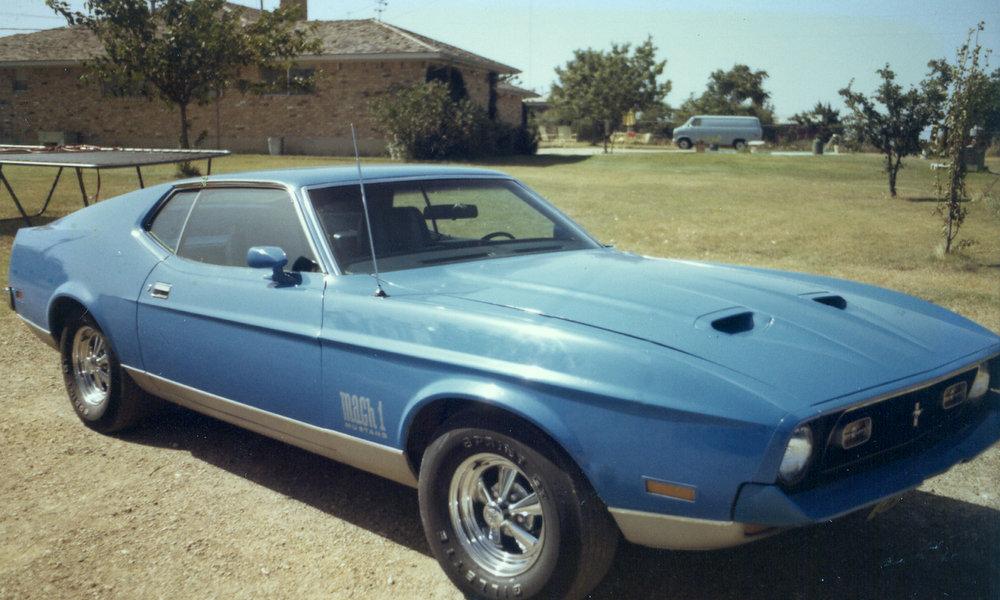
Also, here is a photo of my first car, a 1971 Grabber Blue Mach 1 Mustang with the 351C V8:
1971_mustangr.jpg
 

Sponsored

Devon

Well-Known Member
Joined
Oct 19, 2013
Threads
22
Messages
269
Reaction score
5
Location
43.700° N, 79.400° W
Vehicle(s)
TBD
Not one of Dan's better reviews. He provides zilch on the handling ("better" is all he offers), ride, interior.... I almost wonder if he even drove the thing....
 

Dirtleg

BoostCreep
Joined
May 24, 2014
Threads
34
Messages
481
Reaction score
77
Location
Cloverdale Va
First Name
Greg
Vehicle(s)
15' EB Prem PP, 07' GT (track Car), 01' RC51, 16" S1000XR
This was a well-written article. I've lived and breathed Mustangs since I was a teenager and thought I knew just about all the trivia there was to know about them. This article just goes to prove we never stop learning if we listen (or read in this case). I love the first (1974) Gone In 60 seconds movie. It has some of the best driving of any movie, in my opinion. My first car was a 1971 Mustang and I know the visual cues of the 1971-73 models well. I've always thought the car used in the movie was a 1973. But, lo and behold, the WSJ author is correct! They are 1971s but with facelifted 1973 grills!

If you haven't seen the movie, here it is on Youtube:

Also, here is a photo of my first car, a 1971 Grabber Blue Mach 1 Mustang with the 351C V8:
Correction on the movie. That's the newer Hollywood remake.
Here is the original.
[ame="[MEDIA=youtube]tbiQPIxRDK0[/MEDIA]"]
It has tons more character and the insane 45? minute chase scene.
 

Old Car Guy

Well-Known Member
Joined
Oct 1, 2014
Threads
80
Messages
1,095
Reaction score
446
Location
WV.
First Name
John
Vehicle(s)
GT350 Tech Pack. AG Black Roof Black Stripes G3597
Correction on the movie. That's the newer Hollywood remake.
Here is the original.

It has tons more character and the insane 45? minute chase scene.
This is one of the best B Moves made for Car Chase it was all filmed in Long Beach Calif, Torrance Calif...... The movie starts out a little slow, but the Cars Chase it one of the best ever made! Yes even better then Bullet, and yes I did like that movie very much! The newer Hollywood remake is not Squat, to the this Original Gone in 60 seconds.............. :ford:

Take time to see it! :shocked:
 

mustang#16

Well-Known Member
Joined
May 21, 2014
Threads
19
Messages
322
Reaction score
90
Location
Dallas, TX
Vehicle(s)
2015 Mustang GT
Correction on the movie. That's the newer Hollywood remake.
Here is the original.

It has tons more character and the insane 45? minute chase scene.
No correction needed. Did you click on my link? The link I provided is to the original 1974 Halicki film. I've seen the original many times :) Also, the link I provided does not have the annoying captions at the bottom :)

Perhaps the youtube thumbnail of the remake caused the confusion?
Sponsored


Top