K4fxd
Well-Known Member
- Thread starter
- #1
Gen 2 Coyote (2017 GT, 5.0L) — VCT / Cam-Timing Tuning Findings
Platform: 2017 Mustang GT, Gen 2 Coyote 5.0L, MAF-based, HP Tuners + PCMtec Fuel: Costco 93 (E10) Method: Street pulls, 2nd gear (validated for resolution + full load), datalogged at 50–67 Hz Goal: Understand and optimize the Ti-VCT Optimum Power cam schedules; evaluate a 2018 F-150 truck intake manifold on the Gen 2 long-block.
This is a shared-knowledge writeup of what I found through structured, one-variable-at-a-time testing. Numbers are from my own datalogs on my combo — treat as a starting reference, verify on your own car. Your mileage will vary with heads, cam, manifold, and fuel.
KEY FINDINGS (the short version)
CAM TIMING REFERENCE (Gen 2 command frame)
Base valve events (from tune): IVO 340, IVC 239, Intake Max −20, EVC 369, Exhaust Max 50.
Gen 2 intake phaser: parks at 0, commands −20 advance / +30 retard (50° total travel, bidirectional).
.050" duration: ~211° both cams (from mustang6g/SVT data; the "260/263" in some spec guides is seat/advertised timing mislabeled as .050", not real .050").
MY BEST INTAKE SCHEDULE (Optimum Power, IVO angle vs RPM)
Negative = advance. Derived from airmass + MAF-to-load VE ratio testing.
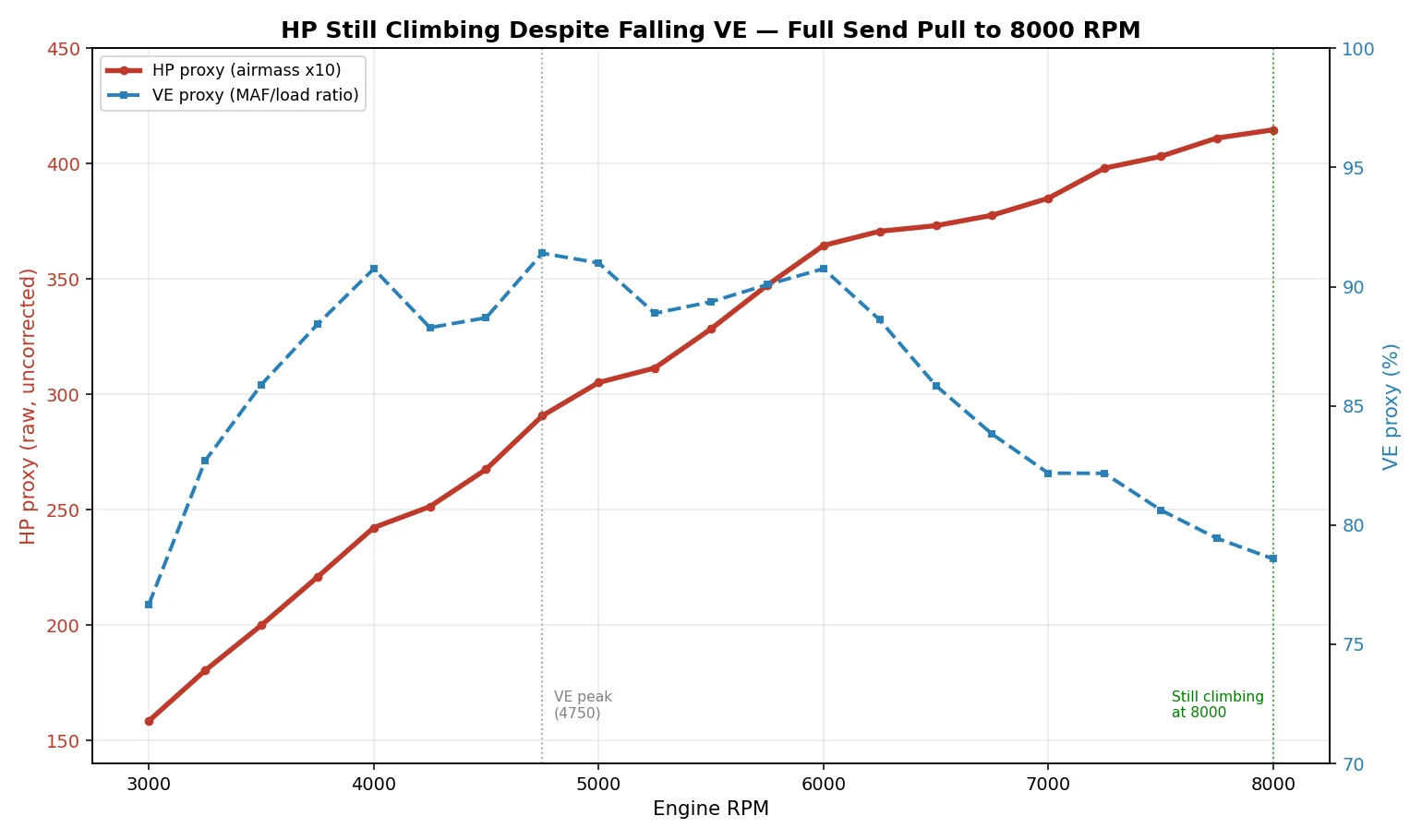
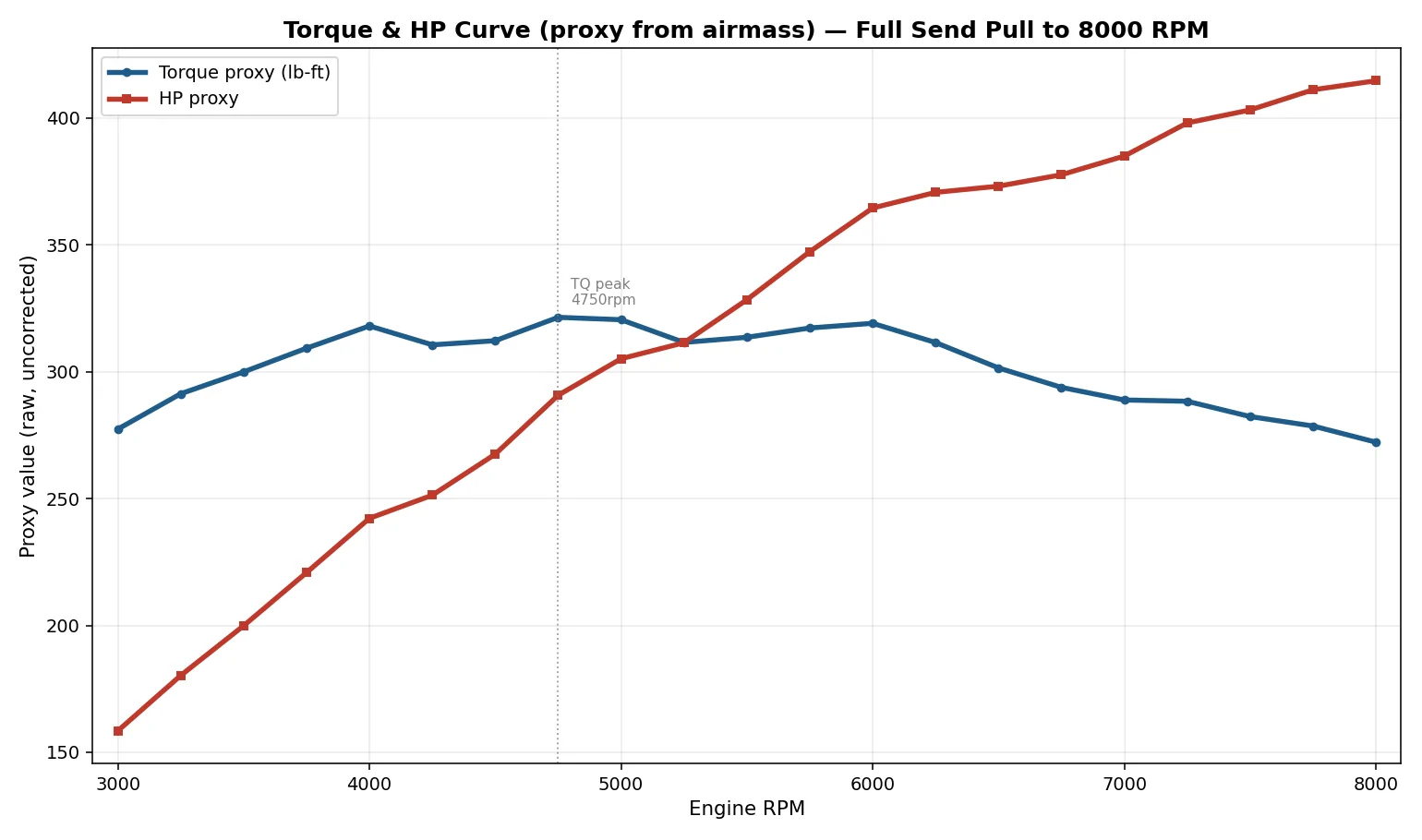
Logic: hold advance through the torque zone (gain), release through the forgiving transition, progressively retard up top for ram filling. This schedule made airmass climb to the rev limiter with throttle open and timing being ADDED (no knock) — the engine wants to rev.
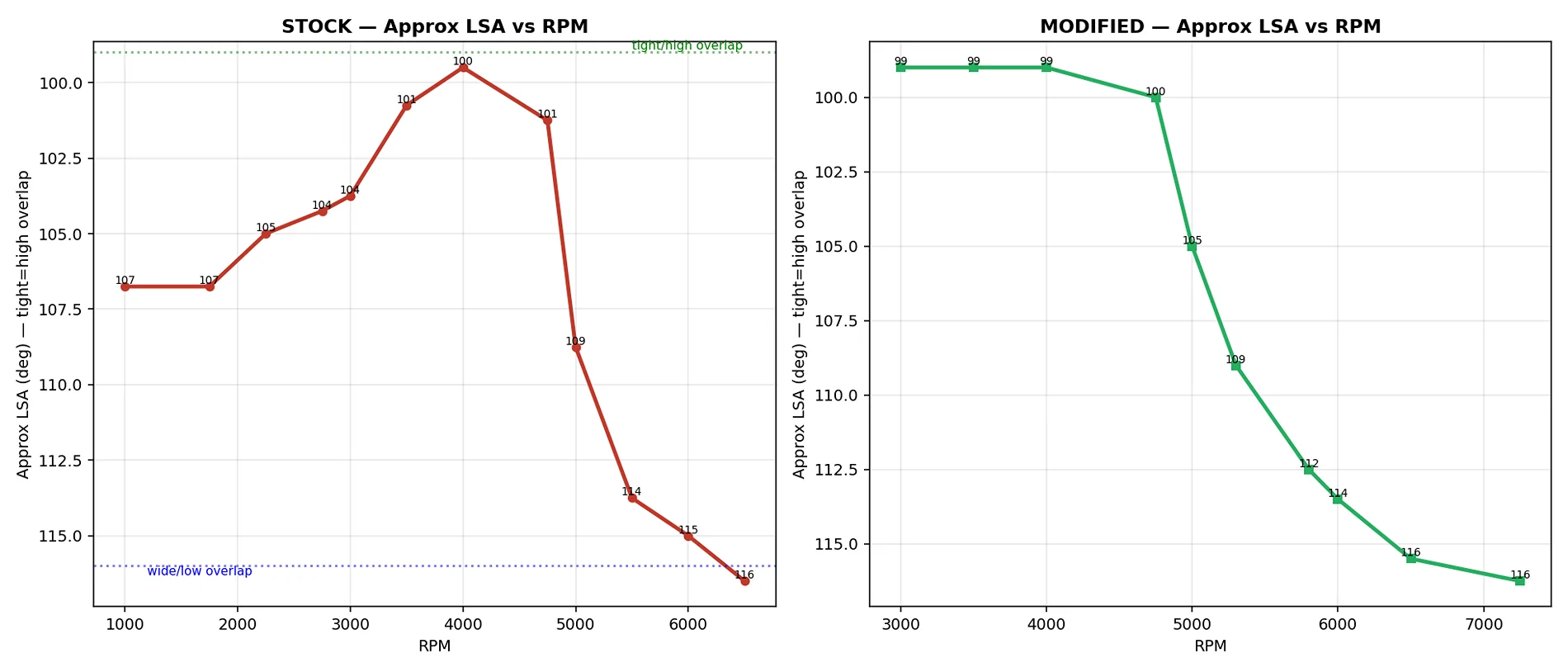
Notable: this independently landed very close to the verified GT350 (5.2 Voodoo) factory OP intake schedule. Two different approaches (my street airmass logging vs Ford's development) converged on nearly the same intake curve. Good confirmation the strategy is sound.
2018 TRUCK MANIFOLD ON GEN 2 — NOTES
METHOD NOTES (what made the data trustworthy)
WHAT I'D TELL SOMEONE STARTING THIS
Shared freely. Verify on your own combo — this is my data on my car, offered as a starting point and a method, not gospel. Corrections and additions welcome.
Platform: 2017 Mustang GT, Gen 2 Coyote 5.0L, MAF-based, HP Tuners + PCMtec Fuel: Costco 93 (E10) Method: Street pulls, 2nd gear (validated for resolution + full load), datalogged at 50–67 Hz Goal: Understand and optimize the Ti-VCT Optimum Power cam schedules; evaluate a 2018 F-150 truck intake manifold on the Gen 2 long-block.
This is a shared-knowledge writeup of what I found through structured, one-variable-at-a-time testing. Numbers are from my own datalogs on my combo — treat as a starting reference, verify on your own car. Your mileage will vary with heads, cam, manifold, and fuel.
KEY FINDINGS (the short version)
- Exhaust cam timing does essentially NOTHING for airflow on this combo. Verified three ways: added overlap (no gain), reverted to stock (no gain), and it matches tuner consensus. The exhaust is a dead lever for WOT airflow on a cross-plane Coyote with these manifolds. (It still affects idle/emissions/NVH — just not WOT airmass.)
- Intake cam ADVANCE is the working lever, but only below a crossover ~4500 rpm. Holding the intake at full advance (−20) through the torque zone (3500–4250) gained measurable airmass. Holding full advance PAST ~4750–5000 lost airmass up top — the engine wants the intake to swing to RETARD up high for late-IVC "ram" cylinder filling.
- The VE crossover is ~4500 rpm. Below it: advance wins (early IVC, higher effective compression, more midrange fill). Above it: retard wins (late IVC ram effect). A "hybrid" schedule — hold advance to ~4500, then progressively retard up top — beat both stock and full-advance across the ENTIRE rpm range.
- The transition zone (4500–5300) is FORGIVING. A locked −8 probe made the same airmass as a lagged ~−12. Anywhere in that range works about the same; what does NOT work is holding −20 too long. Good news: you don't need perfect cam tracking through the transition.
- Phaser slew lag is real in low gears. In 2nd gear the intake phaser lagged commanded position by up to ~8° through steep transitions (delay of ~250–300 rpm before it starts moving, then ~5° per ~150 rpm). Lag shrinks in higher gears (slower rpm climb). Because the transition zone is forgiving, the lag doesn't cost measurable power — but it means a schedule dialed in 2nd gear behaves slightly differently in 3rd/4th.
- Exhaust cam schedule wastes phaser motion. Stock commands a whipsaw (e.g., 12→21→16 across 3000–4000) the phaser can't even execute in 2nd gear, for zero airflow benefit. Flattening the exhaust to a steady ~14 is airflow-neutral AND mechanically calmer (less pointless slewing).
- Inferred Octane pegged at 91 while running 93. The ECM assumes worse fuel than you're feeding it, leaving spark headroom unused. Potential safe timing to capture by correcting the octane assumption (verify at WOT — cruise ≠ WOT knock behavior).
CAM TIMING REFERENCE (Gen 2 command frame)
Base valve events (from tune): IVO 340, IVC 239, Intake Max −20, EVC 369, Exhaust Max 50.
Gen 2 intake phaser: parks at 0, commands −20 advance / +30 retard (50° total travel, bidirectional).
- Gen 1 was single-direction (full 50° one way). Gen 2/3 split it: 20 adv + 30 ret.
.050" duration: ~211° both cams (from mustang6g/SVT data; the "260/263" in some spec guides is seat/advertised timing mislabeled as .050", not real .050").
MY BEST INTAKE SCHEDULE (Optimum Power, IVO angle vs RPM)
Negative = advance. Derived from airmass + MAF-to-load VE ratio testing.
| RPM | Intake |
|---|---|
| 2500 | −11 |
| 3000 | −20 |
| 4750 | −18 |
| 4900 | −12 |
| 5100 | −8 |
| 5300 | 0 |
| 5800 | +7 |
| 6250 | +11 |
| 6500 | +13 |
| 7000 | +15 |
| 7250 | +15 |
Logic: hold advance through the torque zone (gain), release through the forgiving transition, progressively retard up top for ram filling. This schedule made airmass climb to the rev limiter with throttle open and timing being ADDED (no knock) — the engine wants to rev.
Notable: this independently landed very close to the verified GT350 (5.2 Voodoo) factory OP intake schedule. Two different approaches (my street airmass logging vs Ford's development) converged on nearly the same intake curve. Good confirmation the strategy is sound.
2018 TRUCK MANIFOLD ON GEN 2 — NOTES
- Truck manifold peak airmass on my Gen 2: ~40 lb/min with the dialed intake schedule (~400 raw / ~470+ crank hp equivalent, DA-corrected). NOT a low-flow manifold — right in healthy Coyote territory.
- Truck cal is Speed Density (MAP); the car is MAF. The cam strategy transfers as a hypothesis; the airflow calibration does NOT (different sensing architecture).
- Truck OP exhaust runs a big midrange overlap spike (38° @ 3000). GT350 runs 49.5° @ 3500. Both are "big midrange overlap" manifolds — but on my combo, exhaust did nothing for airflow, so I didn't chase it.
- Long-block deltas (Gen 2 car vs Gen 3 truck): 11:1 vs 12:1 compression, 200cc vs 205cc runners, 1.468" vs 1.484" intake valve, 0.511" vs 0.551" lift, 7000 vs 7500 redline. The 205-vs-200 runner match means minimal manifold-to-port step (forgiving direction) for an unported swap.
METHOD NOTES (what made the data trustworthy)
- MAF reads true across the manifold swap — fuel trims stayed flat (STFT ±1%, LTFT −1 to −2%), because the inlet tract (MAF housing, tube) is fixed and upstream of the manifold. Watch STFT for MAF integrity; if it develops rpm-localized bias after an intake swap, the sensor's being disturbed.
- Density altitude correction ("poor-man's dyno correction"): compute DA from local METAR (temp/dewpoint/altimeter) at run time; normalize airmass/power between sessions by density ratio. A 1,500 ft DA swing is worth several % power — bigger than the cam deltas you're chasing, so correct for it or match conditions.
- Match logged air temp between compared pulls. Heat soak (especially from more cruise before a pull) warms intake air and confounds comparisons.
- 2nd gear is fine for data — full load, good resolution. Higher gears reduce phaser lag but add speed/risk.
- Log airmass (lb/min) as the verdict — it's a direct measurement. Same-session pulls need no correction; cross-session needs DA normalization.
- MAF-to-load ratio (measured airflow ÷ theoretical) is a useful VE / MAF-integrity check — shows where breathing efficiency peaks and confirms the MAF reads true.
WHAT I'D TELL SOMEONE STARTING THIS
- Log real airmass and treat it as truth. Don't trust a scanner HP gauge without verifying its math (mine had a unit-scaling bug reading ~30% low).
- One variable at a time. Distinguish what you've verified (your own data) from what you trust (secondhand).
- Exhaust cam: don't waste effort chasing it for airflow. Check it, then leave it flat.
- Intake cam: hold advance in the torque zone, retard up top. Find your VE crossover (~4500 on mine).
- Correct for weather (DA) or you'll chase atmospheric ghosts.
- The phaser lags in low gears — but the transition zone is forgiving, so don't over-obsess about perfect tracking there.
Shared freely. Verify on your own combo — this is my data on my car, offered as a starting point and a method, not gospel. Corrections and additions welcome.
Sponsored