Sponsored

Brake pad questions

RedStallion27

Member
Joined
Jun 2, 2026
Threads
3
Messages
18
Reaction score
10
Location
IL
Vehicle(s)
2016 GT
2016 GT performance pack used for HPDE and occasional street driving (500-1000 miles per year).

Intermediate skill level. 200TW tires. Brembo DOT4 fluid. Stock pads lose a little bite near the end of my sessions.

1. At what thickness do you replace the pads?
2. Would G-Loc R10, R12, or R16 front pads make the most sense for how I use the car?
3. Can I keep using stock rear pad replacements or should those be upgraded at the same time?

Thank you.
Sponsored

 

NightmareMoon

Well-Known Member
Joined
Nov 22, 2015
Threads
62
Messages
7,122
Reaction score
6,401
Location
Austin
Vehicle(s)
2016 Mustang GT PP w/ Voodoo
Vehicle Showcase
1
If you swap pad compounds, do front and rear together. You have to keep the brake balance and dissimilar pads will mess that up. Slightly higher temp front pads are fine but OEM rears and track fronts are not.

Consider swapping at 50% pad thickness for track. Why throw away so much pad you ask? 1) Because pad thickness also provides a thermal barrier. Thin pads will transmit more heat through to the brake fluid and will boil it a lot faster. 2) because track wear can surprise you and running out of pads during a session is Real Bad. So pad thickness is valualble insurance against two problems.

If the brake pedal effort gets higher for similar stopping distance, thats consistent with pad fade, so worth upgrading pad conpounds. If the brake pedal gets squishier, thats fluid, upgrade fluid and/or swap it more often. If you’re upgrading pads you should probably run a more serious brake fluid too. Track fluids have higher boiling points but they can absorb water faster and thus degrade performance faster, so if you’re on a track brake fluid, you have to change it more regularly (regardless if you’re driving street, track, or if its basically just sitting)

So probably yea you should consider upgrading pads if you are having pad fade. The OEM brembo pads are quite good for street with a bit of track work, but they have their limits once you start pushing hard enough.
 

GTP

Deutsche Pony
Joined
May 27, 2015
Threads
264
Messages
6,051
Reaction score
4,002
Location
Indy
Website
www.BambergAudio.com
First Name
Philip
Vehicle(s)
2019 GT PP1 A10 Outrageous Orange HPDE mods
@NightmareMoon has good advice as always.

50% remaining thickness of 10mm (new) pad material (includes the groove depth) is 5mm. Subtract the groove depth and the remaining "operating" pad thickness is 5-3=2mm. That is pretty much a good time to throw them out. Or perhaps throw them in your kit as emergency, half-day spares.

I am a bang-for-the-buck guy (= kinda cheap). I run take-off OEM Ferodo pads on my GT350 brakes. I find them easy to modulate and brake linearly. I used to log thickness a lot, and I recall that they wear about 1mm per track weekend. That is about a season for me.

I stopped measuring total thickness and now I simply stick my 6" metric ruler into the center groove and read the operating thickness directly. (When the center groove is gone it is time to replace pads. But this rule of thumb is for street use, not track.)

Compressing time during braking is an intermediate/advanced skill, so as you improve in this area, pads wear faster and run hotter. Rotors develop micro cracks.

If I go to Road America with 3 long straights, I make sure I am running new-ish pads and not old-ish pads. Gingerman has one 120mph straight, then 50mph 90-degree turn, then another 100mph straight. IOW, not much time for brakes to cool. And four other brake-from-80/90mph turns. So that track heats up my brakes too. NCM has three fast sections, and narrow off-track runoff, so the risk is higher IMO. I don't run old-ish pads there either.
 

Optimum Performance

Well-Known Member
Gold Sponsor
Joined
Mar 13, 2016
Threads
62
Messages
1,849
Reaction score
1,409
Location
Titusville, Florida
Website
www.facebook.com
First Name
Tommy
Vehicle(s)
'15 GT PP
2016 GT performance pack used for HPDE and occasional street driving (500-1000 miles per year).

Intermediate skill level. 200TW tires. Brembo DOT4 fluid. Stock pads lose a little bite near the end of my sessions.

1. At what thickness do you replace the pads?
2. Would G-Loc R10, R12, or R16 front pads make the most sense for how I use the car?
3. Can I keep using stock rear pad replacements or should those be upgraded at the same time?

Thank you.
R10 fronts, R8 rear G-LOCs. I put them on our shop car 10 years ago. Great compromise for improved heat capacity while not being ridiculous on the street. I have data from Daytona, 1.45g's from 150mph into turn one with a Stock S550 Performance pack on a 340 TW tire. They work well, can you overheat them? Absolutely. Anything is possible if you try hard enough. We have been street driving them for a decade now, not winning any money at an HPDE so why make it hard to show up to a track day always ready, then drive to work the next day.
 

John S

Well-Known Member
Joined
Jul 26, 2022
Threads
45
Messages
659
Reaction score
486
Location
Novi, Michigan
First Name
John
Vehicle(s)
2022 Mach 1 HP
show up to a track day always ready, then drive to work the next day.
How does the R10/R8 combo compare with the OEM pads used on Brembo/Mach 1? I'm switching to Castrol fluid and OP's titanium pad insulators as a starting point for my introduction to HPDE events on my PS4S shoed Mach 1 HP. Tires, pads, and rotors are consumables so until I advance with better driving skills, I figure OEM pads with street tires is a balanced approach before switching to R10/R8 with stickier tires?
 

Sponsored

Optimum Performance

Well-Known Member
Gold Sponsor
Joined
Mar 13, 2016
Threads
62
Messages
1,849
Reaction score
1,409
Location
Titusville, Florida
Website
www.facebook.com
First Name
Tommy
Vehicle(s)
'15 GT PP
R10/R8 is our go to for anyone stepping up from OEM pads on a street car. The internet will tell you to jump to a R16. It usually ends badly in our experience because people don't let their coaches run laps in their cars because they all think they a Dean Martin or Billy Johnson.

Every time you move to any R Compound pad from OEM move up progressively. You will be generating more heat so re-learning braking points is critical. Unless you add cooling you will smoke the pads. We have had Customers smoke a set of RST3's in a practice session at Sebring. Pagids are 2 sets of G-LOC's and lunch money.

If you know what you are doing you can go with R12/R10's but they are unhappy on the street because they need heat to work. That said we have had Customers run R18's dropping their kids off at school :cwl:
 
OP
OP

RedStallion27

Member
Joined
Jun 2, 2026
Threads
3
Messages
18
Reaction score
10
Location
IL
Vehicle(s)
2016 GT
R10/R8 is our go to for anyone stepping up from OEM pads on a street car.

If you know what you are doing you can go with R12/R10's but they are unhappy on the street because they need heat to work.
Even if 80% of the street car’s drive time is spent driving to and on the track?

How are the R12/R10 unhappy on the street? Just noisy or are there other detrimental effects?
 

Optimum Performance

Well-Known Member
Gold Sponsor
Joined
Mar 13, 2016
Threads
62
Messages
1,849
Reaction score
1,409
Location
Titusville, Florida
Website
www.facebook.com
First Name
Tommy
Vehicle(s)
'15 GT PP
Even if 80% of the street car’s drive time is spent driving to and on the track?

How are the R12/R10 unhappy on the street? Just noisy or are there other detrimental effects?
Yes, all of the above. If its mostly a track car you will be fine. Cold racing compounds will smear, make noise and wear if operated below their intended operating temperature. It can take a session to clean up the transfer layer if they have been subject to extended low temperature braking.

We always err on the side of less is more. We never know the skill level or expectations. This post was based on moving from Stock pads, so responses are aimed at that.
 

allfivefifty

Well-Known Member
Joined
Jul 1, 2025
Threads
2
Messages
62
Reaction score
123
Location
Florida
First Name
Jaime
Vehicle(s)
2022 Mach 1 HP
Solid advice here. I think you get the point that there is some compromise. One thing that needs to hammered home is that the rotor wear. It seems that street pads produce less rotor wear, but may not be as great on the track; however, race compounds seem to wear rotors at "cold" temps. So I'm thinking of upgrading rotors with titanium heat shields, and keeping the OEM pads to avoid rotor wear. Too much work to swap them at the track unless you swap the front only which is not advisable. I haven't had issues w/ the M1 OEM ones (p/n MR3Z2001H $261) at HPDE. It seems you might be using the GT ones which are different compound (p/n FR3Z2001N $168) and about $100 less for the front set. If you are getting fading and want to track it down, try getting some temperature paint and put it on the unfinished surfaces to see what temps you are getting on rotor and calipers/pads.
 

Autojvnkie

Member
Joined
Jun 28, 2026
Threads
0
Messages
11
Reaction score
10
Location
New York
Vehicle(s)
2025 Mustang
2016 GT performance pack used for HPDE and occasional street driving (500-1000 miles per year).

Intermediate skill level. 200TW tires. Brembo DOT4 fluid. Stock pads lose a little bite near the end of my sessions.

1. At what thickness do you replace the pads?
2. Would G-Loc R10, R12, or R16 front pads make the most sense for how I use the car?
3. Can I keep using stock rear pad replacements or should those be upgraded at the same time?

Thank you.
In terms of Thickness: Replace track pads at 3–4 mm of friction material remaining. Do not start a 20-minute session with less than 5 mm, as they will wear significantly faster under heavy braking.
And for the G-Loc Compound: Go with the R10 or R12. The R10 is ideal for intermediate drivers on 200TW tires, offering great modulation and high heat resistance without being excessively hard on rotors. The R12 provides higher initial bite and fade resistance, but creates more noise and dust on the street. The R16 is too aggressive for an intermediate on street tires.
 

Sponsored

NightmareMoon

Well-Known Member
Joined
Nov 22, 2015
Threads
62
Messages
7,122
Reaction score
6,401
Location
Austin
Vehicle(s)
2016 Mustang GT PP w/ Voodoo
Vehicle Showcase
1
Even if 80% of the street car’s drive time is spent driving to and on the track?

How are the R12/R10 unhappy on the street? Just noisy or are there other detrimental effects?
Noise can vary from none to nearly constant squeaking, and dust levels are extreme. Then add the wear issues and its best to swap them out for street pads.

Driving to and from the track is one thing, daily driving on them is another.
 

Optimum Performance

Well-Known Member
Gold Sponsor
Joined
Mar 13, 2016
Threads
62
Messages
1,849
Reaction score
1,409
Location
Titusville, Florida
Website
www.facebook.com
First Name
Tommy
Vehicle(s)
'15 GT PP
Solid advice here. I think you get the point that there is some compromise. One thing that needs to hammered home is that the rotor wear. It seems that street pads produce less rotor wear, but may not be as great on the track; however, race compounds seem to wear rotors at "cold" temps. So I'm thinking of upgrading rotors with titanium heat shields, and keeping the OEM pads to avoid rotor wear. Too much work to swap them at the track unless you swap the front only which is not advisable. I haven't had issues w/ the M1 OEM ones (p/n MR3Z2001H $261) at HPDE. It seems you might be using the GT ones which are different compound (p/n FR3Z2001N $168) and about $100 less for the front set. If you are getting fading and want to track it down, try getting some temperature paint and put it on the unfinished surfaces to see what temps you are getting on rotor and calipers/pads.
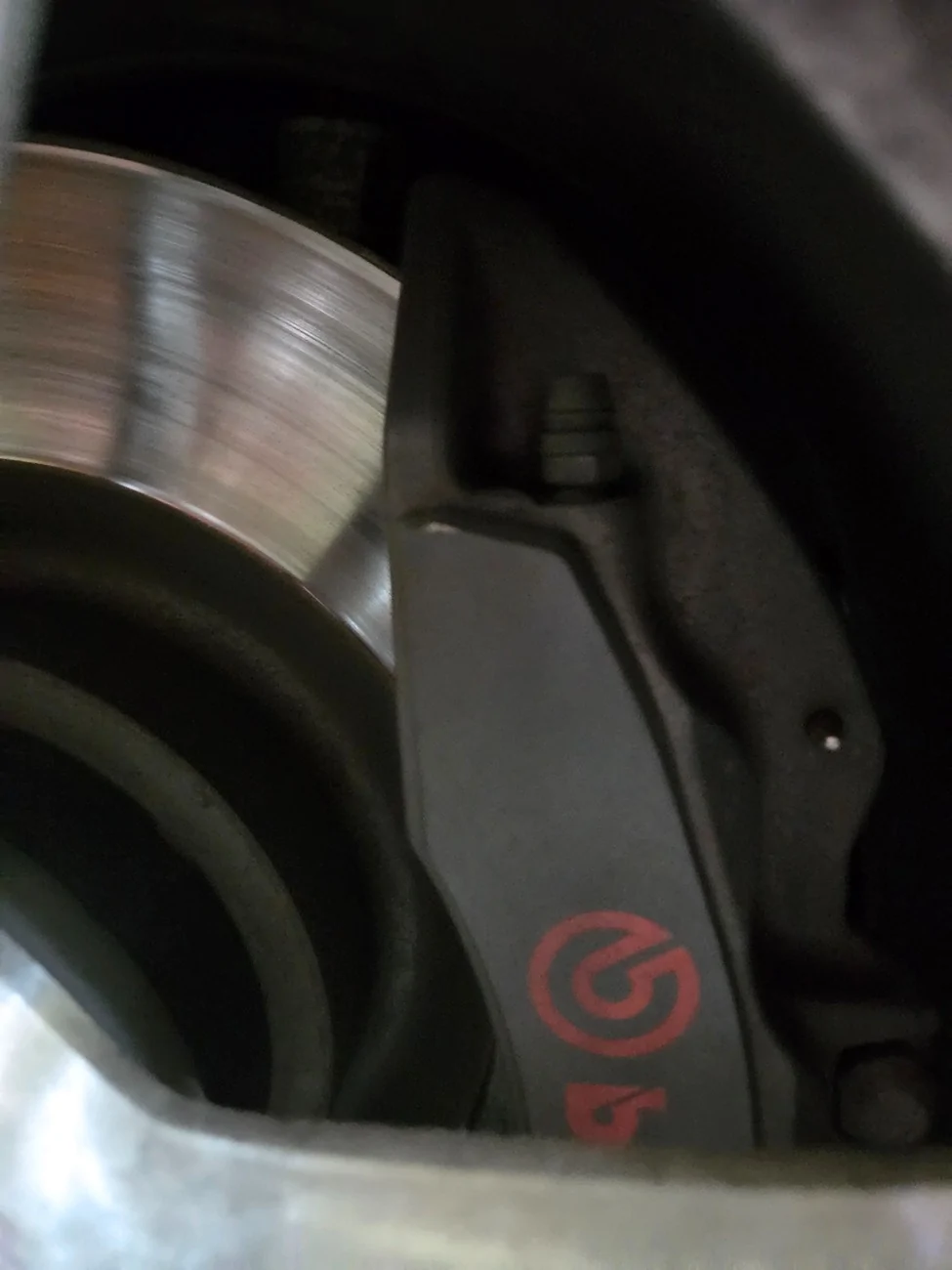
11 years and 22K miles, 10 years with G-LOC R10's. These are the rotors the car was delivered with in 2015. R10's are more rotor friendly than the stock pads IMO.

20260718_124433.webp
Sponsored


Top