Sponsored

What max RPM are you all you track guys shifting at???

Hack

Well-Known Member
Joined
Nov 26, 2014
Threads
86
Messages
12,810
Reaction score
8,226
Location
Minneapolis
Vehicle(s)
Mustang, Challenger
When I went to the Track Attack the instructors told us to hold it on the limiter on 2 of the straights, if I recall correctly. After I heard that I was a lot less concerned about potentially hitting the limiter every once in a while in my personal car. At the Track Attack I just kept the throttle pinned on the end of those straights and let the engine computer take care of holding rpm at the limit. The car had no problems and my assumption is that was being done by most of the people who drove it at the Track Attack.

On track when I owned a GT350 I shifted by sound rather than use the lights. Probably right around 8,000 rpm or so. Every once in a while I hit the limiter before shifting, but not very often.
Sponsored
 

Jason304

Well-Known Member
Joined
May 17, 2020
Threads
2
Messages
173
Reaction score
409
Location
West Virginia
First Name
Jason
Vehicle(s)
2020 Shelby GT350 2016 Ram 2500 2012 Jeep Wrangler Rubicon
Shift light set at 8000. Haven’t yet had mine on a track, but I usually shift between 7800 and 8000 when traffic and road conditions allow.
 

friedmud

Well-Known Member
Joined
Jan 25, 2021
Threads
7
Messages
289
Reaction score
373
Location
Idaho
Vehicle(s)
2019 Mustang GT
I see a couple of people mentioning things about peak power, etc. I just thought I would toss in here that physics-wise it is almost always “best” for acceleration (and will be in all Mustangs) if you shift at the redline (not taking into account whatever is happening to the track).

Engineering Explained has a good explanation of why here:


(Note: I am not a track guy - just a local engineer trying to shed light on the physics. I completely understand that on a track there are many reasons to shift earlier, etc.)
 

AdamIsAdam

Well-Known Member
Joined
Jul 22, 2018
Threads
11
Messages
410
Reaction score
251
Location
Long Island
First Name
Adam
Vehicle(s)
2018 Shelby GT350
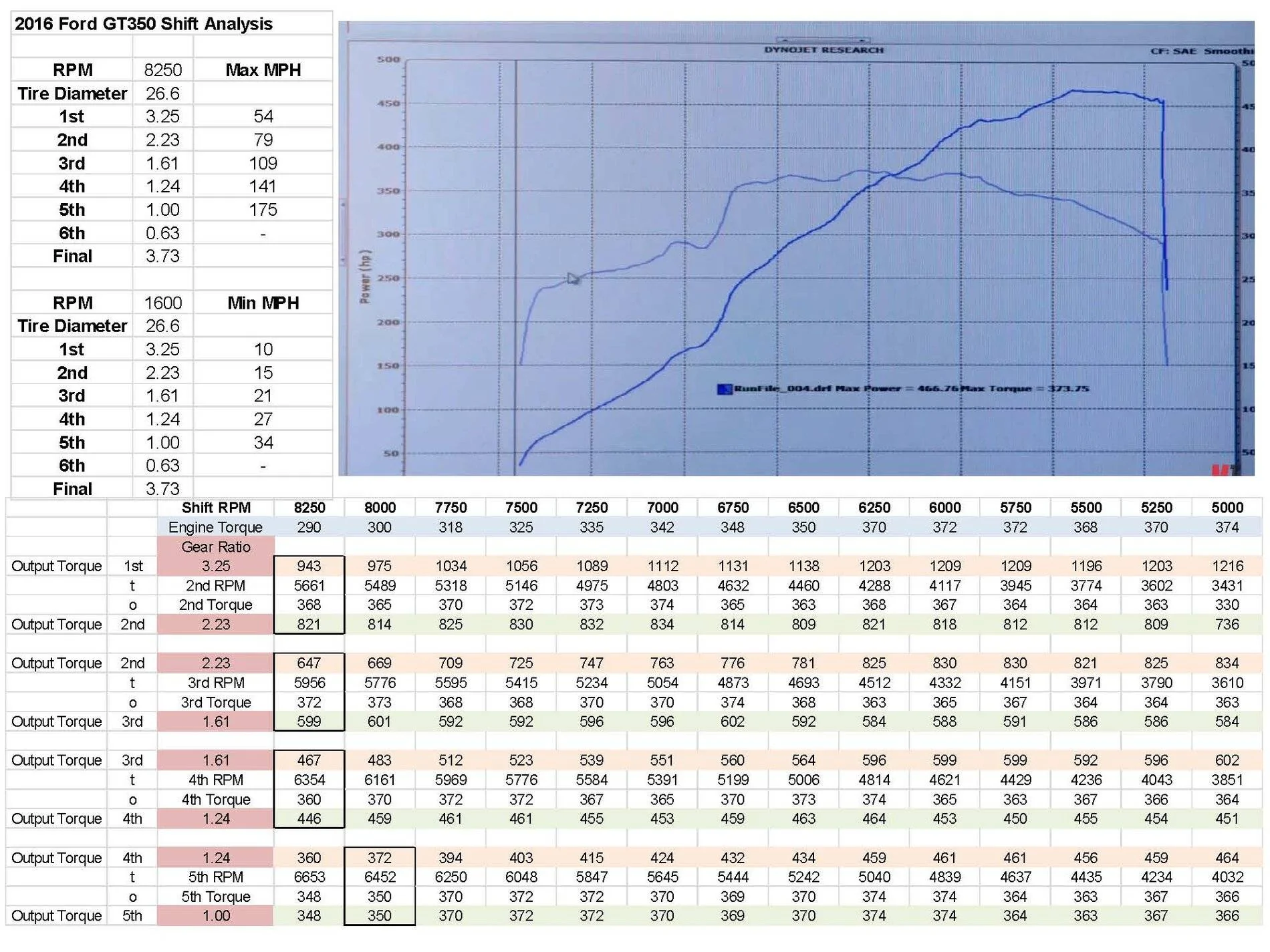
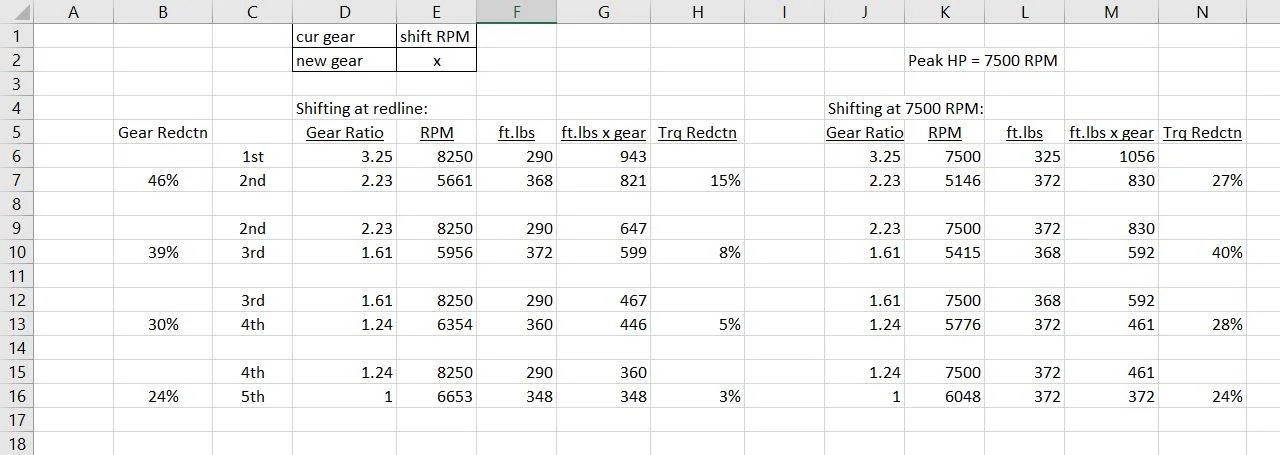
That video is great and I was about to post it also before I saw your post. Now I have something to share which will go hand-in-hand with that. Someone plotted the torque values by gear and RPM. I was trying to figure out if our particular cars will do better shifting at redline. (And again, this does not take into account other reasons for staying in a gear, like braking points, turns, etc. This is really more of a drag racer's view of shift points.) So I followed Jason's formulas in excel.

When I did the math, it looks like Jason's video holds true and shifting at redline will be putting down the most power all the time.


GT350 Shift Analysis_Page_1.webp


Shift Point analysis.webp
 

friedmud

Well-Known Member
Joined
Jan 25, 2021
Threads
7
Messages
289
Reaction score
373
Location
Idaho
Vehicle(s)
2019 Mustang GT
That video is great and I was about to post it also before I saw your post. Now I have something to share which will go hand-in-hand with that. Someone plotted the torque values by gear and RPM. I was trying to figure out if our particular cars will do better shifting at redline. (And again, this does not take into account other reasons for staying in a gear, like braking points, turns, etc. This is really more of a drag racer's view of shift points.) So I followed Jason's formulas in excel.

When I did the math, it looks like Jason's video holds true and shifting at redline will be putting down the most power all the time.


GT350 Shift Analysis_Page_1.jpg


Shift Point analysis.JPG
Nice - thanks for doing the calculations!

Yeah - you would have to have a VERY “peaky” torque curve before your loss in torque at higher RPMs is more than the loss from the change in gear ratios. With the Coyote it’s hard to imagine that it would ever happen…
 

Sponsored

AdamIsAdam

Well-Known Member
Joined
Jul 22, 2018
Threads
11
Messages
410
Reaction score
251
Location
Long Island
First Name
Adam
Vehicle(s)
2018 Shelby GT350
Nice - thanks for doing the calculations!

Yeah - you would have to have a VERY “peaky” torque curve before your loss in torque at higher RPMs is more than the loss from the change in gear ratios. With the Coyote it’s hard to imagine that it would ever happen…
Or a very flat torque curve. My old Pontiac made close to 600 ft lbs, and most of it from about 1800 RPMs. Then the top end falls fast after 5000. In fact, Pontiac drag racers often tested at the strip and found quarter mile times and MPH do not change when shifting at 5,000 vs 5,500 (and fall off dramatically above that).

It's all about that torque.

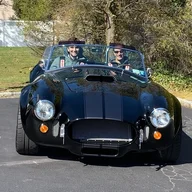
I should try this math with my Cobra. It's got a 347 stroker with one of the flattest torque curves ever but the HP curve just keeps going until the MSD box cuts off the fun.
 

friedmud

Well-Known Member
Joined
Jan 25, 2021
Threads
7
Messages
289
Reaction score
373
Location
Idaho
Vehicle(s)
2019 Mustang GT
Or a very flat torque curve. My old Pontiac made close to 600 ft lbs, and most of it from about 1800 RPMs. Then the top end falls fast after 5000. In fact, Pontiac drag racers often tested at the strip and found quarter mile times and MPH do not change when shifting at 5,000 vs 5,500 (and fall off dramatically above that).

It's all about that torque.

I should try this math with my Cobra. It's got a 347 stroker with one of the flattest torque curves ever but the HP curve just keeps going until the MSD box cuts off the fun.
A flat torque curve would mean it would _definitely_ be best to shift at redline.

The only way that shifting earlier ever makes sense is if you lose a larger amount of torque as the RPMs go up than you would lose in changing gear ratios.

So: if you had a perfectly flat torque curve it could literally _never_ be better to shift early.

You would have to have a torque curve that peaked in the middle and fell off by a huge amount by the end for shifting early to make sense.
 

Hack

Well-Known Member
Joined
Nov 26, 2014
Threads
86
Messages
12,810
Reaction score
8,226
Location
Minneapolis
Vehicle(s)
Mustang, Challenger
Or a very flat torque curve. My old Pontiac made close to 600 ft lbs, and most of it from about 1800 RPMs. Then the top end falls fast after 5000. In fact, Pontiac drag racers often tested at the strip and found quarter mile times and MPH do not change when shifting at 5,000 vs 5,500 (and fall off dramatically above that).

It's all about that torque.

I should try this math with my Cobra. It's got a 347 stroker with one of the flattest torque curves ever but the HP curve just keeps going until the MSD box cuts off the fun.
No, it's only with a peaky torque curve (or at least it has to fall rapidly, the torque curve can be flat at low RPM - that doesn't matter). Especially with an older car that only has 3 or 4 forward speeds. The torque drop at the rear wheels from shifting is a lot. For example on a Muncie 4 speed transmission, first gear is 2.56:1 and second is 1.91:1. So shifting from first to second loses you 25% of your torque at the rear wheels.

Only when engine torque falls off a cliff does it become worth shifting.
 

AdamIsAdam

Well-Known Member
Joined
Jul 22, 2018
Threads
11
Messages
410
Reaction score
251
Location
Long Island
First Name
Adam
Vehicle(s)
2018 Shelby GT350
Got it. Yes, the torque curve on the big Pontiacs falls off a cliff at around 5000 RPM.
 

AdamIsAdam

Well-Known Member
Joined
Jul 22, 2018
Threads
11
Messages
410
Reaction score
251
Location
Long Island
First Name
Adam
Vehicle(s)
2018 Shelby GT350
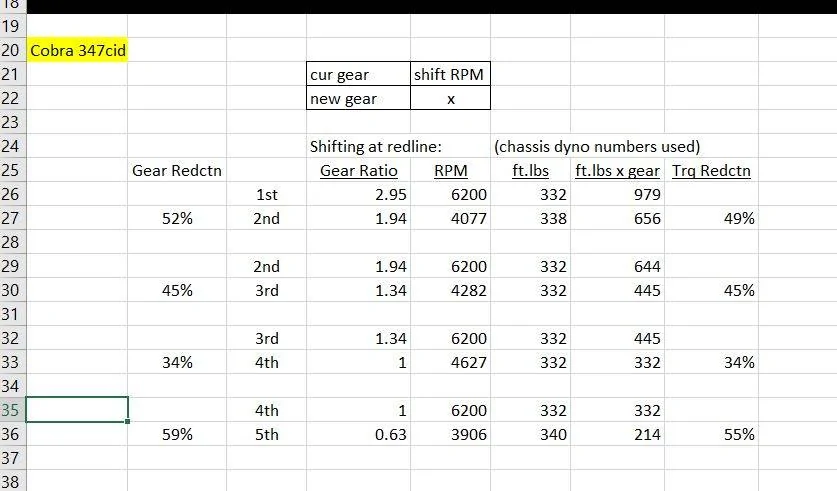
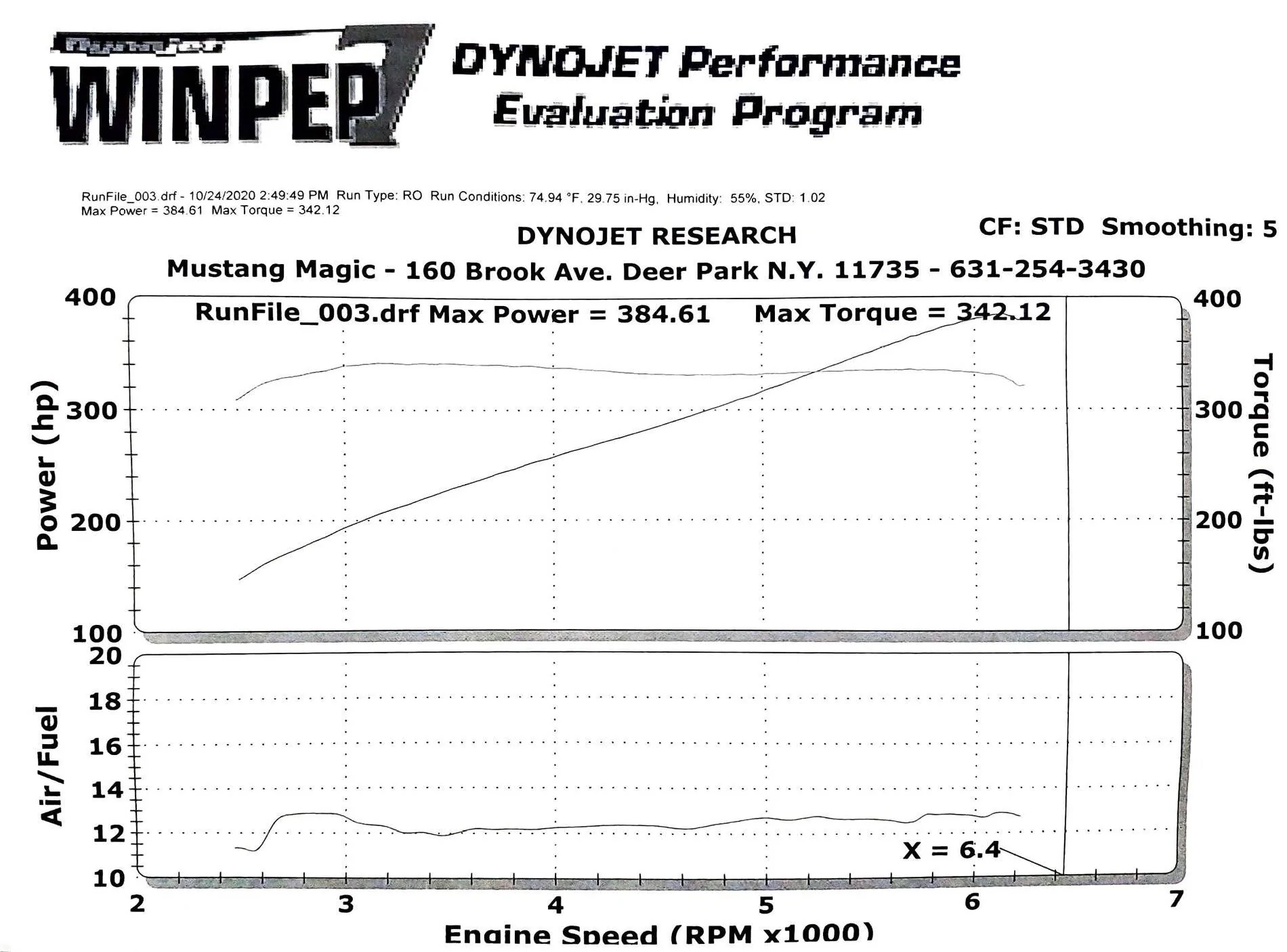
I plotted my Cobra (2,200lb car) with 347 CID (stroker 302), T5 Levy Racing tranny. Remember, these are chassis dyno numbers, not crank HP/Torque numbers.

Shift Point analysis.webp


Dyno Cobra 2020.webp
 

tom_sprecher

Living Race Car Free
Joined
Jul 2, 2016
Threads
30
Messages
1,233
Reaction score
477
Location
Marietta, GA
Vehicle(s)
2016 GT Premium PP 6MT Race Red
I have not had the Mustang on a track, but when I raced my shift points were completely dependent on the track layout.
Sponsored


Top