Sponsored

PMAS Intake Systems from UPR Products. TUNE AND NO TUNE INTAKES

tcador

Well-Known Member
Joined
Feb 5, 2015
Threads
18
Messages
210
Reaction score
45
Location
NJ / NYC
First Name
Travis
Vehicle(s)
Previous: '15 GT PP
Is the consensus to leave the factory funnel off? I left mine off but curious how many decide to leave it on.
 

MyFirst5.0

Well-Known Member
Joined
Oct 15, 2015
Threads
16
Messages
1,208
Reaction score
337
Location
west coast, Fl
Vehicle(s)
2016 deep impact blue premium gt
I'm the opposite, got my intake, awaiting tune revision...
i emailed them late last night, got the revision by 10am today. how long you waiting? i dont go thru their support tickets though, i just email the guy who was revising my flex fuel tune
 

4V Mayhem

Well-Known Member
Joined
May 20, 2016
Threads
9
Messages
1,368
Reaction score
529
Location
US
Vehicle(s)
2015 Mustang GT Premium M6
Well according to some of these guys here, the stock intake was designed with performance in mind and there is no way any aftermarket company could ever build something that outflows it...SMH. Is there any way you could re-do this test with other intakes just for comparison reasons? I think that would put the whole debate to rest. Plus it'll show if the PMAS system really is superior to other brands on the market.
 

Poppacapp

Well-Known Member
Joined
Apr 29, 2015
Threads
11
Messages
1,325
Reaction score
365
Location
NC
Vehicle(s)
2015 Mustang GT
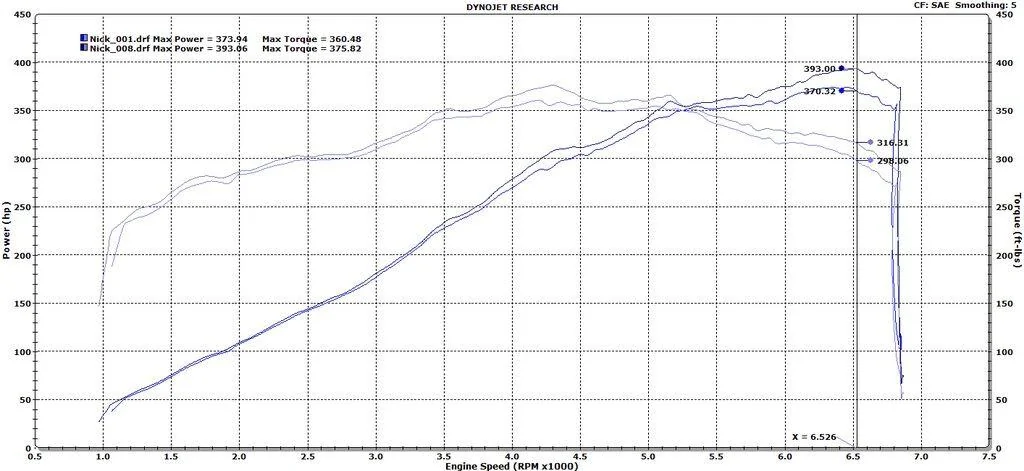
The only dyno chart I've seen is from a Dynojet...

15-16-ford-mustang-gt-5-0-air-intake-system-5.webp
No the dyno chart in the video posted above. That is a Mustang Dyno. 405 on a Mustang dyno with those mods is very unrealistic

That video wasn't done in the proper gear.. That sounded like a 3rd or 4th gear pull.. Hense the low TQ #s
But it still shouldnt be at 405rwhp on a MUSTANG dyno... thats what I mean.
 

Sponsored

Poppacapp

Well-Known Member
Joined
Apr 29, 2015
Threads
11
Messages
1,325
Reaction score
365
Location
NC
Vehicle(s)
2015 Mustang GT
Just ordered a PMAS specifically to test and log. It will be on the same dyno, same day.

My tuner is very skeptical. Says that although the car is not "tuned" timing is added due to different load factoring from the stock MAF.

My car is already tuned on flex fuel/E85 from him and has gone 116 in the quarter with stock intake and manifolds/cats.
I am looking forward to your results. My car has same mods, and traps 116-117 also.
 

Sasuketr

Well-Known Member
Joined
Aug 16, 2014
Threads
61
Messages
2,548
Reaction score
355
Location
Chicago,IL
Vehicle(s)
2015 Ingot Silver GTPP
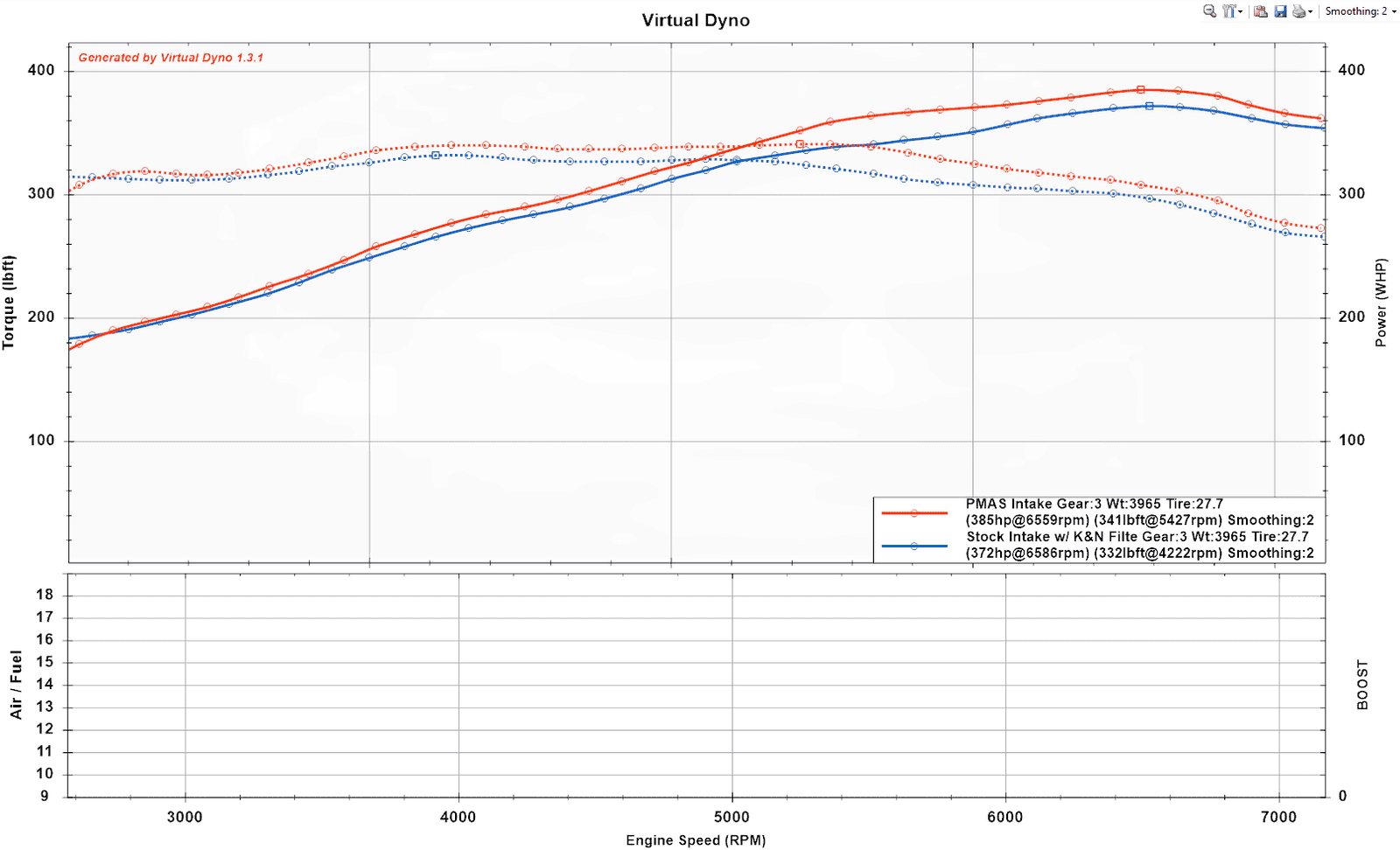
I just logged mine with the PMAS (tune required version) and compared it to logs with the stock intake and K&N filter from two nights ago.

IATs were 90-91° in both logs and the weather + time were nearly identical.

At 5000 RPM:
PMAS: 33.776 lb/min
Stock: 33.371 lb/min

At 6000 RPM:
PMAS: 39.645 lb/min
Stock: 39.121 lb/min

At 6500 RPM:
PMAS: 43.46 lb/min
Stock: 42.925 lb/min

At 7000 RPM:
PMAS: 44.605 lb/min
Stock: 43.182 lb/min

So as you can see, as you get closer to redline, the PMAS intake is bringing in a lot more air compared to the stock intake with a K&N filter. I did the same comparison between the K&N filter and the stock filter and noticed slight gains with the K&N, but nowhere near what I'm seeing with the PMAS.

Here is what VirtualDyno shows when I input both logs with identical information. Keep in mind VD doesn't have a file for the '15 GT so ignore the actual numbers. Just look at the gains between each curve!

45e2a539fb.png


Obviously this test had a very small sample size and I'm not claiming this as some scientific test. Just showing my results from my logs.
Ok so you did mention Tune Required Version! Now, i am taking that your car is tuned, not only that, when you get your tune, your tuner adjusted your parameters to be used on an aftermarket cold air intake to allow more flow. If your car is tuned for an intake, putting the stock back on and even using a high flow filter should restrict the flow.

What we really need is the same test with the stock ecu and non tuned version of the intake. That would actually show the real mass flow rate difference between K&N Filter and PMAS. PMAS already provided similar results and a chart showing their non tuned version flows better than stock.
 

PMAS

Well-Known Member
Joined
Apr 28, 2015
Threads
3
Messages
282
Reaction score
240
Location
Eaton Rapids, MI
Website
WWW.PMAS-MAF.com
Vehicle(s)
multiple
Ok guys and gals, the throttle body is not a flow limiting device and you are not flowing water through it. The flow is dictated by the pressure difference across it. If you decrease outlet pressure flow will increase. If you increase inlet pressure (decrease restriction) flow will increase.if it restricted flow, turbos and superchargers would be useless. Don't forget air is 14.5psia. If your intake has 28"h20 (1psi) pressure drop, your engine will only see 13.5psia. This is the same as turning down the boost.

Ford has a lot of design parameters they are stuck with. -40 to 125 degree temps. Noise, packaging, etc. they also need to enclose the entire airbox for the hydrocarbon trap to work correctly on the airbox lid. Yes they made a good airbox but for absolute performance, it's not perfect. The stock system is at 28"h20 (-1psi) at 430hp. There is a lot of room for improvement.

The maf. We do not trick the maf signal. This would be impossible anyway. The cars use wideband o2 sensors and fuel trims at 4 different points and would correct anything we tried changing tweaking for more power. If you put a stock maf in a larger tube the maf output would be lowered for the same amount of air. This is why you need a tune. Not because of increased power from the intake. The extended tables are already in the factory tune to accommodate more power than stock. We use a calibrated maf to correct the output that was changed because a maf was installed into a tube larger than stock. We calibrate it so it again has the factory output for the same about of air.
A quote from earlier explaining tune vs non tune.

There is no parameter in the tune that needs to be changed to allow for the increased flow of the new cold air kit. The flow tables already extend well past what the car makes for power stock.

A calibrated maf and putting the correct maf transfer function data in the tune accomplish the same thing. One changes the maf to match the stock transfer function, the other changes the transfer function to match the new maf setup.

There is no added power in changing the maf transfer function in the PCM (tune). it is only a X flow = Y HZ table to translate the maf output into something the PCM can work with.
When you use the correct Xfer function for a tune required cold air the load is not changed, the timing is not changed and the air fuel is not changed from what it was stock. (technically the load will go up slightly but only if it makes more horsepower with the kit. In this case timing would actually be lower anyway so no fake gain there either)

A tune does not make a cold air kit make more power, it does not change the restriction of the cold air kit. There is power from the kit and then there is power from a tune. Two totally different processes going on here.

Technically you should see higher gains from a combo of the two instead of them independently because if the tune makes more power and revs higher the engine will flow more air. Restriction goes up exponentially with flow. (higher flow will choke your stock airbox a lot more at the higher end of flow).

Also, we have never posted gains with a tune. Everything we have posted has been on a stock car.
 
Last edited:

Sponsored

Sasuketr

Well-Known Member
Joined
Aug 16, 2014
Threads
61
Messages
2,548
Reaction score
355
Location
Chicago,IL
Vehicle(s)
2015 Ingot Silver GTPP
Well according to some of these guys here, the stock intake was designed with performance in mind and there is no way any aftermarket company could ever build something that outflows it...SMH. Is there any way you could re-do this test with other intakes just for comparison reasons? I think that would put the whole debate to rest. Plus it'll show if the PMAS system really is superior to other brands on the market.
That is an interesting discussion. If you look at most stock sports or muscle cars using NA setup, the intake designs look similar. A closed air box with a bellow type elbow, sucking air through the grill or radiator area. Now if you look at force induced engines they do use aftermarket looking intakes. Even the gt350 has a Roush CAI looking intake due to high rpm and high flow requirements.

Now lets go back to the NA coyote or similar engine intake setup. I totally understand why they use paper filters. They filter really well and have huge surface contact area due to longer fins. The other advantage is the heat transfer rate is better due to material and fin surface area. Paper filters are also cheap and easy to replace. The air box is a closed design to prevent engine bay heat entering the intake, however, this will only help during traffic or car sitting and idling for some time.

Power wise the engine is max rated at 435 hp at the crank with certian air fuel ratio, and compression parameters. With that in mind and stock engines reliability, probably Ford doesn't need the engine to access more air flow. More air means more fuel to burn or lean combustion, resulting in different emissions and fuel consumption. What my understanding is ecu adjusts the timing to some extend to prevent damage to the internals. Either it pulls timing or advances it for the best drivibility conditions. Maybe intakes like PMAS provides enough max air for the engine that actually doesn't hurt the engine but give a slight edge in air flow around mid to high rpm applications. The sacrifice with these open element intakes are heat and filtration. Most of them do filter 98-99% of the particles, and heat is only a problem if your car is not moving for a period of time. The main qustion becomes, if you can really tell the difference of even a 20 whp on a 3700+ lb car? Thats 0.005 hp per pound.
 

v8440

Well-Known Member
Joined
May 3, 2016
Threads
10
Messages
268
Reaction score
48
Location
AL
Vehicle(s)
2016 gt
I'd say another way to compare is whether you can tell a 20 hp gain on a 435 hp engine. That's a 4.6% gain. Actually, it's higher than that because a stock car doesn't make 435 hp at the wheels, it makes that at the crankshaft, and the 20 hp gain is supposed to be at the wheels. My guess is yes, most people could tell the difference.
 

PMAS

Well-Known Member
Joined
Apr 28, 2015
Threads
3
Messages
282
Reaction score
240
Location
Eaton Rapids, MI
Website
WWW.PMAS-MAF.com
Vehicle(s)
multiple
What we really need is the same test with the stock ecu and non tuned version of the intake. That would actually show the real mass flow rate difference between K&N Filter and PMAS. PMAS already provided similar results and a chart showing their non tuned version flows better than stock.
The mass flowrate read by the maf is the mass flow rate. Nothing in the tune changes the output from the maf. It is, quite simply, how much air is entering the engine.

Things in a tune like timing and air fuel do not change engine airflow, they only change volumetric efficiency. (how much power the engine makes for the same airflow)
 

PMAS

Well-Known Member
Joined
Apr 28, 2015
Threads
3
Messages
282
Reaction score
240
Location
Eaton Rapids, MI
Website
WWW.PMAS-MAF.com
Vehicle(s)
multiple
That is an interesting discussion. If you look at most stock sports or muscle cars using NA setup, the intake designs look similar. A closed air box with a bellow type elbow, sucking air through the grill or radiator area. Now if you look at force induced engines they do use aftermarket looking intakes. Even the gt350 has a Roush CAI looking intake due to high rpm and high flow requirements.

Now lets go back to the NA coyote or similar engine intake setup. I totally understand why they use paper filters. They filter really well and have huge surface contact area due to longer fins. The other advantage is the heat transfer rate is better due to material and fin surface area. Paper filters are also cheap and easy to replace. The air box is a closed design to prevent engine bay heat entering the intake, however, this will only help during traffic or car sitting and idling for some time.

Power wise the engine is max rated at 435 hp at the crank with certian air fuel ratio, and compression parameters. With that in mind and stock engines reliability, probably Ford doesn't need the engine to access more air flow. More air means more fuel to burn or lean combustion, resulting in different emissions and fuel consumption. What my understanding is ecu adjusts the timing to some extend to prevent damage to the internals. Either it pulls timing or advances it for the best drivibility conditions. Maybe intakes like PMAS provides enough max air for the engine that actually doesn't hurt the engine but give a slight edge in air flow around mid to high rpm applications. The sacrifice with these open element intakes are heat and filtration. Most of them do filter 98-99% of the particles, and heat is only a problem if your car is not moving for a period of time. The main qustion becomes, if you can really tell the difference of even a 20 whp on a 3700+ lb car? Thats 0.005 hp per pound.
You are on point. All we are really doing is lowering pumping losses. An engine is just a big air pump.


Top