Sponsored

Voodoo Theory

Ponywars

Guest
Realistically, around 510-525.


There have been a number of threads about this on other forums, but keep in mind two things:

1) A 5 liter V8 (2.5 L per cylinder bank) is about the absolute max displacement for a flat plane setup, so we're unlikely to see a 5.1 or 5.2, if anything it would likely be destroked to 4.7-4.8. The reason is vibration due to harmonics.

2) While the Ferrari flat plane 4.5 sounds absolutely wicked, not all flat planes sound good. Have a look at the following (fast forward to 0:28):

Yes that sounds wicked but it lacks the throaty rumble that makes the Mustang so unique on the road. You can identify one without seeing it, that would be a big loss.... altho I wonder if Ford could find a way to make a flat plane emit that familiar rumble.
Sponsored


RTD

Well-Known Member
Joined
Nov 6, 2013
Threads
1
Messages
62
Reaction score
0
Yes that sounds wicked but it lacks the throaty rumble that makes the Mustang so unique on the road. You can identify one without seeing it, that would be a big loss.... altho I wonder if Ford could find a way to make a flat plane emit that familiar rumble.
I posted that vid as an example of a shitty sounding flat plane, actually.

For a wicked sounding one, see:


TearTheHorizon

Well-Known Member
Joined
Nov 3, 2013
Threads
1
Messages
166
Reaction score
0
Those high rev's are pretty intense. But the first exhaust note I ever heard that sounded like that, and this was when I was just a wee child, was one of these:


No knock to the 458, I would die to own that car (minus the blacked out tail lights), or any other flat plane crank, but I can't get past the old memory of the bike. Doesn't carry the same effect as the American V8. I like my exhaust when i feel it in the ground, not when my ear drums ring. But that's personal preference. Although IMO that exhaust note has no reason to come from a mustang.
 

RTD

Well-Known Member
Joined
Nov 6, 2013
Threads
1
Messages
62
Reaction score
0
A flat plane crank V8 will always sound like 2 4 cylinders running at the same time rather than as a V8, there's no getting around that. Whether it has more of a sportbike characteristic or more of an F1 characteristic is largely dependent on the design of the exhaust system.

What give a traditional V8 (cross plane) that deep rumble sound is that you have two cylinders in the same bank firing sequentially providing what gets perceived as a louder bang every so often in the cycle and at typical engine speeds this creates the rumble.
 

Maestro5.0

Guest
What's interesting when you research this is the lack of the traditional v8 burble of the flat plane design is related to the balance and efficiency of its firing order and a pattern that allows for even exhaust gas pressure pulses from each bank.

The crossplane V8 crank that produces the traditional V8 rumble we hear in the Mustang is actually symptomatic of inefficiency with two cylinders firing sequentially on the same bank causing the 2 exhaust pulses to combine to form higher pressure and an exhaust note from the tailpipe which alternates from side to side.

The crossplane V8 crank makes firing order and exhaust design more problematic - the way the crank pins bring the pistons to TDC dictates that firing a cylinder on the same side as the previous cylinder must happen at least twice (once on the left bank and once on the right bank) - in fact this includes 2 adjacent cylinders on one bank, which is far from ideal in terms of mechanical stress and head soak (again there are a number of possible firing orders - but some are never used in practise as they have all 4 cylinders in a bank firing sequentially! The four usable orders are1-8-4-3-6-5-7-2, 1-8-7-3-6-5-4-2, 1-8-7-2-6-5-4-3 and 1-5-4-3-6-8-7-2 which have bank patterns of R-L-L-R-L-R-R-L..., R-L-R-R-L-R-L-L..., R-L-R-L-L-R-L-R... and R-R-L-R-L-L-R-L...


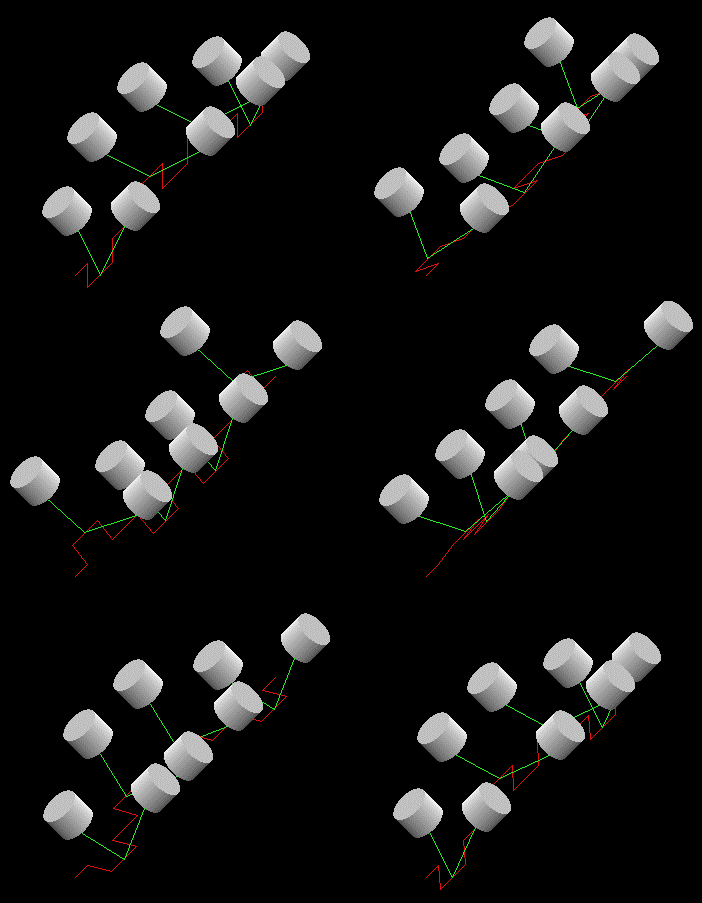
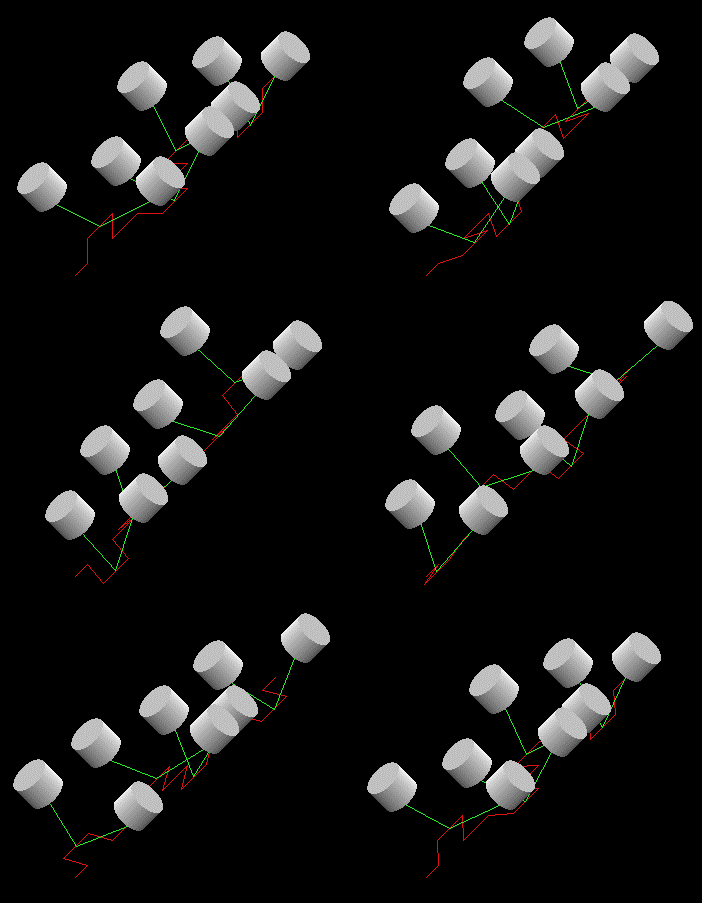
Flat plane

versus

Cross plane


http://www.projectm71.com/Cross_FlatPlane.htm

This site has one of the best explanations of the cross-plane vs flat plane V8 design that I've come across. It's a good read.
 

Sponsored

TearTheHorizon

Well-Known Member
Joined
Nov 3, 2013
Threads
1
Messages
166
Reaction score
0
A 5 liter V8 (2.5 L per cylinder bank) is about the absolute max displacement for a flat plane setup, so we're unlikely to see a 5.1 or 5.2, if anything it would likely be destroked to 4.7-4.8. The reason is vibration due to harmonics.
Is this a valid fact? If so, inefficient exhaust or not, I think crossplane takes the win. 5 liters is fairly small, even in Ford's history there lies an 1,100 ci crossplane 8 cylinder. Thats what, 18 liters?
 

nametoshowothers

Well-Known Member
Joined
Aug 20, 2013
Threads
7
Messages
549
Reaction score
111
Location
north america
Vehicle(s)
description of cars
Is this a valid fact? If so, inefficient exhaust or not, I think crossplane takes the win. 5 liters is fairly small, even in Ford's history there lies an 1,100 ci crossplane 8 cylinder. Thats what, 18 liters?
There is no technical limit. Some engines use balance shafts to overcome this. Maybe some practical limits based on rpm, stroke and bore combinations with material costs
 

Red

Well-Known Member
Joined
Jul 3, 2013
Threads
0
Messages
134
Reaction score
1
Location
Ohio
Vehicle(s)
Fords
I guess there are a few things I can add to the flat crank vs cross-plane crank discussion.

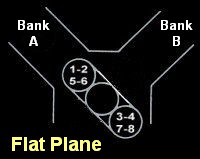
First, thanks Maestro for your visuals. However, there is a typo in the cylinders associated w/ each crankpin in the flat crank drawing. The 'up' crank pins are connected to cylinders 1,2,7,8 while the 'down' pins are connected to cylinders 3,4,5,6 (GM and Mopar cylinder numbering :) ). Both animations are correct.

Second, remember that sound and throttle response in the TVR and Ferrari videos above are not necessarily due solely to crankshaft design -- other things are likely contributing to what we are hearing. Cam, compression, flywheel, clutch, and displacement (mainly stroke here) play a very large role. Lighter flywheel and pressure plate (lower moment of inertia actually) will give better throttle response, all else being equal. A smaller engine will have lighter internals, again improving throttle response. I've heard small block, cross-plane crank, Chevy's in NHRA Comp Eliminator that sound like toggle switches. Amazing throttle response.

Third, a flat plane V8 will indeed have a lighter crank (and likely stronger due to all pins being in the same plane, making forging easier/better, I'd think) due to lighter counterweights, in turn giving a lower moment of inertia. However, the crank does need counterweights to counteract the centrifugal force of the rotating components of the crank, con rod, piston assembly -- which is the crank pin and the lower end of the con rod. Point being, a flat plane crank will still have counterweights. From what I read above, I believe some were thinking a V8 flat plane crank needed no counterweights. My apology if I'm mistaken.

Fourth, a flat plane V8 also has even intake and exhaust pulses in each bank, for improved scavenging and hence torque and power. How much, I don't know. As maestro and others have said, the cross-plane V8 will have uneven pulses from each bank, giving the engine its characteristic sound, unless one has headers the span the banks so that the pulses are evenly spaced in each header -- impractical and expensive.

Fifth, a flat plane crank V8 has what's call a secondary imbalance. This is an oscillating force, varying with crank angle, that, in this case, will be in the horizontal plane (i.e. the engine will want to move side to side). This force has a frequency twice that of the crank. To counteract this vibration, two counter-rotating balance shafts can be used, but this adds to the complexity of the engine and defeats part of the goal of having a light rotating assembly. The best method to reduce this vibration in a high-perf setting, imo, is to have light reciprocating pieces (pistons, rings, wrist pins, upper end of con rod). These forces aren't those that break cranks (I think), but can make life tough for the main and rod bearings and bottom end of the block. I seem to remember some NASCAR teams experimenting w/ flat cranks way back when, and having durability problems. Anyway, be aware a flat crank V8 is going to be rougher than a cross plane.

Sixth, RPM's cost money. Many rotational forces increase w/ the square of RPM, requiring ever better materials. Piston speeds increase w/ RPM, requiring better materials. Bearing speeds increase w/ RPM, requiring better materials and oil. Machining must be top flight. Maintenance needs to be a priority.

So, while I too think a flat plane would be cool, remember there's no free lunch. And remember that cross-plane V8's can still make hellacious power -- ~1500 HP out of NHRA Pro Stock currently, I believe. Naturally aspirated, carbed, gasoline, 500 CID.

All important disclaimer: I am certainly not an automotive engineer. The above is basic and some was dug up from a text book (The Internal-Combustion Engine in Theory and Practice, Vol 2, by C. F. Taylor) that I used early on in grad school (> 30 yrs ago). While I've certainly tried to be correct, I've been around long enough to know that some things I said above could be incorrect, or give the incorrect impression. For that, I apologize, and hope someone with real knowledge will speak up so that we can all learn.

I hope the above is interesting -- that's the goal. Sorry it turned out to be a novel, by internet standards.

Bill
 

Sponsored

Mriley

Guest
Great post Bill. That was very informative.

On a practical level I have to wonder, can Ford really afford to build a one-off flat plane V8 for a low volume Mustang? Especially since as you said, cross plane V8s can still make tons of power even naturally aspirated. It's also cheaper to develop and can possibly be shared by other Ford vehicles.... something I can't see happening with a flat plane V8.
 

crysalis_01

Well-Known Member
Joined
Jun 15, 2013
Threads
0
Messages
134
Reaction score
4
Location
Wyoming
Vehicle(s)
2003 Terminator Cobra
It doesn't have to only be shared with Ford vehicles. If Lincoln gets around to a S550 variant vehicle, it will more than likely use the mid and upper trim engines from Mustang.
 

08gt

Active Member
Joined
Oct 31, 2013
Threads
1
Messages
30
Reaction score
0
Apparently there are both flat plane and cross plane versions of the Voodoo engine being tested right now (info from another forum).

It's interesting, maybe the cross plane version is being setup for use of forced induction in a later SE variant?
 

Twin Turbo

Super Moderator
Moderator
Joined
Aug 2, 2012
Threads
479
Messages
9,832
Reaction score
7,423
Location
England
First Name
Paul
Vehicle(s)
Mustang '05 GT
Apparently there are both flat plane and cross plane versions of the Voodoo engine being tested right now (info from another forum).

It's interesting, maybe the cross plane version is being setup for use of forced induction in a later SE variant?
Woah woah woah...............back that up a little. Another forum? :paddle:

C'mon, we need more details!!!
 

TearTheHorizon

Well-Known Member
Joined
Nov 3, 2013
Threads
1
Messages
166
Reaction score
0
Apparently there are both flat plane and cross plane versions of the Voodoo engine being tested right now (info from another forum).

It's interesting, maybe the cross plane version is being setup for use of forced induction in a later SE variant?
Cross plane voodoo, not that cross plane needs to be mentioned, is in physical form as we speak. A flat plane voodoo, if exists, exists solely on paper, or it is not a true ford motor and is being tested outside of any ford operated owned or related facility.

What I meam by not true ford motor is that if such a thing as a flat plane voodoo is being designed, its by an outside contracting company.
which could be likely, if ford was going to step in such a dramatic direction as to switch crank designs they would not do it in a ford facility, it would cause a pandemic.
Sponsored


Top