
Sponsored

Tires wear issues help?

Fp_Mach1

Well-Known Member
Joined
Sep 2, 2024
Threads
2
Messages
46
Reaction score
35
Location
Central Ca
First Name
Jr
Vehicle(s)
2022 Mach 1
Today I was washing my car and noticed this wear on my front passenger side tire.

Is it the toe that is off or damping .
Car has Steeda Dual rate springs , stock HP package suspension 2022 Mach 1.

1000016998.jpg
1000017000.jpg
Sponsored


Noleftist

Well-Known Member
Joined
Mar 1, 2024
Threads
49
Messages
407
Reaction score
220
Location
USA
Vehicle(s)
Ferrari F40
Today I was washing my car and noticed this wear on my front passenger side tire.

Is it the toe that is off or damping .
Car has Steeda Dual rate springs , stock HP package suspension 2022 Mach 1.
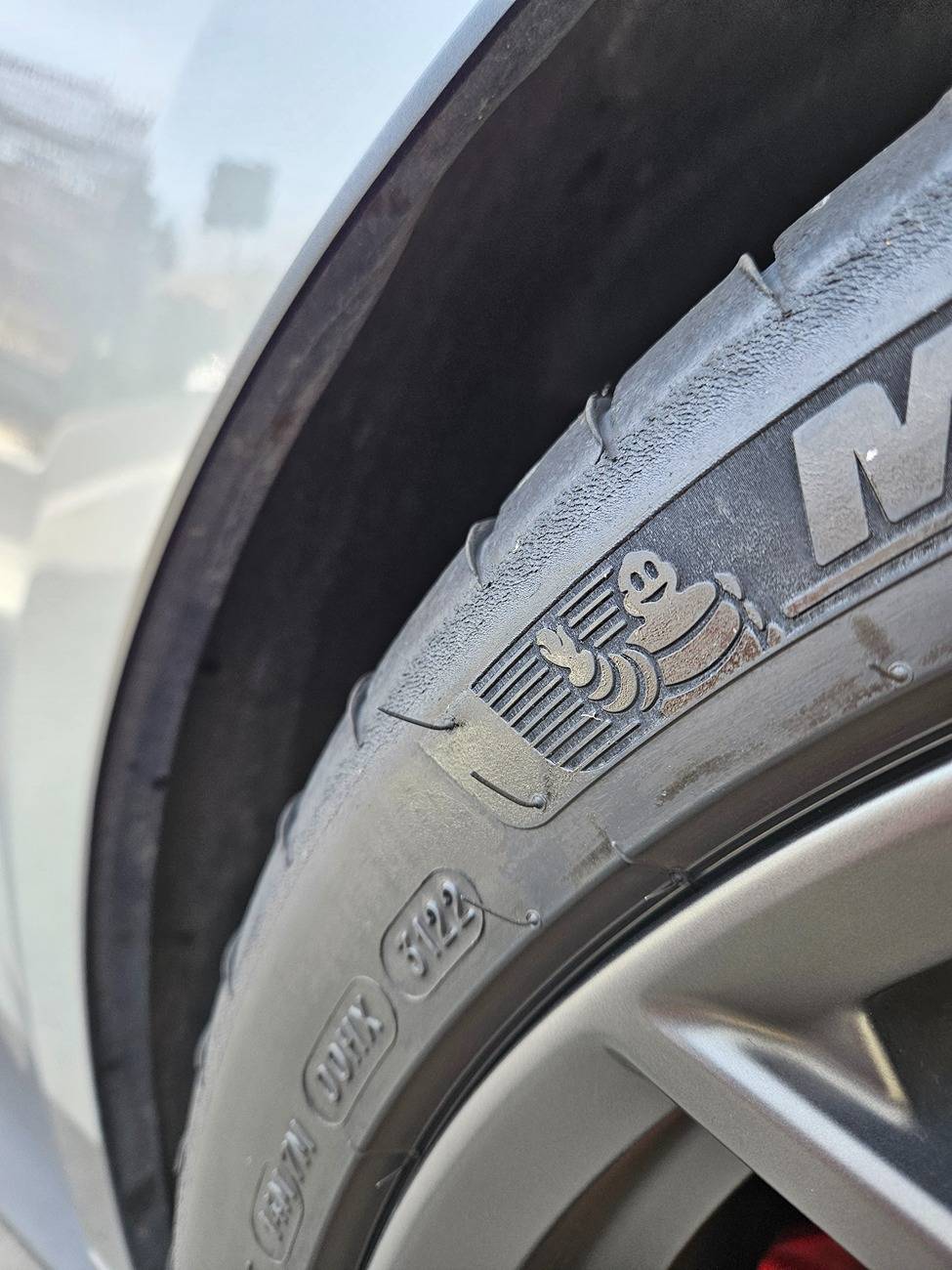
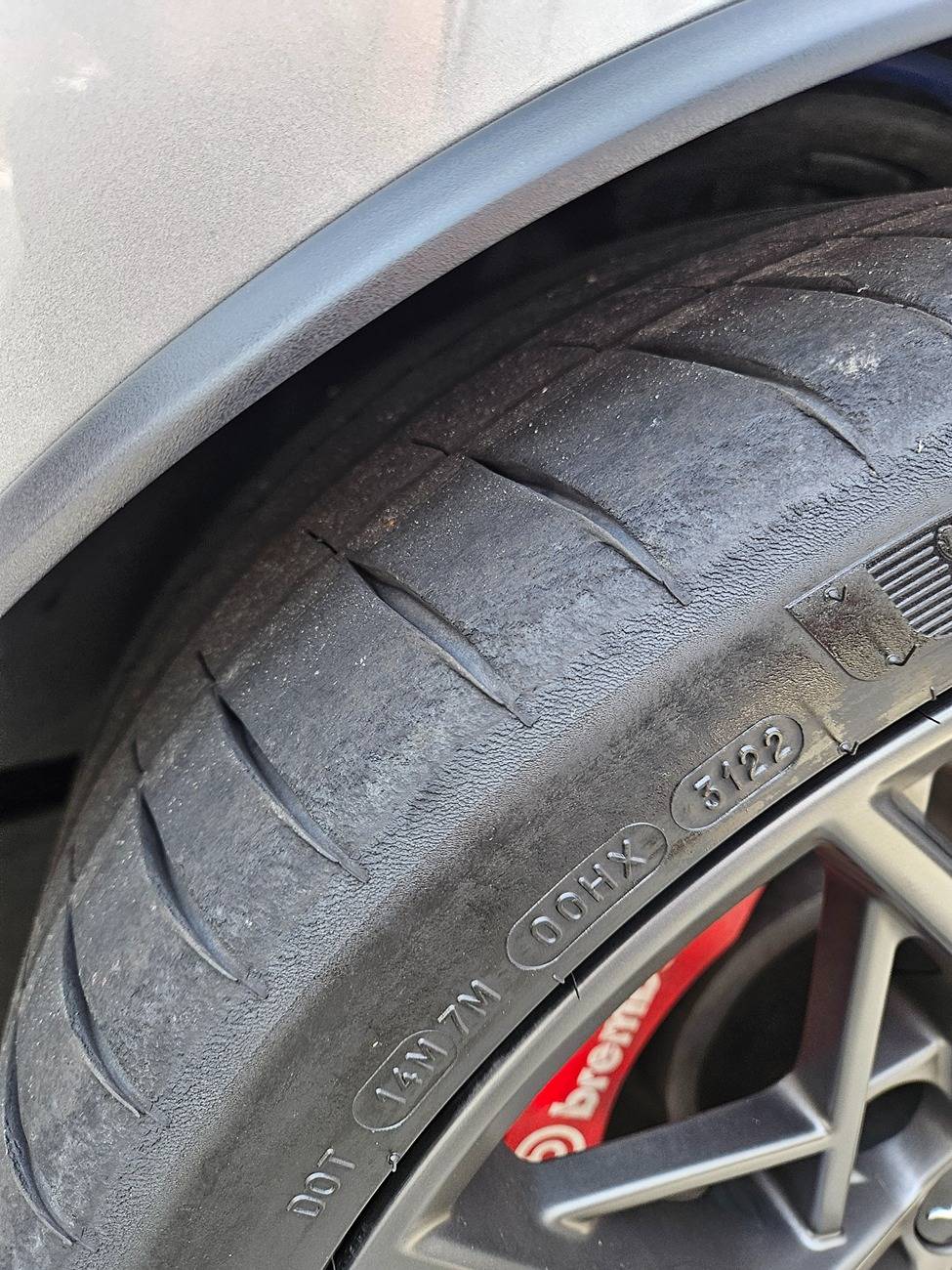
1000016998.jpg
1000017000.jpg
Me thinks this is what may apply in your case:

Look at the heel toe part of the video and compare to your tire!

This is good also:
What Causes Tire Feathering On Inside Or Outside Edge?
If you notice that your tire tread is feathered only on the inside or outside edge, it could be an indication of incorrect toe alignment, as well as camber out of specification.
Negative camber will cause inner shoulder wear and positive camber will cause outer shoulder wear. For improved handling performance and traction, most vehicles are set with a slight amount of negative camber.
Worn suspension components can also cause your vehicle’s alignment settings to go out of specification, which can lead to uneven tire wear.
https://tirecrunch.com/tire-feathering/
 
Last edited:
OP
OP
Fp_Mach1

Fp_Mach1

Well-Known Member
Joined
Sep 2, 2024
Threads
2
Messages
46
Reaction score
35
Location
Central Ca
First Name
Jr
Vehicle(s)
2022 Mach 1
Me thinks this is what may apply in your case:

Look at the heel toe part of the video and compare to your tire!

This is good also:
What Causes Tire Feathering On Inside Or Outside Edge?
If you notice that your tire tread is feathered only on the inside or outside edge, it could be an indication of incorrect toe alignment, as well as camber out of specification.
Negative camber will cause inner shoulder wear and positive camber will cause outer shoulder wear. For improved handling performance and traction, most vehicles are set with a slight amount of negative camber.
Worn suspension components can also cause your vehicle’s alignment settings to go out of specification, which can lead to uneven tire wear.
https://tirecrunch.com/tire-feathering/
Yeah , I got an alignment about 2 months ago .. cars runs straight but I didn't have that wear before that.

I'll take it in tomorrow if I have time to check it . Looks like a Toe issue but am not an expert on alignment at all.
 
OP
OP
Fp_Mach1

Fp_Mach1

Well-Known Member
Joined
Sep 2, 2024
Threads
2
Messages
46
Reaction score
35
Location
Central Ca
First Name
Jr
Vehicle(s)
2022 Mach 1
Just watched it ... yup feathering seems to be the issue.

Thank you
 

RobZ71LM7

Well-Known Member
Joined
Oct 14, 2021
Threads
16
Messages
728
Reaction score
1,206
Location
Louisville, KY
First Name
Rob
Vehicle(s)
2021 Mach 1, 2019 F-150
I'd say your toe is off, even if the car drives straight it can be far off and cause wear in a short period of time.
 

Sponsored

Noleftist

Well-Known Member
Joined
Mar 1, 2024
Threads
49
Messages
407
Reaction score
220
Location
USA
Vehicle(s)
Ferrari F40
This one just popped up on my YouTube and is very good.
 

RustyBit

Active Member
Joined
Jan 28, 2024
Threads
2
Messages
27
Reaction score
14
Location
Carnegie Melbourne VIC
First Name
Russell
Vehicle(s)
2018 FN GT Manual
Used to be in the tyre industry, specialising in alignment. My question for you is, do you do a lot more hard left hand turns than right? This was a common problem on taxi's or cabs as you call them. Especially with that scrabbling on the upper edge of the sidewall. In OZ it was the front passenger as well where the cabbies would do a lot more right hand turns.
If not, and it's definitely only on the outside of one tyre, it would be pretty severe + camber which you would easily see by eye.
There is a bit of scuffing on the sidewall, which could suggest that you have been hitting the kerb with that tyre. That could be knocking your camber out. It is definitely not toe settings as both tyres would wear the same on the front.
 

TonyT930

Well-Known Member
Joined
Dec 16, 2023
Threads
47
Messages
1,152
Reaction score
732
Location
Philadelphia, Pa.
First Name
Tony
Vehicle(s)
2017 Mustang GT Convertible in Ruby Red
Yeah , I got an alignment about 2 months ago .. cars runs straight but I didn't have that wear before that.

I'll take it in tomorrow if I have time to check it . Looks like a Toe issue but am not an expert on alignment at all.
Did you check the tire pressure? I find that many people run these tires too low on pressure.
 

RustyBit

Active Member
Joined
Jan 28, 2024
Threads
2
Messages
27
Reaction score
14
Location
Carnegie Melbourne VIC
First Name
Russell
Vehicle(s)
2018 FN GT Manual
35-36 psi is too high when set at cold as it should be. 32 is the correct pressure; check the sticker inside your door opening; it is right. Starting at 36psi, you will quickly be over 40 and up, causing centre wear.
It's not tyre pressure causing that wear pattern.
Do you track the car often?
 

Sponsored
OP
OP
Fp_Mach1

Fp_Mach1

Well-Known Member
Joined
Sep 2, 2024
Threads
2
Messages
46
Reaction score
35
Location
Central Ca
First Name
Jr
Vehicle(s)
2022 Mach 1
35-36 psi is too high when set at cold as it should be. 32 is the correct pressure; check the sticker inside your door opening; it is right. Starting at 36psi, you will quickly be over 40 and up, causing centre wear.
It's not tyre pressure causing that wear pattern.
Do you track the car often?
Tracked it once so far on this set . Sonoma raceway CA.

I'm at 36 cold I belive right now .

Took it too alignment shop everything is withing Spec "Green"
 

RustyBit

Active Member
Joined
Jan 28, 2024
Threads
2
Messages
27
Reaction score
14
Location
Carnegie Melbourne VIC
First Name
Russell
Vehicle(s)
2018 FN GT Manual
36 is too high, strange that the alignment shop didn't set them correctly, first thing that should be checked and set. Did they mention anything about the shocks? I have heard of Sonoma but have never seen it? I haven't even driven it on the sim, so I don't know what it's like. Had a look at the road circuit track map, turn 1, entry to turn 3, turn 6 and turn 9 would be putting pressure on that tyre. If you change that tyre and do another track day, if you don't already, make sure you lower your pressure to 26-28psi before you start, they will be up to 36+ in a couple of laps. Then you can push, don't forget to reset them before you leave the track,

It could be that you pushed it hard into LH corners and started that wear pattern, once started it only gets worse. It used to be that you could recover from that by taking both front tyres off the rims and swapping them side to side; however, with directional tyres, that doesn't work.

Sadly that tyre is only going to get worse, nothing you can do about it.
Definitely drop your cold pressure to 32psi, as the placard states. Your tyres, suspension, traction, the ride, in fact everything will benefit from it.
Sorry for waffling on, just trying to help.
 
OP
OP
Fp_Mach1

Fp_Mach1

Well-Known Member
Joined
Sep 2, 2024
Threads
2
Messages
46
Reaction score
35
Location
Central Ca
First Name
Jr
Vehicle(s)
2022 Mach 1
36 is too high, strange that the alignment shop didn't set them correctly, first thing that should be checked and set. Did they mention anything about the shocks? I have heard of Sonoma but have never seen it? I haven't even driven it on the sim, so I don't know what it's like. Had a look at the road circuit track map, turn 1, entry to turn 3, turn 6 and turn 9 would be putting pressure on that tyre. If you change that tyre and do another track day, if you don't already, make sure you lower your pressure to 26-28psi before you start, they will be up to 36+ in a couple of laps. Then you can push, don't forget to reset them before you leave the track,

It could be that you pushed it hard into LH corners and started that wear pattern, once started it only gets worse. It used to be that you could recover from that by taking both front tyres off the rims and swapping them side to side; however, with directional tyres, that doesn't work.

Sadly that tyre is only going to get worse, nothing you can do about it.
Definitely drop your cold pressure to 32psi, as the placard states. Your tyres, suspension, traction, the ride, in fact everything will benefit from it.
Sorry for waffling on, just trying to help.
At track I did run lower about 32... but definitely not 26-28lbs ..

I will lower them today overall for street use and keep an eye on it .

Thank you for the help... it kinda makes sense though...

I track my R1 (bike) and have more experience with tire wear and use to running Dunlops for the last couple years . New to tracking a car and especially michellin PS4's
So thanks for the help.
 

RustyBit

Active Member
Joined
Jan 28, 2024
Threads
2
Messages
27
Reaction score
14
Location
Carnegie Melbourne VIC
First Name
Russell
Vehicle(s)
2018 FN GT Manual
I know it's not popular on this site with other members, but I never run my tires that soft and I'm only on the street. I never go by what's listed on the door of the car as far as pressure. Since the max tire pressure marked on the tire is around 51psi on these lower profile radial tires(i have conti dws06s), i always run mine about 43psi cold in the front and 36psi cold in the rear. I find that the tires wear evenly except a little bit of added wear in the inside of the front tires(due to oem alignment set up). The rear tires wore perfectly even. Also, what I've noticed is that the steering response is quick, grip great once warm(no greasy feeling), and the tires never overheat. You can see if you are overheating a tire by the way the rubber looks(i know this through years of experience from motorcycle racing). I've also did this on all my other vehicles for the past 25 years or so. Back in the day, max air pressures on the radials were only like 36psi, so it was common for people to run there pressures at 32psi front and 29 rear and that was recommended on the door sticker. However, tire tech has changed over the years and have improved. It never made sense to me for a max air pressure to be at 51psi for these modern radial tires and yet run them almost 20psi below that. It causes too much belt flexion which generates too much heat and the tire cant dissipate that heat fast enough. My experience has taught me directly that you will wear out the edges of your front tires prematurely, the rubber tends to chunk front and rear(due to over heating), and the handling feels slow and greasy.
I will try not to be rude, but I have never heard anything so ridiculous. And any wonder why "I know it's not popular on this site with other members" It would not be popular on any site with intelligent members. You are so wrong! Now you have got me started. Remeber I am trying very hard not to be rude.

As I said in an earlier post in this thread I was in the tyre industry for almost 20 years, specialising in alignment and suspension repair, modifying and upgrading. I also used to set up suspension and alignments for various types of race cars. The max tyre pressure you are stating is allowing for severe conditions, such as a tyre overheating due to conditions, driving style, load etc. The max pressure is NOT there to be knowingly used at anytime.
You have to picture your tyre as a major part of your suspension, all working together.
Car manufacturers DO NOT put that recommended pressure on the placard for fun. It is there after much testing with the suspension and tyres to provide the best setting for obtaining the largest contact patch, (very important) maximum tyre life, maximum traction, best steering response, fuel economy and ride, covering the weight distribution of the car and passengers and load. Some placards will give you different pressures for vehicles loaded and unloaded etc

This quote is from Continentals own site:-
"For a Continental DWS06 Plus 245/40R19 tire on a Mustang GT, the recommended tire pressure is typically 32 PSI (pounds per square inch) on both the front and rear tires; this can be verified by checking the tire pressure placard on your car's door jamb or owner's manual."

Key points to remember:
  • Check your vehicle's placard:
    Always prioritize the tire pressure specified on your car's placard as it takes into account the specific vehicle weight and design.
  • Load considerations:
    If you are carrying heavy loads, you may need to slightly increase tire pressure within the manufacturer's recommended range.
  • Regularly check pressure:
    Ensure you check your tire pressure regularly, ideally when the tires are cold (before driving a significant distance) to maintain optimal performance and fuel efficiency."
When you were racing motorcycles, did you set your tyre pressues higher than recommended when cold? If so your footprint or contact patch would be at a minimum and only get worse as your tyres heated up. I can picture you struggling in corners, badly, may be okay on the straights as there is less contact/friction with your tyres.
If you follow motorcycle racing such as MOTOGP, you may have noted that they all try and run the least pressure possible AT ALL TIMES. They now get penalised for running their pressures too low for a given period. They do this so that they get the largest footprint possible, both for traction on acceleration and the same for braking.
The same principles apply for cars both road and racing.

Whilst looking for a track map of Sonoma this quote came up:-

" When setting tire pressures before a track day at Sonoma Raceway, a good starting point is to set your pressures 2-4 psi below the manufacturer's recommended cold pressure for road driving, aiming to reach a target hot pressure that is slightly higher once the tires warm up during your first session; always check and adjust pressures after the first few laps to fine-tune based on how your car handles on the track."

There are only a few reasons why you would change the pressures from the manufacturers placarded setting.
One would be a slight increase in pressure, no more than 2-3psi, in constant wet and snow conditions, by increasing the pressure you open the grooves and seperate the tread blocks, allowing better water, ice and snow ejection. It also helps by putting more load on the centre of the tyre allowing it to dig in deeper. Too high and you will virtually have next to no traction in those conditions. This brings up another point, you will have better traction/ grip on narrower tyres in these conditions.
Two would be lowering your pressures in sandy or gravelly and muddyconditions, this really only applies to SUV's or 4WD's, but can help in a car if you are struggling.

Your stated pressures of 43psi cold front and 36psi rear is insane! I'm sorry but I do not believe you are getting even tyre wear on the front. You do say "except a little bit of added wear in the inside of the front tires(due to oem alignment set up)."
At that pressure the crown of the tyre is so rounded that half of your tyre is not coming into contact with the road. On a wide tyre such as the 245 what actually happens is that the tyre trys to rise in the centre but is actually pushed down due to the weight of the car, and the tyre has a wavy surface at the contact patch, picture it as a W. This shows up as wear on the outside shoulders and the centre of the tyre. The two lower points of the W do not wear anywhere near as mch as the upper points. Please prove me wrong, post a pic of your front tyres. What is the OEM alignment set up that you are referring to? I'm only guesssing here, I do not know the weight distribution of a convertible, there may be more weight in the rear due to the roof mechanism, especially with the rood down. You may get away with the 36psi in the rear, but it is not ideal. What does the placard say? You also say that the steering response is quick, any wonder, only a small amount of the tyre is actually in use on the road!
"It never made sense to me for a max air pressure to bet at 51psi for these modern radial tires and yet run them at almost 20psi below that." The 51 psi MAX has absolutely nothing to do with what pressure you should run in them, it is simply that, 51 is the maximum pressure that tyre can withstand. Tyre tech may have changed and increased the MAX presure, mainly due to superior materials and construction. If you had a car that weighed a lot more than the Mustang, and you ran the same tyres, the recommended pressure would be higher, but not by a huge amount. Certainly not 43psi! Your ride must be terrible, your front pressures would be at least 46 after a short distance. FACT
Your assumption about the belt flexion generating too much heat is not based on fact.
Do you have the TPMS system in your car? If not how do know they are not overheating? The recommended tyre pressures are such, that they allow for the tyre heating up as per normal, and that there will be an increase in pressures of around 3-4psi which puts them in there optimum range for street use. Trust me, your tyre pressures will DEFINITELY cause overheating, and is dangerous. I guess that you don't drive the car very hard on twisty roads, as there will definetly be push or understeer due to lack of grip on the front.

Sorry about the essay, but I did say that you got me started.
I'm open for discussion if anyone disagrees with what I have said.
 

TonyT930

Well-Known Member
Joined
Dec 16, 2023
Threads
47
Messages
1,152
Reaction score
732
Location
Philadelphia, Pa.
First Name
Tony
Vehicle(s)
2017 Mustang GT Convertible in Ruby Red
I will try not to be rude, but I have never heard anything so ridiculous. And any wonder why "I know it's not popular on this site with other members" It would not be popular on any site with intelligent members. You are so wrong! Now you have got me started. Remeber I am trying very hard not to be rude.

As I said in an earlier post in this thread I was in the tyre industry for almost 20 years, specialising in alignment and suspension repair, modifying and upgrading. I also used to set up suspension and alignments for various types of race cars. The max tyre pressure you are stating is allowing for severe conditions, such as a tyre overheating due to conditions, driving style, load etc. The max pressure is NOT there to be knowingly used at anytime.
You have to picture your tyre as a major part of your suspension, all working together.
Car manufacturers DO NOT put that recommended pressure on the placard for fun. It is there after much testing with the suspension and tyres to provide the best setting for obtaining the largest contact patch, (very important) maximum tyre life, maximum traction, best steering response, fuel economy and ride, covering the weight distribution of the car and passengers and load. Some placards will give you different pressures for vehicles loaded and unloaded etc

This quote is from Continentals own site:-
"For a Continental DWS06 Plus 245/40R19 tire on a Mustang GT, the recommended tire pressure is typically 32 PSI (pounds per square inch) on both the front and rear tires; this can be verified by checking the tire pressure placard on your car's door jamb or owner's manual."

Key points to remember:
  • Check your vehicle's placard:
    Always prioritize the tire pressure specified on your car's placard as it takes into account the specific vehicle weight and design.
  • Load considerations:
    If you are carrying heavy loads, you may need to slightly increase tire pressure within the manufacturer's recommended range.
  • Regularly check pressure:
    Ensure you check your tire pressure regularly, ideally when the tires are cold (before driving a significant distance) to maintain optimal performance and fuel efficiency."
When you were racing motorcycles, did you set your tyre pressues higher than recommended when cold? If so your footprint or contact patch would be at a minimum and only get worse as your tyres heated up. I can picture you struggling in corners, badly, may be okay on the straights as there is less contact/friction with your tyres.
If you follow motorcycle racing such as MOTOGP, you may have noted that they all try and run the least pressure possible AT ALL TIMES. They now get penalised for running their pressures too low for a given period. They do this so that they get the largest footprint possible, both for traction on acceleration and the same for braking.
The same principles apply for cars both road and racing.

Whilst looking for a track map of Sonoma this quote came up:-

" When setting tire pressures before a track day at Sonoma Raceway, a good starting point is to set your pressures 2-4 psi below the manufacturer's recommended cold pressure for road driving, aiming to reach a target hot pressure that is slightly higher once the tires warm up during your first session; always check and adjust pressures after the first few laps to fine-tune based on how your car handles on the track."

There are only a few reasons why you would change the pressures from the manufacturers placarded setting.
One would be a slight increase in pressure, no more than 2-3psi, in constant wet and snow conditions, by increasing the pressure you open the grooves and seperate the tread blocks, allowing better water, ice and snow ejection. It also helps by putting more load on the centre of the tyre allowing it to dig in deeper. Too high and you will virtually have next to no traction in those conditions. This brings up another point, you will have better traction/ grip on narrower tyres in these conditions.
Two would be lowering your pressures in sandy or gravelly and muddyconditions, this really only applies to SUV's or 4WD's, but can help in a car if you are struggling.

Your stated pressures of 43psi cold front and 36psi rear is insane! I'm sorry but I do not believe you are getting even tyre wear on the front. You do say "except a little bit of added wear in the inside of the front tires(due to oem alignment set up)."
At that pressure the crown of the tyre is so rounded that half of your tyre is not coming into contact with the road. On a wide tyre such as the 245 what actually happens is that the tyre trys to rise in the centre but is actually pushed down due to the weight of the car, and the tyre has a wavy surface at the contact patch, picture it as a W. This shows up as wear on the outside shoulders and the centre of the tyre. The two lower points of the W do not wear anywhere near as mch as the upper points. Please prove me wrong, post a pic of your front tyres. What is the OEM alignment set up that you are referring to? I'm only guesssing here, I do not know the weight distribution of a convertible, there may be more weight in the rear due to the roof mechanism, especially with the rood down. You may get away with the 36psi in the rear, but it is not ideal. What does the placard say? You also say that the steering response is quick, any wonder, only a small amount of the tyre is actually in use on the road!
"It never made sense to me for a max air pressure to bet at 51psi for these modern radial tires and yet run them at almost 20psi below that." The 51 psi MAX has absolutely nothing to do with what pressure you should run in them, it is simply that, 51 is the maximum pressure that tyre can withstand. Tyre tech may have changed and increased the MAX presure, mainly due to superior materials and construction. If you had a car that weighed a lot more than the Mustang, and you ran the same tyres, the recommended pressure would be higher, but not by a huge amount. Certainly not 43psi! Your ride must be terrible, your front pressures would be at least 46 after a short distance. FACT
Your assumption about the belt flexion generating too much heat is not based on fact.
Do you have the TPMS system in your car? If not how do know they are not overheating? The recommended tyre pressures are such, that they allow for the tyre heating up as per normal, and that there will be an increase in pressures of around 3-4psi which puts them in there optimum range for street use. Trust me, your tyre pressures will DEFINITELY cause overheating, and is dangerous. I guess that you don't drive the car very hard on twisty roads, as there will definetly be push or understeer due to lack of grip on the front.

Sorry about the essay, but I did say that you got me started.
I'm open for discussion if anyone disagrees with what I have said.
You wasted a lot of your time. Enjoy!
Sponsored


Top