Sponsored

technical questions - GT350R CF Rims

AgSurfer

Well-Known Member
Joined
Mar 3, 2021
Threads
48
Messages
410
Reaction score
216
Location
Ohio
First Name
Steve
Vehicle(s)
2020 Shelby GT350R / 2021 Shelby GT500
I posted this the other day in "Wheels & Tires" and did not get much traction. Figured I would re-post in this group.

I have received a lot of info on the GT350R CF rims and also read a lot of posts from others members. Some great intel on these forums from members. I am struggling to understand the following. Would appreciate some technical wisdom.

1. If the CF rims are say 30-50 stronger than a metal (AL) rim, then why are owners so concerned about potential road damage from say pot holes? Would the risk be the same if you were driving on a AL rim? Or, is the concern that if you do incur road damage to a CF rim, it is very expensive to repair / replace? Why would the CF rims be more susceptible to road damage if they are supposed to be 30-50% stronger than an AL rim?

2. Explain to me the specs of the ceramic coating on the inside of the barrel. I understand this it to defer / deflect potential heat build up from significant braking while racing. But what potential damage could be done to the front CF rims if the inside ceramic coating was to fail? What would happen to the inside of the CF rim - especially considering that CF is supposed to be 30-50 stronger than an AL rim?

Thanks for the input.
Sponsored

 

Demonic

Well-Known Member
Joined
Feb 21, 2017
Threads
20
Messages
1,118
Reaction score
1,203
Location
Boston
First Name
Austin
Vehicle(s)
GT350R
The real experts on the CF wheels on the forum seem to be those who have never owned or driven an R, so I'll wait for those to chime in shortly. It's important to distinguish between worrying about functional damage vs cosmetic damage. Those of us who drive around on the street with them aren't really worried about functional damage as much as cosmetic damage. Coming from other cars, you have a couple factors working against you. First the tire sidewalls are very low profile and stretched slightly in the rears. So not only do the rear wheels protrude slightly, but the widest part of the car is from rear wheel rim edge to rear wheel rim edge, and these edges are very close to the ground. So while you might not 'curb' the wheel in a parking lot, a large pot hole can cause enough tire deflection to scrape the wheel rim. There are other things on the street you can't always account for. Say you're driving but have to pull aside for an ambulance - if you have to pull off the side of the road, the edge between the road and grass or gravel could be enough to scrape the wheel. Or you're going down a street and enter a road construction zone. The torn up road could contact and scratch the wheel somewhere.

That being said - that's cosmetic damage, and can typically be repaired. When I spoke with one of the employees at Carbon Revolution back in 2017 he had said the outer rim layers of carbon aren't really structural - they couldn't produce a street legal wheel in which curb contact would render it structurally weakened. Frank at Spyder Composites in CA, the official service and repair spot for the wheels, confirmed, and said that he can even lay in a new layer of weave if the rim gets scraped up. Grant it, you're then looking at an expensive repair or refresh.

When I spoke to the person at CR, if I recall correctly (again this was several years ago), he said the ceramic coating was something they were applying to the wheels even before the GT350R. It wasn't necessarily that the GT350R 'required' the coating, but more that they and Ford spec'd it given the proximity to the calipers. So I don't know if anyone can honestly tell you what the risks of a failed coating would be. You quoted the increase strength there too, but remember the ceramic coating isn't related to the strength of the wheel as much as the melting point of the epoxy.

Actual "functional" failures of the wheels are relatively rare. I can only recall having seen a couple on the forum in the past couple years. So all that being said, you can drive the car on the road without living in constant fear of something that couldn't later be touched up or refinished by Spyder. Now, driving thousands of miles on the road without ever seeing a scratch? That might be harder.
 
Last edited:

svttim

Well-Known Member
Joined
Mar 5, 2016
Threads
28
Messages
1,961
Reaction score
1,933
Location
Wisconsin
Vehicle(s)
2019 GT350R
The CF is a stiffer wheel. A Significant impact will break the rim. The same impact may bend the metal (may break too) The CF rim can be repaired. The metal rim is probably not worth repairing. I use my CF wheels for track and Shelby CS21s on street (cant afford two sets of CF wheels) because I want two sets of wheels so I can eventually run race rubber. And you cannot beat the CF wheel on track due to weight and stiffness. Like Demonic stated, let the non owners pipe in and tell us all the technical reason why CF is a bad wheel
 
OP
OP
AgSurfer

AgSurfer

Well-Known Member
Joined
Mar 3, 2021
Threads
48
Messages
410
Reaction score
216
Location
Ohio
First Name
Steve
Vehicle(s)
2020 Shelby GT350R / 2021 Shelby GT500
Great input. Thank you. My CF rims are currently off the car and at the Ford Dealer for inspection and warranty claim submission. The dealer (body shop manager) has been awesome with this process. I sent them so many pics of the damaged ceramic coating, but Ford wanted even more pics of the ceramic coating damage while the rims were off the car. Picking it back up later today.

And holy lord - the brake dust on the front rims. I wiped them down shiny clean two days ago. I drove maybe 10 miles the other day and then 7 miles today and the brake dust accumulation is crazy. I put Hawk ceramic pads on my 2018 front rims and this cut back on brake dust big time. Do the 2020 GT350Rs come with ceramic pads from the factory?
 

oldbmwfan

Well-Known Member
Joined
Oct 19, 2016
Threads
0
Messages
789
Reaction score
947
Location
Chicagoland
Vehicle(s)
2017 GT350R
They are very strong and survived all the standard Ford wheel torture tests, which includes fairly high-speed strikes into a curb.

People are worried mostly about cosmetic damage and the expense of repairs.

In extreme cases, if there is a failure, it is likely to render the car undriveable (as noted above, a big hit can bend an Al window but will crack a CF wheel - but that is a VERY big hit).

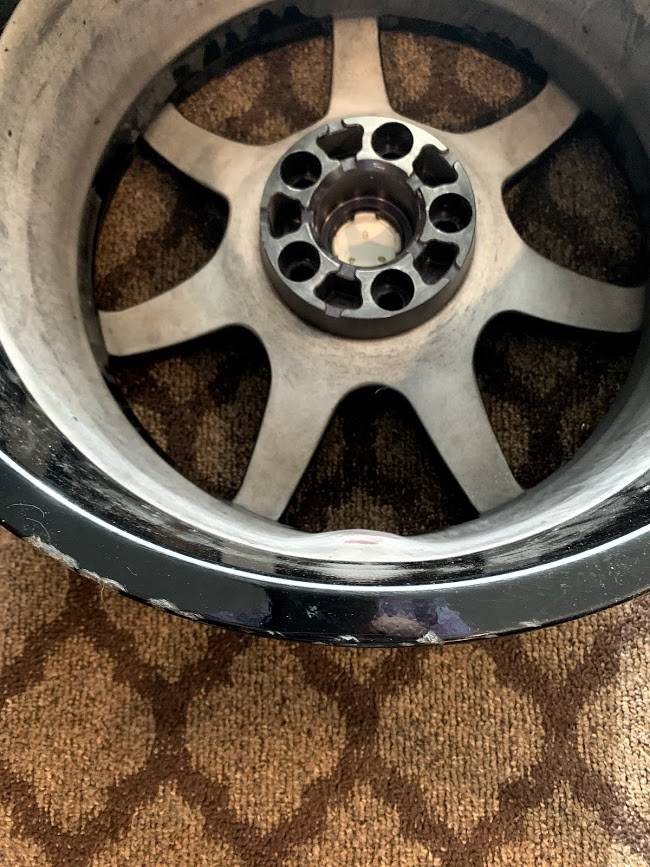
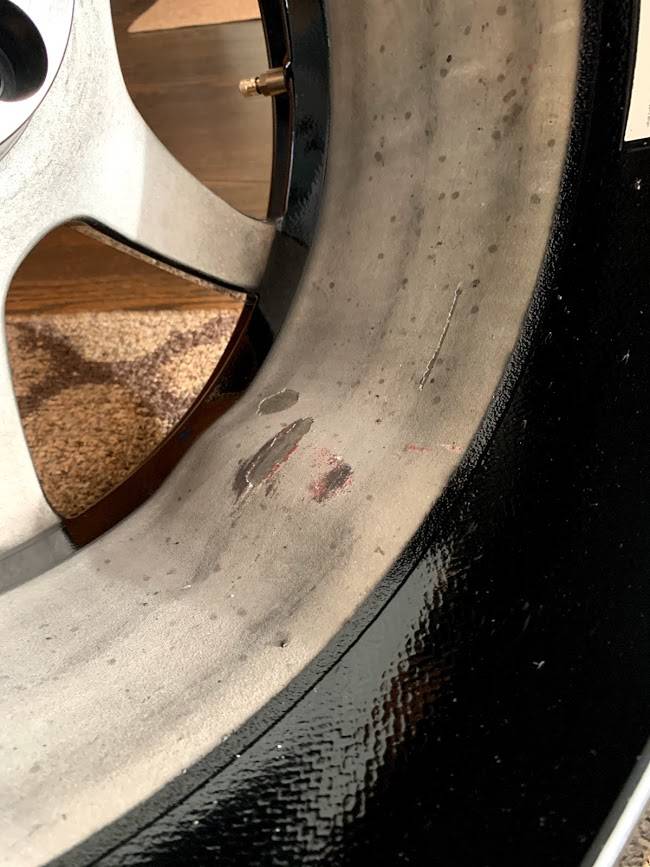
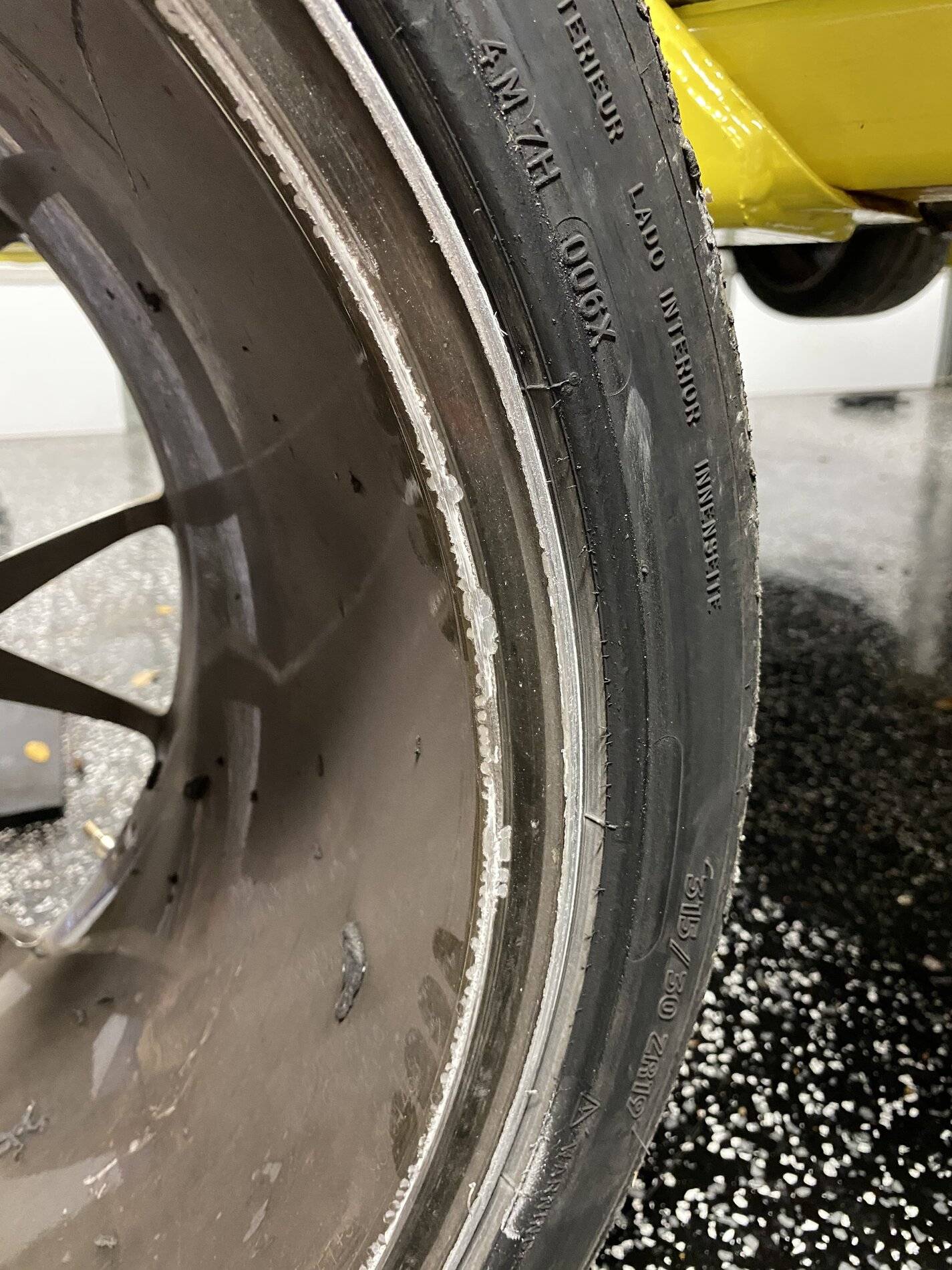
Your 2nd question is what happens when the ceramic coating fails? Here is one failure mode, that is unique to my knowledge. What you are seeing is a bubble in the resin layer under the ceramic coating. (You can see red paint from where the 'bubble' scraped the caliper). The bubble happened while the car was parked ... no issue while rolling off the track, then I parked the car, then 10 minutes later jumped back in to move it and the wheel welt was hitting the caliper.

Also note that the rash on the inside of the barrel lip is from dropping the wheel off the inside of a curb at Mid Ohio in a 100-mph corner, 2+ years and many track events before the ceramic/ resin failure. Doing that lap after lap did no damage to the wheel structurally. Ford replaced this wheel under warranty.
qSQTyTYPCGINBXqiQYy7exPD9l=w651-h867-no?authuser=0.jpg

WE9ePw5KEWT1J31IjyaH4zxMx-=w651-h867-no?authuser=0.jpg
 

Sponsored

oldbmwfan

Well-Known Member
Joined
Oct 19, 2016
Threads
0
Messages
789
Reaction score
947
Location
Chicagoland
Vehicle(s)
2017 GT350R
And holy lord - the brake dust on the front rims. I wiped them down shiny clean two days ago. I drove maybe 10 miles the other day and then 7 miles today and the brake dust accumulation is crazy. I put Hawk ceramic pads on my 2018 front rims and this cut back on brake dust big time. Do the 2020 GT350Rs come with ceramic pads from the factory?
No, they come with pads that work. Dust is a byproduct. (Sorry, I f'n HATE ceramic pads and their mushy pedal feel)
 
OP
OP
AgSurfer

AgSurfer

Well-Known Member
Joined
Mar 3, 2021
Threads
48
Messages
410
Reaction score
216
Location
Ohio
First Name
Steve
Vehicle(s)
2020 Shelby GT350R / 2021 Shelby GT500
They are very strong and survived all the standard Ford wheel torture tests, which includes fairly high-speed strikes into a curb.

People are worried mostly about cosmetic damage and the expense of repairs.

In extreme cases, if there is a failure, it is likely to render the car undriveable (as noted above, a big hit can bend an Al window but will crack a CF wheel - but that is a VERY big hit).

Your 2nd question is what happens when the ceramic coating fails? Here is one failure mode, that is unique to my knowledge. What you are seeing is a bubble in the resin layer under the ceramic coating. (You can see red paint from where the 'bubble' scraped the caliper). The bubble happened while the car was parked ... no issue while rolling off the track, then I parked the car, then 10 minutes later jumped back in to move it and the wheel welt was hitting the caliper.

Also note that the rash on the inside of the barrel lip is from dropping the wheel off the inside of a curb at Mid Ohio in a 100-mph corner, 2+ years and many track events before the ceramic/ resin failure. Doing that lap after lap did no damage to the wheel structurally. Ford replaced this wheel under warranty.
qSQTyTYPCGINBXqiQYy7exPD9l=w651-h867-no?authuser=0.jpg

WE9ePw5KEWT1J31IjyaH4zxMx-=w651-h867-no?authuser=0.jpg
Great info sir.
 

luc

Well-Known Member
Joined
Mar 25, 2018
Threads
16
Messages
2,253
Reaction score
2,585
Location
CA
Vehicle(s)
2017 GT with PP
The real experts on the CF wheels on the forum seem to be those who have never owned or driven an R, so I'll wait for those to chime in shortly. It's important to distinguish between worrying about functional damage vs cosmetic damage. Those of us who drive around on the street with them aren't really worried about functional damage as much as cosmetic damage. Coming from other cars, you have a couple factors working against you. First the tire sidewalls are very low profile and stretched slightly in the rears. So not only do the rear wheels protrude slightly, but the widest part of the car is from rear wheel rim edge to rear wheel rim edge, and these edges are very close to the ground. So while you might not 'curb' the wheel in a parking lot, a large pot hole can cause enough tire deflection to scrape the wheel rim. There are other things on the street you can't always account for. Say you're driving but have to pull aside for an ambulance - if you have to pull off the side of the road, the edge between the road and grass or gravel could be enough to scrape the wheel. Or you're going down a street and enter a road construction zone. The torn up road could contact and scratch the wheel somewhere.

That being said - that's cosmetic damage, and can typically be repaired. When I spoke with one of the employees at Carbon Revolution back in 2017 he had said the outer rim layers of carbon aren't really structural - they couldn't produce a street legal wheel in which curb contact would render it structurally weakened. Frank at Spyder Composites in CA, the official service and repair spot for the wheels, confirmed, and said that he can even lay in a new layer of weave if the rim gets scraped up. Grant it, you're then looking at an expensive repair or refresh.

When I spoke to the person at CR, if I recall correctly (again this was several years ago), he said the ceramic coating was something they were applying to the wheels even before the GT350R. It wasn't necessarily that the GT350R 'required' the coating, but more that they and Ford spec'd it given the proximity to the calipers. So I don't know if anyone can honestly tell you what the risks of a failed coating would be. You quoted the increase strength there too, but remember the ceramic coating isn't related to the strength of the wheel as much as the melting point of the epoxy.

Actual "functional" failures of the wheels are relatively rare. I can only recall having seen a couple on the forum in the past couple years. So all that being said, you can drive the car on the road without living in constant fear of something that couldn't later be touched up or refinished by Spyder. Now, driving thousands of miles on the road without ever seeing a scratch? That might be harder.
What Is the weight difference between a light, good quality aluminum wheel and CF ?
 

ChipG

Well-Known Member
Joined
Jan 27, 2021
Threads
33
Messages
532
Reaction score
590
Location
Nashville TN
First Name
Chip
Vehicle(s)
'20 GT350/'95 F250/'65 Fastback/'96 Cobra Project
What Is the weight difference between a light, good quality aluminum wheel and CF ?
From what I've seen, I think the CF wheels are 17/18# and a good lightweight forged wheel could be found in 21# - 25# range.
 

Demonic

Well-Known Member
Joined
Feb 21, 2017
Threads
20
Messages
1,118
Reaction score
1,203
Location
Boston
First Name
Austin
Vehicle(s)
GT350R
What Is the weight difference between a light, good quality aluminum wheel and CF ?
There are high quality aluminum rims that come close to the CF rims in weight alone, like Forgelines on the GT350C, say in the range of 21-22 lb if I recall. But you also have to consider where the mass is. For the sake of angular momentum you want to avoid weight around the edge/rim. The advantage of the CF is a light barrel, and the strength decreases barrel deflection in hard corners. In a high G corner, the barrel of the wheel can deflect enough to change the tire camber.
 

Sponsored

460Fred

Well-Known Member
Joined
Oct 19, 2019
Threads
75
Messages
2,147
Reaction score
1,786
Location
Wyoming
First Name
Fred
Vehicle(s)
‘19 GT350 (sold)
They are very strong and survived all the standard Ford wheel torture tests, which includes fairly high-speed strikes into a curb.

I’ve always been curious about the OEM standards and testing for wheels sold in the US market.
Please provide further information or a link.
I know wheels sold in the German market must pass rigorous testing set by the German Govt. This includes aftermarket or OE wheels.
Here in the US, not so much.
I’m thinking standards the OEM’s follow are set internally for liability reasons first, performance second for Cars sold in the USA.
 

Scoobs

Well-Known Member
Joined
Jun 23, 2016
Threads
4
Messages
407
Reaction score
356
Location
Ontario
Vehicle(s)
2017 MG GT350 sold, 2019 MG GT350R KR569
The ceramic coating on the front CF wheels was designed to handle the heat caused by a complete failure of the brakes due to excessive heat from braking, exceeding 900 degrees C.

https://www.motortrend.com/news/ford-spills-details-on-shelby-gt350r-mustangs-carbon-fiber-wheels/

https://sam.abuelsamid.com/2015/05/06/2015-ford-shelby-gt350-built-from-the-wheels-up/


Tom mentions testing the brakes to failure in the first post of his thread

https://www.mustang6g.com/forums/threads/gt350r-carbon-fiber-wheel-repair.120081/
 
Last edited:

Demonic

Well-Known Member
Joined
Feb 21, 2017
Threads
20
Messages
1,118
Reaction score
1,203
Location
Boston
First Name
Austin
Vehicle(s)
GT350R
I’ve always been curious about the OEM standards and testing for wheels sold in the US market.
Please provide further information or a link.
I know wheels sold in the German market must pass rigorous testing set by the German Govt. This includes aftermarket or OE wheels.
Here in the US, not so much.
I’m thinking standards the OEM’s follow are set internally for liability reasons first, performance second for Cars sold in the USA.
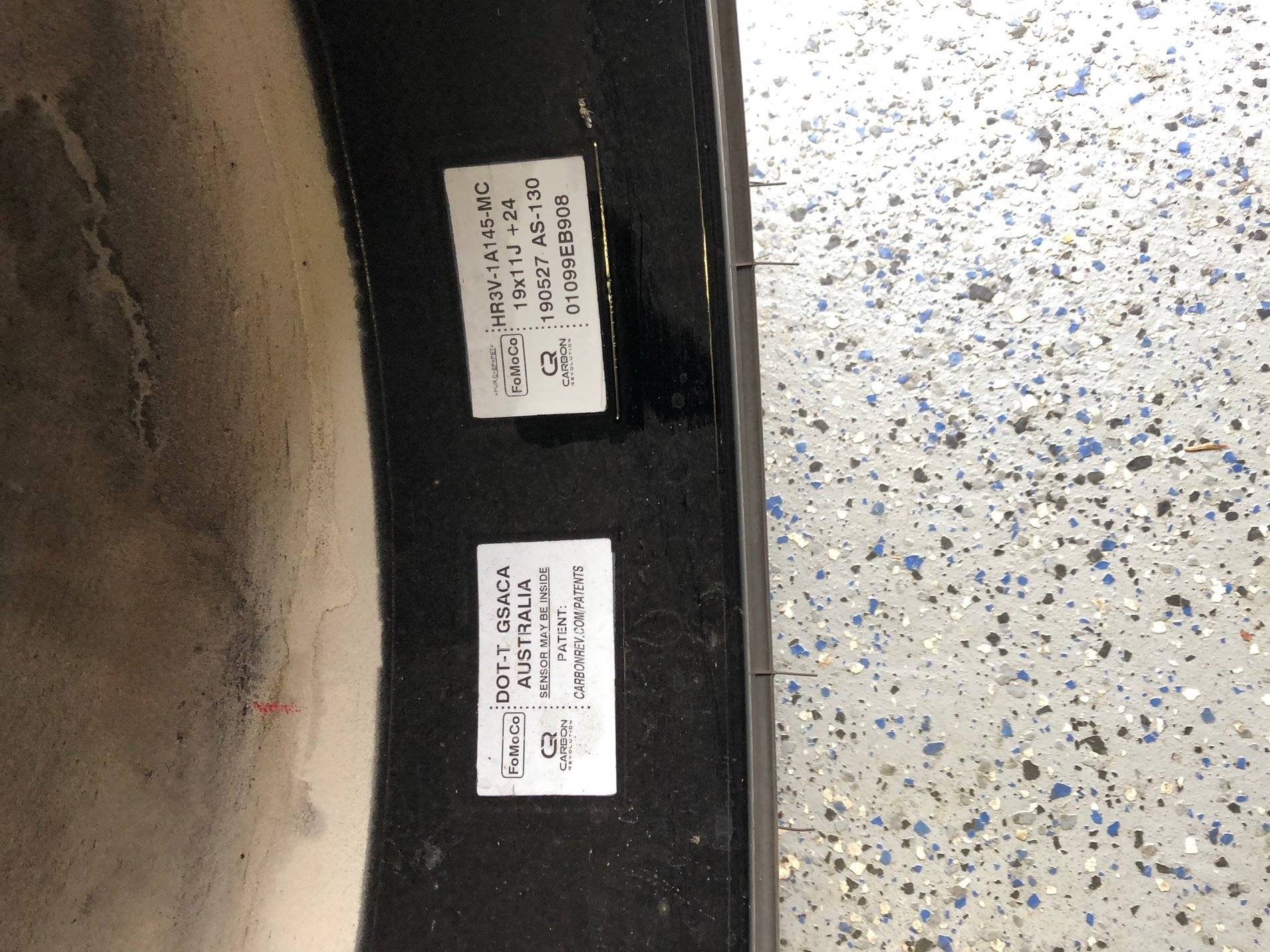
Since these are OEM wheels for a car, they are also required to go through very specific and rigorous govt testing. The inside label on this pic shows the DOT-T rating. (pic lifted from elsewhere on the forum).

https://www.govinfo.gov/content/pkg/CFR-2002-title49-vol5/pdf/CFR-2002-title49-vol5-sec571-120.pdf


img_2031-jpg.jpg
 

honeybadger

Just don't care
Joined
Apr 20, 2016
Threads
63
Messages
4,120
Reaction score
7,497
Location
COTA
First Name
Kevin
Vehicle(s)
'17 GT350
Count me in the camp not recommending the CF wheels for heavy track use...but my objection is purely practical and not performance oriented.

This happened this weekend to my forged wheel when my upper control arm broke. I’ve also bent a few and scraped all the rest. The nice thing about forged wheels is they can be bent back to round for about $75 if they didn’t fully break. And, you can buy an entire forged set of wheels for the cost of 1 to 1 1/4 of a CF replacement (or replace a broken forged wheel for the cost of repair to a CF wheel).

38DC3C1A-50B7-416A-BA5F-8870C60A975E.jpeg


The carbons are badass. And superior in performance. But from a practical standpoint, they just don’t make sense to me. Spend enough time on track, you’re going to break stuff. I’d rather break stuff that’s more repairable and cheaper to fix. Wheels are a consumable regardless of material.
 

WildHorse

N/A or GO HOME
Joined
Jun 28, 2017
Threads
270
Messages
10,297
Reaction score
8,350
Location
Home World: CLASSIFIED
First Name
Puddintane
Vehicle(s)
'17 S550
Vehicle Showcase
1
People are worried mostly about cosmetic damage and the expense of repairs.
If you chip or take a chunk out of a aluminum rim, which we all know happens IE curb rash, it's usually not a big deal. Try the same with a CF wheel. You don't need own CF wheels to realize the outcome as one poster alluded to.
Sponsored


Top