Sponsored

Stepped headers

AZlb5.0

Banned
Banned
Banned
Joined
Nov 16, 2022
Threads
42
Messages
1,157
Reaction score
1,367
Location
Arizona
First Name
Carlos
Vehicle(s)
18 GT Premium
  • Thread starter
  • Banned
  • #1
After doing some reading I think this is the rout I want to go. The car will ultimately have a 150 hit of nitrous but I think this rout will keep the grunt down low with the ability to also make power up top. For those of you who have gone this route I have a couple of questions:

How have they performed?
Would you recommend them?
TIA
Sponsored

 

308 Cal. Bullitt

Well-Known Member
Joined
May 3, 2020
Threads
9
Messages
408
Reaction score
465
Location
Midwestern-former Left coast
First Name
Dee
Vehicle(s)
'22 GT500 + other 2/4/& 6 wheeled trash barges
I doubt we can be of much help to you, even though we have built more step headers than we could ever recall over a few+ decades.
Started building them in early '90s for our clients. I say we can not likely be of much help, because we were doing them for V8, NA, 2 valve, cam in block stuff, w/62.5+ cubic inches per cylinder, & occasionally something smaller in the 50" per cyl range.
(So no real experience with 4v EFI....& that does matter at least a bit, based on what we learned w/EFI vs carb signals, since step headers signal the intake tract harder)

Steps make more power in our experience. Never seen a set make less power, but on rare occasion, the gains were a bit close to negligible. Perhaps they were slightly sized wrong on rare occasion to net measurable gains. We are prof car builders. Our area of expertise is largely drag racing. We are Not professional eng builders. So we had to rely on our clients feedback from the pump (waterbrake dyno).
There is no real down side to them in a NA car, or an eng w/sniff on it, like you said you planned to run. On supercharged stuff we usually built headers, as large as what worked end to end- so No cross sectional area changes thru out the primary. Steps showed no gains in big boost programs.
We played around with 4-2-1 collectors for a few yrs,
(4-2-1's are not the same as a merge collector, & rarely used nowadays as I can tell. They add quitea bit of lengthto the pkg, & many cars justdon'thave the space nowadays)
as those usually made more mid range torque than a standard collector, & not as peaky as a merge collector output design.

Usually per the clients request, we built steps, in most cases. Custom racecars required custom headers, & building a set of headers is quite easy compared to the car itself. So we were in the business by default, until specialty header builders became much more prevalent in the industry. Freeing us up to do other things I suppose. We always had more work than the qualified man power to do it. So subcontracting anything usually benefited us.

Step headers signal a bit harder than straight primaries, so they may not be quite as beneficial (to your EFI situation) as it was for the bulk of our clients, who ran very high quality carbs, & just a handful of them running EFI, by comparison.
The EFI guys benefited more on power output, once they realized they needed something closer to batch fire EFI, when dealing w/cycle speeds well above 8000Rpm,
(vs a true sequential injection) which was eventually discovered to be needed to get the most out of everything. Carbs lay fuel on the back side of the valve when the intake ( or intakes) closes, by nature. This proved critical to understand, once we didn't have it with properly timed EFI, since you needed that rich fatty mixture when the valve 1st opened for the Combustion event, to give you a rich, stochiometric clump of air/fuel, to start & spread the flame front of a leaner mixture, of around 0.31 to 0.35 BSFC. Why is the EFI stuff relevant to a header? Because your increasing the signal with a step header. So understanding your fuel distribution/metering may be effected differently, than a closed loop 02 metering.
I say "may". Because I am not by any means an expert in this area-- 'Not our wheelhouse'.

We always thought sequential fuel injection ( before we had it in a hi quality system) was gonna give us something carbs never could, & we needed to get to the high resolution EFI systems that we knew technology would eventually bring to us, only to then find out that carbs were quicker than EFI, initially.
NHRA Pro Stock even proved that, as it took awhile for mandated EFI technology to run as qwik, & as much mph, as the carburetor stuff did. We didn't know how good the csrb experts had gotten at metering fuel, even with low, intermediate, & high speed circuitry. We gained even more respect for there skills in fuel distribution & homogeneous mixture control.

As for the actual header construction itself, we dont mind building step headers, because they go together a bit qwiker, (thus easier) & the only down side is there can be a small amount of increased waste from mandated cuts every so many inches as you travel down all 8 primary tubes.
Not really relevant, (the waste) since you can often use the drop pcs in the future on another set at some point. We kept bins if every size in scraps/drops, to use in future.
Our standard formula was close to (no exactly-just a example)
of a 1/3, - 1/3, & a 1/3, when doing a 3 step.
Some guys only do 2 steps. As to where to place the steps, in our area of eng types, ( nothing close to yours) we usually did ~8" out from the flange, on say, a ~28" long primary. The last length on a 3 step us usually the longest of the 3, obviously.

I have no way to quantify the actual hp/Torque gains on a 4 valve EFI, with less than 40 cubic inches per cylinder, like a 5.0L

As we said, we never saw a NA or a nitrous eng that made LESS power w/a step header, vs a straight cross section primary. May not make much more, but less is rather unlikely, unless boosted perhaps. Boosted to us means over ~38lbs thou, & closer to ~50+lbs.

So as I said in the beginning, this may be of no help to you. Good luck in what you decide. If I were building a set of headers for my own GT500, & staying under 20-25lbs of boost, Id be building step headers myself. We have our own 'Indian Tricks' to do near the collector, to fool the collector into thinking its a merge collector...
....vs the cost to buy, or the labor to build a full merge. They are labor intensive.
I dont even know if anyone in the "production header arena"
even builds a 4-2-1 collector these days?? or not,-- but they did make more power that a straight collector in our experience, on our clients stuff.
Well, more Torque I should say. Not necessarily much more peak hp. Pesk hp is overated in nearly everything that needs a reasonably wide/broad Torque curve.
Torque accelerates a vehicle, not hp. We just get an artificial Torque gains nowadays with these 7spd trannys like our 500, & the 10spd in the GTs & Mock. Torque multiplication by gear ratio, as opposed to being largely from the bk flange of the crank arm itself.

The ring & pinion doesn't really care how the LbFt of Torque got there. Packaging a 4-2-1 collector on 1 of these cars may prove to be prohibitive by space constraints.
& a good merge design will likely get you close enough. Yet, doubtful it will ever produce the midrange Torque of the 4-2-1, though, that we seen via the dyno. Again, our eng design/size experience are vastly different thsn a 5.0L eng. So take this info w/grain of salt.

None of the gains between everything discussed above are all so vast, that you must have any 1 design in particular, or your fate will be catastrophic. They all work. Even a straight header.
Regards,
 
Last edited:
OP
OP
AZlb5.0

AZlb5.0

Banned
Banned
Banned
Joined
Nov 16, 2022
Threads
42
Messages
1,157
Reaction score
1,367
Location
Arizona
First Name
Carlos
Vehicle(s)
18 GT Premium
  • Thread starter
  • Banned
  • #3
I doubt we can be of much help to you, even though we have built more step headers than we could ever recall over a few+ decades.
Started building them in early '90s for our clients. I say we can not likely be of much help, because we were doing them for V8, NA, 2 valve, cam in block stuff, w/62.5+ cubic inches per cylinder, & occasionally something smaller in the 50" per cyl range.
(So no real experience with 4v EFI....& that does matter at least a bit, based on what we learned w/EFI vs carb signals, since step headers signal the intake tract harder)

Steps make more power in our experience Never seen a set make less power, but on rare occasion, the gains were a bit close to negligible. Perhaps they were slightly sized wrong on rare occasion to net measurable gains. We are prof csr builders. Not professional eng builders. So we relied on our clients feedback from the pump (aka: waterbrake dyno)
There is no real down side to them in a NA car or an eng w/sniff on it, like you said you planned to run. On supercharged stuff we usually just built headers as large as what worked end to end- so No cross sectional area changes thru out the primary.
We played around with 4-2-1 collectors for a few yrs, as those made more mid range torque than a standard collector, & not as peaky as a merge collector output.

Usually per the clients request, we built steps in most cases. Cudtom racecars required custom hesders, & building a set of headers is quite easy compared to the car itself. So we were in the business by default, until specialty header builders became more prevalent in the industry.
These were nearly all drag race cars btw.

Steps signal a bit harder, so they may not be quite as beneficial (to your EFI situation) as it was for the bulk of our clients, who ran very high quality carbs, & just a handful of them running EFI, by comparison.
The EFI guys benefited more on power output, once they realized they needed something closer to batch fire EFI, when dealing w/cycle speeds well above 8000Rpm,
(vs a true sequential injection) which was eventually discovered to be needed to get the most out of everything. Carbs lay fuel on the back side of the valve when the intake ( or intakes) closes, by nature. This proved critical to understand, once we didn't have it with properly timed EFI, since you needed that rich fatty mixture when the valve 1st opened for the Combustion event, to give you a rich, stochiometric clump of air/fuel, to start & spread the flame front of a leaner mixture, of around 0.31 to 0.35 BSFC. Why is the EFI stuff relevant to a header? Because your increasing the signal with a step header. So understanding your fuel distribution/metering may be effected differently, than a closed loop 02 metering.
I say "may". Because I am not by any means an expert in this area-- 'Not our wheelhouse'.

We always thought sequential fuel injection ( before we had it in a hi quality system) was gonna give us something carbs never could, & we needed to get to the high resolution EFI systems that we knew technology would eventually bring to us, only to then find out that carbs were quicker than EFI, initially.
NHRA Pro Stock even proved that, as it took awhile for mandated EFI technology to run as qwik, & as much mph, as the carburetor stuff did. We didn't know how good the csrb experts had gotten at metering fuel, even with low, intermediate, & high speed circuitry. We gained even more respect for there skills in fuel distribution & homogeneous mixture control.

As for the actual header construction itself, we dont mind building step headers, because they go together a bit qwiker, (thus easier) & the only down side is there can be a small amount of increased waste from mandated cuts every so many inches as you travel down all 8 primary tubes.
Not really relevant, (the waste) since you can often use the drop pcs in the future on another set at some point. We kept bins if every size in scraps/drops, to use in future.
Our standard formula was close to (no exactly-just a example)
of a 1/3, - 1/3, & a 1/3, when doing a 3 step.
Some guys only do 2 steps. As to where to place the steps, in our area of eng types, ( nothing close to yours) we usually did ~8" out from the flange, on say, a ~28" long primary. The last length on a 3 step us usually the longest of the 3, obviously.

I have no way to quantify the actual hp/Torque gains on a 4 valve EFI, with less than 40 cubic inches per cylinder, like a 5.0L

As we said, we never saw a NA or a nitrous eng that made LESS power w/a step header, vs a straight cross section primary. May not make much more, but less is rather unlikely, unless boosted perhaps. Boosted to us means over ~38lbs thou, & closer to ~50+lbs.

So as I said in the beginning, this may be of no help to you. Good luck in what you decide. If I were building a set of headers for my own GT500, & staying under 20-25lbs of boost, Id be building step headers myself. We have our own 'Indian Tricks' to do near the collector, to fool the collector into thinking its a merge collector...
....vs the cost to buy, or the labor to build a full merge. They are labor intensive.
I dont even know if anyone in the "production header arena"
even builds a 4-2-1 collector these days?? or not,-- but they did make more power that a straight collector in our experience, on our clients stuff.
Well, more Torque I should say. Not necessarily much more peak hp. Pesk hp is overated in nearly everything that needs a reasonably wide/broad Torque curve.
Torque accelerates a vehicle, not hp. We just get an artificial Torque gains nowadays with these 7spd trannys like our 500, & the 10spd in the GTs & Mock. Torque multiplication by gear ratio, as opposed to being largely from the bk flange of the crank arm itself.

The ring & pinion doesn't really care how the LbFt of Torque got there. Packaging a 4-2-1 collector on 1 of these cars may prove to be prohibitive by space constraints.
& a good merge design will likely get you close enough. Yet, doubtful it will ever produce the midrange Torque of the 4-2-1, though, that we seen via the dyno. Again, our eng design/size experience are vastly different thsn a 5.0L eng. So take this info w/grain of salt.

None of the gains between everything discussed above are all so vast, that you must have any 1 design in particular, or your fate will be catastrophic. They all work. Even a straight header.
Regards,
Thanks for the reply and that’s a ton of good info. This is what I’m trying to accomplish. It’s going to be mainly a street car. So 1 3/4 x 3 headers help with low to midrange torque on the 5.0 engines but once you get to higher revs the restriction will slow down the exhaust speed and thus hinder scavenging effect and you’ll lose power up top because you can’t get the exhaust out fast enough.

If I go with the 1 3/4 - 1 7/8 x 3. I’m thinking that I’ll not only will I keep the torque down/mid but once I’m spraying 3500-6800 (shifting@7K) and get to the higher rpm’s 6800-7200 where you need the bigger primaries the step up will help maintain exhaust speed and scavenging effect and I won’t lose that top end power, I’m trying to maintain. In another words trying to kill 2 birds with one shot. Being able to make power up top while keeping the low to mid rpm tq.

I am running an M6 and again thanks for the detailed post. 🫡
 

Decible

Well-Known Member
Joined
Dec 27, 2020
Threads
52
Messages
932
Reaction score
500
Location
Georgia
First Name
Sam
Vehicle(s)
2023 Mach 1 HP
I wish I wish I wish the equal length stepped ramjet headers from Australia worked on the American cars 😭
 

Sponsored

K4fxd

Well-Known Member
Joined
Apr 2, 2020
Threads
121
Messages
13,455
Reaction score
12,262
Location
NKY
First Name
Dan
Vehicle(s)
2017 gt, 2002 FXDWG, 2008 C6,
If I go with the 1 3/4 - 1 7/8 x 3.
I've not done much with stepped headers. So grain of salt.

I still believe you need to size the smallest step for the max amount of air. In other words I would make the smallest tube 1 7/8.

I would think the 1 3/4 step would restrict the top end
 
OP
OP
AZlb5.0

AZlb5.0

Banned
Banned
Banned
Joined
Nov 16, 2022
Threads
42
Messages
1,157
Reaction score
1,367
Location
Arizona
First Name
Carlos
Vehicle(s)
18 GT Premium
  • Thread starter
  • Banned
  • #7
I've not done much with stepped headers. So grain of salt.

I still believe you need to size the smallest step for the max amount of air. In other words I would make the smallest tube 1 7/8.

I would think the 1 3/4 step would restrict the top end
but that’s what the 2nd step is for Im assuming. To help with the scavenging of the smaller primary. The first post from @308 Cal. Bullitt has a shit ton of info. Some I can read and other that’s Chinese to me but I get the majority of what he’s trying to say.

I sent an email to ARH. I’m hoping someone will call me next week and see what their thoughts are since they are also in the exhaust game. These engines are tricky because of the power they make but the small volume of the cylinder. They are a top end engine for sure but there’s power to be made down low and that’s what I’m trying to exploit if I can with a set correctly made headers.
 

K4fxd

Well-Known Member
Joined
Apr 2, 2020
Threads
121
Messages
13,455
Reaction score
12,262
Location
NKY
First Name
Dan
Vehicle(s)
2017 gt, 2002 FXDWG, 2008 C6,
They are a top end engine for sure but there’s power to be made down low and that’s what I’m trying to exploit if I can with a set correctly made headers.
Like I said I have not played wit stepped. I do know at blow down the gas is at its fastest and due to heat has the most volume, however it is the least dense. I don't know if that step will restrict or not.

Maybe reach out to the Ausie' (ramjet) who make the equal length stepped headers and find out what they say works best.

Hopefully they tested.
 
OP
OP
AZlb5.0

AZlb5.0

Banned
Banned
Banned
Joined
Nov 16, 2022
Threads
42
Messages
1,157
Reaction score
1,367
Location
Arizona
First Name
Carlos
Vehicle(s)
18 GT Premium
  • Thread starter
  • Banned
  • #9
Like I said I have not played wit stepped. I do know at blow down the gas is at its fastest and due to heat has the most volume, however it is the least dense. I don't know if that step will restrict or not.

Maybe reach out to the Ausie' (ramjet) who make the equal length stepped headers and find out what they say works best.

Hopefully they tested.
They only make RHD ones. I already reached out. If ARH doesn’t have any options I’m going to go with lethal performance. They sell a set of Pypes stepped headers. Right now it seems they are the only ones with a set for 5.0s. Then it’s all about tuning and seeing how they work out. I’ll be making a thread once I get the car set up completely with nitrous and see how it all works together.
 

K4fxd

Well-Known Member
Joined
Apr 2, 2020
Threads
121
Messages
13,455
Reaction score
12,262
Location
NKY
First Name
Dan
Vehicle(s)
2017 gt, 2002 FXDWG, 2008 C6,
They only make RHD ones
RHD or LHD won't matter. I'd ask them about the tube sizes and if they tested different ones. If they say 1 3/4 works to 8200 all is good.
 

Sponsored
OP
OP
AZlb5.0

AZlb5.0

Banned
Banned
Banned
Joined
Nov 16, 2022
Threads
42
Messages
1,157
Reaction score
1,367
Location
Arizona
First Name
Carlos
Vehicle(s)
18 GT Premium
RHD or LHD won't matter. I'd ask them about the tube sizes and if they tested different ones.
Oh gotcha I can definitely do that. Thanks for clearing that up.
 

GregO

Well-Known Member
Joined
Mar 5, 2018
Threads
41
Messages
3,320
Reaction score
2,470
Location
Illinois
Vehicle(s)
S550 GTPP
It’s the header bend radius directly off the head that matters and a 6” radius is an ideal first bend for header fabrication.
The unfortunate reality is the S550 strut towers will not allow a 6” bend radius off the Coyote heads. Anytime the first header bend is less than a 6” radius the tubing size must be increased in diameter. I’m of the opinion that 1.875” or 2.0” primary diameter is ideal when fitting thin wall tubular headers in the S550 chassis.
The theoretical loss in low end torque isn’t a real issue when dealing with 4 valve VCT heads. Header tuning can be sloppy at best and still make great power due to 4V flow characteristics and the ability to control cam timing. This isn’t a 2V motor so most of what we think we know about header design and scavenging goes out the window with 4V VCT motors.
IMO, go with 2.0” primary’s and move on.
Pypes step tube headers don’t have the best primary layout plus they’re made in China.
AHR, Kooks or SW, I’ve seen a few post stating that the 2.0” fit better than 1.875”.
 
Last edited:

91gt331sc

Well-Known Member
Joined
Dec 21, 2018
Threads
17
Messages
122
Reaction score
87
Location
Bethlehem Pa
First Name
Chris
Vehicle(s)
2019 mustang gt, 2017 mustang gt
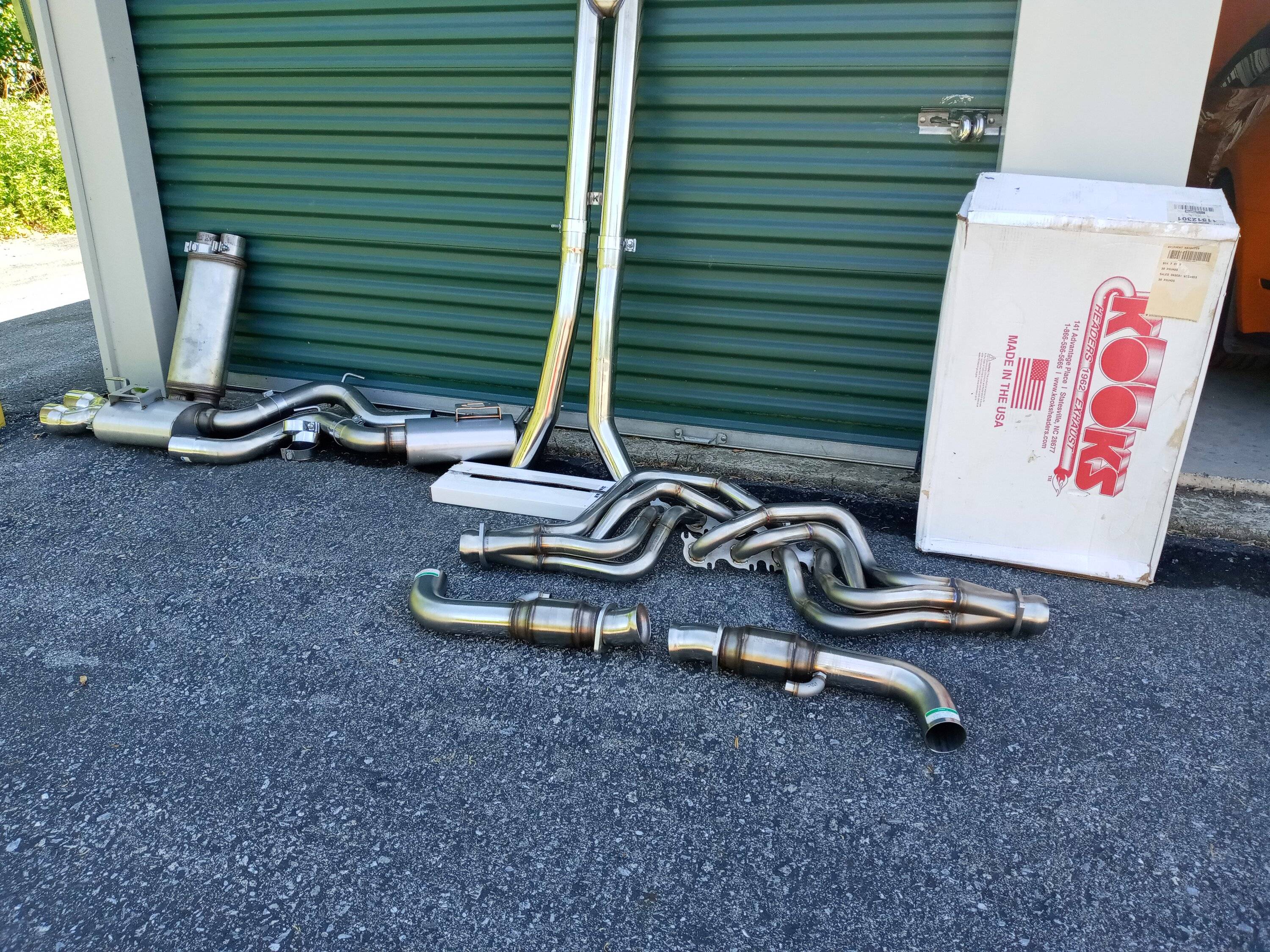
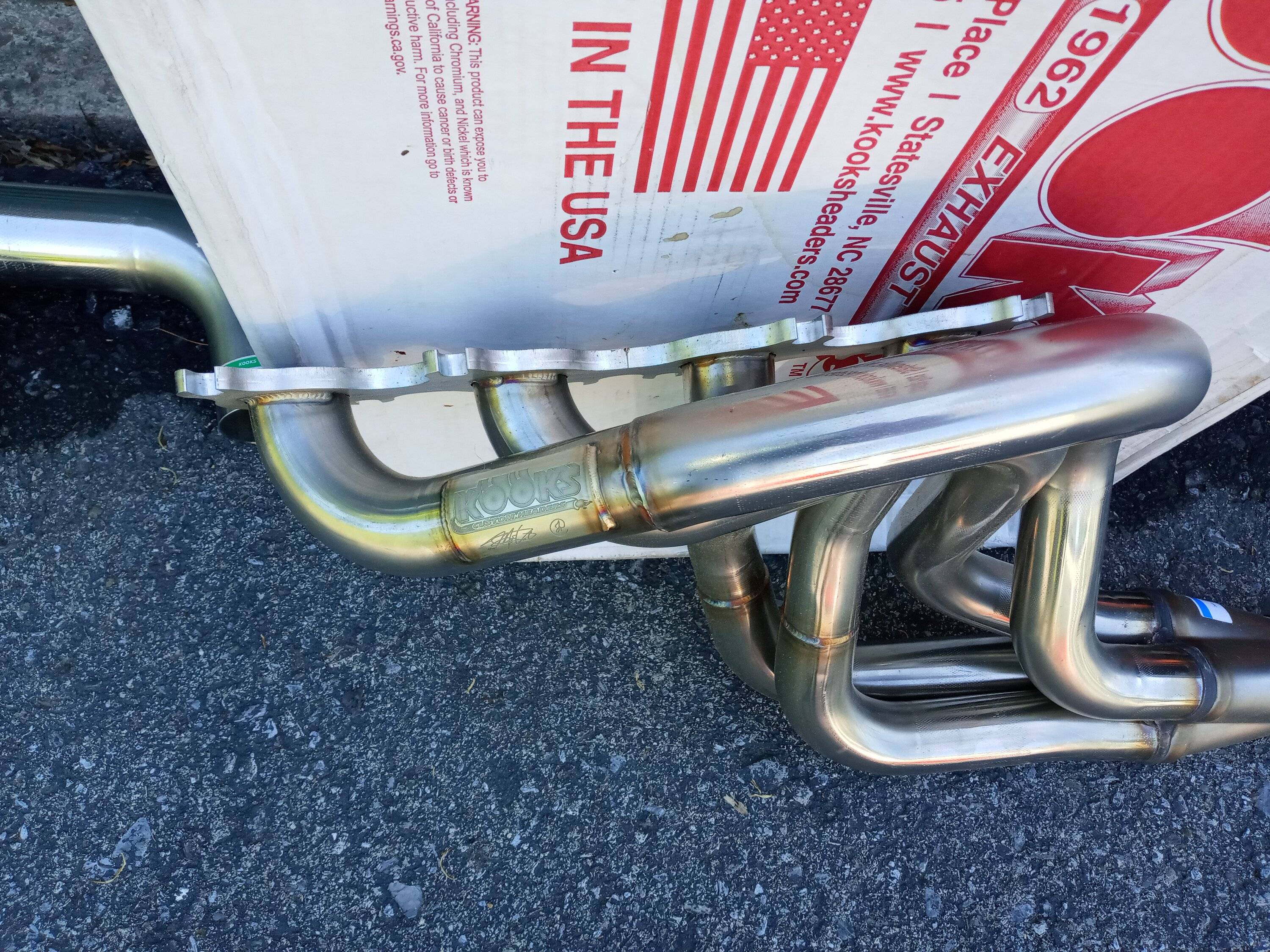
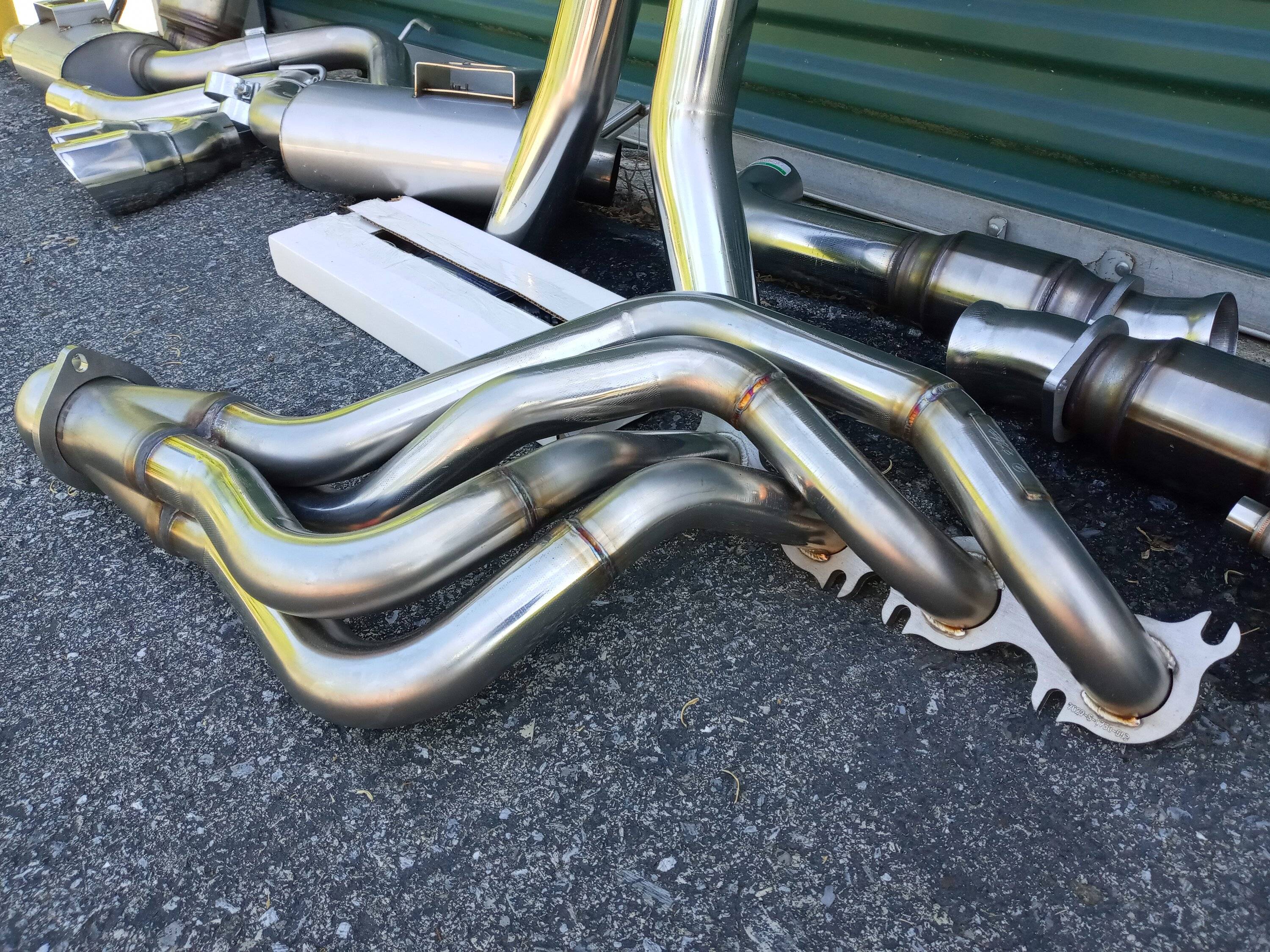
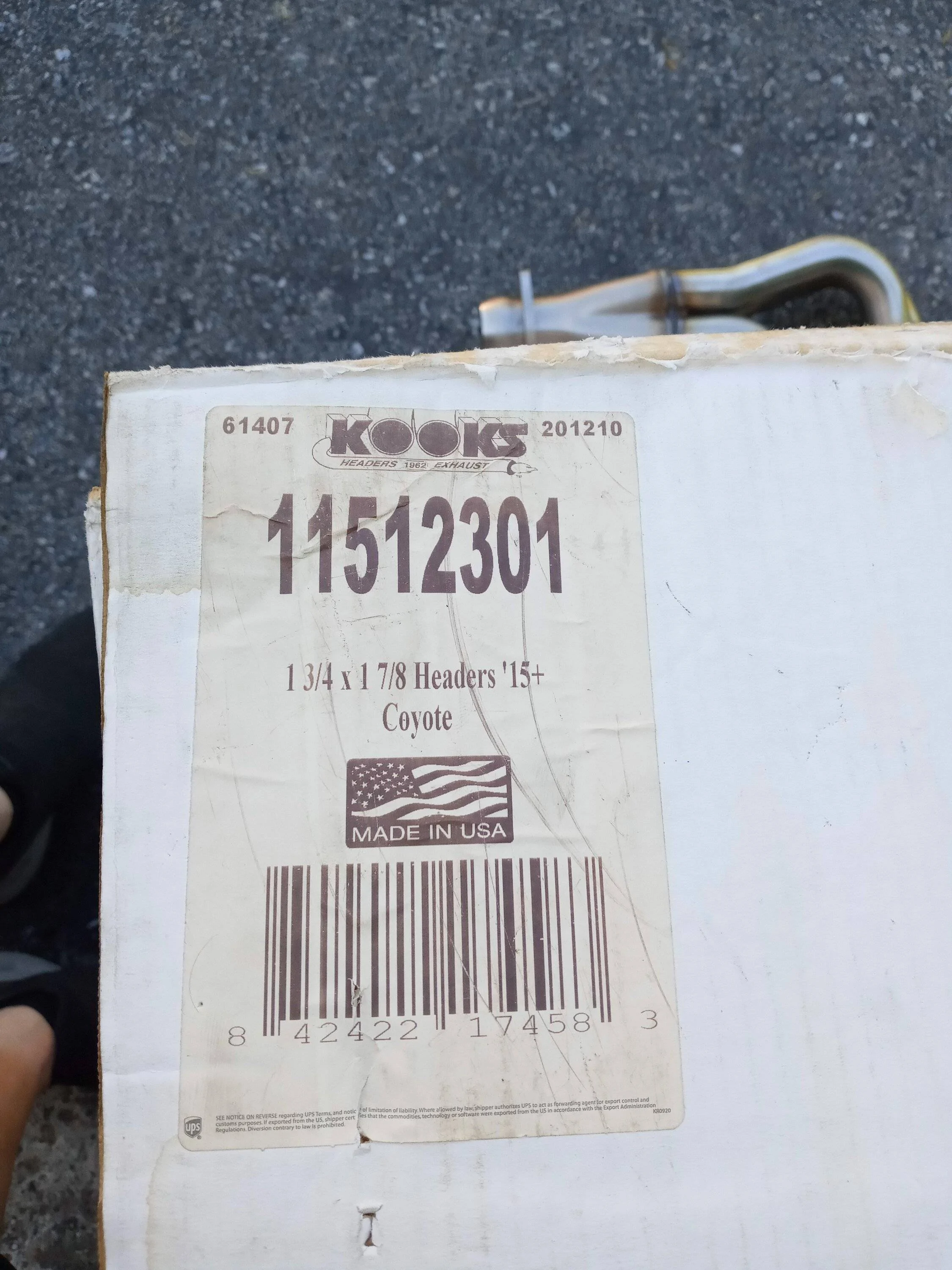
Installed mine yesterday. Kooks 1 3/4 to 1 7/8 stepped with green cats. I bought these a few years ago when stepped headers were very popular. Would have just went 1 7/8 if I didn't already have these. My car is just a manual trans pp1 car with a gt350 manifold and exhaust, if it end up getting a little more low end torque it would be a plus!

20230528_092100.jpg


20230528_093428.jpg


20230528_093513.jpg


20230528_093545.webp
 

NGOT8R

Well-Known Member
Joined
Jul 19, 2020
Threads
153
Messages
9,207
Reaction score
7,653
Location
Florida
First Name
Adrian
Vehicle(s)
2019 Bullitt
Installed mine yesterday. Kooks 1 3/4 to 1 7/8 stepped with green cats. I bought these a few years ago when stepped headers were very popular. Would have just went 1 7/8 if I didn't already have these. My car is just a manual trans pp1 car with a gt350 manifold and exhaust, if it end up getting a little more low end torque it would be a plus!
Will you please post some sound clips?
 

91gt331sc

Well-Known Member
Joined
Dec 21, 2018
Threads
17
Messages
122
Reaction score
87
Location
Bethlehem Pa
First Name
Chris
Vehicle(s)
2019 mustang gt, 2017 mustang gt
I will get some tomorrow. It is actually much quieter than I expected. It is very deep. I took off corsa active and installed kooks catback with h-pipe when I installed the headers.
Sponsored


Top