
Sponsored

Spun rod bearing..

GT Pony

Well-Known Member
Joined
Mar 13, 2015
Threads
77
Messages
9,402
Reaction score
4,839
Location
Pacific NW
Vehicle(s)
2015 GT Premium, Black w/Saddle, 19s, NAV
This could go back and forth and obviously you prefer and advocate thicker oil gives better protection, and in that camp there's plenty of information to support that. Conversely there is also information and studies that show that oil flow (not to be confused with pressure) is what keeps these very close tolerance parts and surfaces from overheating, and this fresh consistant flow oil is what promotes a oil wedge that is stable. I'm not saying if someone uses 5-30 instead of 5-20 that they will toast there motor by any means. It's when it's taken to far (thinking thicker oil always protection more) thicker viscosity oil will not give the same protection overall on a street car where most of us are driving out of Boost more than 90% of the time.
I agree ... you can go "too thick" on oil.

If you read everything I said in those 3 posts it boils down to choosing an oil that will provide the best oil film thickness in the journal bearing when the oil is at it's hottest expected temperature. That's exactly why Ford Performance recommends 5W-50 full synthetic for track use. The oil inside the journal bearing heats up even more than the sump temperature, so if your sump is at say 275 deg F (due to track use, etc), then the oil in that 30~80 micron wedge between the bearing and journal will most likely be over 300 deg F which will decrease the film thickness even more as shown in that chart I posted.

And I tried to make it clear that using too thick of an oil can reduce the oil flow to the engine components if the oil pump goes into pressure relief (by trying to force that thicker oil through the oiling system) at a much lower RPM than near redline. You will never lose any oil flow volume to speak of using a thicker oil if the positive displacement oil pump is in good shape and doesn't go into pressure relief. If the oil pump hit pressure relief at 4000 RPM with a thick oil vs 7000 RPM with a thinner oil, then there will be less oil volume going into the oiling system at 4000 RPM with the thicker oil (even if it's 5W-20) - that's the kind of situation you want to avoid. The GT350 oil pump uses the same OPGs as the 5.0L Coyote, but it's pressure relief is set higher to ensure it's still supplying adequate oil flow all the way to the higher redline.

Also, another reason to NOT go high RPM with thicker oil until it's at full operating temperature is because it can put the pump into pressure relief way too soon. 20W oil at 100 deg F is magnitudes thicker than 50 weight oil at 200 deg F. If you went high RPM with thick cold oil (even if it was 5W-20 because it's still thicker cold than hot), then it's possible the oil pump will hit pressure relief and starved the engine of oil flow at high RPM ... a bad situation. Keep RPMs way down until the oil is fully hot, even if running a specified low viscosity like 5W-20.

So the key to homing in on a good oil choice is to find one that's the right viscosity to match the maximum expected oil temperatures, and isn't so thick that it puts the oil pump in pressure relief way before redline when it's 200 deg or more. And also to find one that's supposedly better for high load/extreme load conditions and has good anti-wear properties if you can find decent comparison information between oils. Those properties (vs viscosity) helps more with preventing wear on things like cams, rings, gears and chains that aren't hydrodynamic lubrication like journal bearings are. Like I said, the whole key to keeping journal bearings safe is to maintain a good as possible minimum oil wedge thickness. You're only playing with 30~80 microns of oil film depending on your bearing clearance setting ... so not much room to play with. Once metal-to-metal contact starts, it's all a downhill spiral to total failure given enough time.
 
Last edited:

GT Pony

Well-Known Member
Joined
Mar 13, 2015
Threads
77
Messages
9,402
Reaction score
4,839
Location
Pacific NW
Vehicle(s)
2015 GT Premium, Black w/Saddle, 19s, NAV
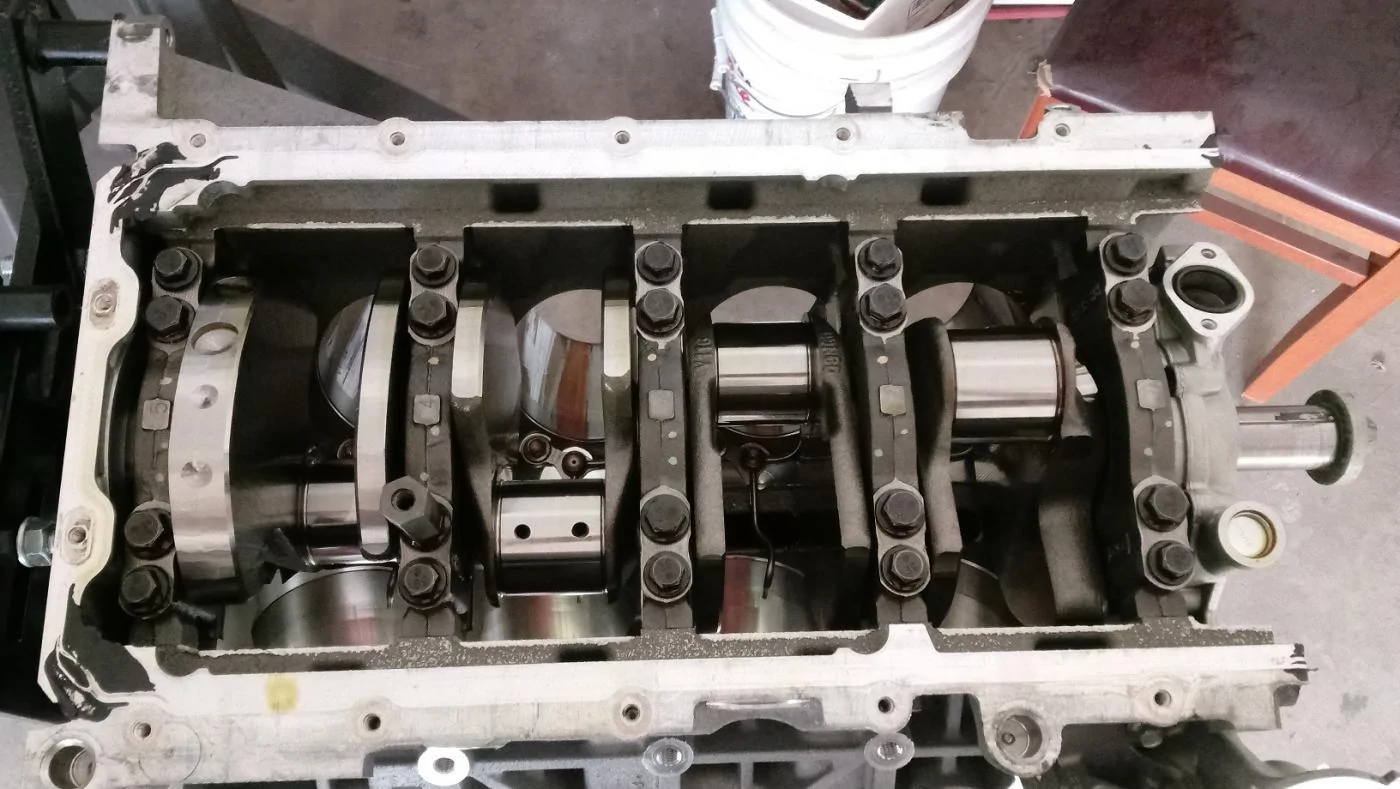
Is that an oil piston squirter I see there? I thought they took away those after the 12MY...
Apparently not. Seems taking the piston squirters away would be a bad move IMO.
 

EFI

Well-Known Member
Joined
May 19, 2015
Threads
65
Messages
5,287
Reaction score
4,732
Location
Masshole central
Vehicle(s)
5.Br0
Apparently not. Seems taking the piston squirters away would be a bad move IMO.
I thought so too, which is why I was confused when they did so.

I did some searching and another person re-building their block has shown these:
021.webp
 

Roh92cp

Well-Known Member
Joined
Jun 27, 2015
Threads
79
Messages
2,896
Reaction score
1,174
Location
Fort Kent Maine
First Name
Shawn
Vehicle(s)
OW GTPP Whipple
I agree ... you can go "too thick" on oil.

If you read everything I said in those 3 posts it boils down to choosing an oil that will provide the best oil film thickness in the journal bearing when the oil is at it's hottest expected temperature. That's exactly why Ford Performance recommends 5W-50 full synthetic for track use. The oil inside the journal bearing heats up even more than the sump temperature, so if your sump is at say 275 deg F (due to track use, etc), then the oil in that 30~80 micron wedge between the bearing and journal will most likely be over 300 deg F which will decrease the film thickness even more as shown in that chart I posted.

And I tried to make it clear that using too thick of an oil can reduce the oil flow to the engine components if the oil pump goes into pressure relief (by trying to force that thicker oil through the oiling system) at a much lower RPM than near redline. You will never lose any oil flow volume to speak of using a thicker oil if the positive displacement oil pump is in good shape and doesn't go into pressure relief. If the oil pump hit pressure relief at 4000 RPM with a thick oil vs 7000 RPM with a thinner oil, then there will be less oil volume going into the oiling system at 4000 RPM with the thicker oil (even if it's 5W-20) - that's the kind of situation you want to avoid. The GT350 oil pump uses the same OPGs as the 5.0L Coyote, but it's pressure relief is set higher to ensure it's still supplying adequate oil flow all the way to the higher redline.

Also, another reason to NOT go high RPM with thicker oil until it's at full operating temperature is because it can put the pump into pressure relief way too soon. 20W oil at 100 deg F is magnitudes thicker than 50 weight oil at 200 deg F. If you went high RPM with thick cold oil (even if it was 5W-20 because it's still thicker cold than hot), then it's possible the oil pump will hit pressure relief and starved the engine of oil flow at high RPM ... a bad situation. Keep RPMs way down until the oil is fully hot, even if running a specified low viscosity like 5W-20.

So the key to homing in on a good oil choice is to find one that's the right viscosity to match the maximum expected oil temperatures, and isn't so thick that it puts the oil pump in pressure relief way before redline when it's 200 deg or more. And also to find one that's supposedly better for high load/extreme load conditions and has good anti-wear properties if you can find decent comparison information between oils. Those properties (vs viscosity) helps more with preventing wear on things like cams, rings, gears and chains that aren't hydrodynamic lubrication like journal bearings are. Like I said, the whole key to keeping journal bearings safe is to maintain a good as possible minimum oil wedge thickness. You're only playing with 30~80 microns of oil film depending on your bearing clearance setting ... so not much room to play with. Once metal-to-metal contact starts, it's all a downhill spiral to total failure given enough time.
Thank you for the great information here:thumbsup: I would also like add that oils ability to provide high levels of shear protection depends greatly on the additive packages in the oils as well.

 

Sponsored

Jay-rod427

Well-Known Member
Joined
Jun 8, 2016
Threads
29
Messages
2,422
Reaction score
1,011
Location
Kansas
Vehicle(s)
2016 GT C/S
The piston squirters came back in 15'
 

stephenj37824

Member
Joined
Dec 9, 2019
Threads
0
Messages
5
Reaction score
1
Location
Tennessee
First Name
Steve
Vehicle(s)
2019 GT350
Anyone thinking these motors may be oil starved under hard acceleration due to oil going to back of the pan and oil pump losing prime? Boosted could be the extra G's needed to cause this. I am going to put a 3 quart oil accumulator on my 19 GT350 before the procharger goes on.
Sponsored


Top