
Sponsored

Resource for translating effects of downforce

Performance nut

Well-Known Member
Joined
Feb 10, 2015
Threads
178
Messages
1,665
Reaction score
636
Location
TX
Vehicle(s)
2018 Mustang GT A10
Vehicle Showcase
1
I have been researching downforce for awhile now but have not found anything that truly translates downforce into an appreciative value. The closest I ever found was this article which was useful in the respect that it validates the necessity of downforce and that tuning is essential.

The reason I'm looking into this is to determine a rough place to start and then dial it in. I'm figuring there is some sort of sagely wisdom that says "x amount of downforce will have y effect".

Rabbithole
Others have correlated effects of drag to horsepower. This got me wondering if there was a correlation between downforce and measurable forces like effects on lateral G force. I realize that that in itself is subjective but I'm wanting to see where downforce starts having effects and how dramatic they are. When I look at the race lines between F1 and GT on the same course, it's dramatic. But the amounts of downforce involved are also dramatic. There also has to be a point of diminished gains in which increasing downforce has minimal or even detrimental effects.

I also realize the importance of tuning and balance. You can go from low speed understeer to high speed oversteer by messing with F/R downforce balance. I realize that you eventually need to actually drive on track to get the full answer. But again, where do you start? Throw every possible aero you can on a car and then tune seems like a really horrible and potentially dangerous approach.
Sponsored
 

CarbonZ

Well-Known Member
Joined
Mar 14, 2021
Threads
7
Messages
309
Reaction score
470
Location
Raleigh, NC
Vehicle(s)
2017 GT350
I've been researching this as well for my active wing and wish there was a one size fits all answer.

More rear downforce equals more understeer.... especially with the air brakes activated. At least through my limited testing so far. I have not yet installed my front splitter yet though so I have major bias atm. I will be playing with settings for a long time I'm sure.

Seems the only realistic way (besides a sim) to measure the effects would be to rent time at a wind tunnel. Play with settings/parts, then take it to the track and play with it more.

A member here recently posted a vid in the gt350 forum with his wind tunnel tests that is prob worth a watch. (Too lazy to search for a link atm). How that data translated to track benefits would be an interesting follow up vid.

I'm not sure that bolting on a bunch of aero is the best option, but in reality that's what's most do. And sure, it can absolutely make the car dangerous. But that's for extreme aero bits. Prob wouldn't hurt giving an aero parts manufacturer a call letting him know what you plan to do with the car, and see what they advise as far as parts go. Assuming the company you contact knows what they are doing, they can advise. That still wouldn't be a be all end all answer though, just a starting point.
 
OP
OP
Performance nut

Performance nut

Well-Known Member
Joined
Feb 10, 2015
Threads
178
Messages
1,665
Reaction score
636
Location
TX
Vehicle(s)
2018 Mustang GT A10
Vehicle Showcase
1
I think I have read some of your posts on active aero. Perhaps even more important for you as vast majority of is are static whereas yours is dynamic. Be really interested in your findings. 😊
 

NightmareMoon

Well-Known Member
Joined
Nov 22, 2015
Threads
62
Messages
7,081
Reaction score
6,352
Location
Austin
Vehicle(s)
2016 Mustang GT PP w/ Voodoo
Vehicle Showcase
1
If you watch this video closely, he actually gives up enough of the formulas involved to calculate the downforce, and how much the cornering grip will improve at a given speed. Its not trivial, but you can build a spreadsheet which can estimate these things. Once you know approximately how the G force limits increase its possible to run some simulations for a given track and figure out how much faster a car might go.

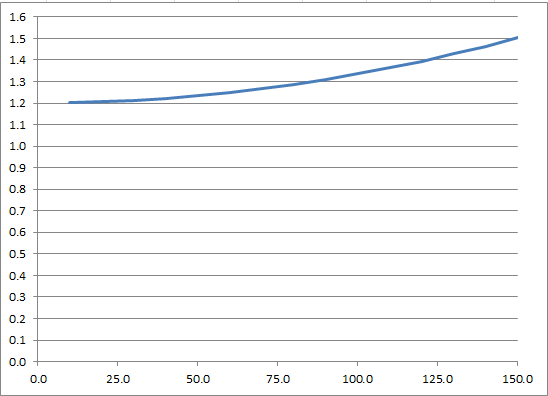
This is grip verus speed (with a specific coefficient of lift) and a car that starts with 1.2g of grip w/o aero. Faster you go the more it helps, but its helping at 40mph already.

1641771820968.png

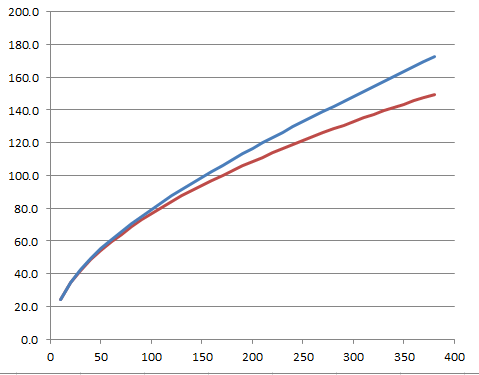
Here's a graph for corner radius versus corner speed with the same inputs. The horizontal is corner radius in meters, vertical is speed in mph, and the red /blue lines are the car w/o aero and with.

1641771712280.png


There is not point where downforce (negative coefficient of lift) will hurt things assuming 1) you don't screw up the the front/rear balance, and 2) your downforce is free of drag (which it won't be).

A slight bias to understeer from aero at speed can be kind of nice to drive. Gives you some confidence the rear won't let go when you're bombing things at high double digit or triple digit speeds, but its definitely possible to go to far and screw up the balance of the car if the aero isn't even front/rear. I have a January/Feb project to make a smaller version of my nascar style autocross spoiler that's sized better for high speeds on road courses. The bias is a bit too much with my current spoiler and its almost a little too hard to get to the slip angles I'd like to be at.

On a small road course lots of corners and short straights, event seemingly excessive drag isn't a issue because we can power through the drag and the gains in the corners make up more time than we loose from drag. If a course has a long and fast enough straight that might change at some point, but you've probably seen the time attack cars with huge rear wings and tennis court sized front aero.

P3173291.jpg
 

Sponsored

OP
OP
Performance nut

Performance nut

Well-Known Member
Joined
Feb 10, 2015
Threads
178
Messages
1,665
Reaction score
636
Location
TX
Vehicle(s)
2018 Mustang GT A10
Vehicle Showcase
1
If you watch this video closely, he actually gives up enough of the formulas involved to calculate the downforce, and how much the cornering grip will improve at a given speed. Its not trivial, but you can build a spreadsheet which can estimate these things. Once you know approximately how the G force limits increase its possible to run some simulations for a given track and figure out how much faster a car might go.

This is grip verus speed (with a specific coefficient of lift) and a car that starts with 1.2g of grip w/o aero. Faster you go the more it helps, but its helping at 40mph already.

1641771820968.png

Here's a graph for corner radius versus corner speed with the same inputs. The horizontal is corner radius in meters, vertical is speed in mph, and the red /blue lines are the car w/o aero and with.

1641771712280.png


There is not point where downforce (negative coefficient of lift) will hurt things assuming 1) you don't screw up the the front/rear balance, and 2) your downforce is free of drag (which it won't be).

A slight bias to understeer from aero at speed can be kind of nice to drive. Gives you some confidence the rear won't let go when you're bombing things at high double digit or triple digit speeds, but its definitely possible to go to far and screw up the balance of the car if the aero isn't even front/rear. I have a January/Feb project to make a smaller version of my nascar style autocross spoiler that's sized better for high speeds on road courses. The bias is a bit too much with my current spoiler and its almost a little too hard to get to the slip angles I'd like to be at.

On a small road course lots of corners and short straights, event seemingly excessive drag isn't a issue because we can power through the drag and the gains in the corners make up more time than we loose from drag. If a course has a long and fast enough straight that might change at some point, but you've probably seen the time attack cars with huge rear wings and tennis court sized front aero.

P3173291.jpg
Thank you, thank you, thank you. I have been looking everywhere for something like this. I only wish I could get my spreadsheet functional. What got from the video though was at the end when he spoke about a heavy car and aero. Having a huge amount of aero (which I still don't understand how he found his CL values to be so small), cars like ours can only see a 0.1g increase at 120mph. This is really discouraging as I was hoping to achieve a higher level of grip on our cars without having insane amounts of downforce on the car (I'm talking wings that generate close to 1000lbs of downforce at 100mph that has insane amount of power reducing drag) and a comparable splitter to help balance the car.

Probably wouldn't hurt to check out the other 2 articles JR Hildebrand wrote on the subject too
Part 2
Part 3
You found part 3! I was only able to read part 1 and 2. Thank you!
 

NightmareMoon

Well-Known Member
Joined
Nov 22, 2015
Threads
62
Messages
7,081
Reaction score
6,352
Location
Austin
Vehicle(s)
2016 Mustang GT PP w/ Voodoo
Vehicle Showcase
1
Thank you, thank you, thank you. I have been looking everywhere for something like this. I only wish I could get my spreadsheet functional. What got from the video though was at the end when he spoke about a heavy car and aero. Having a huge amount of aero (which I still don't understand how he found his CL values to be so small), cars like ours can only see a 0.1g increase at 120mph. This is really discouraging as I was hoping to achieve a higher level of grip on our cars without having insane amounts of downforce on the car (I'm talking wings that generate close to 1000lbs of downforce at 100mph that has insane amount of power reducing drag) and a comparable splitter to help balance the car.
His numbers for the wrx at the end were to prove a point, which was conservative aero on a heavy car is not worth much, which is true, but his conservative CL numbers were exactly that. 0.1 cl is weak, its not hard to do better than that.

You have to figure out what CL you can expect and then run the numbers. If your CL is as low as his final example then yes your results will be low too.

On my heavy pig of an autocross car at low autox speeds, it was easily worth it. Results improved and the lap times at tracks where I had plateaued actually dropped measurably. On a 35 second test road course with a too soeed of only ~80 mph I gained less than a second fron aero, but it was a good chunk of time and I was immediately hitting new personal bests and *averaging* where my old PB was. On a 1:30 sec course I dropped more than a couple seconds. I actually beat my fastest lap on my daily tires versus RE71Rs and was more than a couple seconds faster on good tires.
 
Last edited:
OP
OP
Performance nut

Performance nut

Well-Known Member
Joined
Feb 10, 2015
Threads
178
Messages
1,665
Reaction score
636
Location
TX
Vehicle(s)
2018 Mustang GT A10
Vehicle Showcase
1
His numbers for the wrx at the end were to prove a point, which was conservative aero on a heavy car is not worth much, which is true, but his conservative CL numbers were exactly that. 0.1 cl is weak, its not hard to do better than that.

You have to figure out what CL you can expect and then run the numbers. If your CL is as low as his final example then yes your results will be low too.

On my heavy pig of an autocross car at low autox speeds, it was easily worth it. Results improved and the lap times at tracks where I had plateaued actually dropped measurably. On a 35 second test road course with a too soeed of only ~80 mph I gained less than a second fron aero, but it was a good chunk of time and I was immediately hitting new personal bests and *averaging* where my old PB was. On a 1:30 sec course I dropped more than a couple seconds. I actually beat my fastest lap on my daily tires versus RE71Rs and was more than a couple seconds faster on good tires.
I have zero doubts that aero works on our cars. It has always been a question of how effective is it. The video was perfect because it really spoke to exactly what I was trying to answer. But yes, the WRX example was really disappointing.

Ok, lets back to what he did there at the end. When he used a -0.9 CL for the WRX, I was trying to figure out what exactly that would look like on our cars last night. I found several resources from AJ Hartman that related directly to the S550 Mustang:

Crusher custom splitter CFD
AJ Hartman Apex 12 wing

Pairing the AI7 front splitter with the Apex 12 wing at 0* AoA seem to balance almost perfectly. Again these are CFD numbers, not real life so let's pretend that they work as graphed since they were both modeled on an S550. They never calculated CL for the splitter but the wing has both CL and CLR and I found that the wing actually had a -0.8 CL value at 0* AoA. Ok, if I'm interpreting that right, the wing alone puts the S550 at almost the same value as the WRX example. The question I couldn't answer is if the splitter which puts down pretty much the same exact downforce, do you sum the CL values of each component which would put the car at -1.6 CL? If so, then yes it seems with this combination you can achieve more than 0.1g increase without insane aero (this aero has a low amount of drag compared to the Aero 15 wing and ST4 splitter).
 

NightmareMoon

Well-Known Member
Joined
Nov 22, 2015
Threads
62
Messages
7,081
Reaction score
6,352
Location
Austin
Vehicle(s)
2016 Mustang GT PP w/ Voodoo
Vehicle Showcase
1
The question I couldn't answer is if the splitter which puts down pretty much the same exact downforce, do you sum the CL values of each component which would put the car at -1.6 CL? If so, then yes it seems with this combination you can achieve more than 0.1g increase without insane aero (this aero has a low amount of drag compared to the Aero 15 wing and ST4 splitter).
Well with this type of analysis we're baking the entire car (the weight on all four tires) down to a single point, a single CL for the whole car. Since the wing generally only adds downforce to the rear tires, if you only had the wing, I wouldn't use the full CL value. Taking the average of the front aero CL and rear aero CL is probably a safe bet. If AJ Hartman says the handling is balanced with a -0.9 rear wing and an -?.? front aero, I'm going to take him at his word and assume -0.9 for the entire car (assuming the front aero is also doing an equal part).

But, you know what they say about assumptions.
 

TeeLew

Banned
Banned
Banned
Joined
Apr 27, 2020
Threads
15
Messages
3,396
Reaction score
2,612
Location
So Cal
First Name
Tim
Vehicle(s)
Honda Odyssey, Toyota Tacoma, 89 GT project, 2020 Magnetic EB HPP w/ 6M
On my heavy pig of an autocross car at low autox speeds, it was easily worth it. Results improved and the lap times at tracks where I had plateaued actually dropped measurably. On a 35 second test road course with a too soeed of only ~80 mph I gained less than a second fron aero, but it was a good chunk of time and I was immediately hitting new personal bests and *averaging* where my old PB was. On a 1:30 sec course I dropped more than a couple seconds. I actually beat my fastest lap on my daily tires versus RE71Rs and was more than a couple seconds faster on good tires.
I'm glad you posted. I remembered that someone had done the big spoiler, but I forgot who it was. Your findings are the same mine. Drag be damned, more downforce is always faster around the lap.
 

Sponsored
OP
OP
Performance nut

Performance nut

Well-Known Member
Joined
Feb 10, 2015
Threads
178
Messages
1,665
Reaction score
636
Location
TX
Vehicle(s)
2018 Mustang GT A10
Vehicle Showcase
1
Well with this type of analysis we're baking the entire car (the weight on all four tires) down to a single point, a single CL for the whole car. Since the wing generally only adds downforce to the rear tires, if you only had the wing, I wouldn't use the full CL value. Taking the average of the front aero CL and rear aero CL is probably a safe bet. If AJ Hartman says the handling is balanced with a -0.9 rear wing and an -?.? front aero, I'm going to take him at his word and assume -0.9 for the entire car (assuming the front aero is also doing an equal part).

But, you know what they say about assumptions.
Yeah I have actually learned alot from AJ Hartman. His wings have multiple downforce calculations: overall downforce, front end down force, and rear end downforce. I guess when the wing generates downforce that causes the rear to squat so it generates a minor amount of lift in the front since the front is higher. Guy really goes in deep. So his CL calculations are overall downforce taking into consideration the lift generated up front. Though his wing calculations assume that only the wing is being added and nothing else. Same goes for his splitter, that is only if you add the splitter.

Adding both, I'm left wonder what the overall CL would be. I'm thinking they would sum on paper and probably be a little lower value in real life. My rationale for that is that if adding just a wing causes front end lift, you would have to subtract (or add to be technically correct) the lift generated from the wing from what the splitter is generating in the front. And if the splitter causes any adverse effects in the rear, same would go with the lift generated by the wing. So on paper it would be -1.6 but in reality it would be -1.3 for example

Though for my intent, I'm just trying to get in the ballpark and set expectations rather than science the $hit out it. This is by far the closest I have come to a real answer. If adding the splitter and wing get me into a realm that is higher than the WRX example (say -1.5 instead of -0.8), then I would say I'll see probably 0.2g worth of grip maybe slightly more. If they don't sum and overall with the wing and splitter is just like the -0.9 CL WRX example, I would say I already have my answer that I'll likely see 0.1g of grip increased and at least my expectations will be aligned. We all know it will make a change, it is the magnitude of change that I have been trying to figure out for months. 0.2g of grip is not a huge change but will definitely be noticeable. Lap times will improve but I'm not going to be flying past McLaren's at COTA any time soon. :)
 
OP
OP
Performance nut

Performance nut

Well-Known Member
Joined
Feb 10, 2015
Threads
178
Messages
1,665
Reaction score
636
Location
TX
Vehicle(s)
2018 Mustang GT A10
Vehicle Showcase
1
Ok, I went into the video again and "cheated" to correct my spreadsheet. I know I missed something somewhere on how he calculates max lateral G but at least the math is checking out when I rewatched the end and used his numbers on my spreadsheet and got what he got. I'm taking the risk of sounding completely wrong on this but I rather put this out there and someone correct me than assume I'm right.

Using AJ Hartman's page as a reference, they calculated the stock S550 CL to be -0.2. Using the acceleration formula (a=v^2/r), I used max g force and a set velocity to calculate the minimum radius you could take a turn at that speed. Using 0.8 for the coefficient for friction for performance tire on a decent track (probably low but just to illustrate my point) going 60mph, the difference is 10' radius (299.5' vs 289.8') which is 1.5 times the width of our cars. That is someone easily passing you on the inside on a small oval track. Reversing the formula to calculate max speed for a set radius, following the same line on a 250' oval, an S550 with -0.9CL aero will lead by 2 mph over a stock S550 with no aero.

Getting a better tire (or better track) which increases the coefficient of friction (which in turn increases the max lateral g force) for both cars actually has an interesting effect. Setting the same exact speed on an oval track, you are swapping paint as your radius difference is significantly reduced to 66". Following the same exact line and now the car with aero is 1.75 mph faster. Meaning you aren't going to beat #2 by as much but both of your lap times are going to be significantly better.

So much for not sciencing the $hit out of this. I might be wrong on some (or all) of this but if it is correct, it is nice to put something in a fashion that is understandable and relatable.
Sponsored


Top