Sponsored

Can Bus flex question

mejohn50

Intergalactic Snail
Joined
Jun 12, 2016
Threads
24
Messages
876
Reaction score
1,060
Location
United States
First Name
Mitch
Vehicle(s)
slow junk
The PCMTEC logic retains the last known ethanol content reading when the sensor is disconnected.

If the sensor is reading 0% ethanol, then it reports 0% ethanol.

An option that exists to prevent basically everything you’re saying @Angrey is to unplug the ECA2 after the alcohol content has stabilized. It will remember that alcohol value until you plug the ECA2 back in. So, it’s possible to fill the tank, stabilize alcohol content, unplug the sensor, then only plug it back in on a refill.
Sponsored


 

Corporate_Rebel

Well-Known Member
Joined
Feb 5, 2022
Threads
1
Messages
85
Reaction score
112
Location
Michigan
First Name
Dave
Vehicle(s)
22 Mustang GT
Purely speaking from an industrial perspective and not automotive... Feel free to flame me on this one.

Would it be possible to put a higher pressure cracking check valve in line on the return? Say if the return line comes back at 50psig could you put a 20psig cracking check in and then once the return bleeds down after shutdown it would close around 20psig?

Again, I have no idea what the pressures on a coyote fuel system are but this is how we would do it in the chemical world. When working air free water free always want to keep line pressure above atmospheric pressure.
 
OP
OP

GL95

Well-Known Member
Joined
Jul 16, 2024
Threads
2
Messages
231
Reaction score
183
Location
SC
Vehicle(s)
2019 Mustang GT
Purely speaking from an industrial perspective and not automotive... Feel free to flame me on this one.

Would it be possible to put a higher pressure cracking check valve in line on the return? Say if the return line comes back at 50psig could you put a 20psig cracking check in and then once the return bleeds down after shutdown it would close around 20psig?

Again, I have no idea what the pressures on a coyote fuel system are but this is how we would do it in the chemical world. When working air free water free always want to keep line pressure above atmospheric pressure.
Something like this is what I was initially thinking also, but after a lot of research I decided I didn't want to be a test dummy. My pressure is set at 55 PSI static
 

Angrey

Well-Known Member
Joined
Jun 21, 2020
Threads
104
Messages
2,794
Reaction score
2,984
Location
Coral Gables
Vehicle(s)
2016 GT350
The PCMTEC logic retains the last known ethanol content reading when the sensor is disconnected.

If the sensor is reading 0% ethanol, then it reports 0% ethanol.

An option that exists to prevent basically everything you’re saying @Angrey is to unplug the ECA2 after the alcohol content has stabilized. It will remember that alcohol value until you plug the ECA2 back in. So, it’s possible to fill the tank, stabilize alcohol content, unplug the sensor, then only plug it back in on a refill.
yeah, a simple switch after the sensor value comes to rest seems like it would work.
 

Sponsored

Angrey

Well-Known Member
Joined
Jun 21, 2020
Threads
104
Messages
2,794
Reaction score
2,984
Location
Coral Gables
Vehicle(s)
2016 GT350
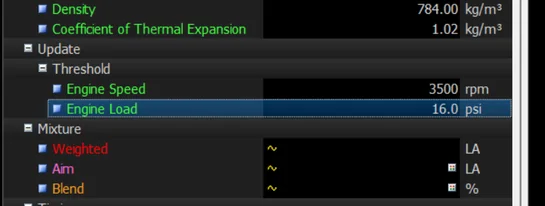
Got a response. MOTEC features two thresholds that once met, "lock" the ethanol value and prevent it from updating until one or both are unsatisfied. This prevents anything nefarious for e sensor going low or out during a WOT rip if the return line runs dry. Tuner recommended that I reduce the load/boost to 6 psi.

Indicated that most stand alones employ this type of control (with e sensor on return side).

Resolves the dangers under loaded conditions but not for idle and low load. Then again, it's probably not as big of a deal on lower end conditions. The computer would try to lean out to match the ethanol content but the widebands would add fuel to keep the trims acceptable. Would throw a code.

I suppose a case exists where the e sensor craps out and before it can throw a code, you mash the accelerator, both conditions are met and it "freezes" the the low value. But we're talking about a pretty obscure risk and near impossible timing. Plus there are other safety features that would kick in once it started knocking and 02's went off the charts.


1721690761251-ei.webp
 

mejohn50

Intergalactic Snail
Joined
Jun 12, 2016
Threads
24
Messages
876
Reaction score
1,060
Location
United States
First Name
Mitch
Vehicle(s)
slow junk
Got a response. MOTEC features two thresholds that once met, "lock" the ethanol value and prevent it from updating until one or both are unsatisfied. This prevents anything nefarious for e sensor going low or out during a WOT rip if the return line runs dry. Tuner recommended that I reduce the load/boost to 6 psi.

Indicated that most stand alones employ this type of control (with e sensor on return side).

Resolves the dangers under loaded conditions but not for idle and low load. Then again, it's probably not as big of a deal on lower end conditions. The computer would try to lean out to match the ethanol content but the widebands would add fuel to keep the trims acceptable. Would throw a code.

I suppose a case exists where the e sensor craps out and before it can throw a code, you mash the accelerator, both conditions are met and it "freezes" the the low value. But we're talking about a pretty obscure risk and near impossible timing. Plus there are other safety features that would kick in once it started knocking and 02's went off the charts.


1721690761251-ei.webp
PCMTEC at least has an air mass value that does the same thing. Above this load (air mass) value it will ignore the sensor and use the last known ethanol content.

IMG_0306.jpeg
 

Rolls

Well-Known Member
Gold Sponsor
Joined
Jan 29, 2020
Threads
2
Messages
355
Reaction score
457
Location
Australia
Website
www.pcmtec.com
Vehicle(s)
Mustang 18 GT
I had an email chain going on you where I added my tuner so we could send you some
Logs but it looks like you stopped replying or missed my email

I have not been able to hook the gauge up, but I have verified the readings with the analog outputs. I will have the gauge later on this week and I am also moving the sensor to the feed line + adding a check valve.

As for the air question, I'm obviously not an expert on these fuel systems, but there is another several page long thread about this same fuel system having issues with air getting into the lines due to not having a check valve.

I also have verified the wiring is correct when the sensor reads zero in 2 different ways, I have ohm checked from the ECA back to the sensor, and I have also hooked up an oscilloscope to verify the can bus output is functioning as it should.

The whole thing is very odd to me because everything works absolutely perfect while the car is running, it's just between starts I get weird readings, and I've noticed over the past couple days sometimes it does seem to hold the values perfectly where as before it never did. ( we are holding off on anymore logging until I change the location of the sensor and add a check valve)
You can always check your replies via the support portal here https://support.pcmtec.com we don't reply via email as this way we can see the entire email chain.

If you forwarded the email to your tuner or your tuner replied the metadata that link the tickets would have got lost. If you let us him know the ticket number is TECH00001936 we can merge them together so everyone gets all Reponses.

Here is the response I sent "

GL95 said:
What I don't understand is how it drains back to the tank. There would have to be something to fill the line if it drained. For example put a straw in a cup of water and put your thumb over it, lift it out the cup, no water comes out the draw. If you lift your finger it drains and you now have vapour in the straw. The fuel return line should be the same as this. Especially as the sensor should be after the pressure regulator (which would act like your thumb as it is trying to retain pressure in the fuel rail). Do you have any ideas how it could be draining? Could you have a fuel leak in the return line? What happens if you prime the pump with the engine off, does the ethanol content increase again?

If the sensor is drained and filled with vapour, it will read 0%. Depending on the setup and pressures it could boil/froth in the return line, if you get any vapour phase change (eg a mix of liquid and gas) the sensor won't read correctly.

Regards,
Can you answer the part in bold? It honestly makes no sense at all how you could get the fuel to drain out the line, what replaces the fluid in the line in this scenario and how?

I'm curious as to why the PCM logic wouldn't revert back to last signal if there's a loss in active ethanol sensor input (there's more than one scenario where you could lose ethanol sensing, if the sensor takes a shit, etc).
That is exactly what we do and it is easy to test, simply pull the canbus wires or the power to the sensor and the value will lock and you can use the cruise control buttons to adjust manually. I can even show you a video of this in action and the code that does this. It will hold last value until you you reflash the car, even then only an OSID change would clear the NVRAM.

If the value drops, then the sensor is seeing it drop and reporting it via canbus. If this is the case there is something up with your setup.

A bug isn't impossible, however we can test this exact exact scenario on the bench with a steering wheel sensor and ECA-2 emulator to show it working, if it fails in your car but not in our test rig, then something is wired wrong or you have funky phase change in your return line.

We see foaming in the return line all the time in the Falcons when they run out of fuel flow. Do a 10 second dyno run, the swirl pot empties and the regulator works harder and harder to maintain pressure, eventually it fails and closes, this causes pressure waves/spikes causing bubbles of gas in the fluid, if you put it in a bucket you see a white foam, these sensors cannot cope with that (and neither can the engine). They must be completely filled with fluid at all times.
 

Angrey

Well-Known Member
Joined
Jun 21, 2020
Threads
104
Messages
2,794
Reaction score
2,984
Location
Coral Gables
Vehicle(s)
2016 GT350
You can always check your replies via the support portal here https://support.pcmtec.com we don't reply via email as this way we can see the entire email chain.

If you forwarded the email to your tuner or your tuner replied the metadata that link the tickets would have got lost. If you let us him know the ticket number is TECH00001936 we can merge them together so everyone gets all Reponses.

Here is the response I sent "


Can you answer the part in bold? It honestly makes no sense at all how you could get the fuel to drain out the line, what replaces the fluid in the line in this scenario and how?


That is exactly what we do and it is easy to test, simply pull the canbus wires or the power to the sensor and the value will lock and you can use the cruise control buttons to adjust manually. I can even show you a video of this in action and the code that does this. It will hold last value until you you reflash the car, even then only an OSID change would clear the NVRAM.

If the value drops, then the sensor is seeing it drop and reporting it via canbus. If this is the case there is something up with your setup.

A bug isn't impossible, however we can test this exact exact scenario on the bench with a steering wheel sensor and ECA-2 emulator to show it working, if it fails in your car but not in our test rig, then something is wired wrong or you have funky phase change in your return line.

We see foaming in the return line all the time in the Falcons when they run out of fuel flow. Do a 10 second dyno run, the swirl pot empties and the regulator works harder and harder to maintain pressure, eventually it fails and closes, this causes pressure waves/spikes causing bubbles of gas in the fluid, if you put it in a bucket you see a white foam, these sensors cannot cope with that (and neither can the engine). They must be completely filled with fluid at all times.
In fairness to him, if there's no check valve on the return line, the fuel will migrate out when the car is off. No different than after you shutoff the hose bib and leave an open end hose, if there's an elevation difference, the natural draw will cause the line to gulp and seep out until it resolves the elevation pull.

Under operation however, this can be resolved at mid-low rpm by simply increasing the pump duty so that there's flow in excess to be returned, forming a filled return line. There IS a risk that if your fuel system is riding on the ragged edge for full sauce, that the regulator basically closes and there's no extra flow to immerse the sensor in the return line. We've addressed this issue above (with the threshold and last recognized signal).

As far as resolving low rpm-mid rpm conditions, it's as simple as increasing pump duty slightly to ensure there's a flow in the return line.

As far as when the car is off, I would think the pump prime would at least fill the return line up enough to get some form of signal (maybe not full value) but once the motor is fired, I wouldn't imagine it being a long term issue. Might make the start ups a little grumpier.

Seems like he's getting intermittent signal though during operation and that speaks to the fuel pumps not being over tasked enough to create a consistent return line flow.
 

Sponsored

Angrey

Well-Known Member
Joined
Jun 21, 2020
Threads
104
Messages
2,794
Reaction score
2,984
Location
Coral Gables
Vehicle(s)
2016 GT350
This discussion got me thinking. OP, how is your return line plumbed into the tank/bucket? Are you dumping from the head/cover with an air gap into the bucket or is it plumbed through the hanger cover with a hose/line that continues to the bottom of the bucket?

If you continue the return line inside the tank until it's submerged in fuel, the gravity draw between the line and elevation of the tank would be offset by the vacuum in trying to replace the fuel with air. However if you're simply dumping into the tank or hanger with an air gap, it definitely will seep out.

I recommend checking your return line setup. I'd recommend ensuring the return line feeds into the bottom of the hanger/bucket and not an air/splash gap as it will create turbidity and aeration in the fuel in the bucket. They also sell these to ensure the return line flow is laminar as it pushes into the bucket. https://www.radiumauto.com/Duckbill-Valve-P916.aspx
 
OP
OP

GL95

Well-Known Member
Joined
Jul 16, 2024
Threads
2
Messages
231
Reaction score
183
Location
SC
Vehicle(s)
2019 Mustang GT
This discussion got me thinking. OP, how is your return line plumbed into the tank/bucket? Are you dumping from the head/cover with an air gap into the bucket or is it plumbed through the hanger cover with a hose/line that continues to the bottom of the bucket?

If you continue the return line inside the tank until it's submerged in fuel, the gravity draw between the line and elevation of the tank would be offset by the vacuum in trying to replace the fuel with air. However if you're simply dumping into the tank or hanger with an air gap, it definitely will seep out.

I recommend checking your return line setup. I'd recommend ensuring the return line feeds into the bottom of the hanger/bucket and not an air/splash gap as it will create turbidity and aeration in the fuel in the bucket. They also sell these to ensure the return line flow is laminar as it pushes into the bucket. https://www.radiumauto.com/Duckbill-Valve-P916.aspx
Dunno exactly how it's routed inside the hat, I bought the radium hat and pumps fully assembled

There is plenty of evidence that air gets inside these fuel systems, I dunno why it seems like such a huge thing that I believe the same thing is happening to me, I just happen to have an ethanol sensor.

I drove the car for the first time in a few days today, the reading prior to starting the engine was E23, drive a couple of miles and came back home and it read E54. No fueling changes. It has consistently read E54 with the engine running and after driving. I should have the gauge tomorrow so I can see what is actually happening
 

Angrey

Well-Known Member
Joined
Jun 21, 2020
Threads
104
Messages
2,794
Reaction score
2,984
Location
Coral Gables
Vehicle(s)
2016 GT350
Dunno exactly how it's routed inside the hat, I bought the radium hat and pumps fully assembled

There is plenty of evidence that air gets inside these fuel systems, I dunno why it seems like such a huge thing that I believe the same thing is happening to me, I just happen to have an ethanol sensor.

I drove the car for the first time in a few days today, the reading prior to starting the engine was E23, drive a couple of miles and came back home and it read E54. No fueling changes. It has consistently read E54 with the engine running and after driving. I should have the gauge tomorrow so I can see what is actually happening
It's worth a look to see how it's plumbed. If you have a hose from the return fitting in the hat to the bottom of the bucket, it should prevent gravity draw from allowing the return to bleed out (with no air to replace it). Again, I'd also ensure that you're not needlessly splashing fuel into the surface of the bucket creating voids and foam.
 

Angrey

Well-Known Member
Joined
Jun 21, 2020
Threads
104
Messages
2,794
Reaction score
2,984
Location
Coral Gables
Vehicle(s)
2016 GT350
Think of it this way, if you turn off the garden hose with no end on it and leave it on the ground, it will gravity gulp until the remaining water runs out onto your lawn. If you place the end of the hose submerged in water, even though it's trying to gravity draw down, it can't move very much because it has to replace the displaced water with air and it doesn't have an air source to gulp.
Sponsored


Top