
GTP
Deutsche Pony
- Joined
- May 27, 2015
- Threads
- 265
- Messages
- 6,104
- Reaction score
- 4,094
- Location
- Indy
- Website
- www.BambergAudio.com
- First Name
- Philip
- Vehicle(s)
- 2019 GT PP1 A10 Outrageous Orange HPDE mods
- Thread starter
- #1
This post is one of a multi-part series for DIY alignment measurement and adjustment.
Slotting the strut for more camber
At-home method for measuring camber (this post)
At-home method for measuring toe with Toe Plates
Tips for easily adjusting Camber and Toe between street and track settings
Review of Rear Camber Adjustment Kit (Steeda or J&M camber arm brackets)
My DIY Wheel Cribs
___
Measuring camber at home is tricky. After some trial and error of various techniques, I finally developed a method that I trust.
First, the floor does NOT have to be level to use this method. It also does not have to be especially flat.
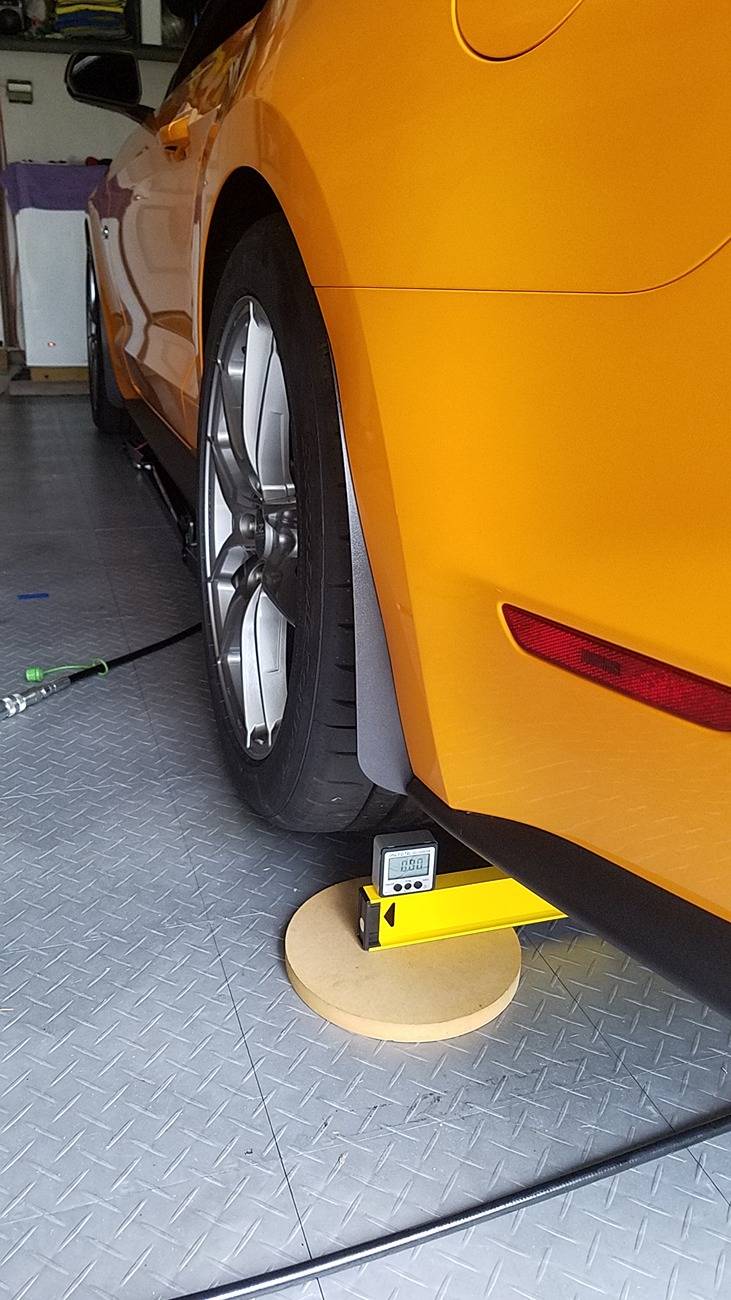
I put down two flat and smooth (3/4" thick MDF) boards to establish a reference surface next to the tires.
I laid a 6-foot level ($14 at Harbor Freight) onto the boards.
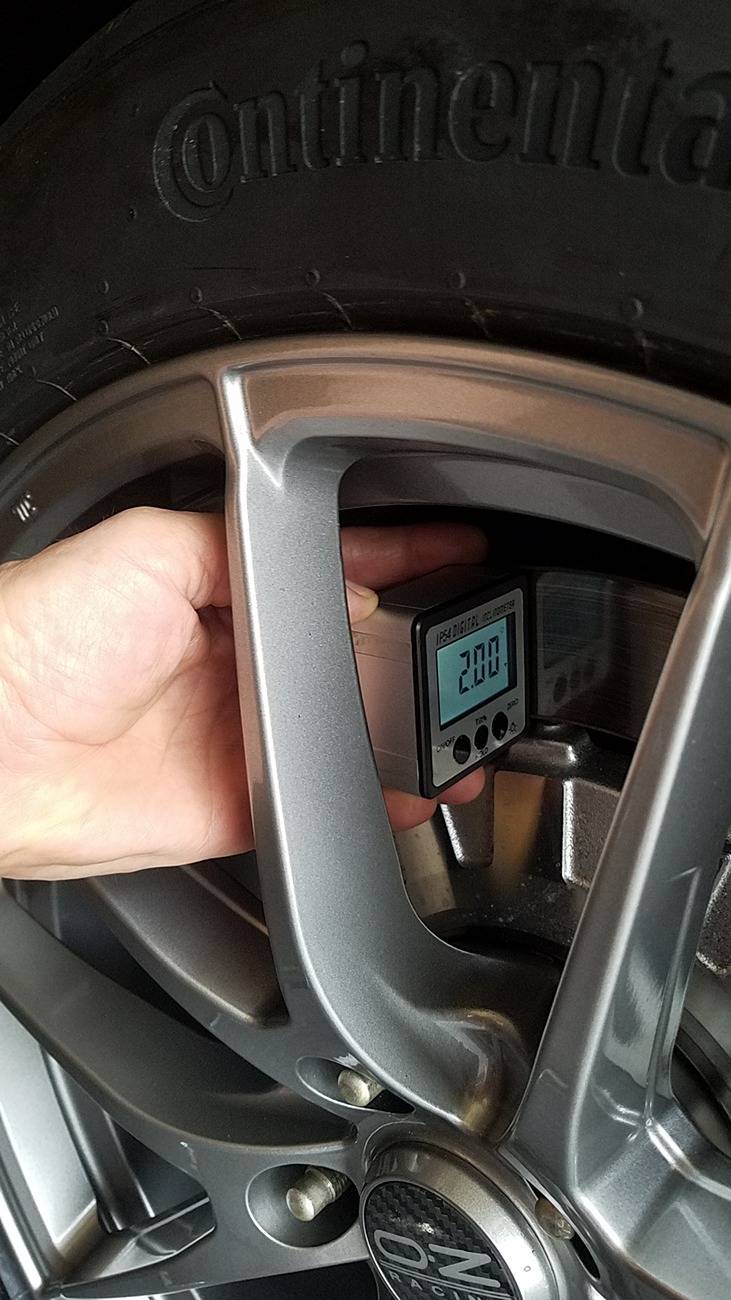
I put a small square magnetic angle gauge ($12 off eBay) on top of the level and near one end. I zero the gauge. Then I hold the gauge against the rotor to read the camber.
I repeat for the other side. With this technique, the gauge reads zero at the other end of the level without having to re-zero the gauge. This is a measurement validity check.
IMPORTANT NOTE
I had a lot of trouble getting consistent and repeatable measurements when I set the gauge down in the 90° position, zeroing the gauge, and then magnetically clipping the gauge to the rotor. Too bad.

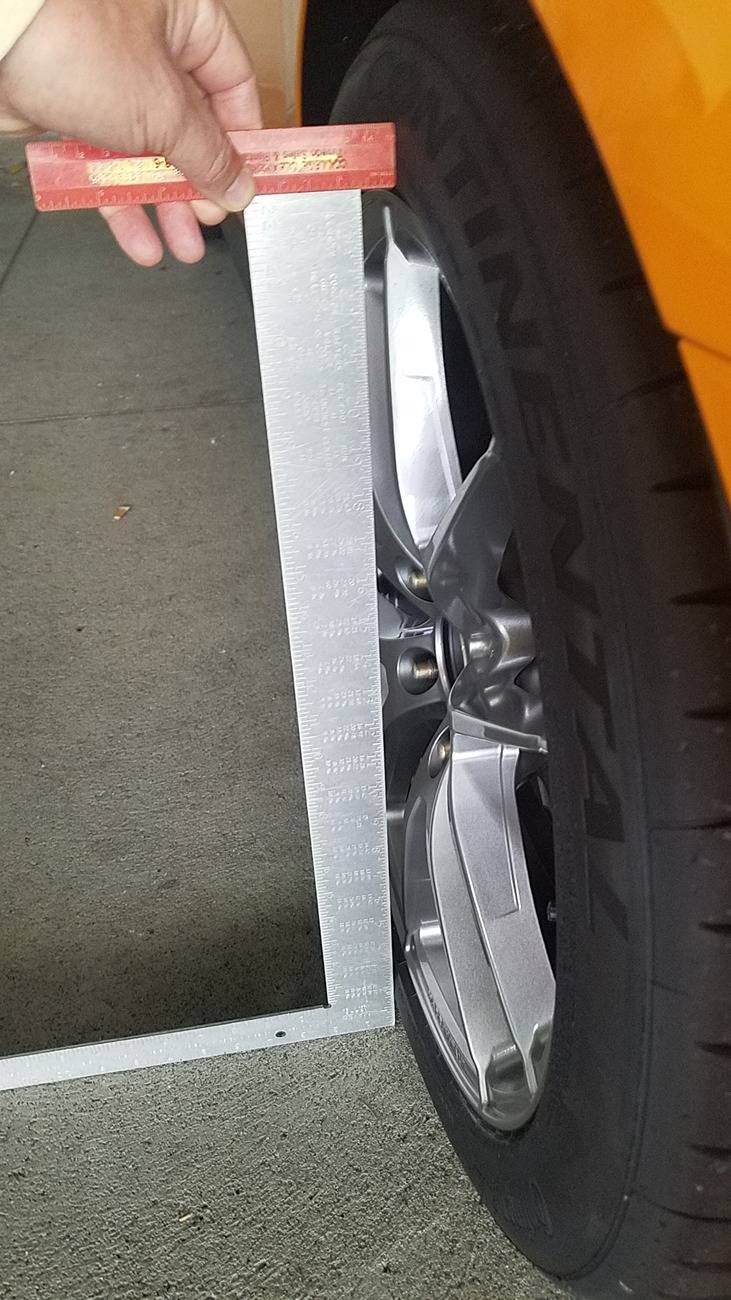
In theory, if you DID have a perfectly flat floor, you could use the simple method pictured here, and do the math. Camber = Tan-1[Offset / (contact point spacing)]. In this example the tire is offset from the framing square by 9/16", and the lower contact point is 1.5" above the floor. So, Camber = Tan-1[0.56" /(24 - 1.5)] = 1.4°.
I actually drove around to a couple parking garages in search of a flat floor, and this technique was not too bad.
Slotting the strut for more camber
At-home method for measuring camber (this post)
At-home method for measuring toe with Toe Plates
Tips for easily adjusting Camber and Toe between street and track settings
Review of Rear Camber Adjustment Kit (Steeda or J&M camber arm brackets)
My DIY Wheel Cribs
___
Measuring camber at home is tricky. After some trial and error of various techniques, I finally developed a method that I trust.
First, the floor does NOT have to be level to use this method. It also does not have to be especially flat.
I put down two flat and smooth (3/4" thick MDF) boards to establish a reference surface next to the tires.
I laid a 6-foot level ($14 at Harbor Freight) onto the boards.
I put a small square magnetic angle gauge ($12 off eBay) on top of the level and near one end. I zero the gauge. Then I hold the gauge against the rotor to read the camber.
I repeat for the other side. With this technique, the gauge reads zero at the other end of the level without having to re-zero the gauge. This is a measurement validity check.
IMPORTANT NOTE
I had a lot of trouble getting consistent and repeatable measurements when I set the gauge down in the 90° position, zeroing the gauge, and then magnetically clipping the gauge to the rotor. Too bad.
In theory, if you DID have a perfectly flat floor, you could use the simple method pictured here, and do the math. Camber = Tan-1[Offset / (contact point spacing)]. In this example the tire is offset from the framing square by 9/16", and the lower contact point is 1.5" above the floor. So, Camber = Tan-1[0.56" /(24 - 1.5)] = 1.4°.
I actually drove around to a couple parking garages in search of a flat floor, and this technique was not too bad.
Sponsored
Last edited: