Fenderaddict2
Well-Known Member
- Joined
- Apr 15, 2013
- Threads
- 27
- Messages
- 844
- Reaction score
- 4
- Location
- Oakville
- Website
- www.fastmyles.com
- First Name
- Stephen
- Vehicle(s)
- 2012 Mustang Boss 302
- Thread starter
- #1
http://www.edmunds.com/ford/mustang/2015/road-test.html
Quick Summary
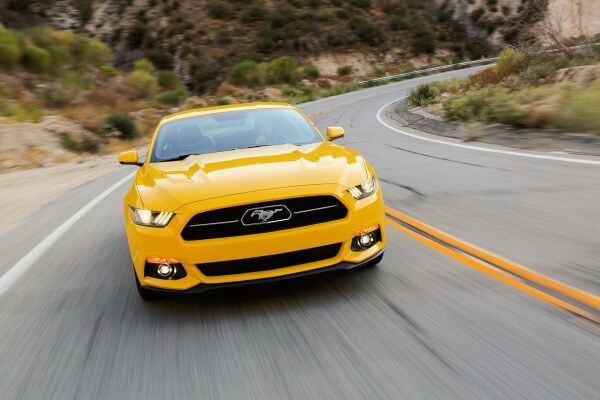
One of America's favorite four-passenger, rear wheel-drive coupes, the Ford Mustang is completely overhauled for 2015. The formula hasn't changed, but the details have. It's more capable, comfortable and better-equipped than ever.
What Is It?
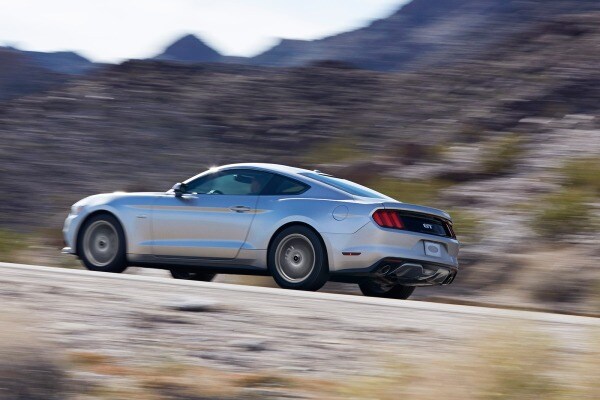
This midsize coupe shares its wheelbase with the outgoing Mustang, sits a bit lower and wider and has a broader track width. However, it's essentially a clean-sheet redesign for 2015. The new car also marks another milestone for the Mustang, as it's the first time an independent suspension has been fitted to the base model, relegating its previous, less sophisticated straight axle design to the scrap heap of history. That might not sound like a big deal since, well, every other rear-wheel-drive car on the road did the same years ago, but in Mustang-land, it's significant.
The multilink rear end underpins the new chassis and is joined by a revised MacPherson strut front suspension and an expanded powertrain lineup. Another side benefit of the independent rear suspension is that it allows the chassis to be inherently stiffer. Elsewhere, the new car's interior has been thoroughly updated while retaining traditional Mustang cues.

What Does the Powertrain Lineup Consist of?
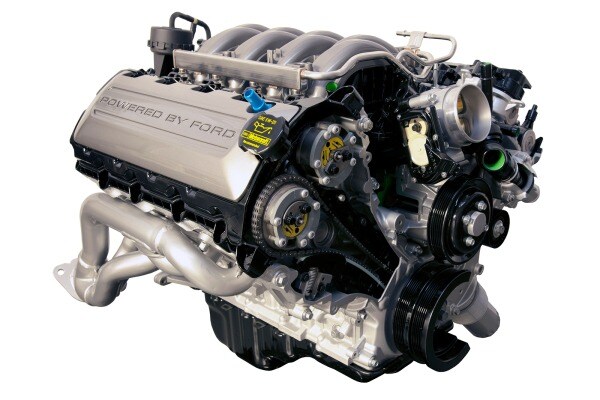
Entry-level Mustangs are equipped with a 3.7-liter V6, and GT models have a 5.0-liter V8. For the first time in decades, a four-cylinder option is available, a 2.3-liter turbocharged unit. You will be able to pair all three engines with either a six-speed manual transmission or a six-speed automatic. More details on the engines can be found in our 2015 Mustang First Look.
The V6 now generates 300 horsepower and 280 pound-feet of torque, figures that are actually 5 hp and 10 lb-ft of torque lower than last year's model. The power drop is said to be attributed to packaging the intake manifold under the new car's lower hood. That the V6's slight reduction in output creates some marketing airspace for the new EcoBoost turbocharged four-cylinder engine that sits above the V6 in the pecking order is, well, serendipitous.
Generating 310 hp and 320 lb-ft of torque on 93 octane premium fuel, the EcoBoost four outshines the V6 slightly (it will run just fine on 87 octane, though peak output drops to 270 hp due to the knock propensity of the crummier fuel). Note that the EcoBoost four generates its maximum torque over a wider portion of the rev range than does the relatively peakier V6.
The other upside to the EcoBoost is fuel economy. It is expected to return 25 mpg combined (21 city/32 highway) with the six-speed automatic and 26 mpg combined (22 city/31 highway) with the six-speed manual. These results eclipse the V6's combined mpg by 3 mpg for the automatic and 5 mpg for the manual.
Topping the range (for now) is the GT's revised 5.0-liter V8, now generating 435 hp and 400 lb-ft of torque. It is expected to deliver 19 mpg combined (16 city/25 highway) with the automatic. Manual-equipped GTs are rated at 1 mpg lower in the city.
What Body Styles and Trim Levels Are Available?
For now, all Mustangs are coupes, or "fastbacks" in Ford-speak. As always, it's rear-wheel drive, has a conventional trunk, two doors and a backseat. In other words, it's a Mustang.
Base models are equipped with the V6, and GT models get the V8. V6 models are the least expensive starting at $24,425, while the base price of the GT is $32,925. EcoBoost variants start at $25,995.
A Premium package is available for GT and EcoBoost models that adds a variety of features and brings the price up another $4,000.
Enthusiasts will gravitate toward the Performance package available for EcoBoost and GT models. This consists of stiffer springs, monotube dampers, a larger rear stabilizer bar, additional chassis braces, a shorter final-drive ratio, bigger brakes and summer tires. It'll run you $1,995 for EcoBoost variants and $2,495 for GT models.
A convertible version of the new Mustang will be available before the end of this year, probably in December.
How Does It Feel on the Road?
We spent some time driving a 2015 Ford Mustang GT equipped with the manual gearbox, base suspension and 255/40 all-season tires on the optional 19-inch wheels. Right away, things are looking up. The shifter moves through its gates positively, with short, slick throws, and the pedals are laid out well for heel-toe downshifting.
As for power, it's got that, too. The "Coyote" V8 is still a beaut, pulling all the way to the rev limiter with enthusiasm and that familiar V8 soundtrack. It makes more power this year, but not enough more to notice in street driving.
"Refined" is the word that keeps coming to mind. On a freeway cruise the new Mustang is tight, quiet and feels like it's traveling 20 mph slower than it really is, so watch that speedometer.
All those live axle histrionics of the old car are a memory. Excessive nosedive and squat, traditional Mustang characteristics have been largely eradicated in the new Mustang, so in this respect the new car feels less ponderous. It picks its feet up well over bumps, lending it a ride refinement the old car could never match. The steering is well-weighted, quicker than you expect and very precise, though there could be more feel. Despite being heavier than last year's Mustang (the 2015 Mustang GT's base curb weight is 3,705 pounds), the new car has more composure and feels lighter on its feet.
Does It Have Any Weaknesses?
It's all roses and thumbs-up for this Mustang until you throw it into a series of corners, where it's kind of a mixed bag. Working it hard on a canyon road reveals a base suspension that is too floaty and soft, and as a result the chassis never quite feels settled, even as the tires feel sure-footed. But you need to press through this vagueness. If you do you'll find there's a surprising amount of grip available, and a chassis that's immune to midcorner bumps, so at least all that compliance has an upside.
So, if you ever plan on taking the new Mustang through a corner in anger, skip right to the Performance Pack. We sampled an EcoBoost Mustang thusly equipped, and the handling improvement is immediately obvious even before you explore the outer limits of grip. The floatiness is turned way down and the chassis is far more eager to change direction, though at least some of this latter characteristic is down to the EcoBoost's 100-pound lighter front end. This is still a big car, but in this guise it seems to shrink significantly.
The EcoBoost's power delivery is strong from low revs, and Ford engineers weren't shy about piping intake honk into the cabin. It's unabashedly a four-cylinder sound, and this will appeal to some people as much as it turns others off. The raucousness grows a bit tiresome if you hammer the EcoBoost near the rev limiter for a while, but around town the engine is muted, pleasant and mannerly. Despite the EcoBoost's solid torque, the grunt doesn't hit all at once when you pick up the throttle exiting a corner. In this respect, the four-cylinder Mustang is less of a hooligan than it could be.
Thus, the sweet spot among all the permutations of the 2015 Ford Mustang appears to be, perhaps unsurprisingly, the GT equipped with the Performance Pack.
What Is the Interior Like?
Even peering at it through the window, it's obvious that the 2015 Mustang's cabin is significantly improved. Things get even better once you're seated inside, as there's a more spacious feel thanks to the new car's less-monolithic dashboard and smaller center console. Its materials have a more premium look, and feel better than ever before. Our tester was not equipped with a sunroof, and headroom was adequate for this 6-foot-plus driver.
The steering wheel's contoured grips and tidier size means it's far nicer to use than the old-school wheel in the outgoing Mustang. There's a soft elbow pad on the console, too. The gauges are actually legible now, and they don't reflect on the inside of the windshield like the old ones.
Visibility is reasonably good, certainly better than a Camaro or Challenger, though the thick C-pillars block everything over your shoulders. The cabin temperature controls are fiddly momentary rockers with tiny protrusions, so there's an incentive to simply use the auto climate control function. Finally, that row of rockers beneath the climate controls sure looks cool.
What Are Its Closest Competitors?
The Ford Mustang GT faces off squarely against two rivals in a pony car battle royale, both of which originate from America.
Chevrolet Camaro SS: Mustang versus Camaro is the stuff of the ages. Equipped with a 426-hp 6.2-liter pushrod V8, the Camaro is vocal and rapid. It's more difficult to live with on a daily basis, however, due to its small trunk opening and pillbox styling that hampers outward visibility.
Down the street, the Dodge Challenger R/T offers a more cruiser-like riff on the idea of these big American coupes. With the 5.7-liter pushrod V8 that generates 375 hp, it's a bit outgunned but not out of the hunt.
Why Should You Consider This Car?
If the idea of a Mustang has held appeal previously but you just couldn't get past its dated interior or bobbling rear axle, this car is for you. The new car has moved the Mustang into the modern age, adding heaps of refinement at every turn without abandoning its core appeal.
Why Should You Think Twice About This Car?
Despite its across-the-board improvements, the Mustang is still a large, heavy car. Physics can't change that it's a different sort of car from, for example, a Scion FR-S or Mazda Miata.
Sponsored