
Sponsored
EODTech87
Well-Known Member
- Joined
- Feb 7, 2018
- Threads
- 0
- Messages
- 92
- Reaction score
- 56
- Location
- Copperas Cove, Texas
- Vehicle(s)
- 2015 Mustang GT Premium
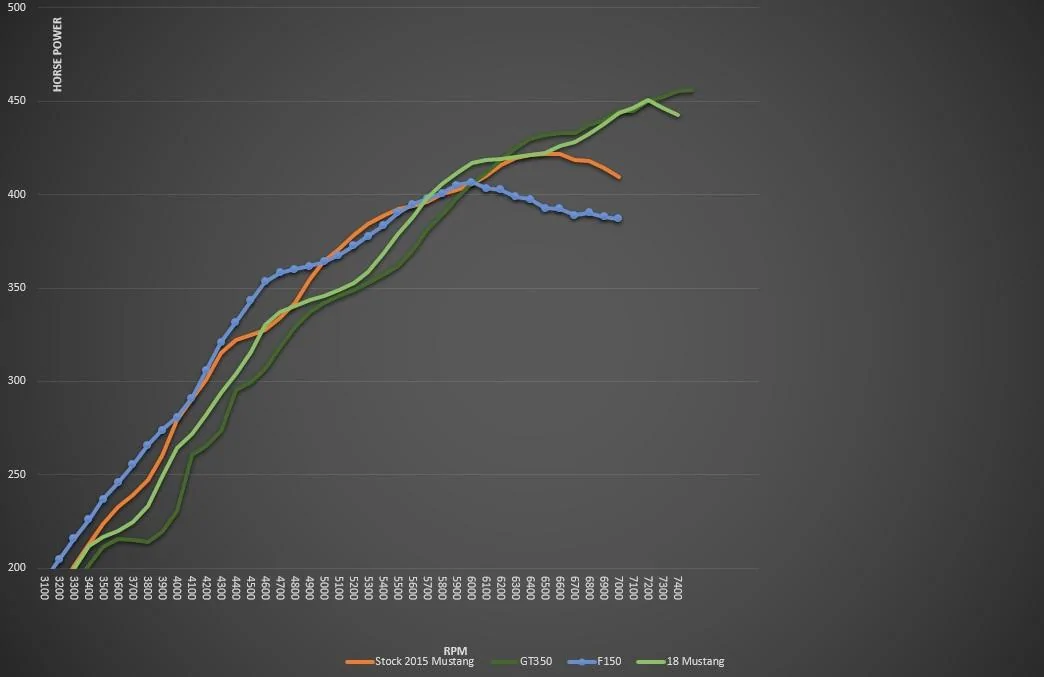
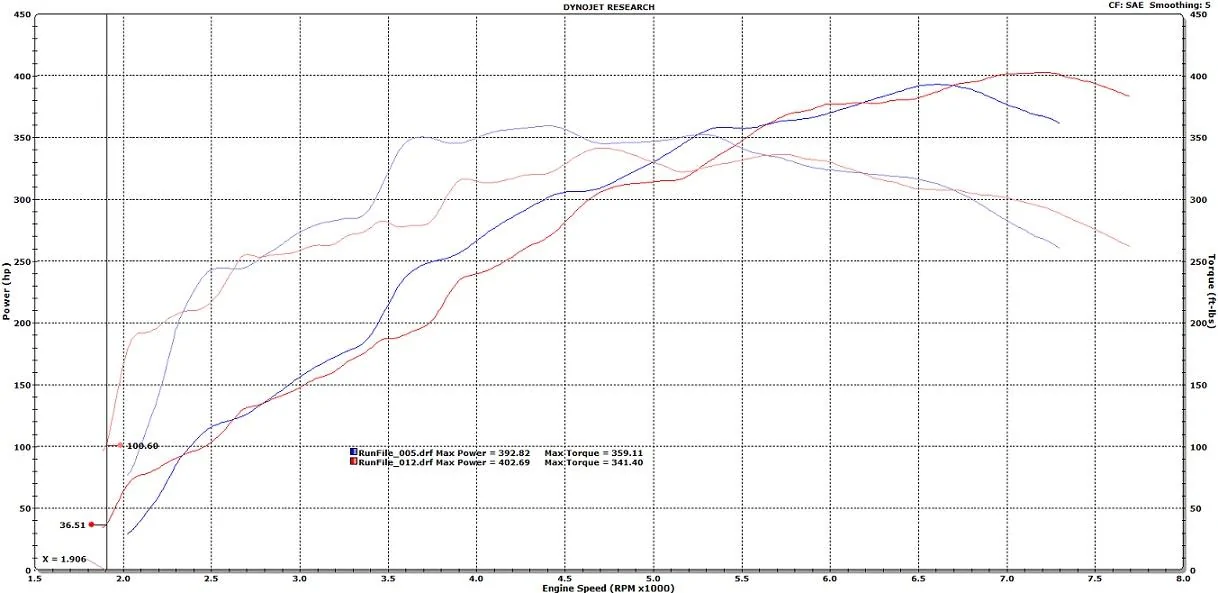
This graph posted back on post #59 looks very much like my comparison.


texasboy21
Well-Known Member
Sure, youll gain power for 800 rpms compared to the stock manifold.I must be reading it wrong because. The dyno graph and comparison shows 40 hp gain at 7300?
What about the other six thousand rpms worth of the power band?
Peak numbers mean very little. Its the total area under the curve that makes and car feel and perform better.
Kahboom
Kahboom
- Joined
- Nov 28, 2014
- Threads
- 26
- Messages
- 1,201
- Reaction score
- 184
- Location
- Cathedral City, CA
- Vehicle(s)
- 2015 Mustang GTPP, Recaros/2014 Explorer Sport 4X4
And that comparison the photo above gains close to or around 30 Peak horsepower, something really seems to be on in your tune. For your current mods with the standard GT manifold it seems to be pretty dead on compared to a lot of others on similar dynos.
Sponsored
EODTech87
Well-Known Member
- Joined
- Feb 7, 2018
- Threads
- 0
- Messages
- 92
- Reaction score
- 56
- Location
- Copperas Cove, Texas
- Vehicle(s)
- 2015 Mustang GT Premium
Based off of percentages it's fairly accurate. The top graph shows about 420@6200 and then 450@7200 which is a 7.15% increase in power mine is 377.81@6200 and 402.64@7200 which is a 6.57% increase. a 7.15% increase would put me at 404.8And that comparison the photo above gains close to or around 30 Peak horsepower, something really seems to be on in your tune. For your current mods with the standard GT manifold it seems to be pretty dead on compared to a lot of others on similar dynos.
EODTech87
Well-Known Member
- Joined
- Feb 7, 2018
- Threads
- 0
- Messages
- 92
- Reaction score
- 56
- Location
- Copperas Cove, Texas
- Vehicle(s)
- 2015 Mustang GT Premium
I don't think the horse is quite dead so lets beat it some more.
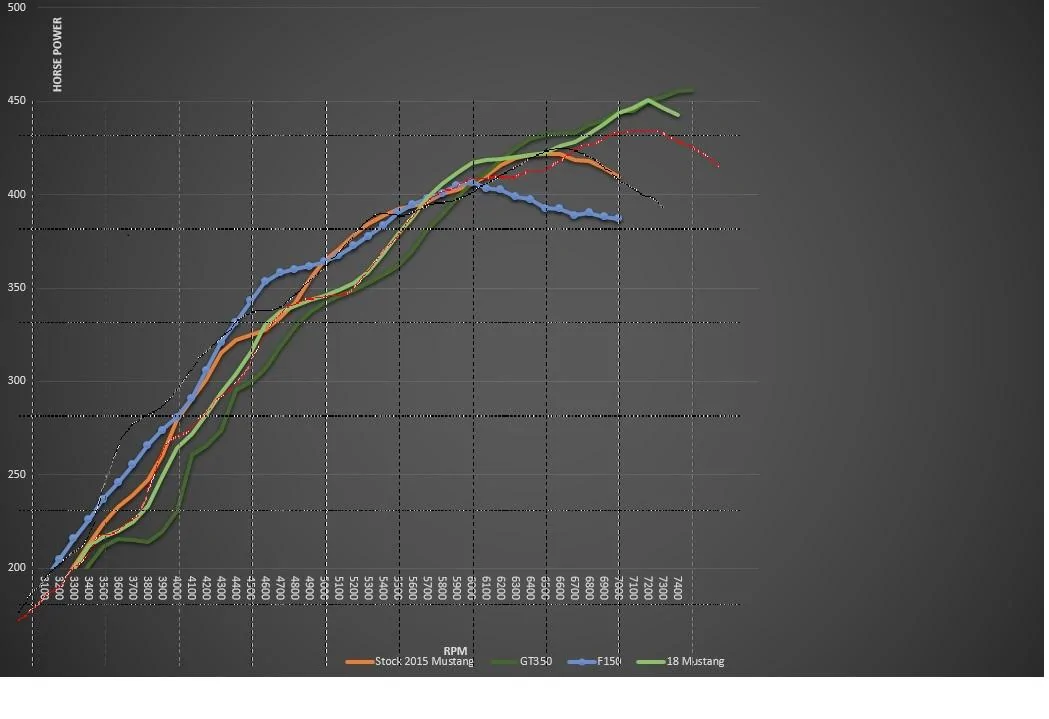
I decided to do a overlay with my graph and the graph Edelbrock posted. The line for my 2018 IM (Red) Lines up almost perfectly with theirs (Light Green) until 5700 and then theirs jump ahead so I definitely think there's something going on with the tune up top that's hurting my numbers. I'm going to be contacting Lund and hopefully figuring out what's not right. The black line on the overlay is my 2015 IM dyno which is also very close to Edelbrocks 2015 IM line.

I decided to do a overlay with my graph and the graph Edelbrock posted. The line for my 2018 IM (Red) Lines up almost perfectly with theirs (Light Green) until 5700 and then theirs jump ahead so I definitely think there's something going on with the tune up top that's hurting my numbers. I'm going to be contacting Lund and hopefully figuring out what's not right. The black line on the overlay is my 2015 IM dyno which is also very close to Edelbrocks 2015 IM line.

kcc0521
Well-Known Member
- Joined
- Feb 24, 2015
- Threads
- 231
- Messages
- 2,169
- Reaction score
- 307
- Location
- Falls Church VA
- First Name
- Bo
- Vehicle(s)
- 2015 Black GT PP
Are you guys deleting EVAP as well?
Orange_cru$h
Well-Known Member
Nice gain on MPH..! You were not hooking up, the car is much faster. Once you pass the first 60ft in 1st your revs didnt drop lower than 6k getting the new found power.Here's my results with the 2018 Manifold.
Only changes since previous best was 2018 Manifold (Unported) and PMAS.
Previous best was 11.7.@ 117. Mods were Full exhaust and E85 on MP4S tires.
New Times with only changes being 2018 Manifold and PMAS, 12.2 @ 122 with a 2.0 60'. The cold ass weather with people dragging water up to the start line was making launching impossible. Notice I am wearing a winter coat. But MPH was 122. Maybe it will end up around 120-121 with a better 60' which usually lowers mph a bit. I did pedal it in first a little so we will see what happens when the weather warms up.
Sponsored
WildHorse
N/A or GO HOME
- Joined
- Jun 28, 2017
- Threads
- 270
- Messages
- 10,297
- Reaction score
- 8,350
- Location
- Home World: CLASSIFIED
- First Name
- Puddintane
- Vehicle(s)
- '17 S550
- Vehicle Showcase
- 1
Bingo. The VVT has way more to do with the stock gen2 manny upper limits then the manifold itself. Back in my dirt track days we were buzzing 5.9l V8 engines to 7500 rpm on a 500cfm 2-bbl carb and iron 2-bbl intake and making good power. It was all camshaft & 1" carb adaptor.I would bet the VVT is unchanged from stock to the final tune.
EODTech87
Well-Known Member
- Joined
- Feb 7, 2018
- Threads
- 0
- Messages
- 92
- Reaction score
- 56
- Location
- Copperas Cove, Texas
- Vehicle(s)
- 2015 Mustang GT Premium
I should have logs from both manifolds. I’ll check them and see if there is a difference on the VVT

DarkestHour
Hi
Thinking about it. If all OBD tests pass then I probably will.Are you guys deleting EVAP as well?
GrabberS55017
Member
- Joined
- Mar 10, 2018
- Threads
- 0
- Messages
- 17
- Reaction score
- 2
- Location
- Washington
- First Name
- Tyler
- Vehicle(s)
- 2017 Grabber Blue GT
So I believe I found the issue that's causing the P2005 code. I'll give a little technical information first.
The sensor that detect if the flaps are opened or closed put out a voltage that the ECU reads and determines the state of the flaps.
These sensors are the 3 pin connectors that are separate on the 15-17 IM and integrated on the 18 IM.
The voltages I'm going to be referencing are rounded and will vary from car to car slightly.
I looked at datalog I took with my 2015 IM and the IMRC Sensors are putting out 1.16v when they are closed and 4.00v when they are opened. On the 2018 IM the sensors are putting out 1.45v when they are closed and 3.39v when they are opened. Now this is causing a issue because while driving around the ECU is looking for 1.16v to verify that the IMRC's are fully closed but instead they are getting 1.45v which makes the ECU believe that the IMRC's aren't fully closing. Because it detects this issue it will revert to a permanent open state and give the P2005 code that they are stuck open because it never seems them as fully closed.
Now for possible solutions. I don't know if the voltage that the ECU is looking for are adjustable in the the tune. If they are then the tune will just need to be adjusted to the new voltage's that way the ECU correctly determines the state of the IMRC's. The other solution would be to add a resistor in the wiring harness to reduce the 1.45v to 1.16v that the ECU is expecting to see. The possible issue with doing this is that the open voltage, which reads 0.61v low on the 2018 IM, will be even lower which will make the ECU think that the IMRC's aren't opening all the way.
Tomorrow I plan on trying the resistor method with the adapters that I'm developing and we'll see if the ECU is happy once I bring the closed voltage closer to the original reading.
I really appreciate you doing this I've been dealing with this code P2005 for a few weeks now and I missed this post. Had to change the values and no more code and the imrc work perfectly now and do not shut down anymore thanks again.
Last edited:
16s550
Well-Known Member
Did you splice or leave a connector hanging?I really appreciate you doing this I've been dealing with this code P2005 for a few weeks now and I missed this post. Had to chnage the values and no more code and the imrc work perfectly now and do not shut down anymore thanks again.
Sponsored


