Sponsored

Torsen differential, is friction modifier required?

Blufc3s

Well-Known Member
Joined
Jan 1, 2015
Threads
23
Messages
419
Reaction score
680
Location
Quispamsis New Brunswick Canada
First Name
Stew
Vehicle(s)
15 Mustang Premium GT PP1, 2003 BMW Z4 3.0 Manual
Vehicle Showcase
3
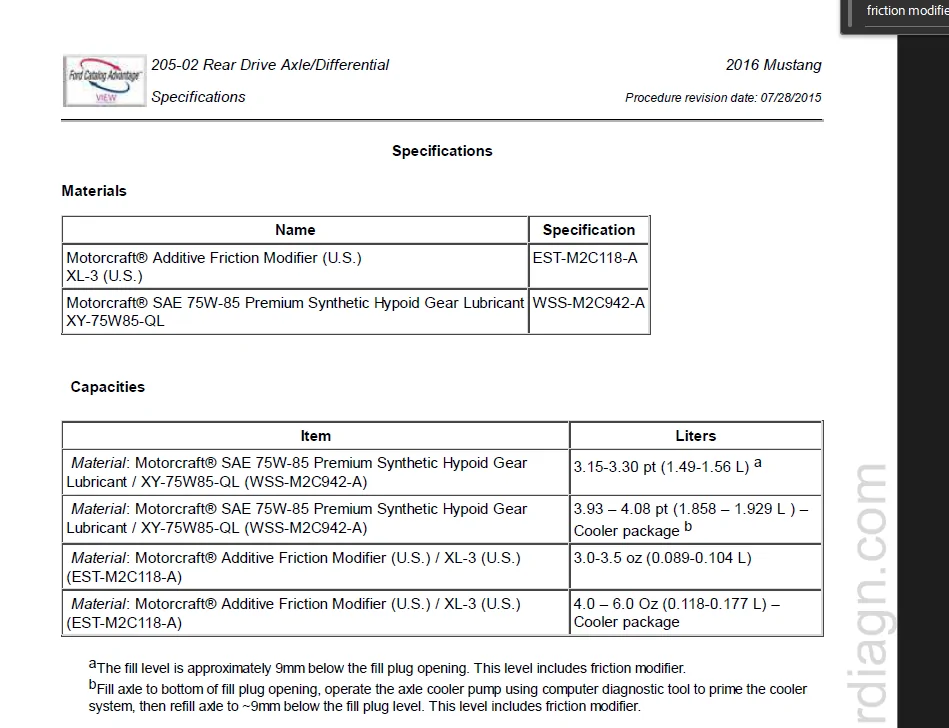
I recently changed my diff fluid with what ford recommended for my 2015 GT PP1. I didn’t add modifier and wondering if its recommended/required for the Torsen.
TIA
Sponsored

 
OP
OP
Blufc3s

Blufc3s

Well-Known Member
Joined
Jan 1, 2015
Threads
23
Messages
419
Reaction score
680
Location
Quispamsis New Brunswick Canada
First Name
Stew
Vehicle(s)
15 Mustang Premium GT PP1, 2003 BMW Z4 3.0 Manual
Vehicle Showcase
3

RobZ71LM7

Well-Known Member
Joined
Oct 14, 2021
Threads
17
Messages
731
Reaction score
1,207
Location
Louisville, KY
First Name
Rob
Vehicle(s)
2021 Mach 1, 2019 F-150
No it is not required at all. That being said most gear oils already have it included. IF we did have a clutch type diff and you used the additive plus a gear oil that already had it you can in fact make the diff action worse (more prone to slippage).
 

Sponsored

Eyesac

Well-Known Member
Joined
Jan 26, 2021
Threads
3
Messages
173
Reaction score
231
Location
Reno NV
First Name
Isaac
Vehicle(s)
2020 Mustang GT PP
No it is not required at all. That being said most gear oils already have it included. IF we did have a clutch type diff and you used the additive plus a gear oil that already had it you can in fact make the diff action worse (more prone to slippage).
I sell a couple common brands of full syn gear oil and don't know of any that come with modifiers. I guess I haven't googled it or anything, but I'd say most gear oil does not.
 

robvas

Well-Known Member
Joined
Nov 18, 2023
Threads
15
Messages
3,496
Reaction score
3,282
Location
MI
Vehicle(s)
2011 GT
From the Torsen website:

https://torsen.com/tbr-lube-friction-modifier/

Torque Bias Ratio (TBR) – also referred to as Locking Effect – is a term used to quantify how much resistance to wheel spin a differential has. This is true of any type of LSD, plate or a helical design like Torsen®. These devices work by creating internal friction; friction in the diff is what allows it resist wheel spin.

By the same token, that resistance is also what allows a differential of the non-open variety to distribute more torque to the side that can best use it. The higher the TBR setting is, the greater the resistance will be to the start of slippage. That means more torque can be sent to whichever tire has better traction. In essence, by building resistance to spin, the differential can hold back the wheel with lower traction from spinning, allowing the higher traction wheel make use of more torque.

The actual amount of friction that the differential develops will be different depending on if the internal gears are static (not moving in relation to the diff case) or if differentiation is taking place. Think of trying to push a crate across a floor – you need more force to get it to move initially than you need to keep it moving. The coefficient of friction is higher when things are not moving compared when to when they’re sliding. The same is true for the gearing in the differential.

So, there is more resistance to wheelspin when the diff gearing is not moving inside the case, which is the case when driving in a straight line. But when you turn, and one wheel speeds up while the other slows down, the differential gears want to move. Once there is enough force is on the axle shafts to overcome the friction, the gearing will start to move. In doing that, the amount of friction generated is reduced. However, this is true for clutches as well as for helical gears.

Now, that transition from static to dynamic friction is often kind of abrupt; torque gets wound into the gearing until the friction is overcome, then it pops free and moves. But when it does that, the movement slows and the coefficient goes up, and so it stops moving. At least, until the friction is again overcome and it pops free – again. In that transition, sometimes you find that stick/slip/stick/slip behavior occurs a lot. This stick/slip characteristic is also what causes clutch plates to chatter in a tradition limited slip device.

Bringing this all back around to friction modifier – the actual function of modifier (the “modification” it makes to the friction) is that it brings the static coefficient of friction down to a similar level as the dynamic coefficient of friction. This helps smooth out the transition from static to dynamic friction, getting rid of the tendency for abrupt stick/slip. This, as a result, largely eliminates the chatter or squeak . However, it does this at a price – the price of lowering the coefficient of friction for the whole system.

So, if we return to the notion that the differential is a friction device, it then stands to reason that the friction the differential generates is directly influenced by the lubricity of the oil blend that is used in the system. If the oil’s friction properties are reduced, the amount of friction that the diff produces is proportionally reduced. That, in turn, has the same affect on TBR. Usually, it is a small but measurable amount, maybe up to a 10% loss of TBR.

This begs the question of whether or not friction modifier is actually necessary in a Torsen. Like I said earlier, the modifier is beneficial in smoothing out the operations of friction devices. However, because our friction properties are different than that of a clutch plate differential, you might not see the same symptoms of stick-slip behavior that those would. As noted, clutch plate differentials have a distinct tendency to chatter without friction modifier in the oil, and that chattering can become very objectionable. So, the modifier is essentially a requirement.

In a helical gear diff, however, the stick-slip tends to show up as an audible noise, described by some as a “rusty screw” noise, or as a squeak or moan. You tend to hear it in very low-speed turns, when the steering is at or near full-lock. So, you might hear it while maneuvering in a parking lot, or turning the car around in your driveway. This noise is, as I said, just a characteristic of the friction properties, and is normal. But, if you hear it a lot and it annoys you, adding a few ounces of friction modifier to the axle lubricant will almost always eliminate it. So, the bottom line is it’s up to you.
 

RobZ71LM7

Well-Known Member
Joined
Oct 14, 2021
Threads
17
Messages
731
Reaction score
1,207
Location
Louisville, KY
First Name
Rob
Vehicle(s)
2021 Mach 1, 2019 F-150
I sell a couple common brands of full syn gear oil and don't know of any that come with modifiers. I guess I haven't googled it or anything, but I'd say most gear oil does not.
Valvoline synthetic gear oil claims to already have a friction modifier. Mobil 1 claims to have it. Amsoil claims to have it. All Redline gear oils have it unless you get the NS version. We used to run Redline NS in clutch type diffs for better lockup when I used to autocross in the early 2000's.

Even Super Tech gear oil has the additive I believe.
 
OP
OP
Blufc3s

Blufc3s

Well-Known Member
Joined
Jan 1, 2015
Threads
23
Messages
419
Reaction score
680
Location
Quispamsis New Brunswick Canada
First Name
Stew
Vehicle(s)
15 Mustang Premium GT PP1, 2003 BMW Z4 3.0 Manual
Vehicle Showcase
3
From the Torsen website:

https://torsen.com/tbr-lube-friction-modifier/

Torque Bias Ratio (TBR) – also referred to as Locking Effect – is a term used to quantify how much resistance to wheel spin a differential has. This is true of any type of LSD, plate or a helical design like Torsen®. These devices work by creating internal friction; friction in the diff is what allows it resist wheel spin.

By the same token, that resistance is also what allows a differential of the non-open variety to distribute more torque to the side that can best use it. The higher the TBR setting is, the greater the resistance will be to the start of slippage. That means more torque can be sent to whichever tire has better traction. In essence, by building resistance to spin, the differential can hold back the wheel with lower traction from spinning, allowing the higher traction wheel make use of more torque.

The actual amount of friction that the differential develops will be different depending on if the internal gears are static (not moving in relation to the diff case) or if differentiation is taking place. Think of trying to push a crate across a floor – you need more force to get it to move initially than you need to keep it moving. The coefficient of friction is higher when things are not moving compared when to when they’re sliding. The same is true for the gearing in the differential.

So, there is more resistance to wheelspin when the diff gearing is not moving inside the case, which is the case when driving in a straight line. But when you turn, and one wheel speeds up while the other slows down, the differential gears want to move. Once there is enough force is on the axle shafts to overcome the friction, the gearing will start to move. In doing that, the amount of friction generated is reduced. However, this is true for clutches as well as for helical gears.

Now, that transition from static to dynamic friction is often kind of abrupt; torque gets wound into the gearing until the friction is overcome, then it pops free and moves. But when it does that, the movement slows and the coefficient goes up, and so it stops moving. At least, until the friction is again overcome and it pops free – again. In that transition, sometimes you find that stick/slip/stick/slip behavior occurs a lot. This stick/slip characteristic is also what causes clutch plates to chatter in a tradition limited slip device.

Bringing this all back around to friction modifier – the actual function of modifier (the “modification” it makes to the friction) is that it brings the static coefficient of friction down to a similar level as the dynamic coefficient of friction. This helps smooth out the transition from static to dynamic friction, getting rid of the tendency for abrupt stick/slip. This, as a result, largely eliminates the chatter or squeak . However, it does this at a price – the price of lowering the coefficient of friction for the whole system.

So, if we return to the notion that the differential is a friction device, it then stands to reason that the friction the differential generates is directly influenced by the lubricity of the oil blend that is used in the system. If the oil’s friction properties are reduced, the amount of friction that the diff produces is proportionally reduced. That, in turn, has the same affect on TBR. Usually, it is a small but measurable amount, maybe up to a 10% loss of TBR.

This begs the question of whether or not friction modifier is actually necessary in a Torsen. Like I said earlier, the modifier is beneficial in smoothing out the operations of friction devices. However, because our friction properties are different than that of a clutch plate differential, you might not see the same symptoms of stick-slip behavior that those would. As noted, clutch plate differentials have a distinct tendency to chatter without friction modifier in the oil, and that chattering can become very objectionable. So, the modifier is essentially a requirement.

In a helical gear diff, however, the stick-slip tends to show up as an audible noise, described by some as a “rusty screw” noise, or as a squeak or moan. You tend to hear it in very low-speed turns, when the steering is at or near full-lock. So, you might hear it while maneuvering in a parking lot, or turning the car around in your driveway. This noise is, as I said, just a characteristic of the friction properties, and is normal. But, if you hear it a lot and it annoys you, adding a few ounces of friction modifier to the axle lubricant will almost always eliminate it. So, the bottom line is it’s up to you.
Thanks for this, very informative. I’m ok with the “sounds” from my Torsen diff, so will leave as is.
 

Optimum Performance

Well-Known Member
Gold Sponsor
Joined
Mar 13, 2016
Threads
62
Messages
1,836
Reaction score
1,397
Location
Titusville, Florida
Website
www.facebook.com
First Name
Tommy
Vehicle(s)
'15 GT PP
I recently changed my diff fluid with what ford recommended for my 2015 GT PP1. I didn’t add modifier and wondering if its recommended/required for the Torsen.
TIA
Fords uses it for NVH.
Sponsored


Top