garagelogic
Well-Known Member
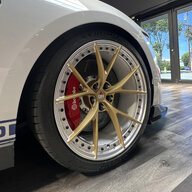
I get what you're saying, but in my case, the outer, cosmetic lugnut does not come into contact with the inner, open lug. The inner lug is the only one torqued to spec. The outer lug is tightened until snug and then another 1/4 turn. So far, not one of the outer lugs, using this method, has loosened in 3000 miles over mixed surface conditions. If I was really concerned about one coming off, I'd simply apply, as you noted, some thread locker to the studs.The fact that you have traveled a certain number of miles is not a metric by which to measure the effect of a second nut being added atop a factory or after market lug nut.
When you tighten a second nut, you are forcing the bottom nut flanks in the opposite direction they need to be in order to attain proper clamping force. You are relieving the friction to a certain degree. If you continue to tighten the top nut (while holding the bottom nut in a static position) you are increasing the force between the two nuts. At a certain point (difficult to discern with careful measurements and analysis) you risk fatiguing and stripping the threads or a tensile fracture between the two nuts on the stud.
The only way (short of a chemical thread locker or Nyloc-style second nut) the second nut stays in place is as a result of the friction created when the proper amount of preload has been reached. You are stretching the stud a given amount in order to do that. In this case, 150ft-lbs (+/- 15 ft-lbs according to the factory manual) allows proper stretch. For a dynamic application such as this I would not add a second nut for mere cosmetic reasons.
Studies have shown that transversely applied, alternating forces, can generate the most severe conditions for the self loosening of a fastened connection. Something (such as a poorly balanced wheel, failed damper, or weak spring) that generates a lot of vibration may help facilitate a fastener such as a lug nut coming loose but I don't see root causation - in general. As long as proper preload is maintained, without fatigue of either the stud or nut, typical road "NVH" shouldn't be of concern.
I get some people might not be comfortable with my solution, but that does not make it a wrong solution. Some are not comfortable driving in the rain on their Cup2's, others are uncomfortable driving their GT350 in the snow or without having the oil line recall performed. Doing those things does not mean they are stupid or driving their cars wrong, they're just not doing things the way many would choose.
I choose not to run ugly open lugs and am very comfortable with my setup.
Sponsored