Sponsored

Flat Plane Crank Coyote conversion kit....

OP
OP
zackmd1

zackmd1

Well-Known Member
Joined
Oct 1, 2013
Threads
139
Messages
5,234
Reaction score
3,265
Location
Maryland
First Name
Zack
Vehicle(s)
1970 Mustang, 1965 AC Cobra, 2023 Ford Bronco 2Dr
Actually these engines are internally balanced so the balancer and flywheel balance don't matter. Of course the crank would need to be rebalanced with different weight rods and pistons.

Just stick with a good quality damper and balance accordingly.
True but I believe that the harmonic balancer helps with the 2nd order harmonics caused by the FPC layout. That is what I am not entirely sure about. I am not quite sure yet how lower displacement (bore only, stroke remains the same) would effect these second order harmonics if at all.
Sponsored


tsloms

Well-Known Member
Joined
Jan 3, 2016
Threads
8
Messages
406
Reaction score
114
Location
Wisconsin
Vehicle(s)
2016 Mustang GT Magnetic PP
True but I believe that the harmonic balancer helps with the 2nd order harmonics caused by the FPC layout. That is what I am not entirely sure about. I am not quite sure yet how lower displacement (bore only, stroke remains the same) would effect these second order harmonics if at all.
No question that a damper will absolutely help. I'm no engine engineer but have built tons of engines over the years. Im sure the weight of the rotating assembly as well as the power level of the engine will affect the strength of the harmonics. Im not sure either how much effect displacement has in this equation.
 
OP
OP
zackmd1

zackmd1

Well-Known Member
Joined
Oct 1, 2013
Threads
139
Messages
5,234
Reaction score
3,265
Location
Maryland
First Name
Zack
Vehicle(s)
1970 Mustang, 1965 AC Cobra, 2023 Ford Bronco 2Dr
From just my initial research, it looks as though the 2nd order harmonics depend mostly on the conrod length to stroke. So with the 5.2 having the same stroke and I believe the same connecting rod length, 2nd order harmonics should be nearly identical to the 5.2 in a 5.0 application assuming equal reciprocating mass. Again this is just from my initial research so this might not be entirely correct.

PS: decreasing rod and piston mass should decrease severity of 2nd order harmonics from what I am reading so far.
 
OP
OP
zackmd1

zackmd1

Well-Known Member
Joined
Oct 1, 2013
Threads
139
Messages
5,234
Reaction score
3,265
Location
Maryland
First Name
Zack
Vehicle(s)
1970 Mustang, 1965 AC Cobra, 2023 Ford Bronco 2Dr
The other idea I had would be to build a 4.7L (289CI) FPC using a custom crank modeled after the 5.2 so I could still use 350 cams or slightly modified 350 cams. The custom crank cost from what I am seeing is roughly equal to the cost of the FPC 5.2 crank from Ford.... The lower displacement would come from a shorter stroke, thus increasing conrod ratio and decreasing harmonics (if I am understanding things correctly). That would likely ensure longevity of the stock 5.0 engine block.
 

TexasRebel

Gearshifter
Joined
Mar 19, 2016
Threads
27
Messages
2,493
Reaction score
836
Location
between the mustard and the mayo
Vehicle(s)
2016 YZ GTPP - PP2
2nd order harmonics depend on the acceleration of the reciprocating mass.
Remember, for every revolution each piston comes to a complete stop twice, once at TDC and once at BDC. As RPM increases maximum piston velocity increases as well. The harmonics come into play because the forces acting on the pistons through the connecting rod are on 8 different planes orthogonal to the crankshaft. On a V8 there are ways to reduce this to 4:
170px-Forked_connecting_rods_%28Autocar_Handbook%2C_13th_ed%2C_1935%29.webp

but for simplicity and manufacturing... it doesn't happen.

One major limitation in any engine is the maximum velocity of the pistons which usually determines the "red line". Longer strokes mean higher reciprocating velocity at lower RPM.

TRUE_piston3_ANI.gif
 

Sponsored

OP
OP
zackmd1

zackmd1

Well-Known Member
Joined
Oct 1, 2013
Threads
139
Messages
5,234
Reaction score
3,265
Location
Maryland
First Name
Zack
Vehicle(s)
1970 Mustang, 1965 AC Cobra, 2023 Ford Bronco 2Dr
Thanks for the clarifications! So a shorter stroke and longer connecting rod (assuming we still want to keep the 5.0 bore and deck height) helps decrease piston velocity and there by decrease forces acting on the crank?
 

TexasRebel

Gearshifter
Joined
Mar 19, 2016
Threads
27
Messages
2,493
Reaction score
836
Location
between the mustard and the mayo
Vehicle(s)
2016 YZ GTPP - PP2
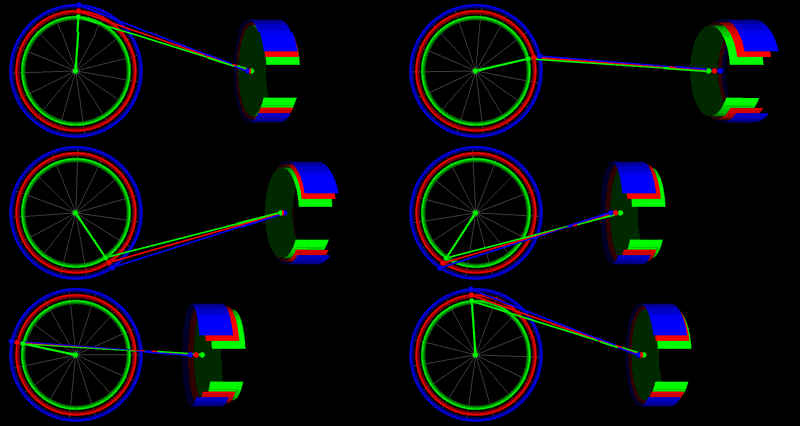
Connecting rod length doesn't affect piston velocity at all, it is purely a function of stroke length. No matter how long the connecting rod is, at 7,000 RPM the piston will have .0043 s to travel the length of the stroke (93mm in the Voodoo), starting from a dead stop, and ending at a dead stop. (It then turns around and has .0043s to make the return trip). There's no better way to visualize this than on a steam locomotive. For gearheads those things are awesome since the running gear is on the outside! If you want to learn a lot about engine balancing and high order harmonics study up on steam locomotives and hammer blow. Very briefly, counterweights were added to oppose the reciprocating pistons. The counterweights introduced vertical forces that acted against nothing more than the weight of the locomotive on the upswing an the rails on the downswing (Rotate fast enough and the driver would leave the rails entirely). While the counterweights acted against the reciprocating mass, they did so on two different planes which also introduced higher order harmonics which caused the crankshaft (in this case the driver axle) to twist. Similar twisting happens to internal combustion engines, too.

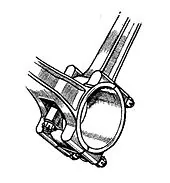
Connecting rod length does change the direction and magnitude of the forces between the piston and crankshaft. This is usually referred to as rod:stroke ratio. A long rod will reduce the side loading of the piston and crankshaft, but at the cost of weight. There is a point of diminishing returns, where increasing the rod length no longer reduces forces on the crankshaft and begins to increase them again simply because the rod is part of the reciprocating mass, too.

Very short connecting rods don't weigh much and can change direction as necessary with reduced force, but the swing angle is increased which in turn increases the forces acting in directions that aren't doing any work (increasing heat and friction, reducing mechanical efficiency and part life).

Deck height is a function of stroke length, rod:stroke ratio, and wrist pin placement. If you have a set deck height and stroke length, you would have to play with rod:stroke ratio and wrist pin placement. You don't want the rings leaving the cylinder, the pistons slapping the heads, or too much volume in the combustion chamber.

Finally, if you want to circle back to the harmonic balancer, torque is not applied to the crankshaft in a constant manner. It is applied in pulses created by combustion events, and changes with crankshaft angle. It is these high frequency pulses that the harmonic balancer is to dampen.
 
OP
OP
zackmd1

zackmd1

Well-Known Member
Joined
Oct 1, 2013
Threads
139
Messages
5,234
Reaction score
3,265
Location
Maryland
First Name
Zack
Vehicle(s)
1970 Mustang, 1965 AC Cobra, 2023 Ford Bronco 2Dr
Connecting rod length doesn't affect piston velocity at all, it is purely a function of stroke length. No matter how long the connecting rod is, at 7,000 RPM the piston will have .0043 s to travel the length of the stroke (93mm in the Voodoo), starting from a dead stop, and ending at a dead stop. (It then turns around and has .0043s to make the return trip). There's no better way to visualize this than on a steam locomotive. For gearheads those things are awesome since the running gear is on the outside! If you want to learn a lot about engine balancing and high order harmonics study up on steam locomotives and hammer blow. Very briefly, counterweights were added to oppose the reciprocating pistons. The counterweights introduced vertical forces that acted against nothing more than the weight of the locomotive on the upswing an the rails on the downswing (Rotate fast enough and the driver would leave the rails entirely). While the counterweights acted against the reciprocating mass, they did so on two different planes which also introduced higher order harmonics which caused the crankshaft (in this case the driver axle) to twist. Similar twisting happens to internal combustion engines, too.

Connecting rod length does change the direction and magnitude of the forces between the piston and crankshaft. This is usually referred to as rod:stroke ratio. A long rod will reduce the side loading of the piston and crankshaft, but at the cost of weight. There is a point of diminishing returns, where increasing the rod length no longer reduces forces on the crankshaft and begins to increase them again simply because the rod is part of the reciprocating mass, too.

Very short connecting rods don't weigh much and can change direction as necessary with reduced force, but the swing angle is increased which in turn increases the forces acting in directions that aren't doing any work (increasing heat and friction, reducing mechanical efficiency and part life).

Deck height is a function of stroke length, rod:stroke ratio, and wrist pin placement. If you have a set deck height and stroke length, you would have to play with rod:stroke ratio and wrist pin placement. You don't want the rings leaving the cylinder, the pistons slapping the heads, or too much volume in the combustion chamber.

Finally, if you want to circle back to the harmonic balancer, torque is not applied to the crankshaft in a constant manner. It is applied in pulses created by combustion events, and changes with crankshaft angle. It is these high frequency pulses that the harmonic balancer is to dampen.

I was jumping ahead with the rod length in my previous post! :headbonk: Decreasing the stroke on a fixed deck height would require either a longer rod or like you said, a different wrist pin placement in the piston.

My "idea" if you will would be to create a custom crank and change as few 5.0 parts as possible. So things like the pistons would be a fixed value and rod length would have to increase if stroke decreased. This Rod:Stroke ratio seems to be what alot of people refer to when discussing FPC applications. Typical FPC engines seem to have a ratio of about 1.8:1. I believe I read somewhere that the 5.2 has a ratio of 1.63:1 which would be the same for an FPC 5.0 if you just dropped the 5.2 crank into a 5.0 block.

So for my hypothetical 289 CI FPC, keeping the bore the same as the 5.0, stroke would have to decrease from 92.8mm to 88.7-88.8mm. This should also mean that con rod length would have to increase from 150.7mm to 154.8mm. That would provide a conrod ratio of about 1.75:1.
 

TexasRebel

Gearshifter
Joined
Mar 19, 2016
Threads
27
Messages
2,493
Reaction score
836
Location
between the mustard and the mayo
Vehicle(s)
2016 YZ GTPP - PP2
I was jumping ahead with the rod length in my previous post! :headbonk: Decreasing the stroke on a fixed deck height would require either a longer rod or like you said, a different wrist pin placement in the piston.

My "idea" if you will would be to create a custom crank and change as few 5.0 parts as possible. So things like the pistons would be a fixed value and rod length would have to increase if stroke decreased. This Rod:Stroke ratio seems to be what alot of people refer to when discussing FPC applications. Typical FPC engines seem to have a ratio of about 1.8:1. I believe I read somewhere that the 5.2 has a ratio of 1.63:1 which would be the same for an FPC 5.0 if you just dropped the 5.2 crank into a 5.0 block.

So for my hypothetical 289 CI FPC, keeping the bore the same as the 5.0, stroke would have to decrease from 92.8mm to 88.7-88.8mm. This should also mean that con rod length would have to increase from 150.7mm to 154.8mm. That would provide a conrod ratio of about 1.75:1.
152.7-152.8mm since the stroke is measured as the diameter, but the deck height depends on the radius (1/2 stroke) + con rod length.
 

ForTehNguyen

Well-Known Member
Joined
Apr 23, 2015
Threads
17
Messages
2,247
Reaction score
693
Location
Houston, Texas
Vehicle(s)
15 GT
thats why some of the earlier F1 cars have a 2.0" stroke but go to 18k RPM, short stroke enables higher revs
 

Sponsored
OP
OP
zackmd1

zackmd1

Well-Known Member
Joined
Oct 1, 2013
Threads
139
Messages
5,234
Reaction score
3,265
Location
Maryland
First Name
Zack
Vehicle(s)
1970 Mustang, 1965 AC Cobra, 2023 Ford Bronco 2Dr
152.7-152.8mm since the stroke is measured as the diameter, but the deck height depends on the radius (1/2 stroke) + con rod length.
Thanks for the correction! :headbonk: Still brings the rod ratio to 1.72:1. Hard to say just how much this would improve the FPC characteristics though. More research needed.
 
OP
OP
zackmd1

zackmd1

Well-Known Member
Joined
Oct 1, 2013
Threads
139
Messages
5,234
Reaction score
3,265
Location
Maryland
First Name
Zack
Vehicle(s)
1970 Mustang, 1965 AC Cobra, 2023 Ford Bronco 2Dr
So looking at connecting rods available for purchase (again trying to keep custom parts to a minimum for this idea), Manley makes a rod that is 153.87mm in length (center to center) that would fit a coyote spec crank and piston. So adjusting the engine parameters around this rod I come out to final values of 92.2 (stock) bore and 87.8 stroke FPC making for a final displacement of 4.7L and rod ratio of 1.75:1. Cams ideally would be stock 350 cams and firing order for the FPC will match the 5.2 (obviously if using the same cams). So with all of that said, the only custom bits should be the crank and harmonic balancer from what I am thinking so far.
Sponsored


Top