96Mustang460cid
Well-Known Member
- Joined
- Aug 4, 2014
- Threads
- 6
- Messages
- 46
- Reaction score
- 4
- Location
- Tulsa, OK United States of America
- First Name
- Michael
- Vehicle(s)
- 2015 Ford Mustang GT w/ PP
I originally corrected a post (quoted below, for reference) that erroneously used the water hose analogy...which I corrected with my original post in this thread.If you assume both turbos are too much alike, then yes, you've built a strawman and your contentions are correct. The garden and fire hose analogy is specifically for pointing out this kind of discrepancy.
18psi of water spraying from a garden hose versus 18psi coming from a fire hose; what one is putting more water on the ground?
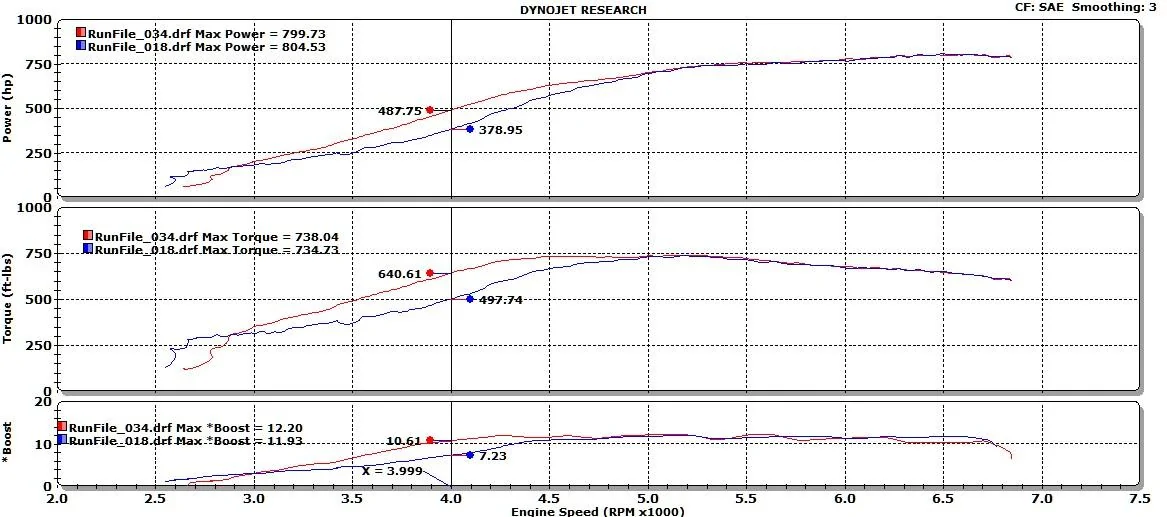
I understand and agree about pushing a small turbo past its efficiency island. I felt that some were implying (the water hose analogy) that a larger turbo, disregarding other factors, will always push more air into an engine with the same boost setting. While that can most definitely be true, I feel the statement should be qualified. It would not be difficult to create conditions where each of our arguments are true. For most gearheads, though, you'd most likely be right more often than myself.Take two compressor maps for similar, but one larger than the other, turbos. At identical pressure ratios the mass flow can vary substantially while staying in the same efficiency island. Or, more realistically...pushing the stock EB turbo to higher mass flow forces it outside of any good islands, so it just superheats the air. A larger turbo allows the same pressure ratio, yet can supply the required airflow while maintaining high efficiency.
I think the biggest question is how far has the OEM turbo been pushed before the owner "upgrades" his turbo? If a guy upgrades his 97% stock combo w/ stock boost levels, I would be shocked to see a magic 75 hp increase with the new turbo...given everything else was left the same. If a guy is already pushing the limits of the OEM turbo and still desires more power, his combo is a much better candidate for the upgraded turbo and he'll obviously gain a lot more from the turbo upgrade.
You're obviously knowledgeable about this topic and I, admittedly, am just an amateur gearhead. Nevertheless, I've seen too many people purchase 'upgrades' that fail to yield the desired results because it was not a good fit for the combo. I'm not trying to split hairs on this subject, but I also don't want people thinking a turbo swap on a mostly stock engine will yield x,xxx,xxx hp increase. I'm not implying people and/or companies intentionally mislead consumers. Instead, I felt the topic should be qualified for the sake of the less knowledgeable.
energy in * efficiency = energy outHmm...just to be clear, the wastegate is controlling turbine speed and has nothing to do directly w/ 'bypassing excess air' as you keep stating. Again, mass flow will be higher from the larger compressor than the smaller at identical output pressures.
Respectfully, I disagree. How does the wastegate control turbine speed? By bypassing excess air (aka: energy) around the turbine wheel. Once you reach your desired boost level, the wastegate opens and bypasses 'just' enough air to maintain the desire boost. As engine conditions change, the WG also adjust how much air its bypassing and, therefore, controls boost.
This is why you have different sizes of WG. Generally speaking, a large turbo on a small engine or reducing boost levels on the same engine requires more WG capacity to effectively bypass enough air and control boost. Otherwise, you start getting boost creep.
It's been enjoyable and I hope other readers get something out of it. Herr, don't dumb it down too much. Some people want to understand at a deeper level. I encourage you to not deprive the thirsty ones
 .
.Have a good day!
Michael
Sponsored